Bone: Conventional Osteosarcoma
2018-09-01 Natasja Franceschini , Anne-Marie Cleton-Jansen , Judith VMG Bovée Affiliation1.Dept of Pathology, Leiden University Medical Center, P.O Box 9600 2300 RC Leiden, The Netherlands
2.Department of Pathology, Leiden University Medical Center, P.O. Box 9600, L1-Q, 2300 RC Leiden, The Netherlands
3.Laboratoire de Cytogénétique Oncologique, Hpital de la Timone, 264 rue Saint Pierre, 13005 Marseille, France
Summary
Note
Abstract
Review on Osteosarcoma, with data on clinics, and the genes involved.
Classification
Note
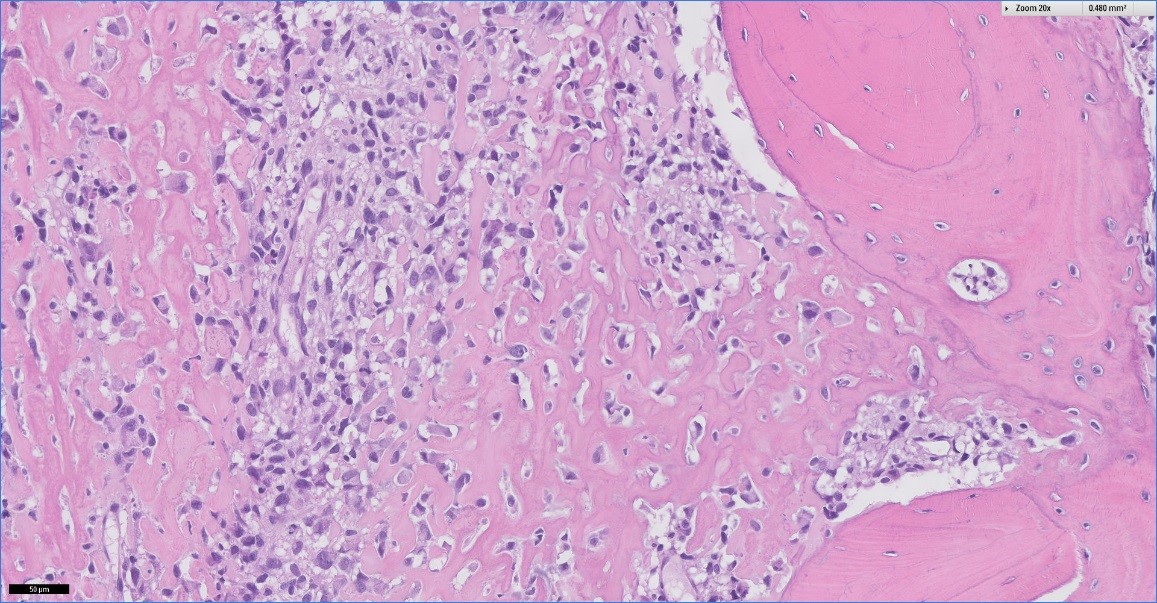
Osteoblastic osteosarcoma: predominantly bony/osteoid matrix
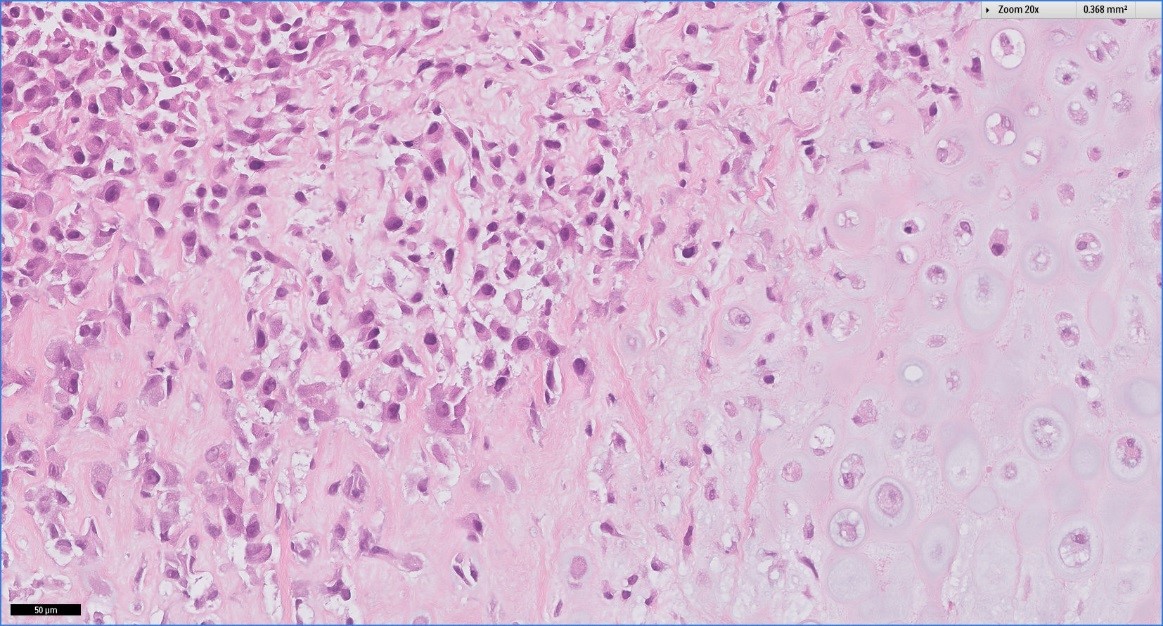
Chondroblastic osteosarcoma: predominantly chondroid matrix
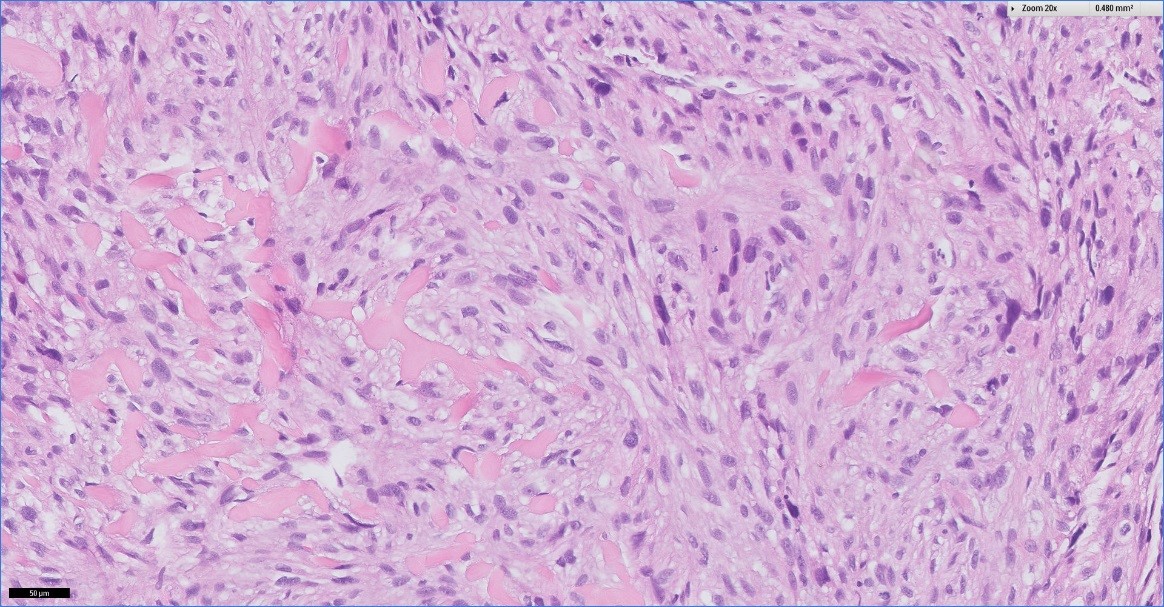
Fibroblastic osteosarcoma: predominantly spindle cells, low osteoid
Unusual histological forms with the same clinical behavior Intermediary forms may occur, consisting of mixed ECM types.
Clinics and Pathology
Etiology
Epidemiology
Clinics
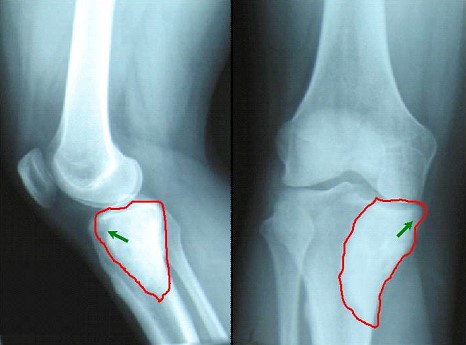
Macroscopy: Conventional osteosarcoma can arise in any bone, but most often affects the ends of the long bones, in particular the distal femur (30%), proximal tibia (15%) and proximal humerus (15%). It is often a fleshy or hard tumour 5-10 cm in size localized at the metaphysis (90%) or diaphysis 9%) and very rarely the epiphysis of the bone. Conventional osteosarcoma frequently penetrates the cortex and is associated with a soft tissue mass.
Radiography: The overall radiographic appearance of conventional osteosarcoma is a mixed lytic/sclerotic lesion with cortical destruction and tumor expansion into soft tissue. Sometimes a so-called Codmans triangle is observed when the tumor raises the periosteum away from the bone. To evaluate the extent of the tumor preoperative CT scan, and (dynamic) MRI may be helpful. Furthermore dynamic MRI is useful to monitor the effect of neoadjuvant chemotherapy.
Cytology
Microscopy: The main hematoxylin and eosin stain (H&E) based characteristic of osteosarcoma is the identification of osteoid which is dense, pink, amorphous extra cellular material containing large amounts of collagen type I. Metastases are mostly similar in histology to the primary tumor with respect to growth rate and ECM, but exceptions occur. Histochemical staining of alkaline phosphatase can demonstrate the osteoblastic nature of the tumor. Novel immunohistochemical markers SATB2 and DMP1 demonstrate osteogenic differentiation, but these are not entirely specific for osteosarcoma.
Treatment
Prognosis
Genetics
Note
Genes Involved and Proteins
Gene name
Location
Note
Protein description
Note
Gene name
Location
Note
Protein description
Article Bibliography
| Pubmed ID | Last Year | Title | Authors |
|---|---|---|---|
| 21703851 | 2011 | Chemotherapeutic adjuvant treatment for osteosarcoma: where do we stand? | Anninga JK et al |
| 28643781 | 2017 | Recurrent mutation of IGF signalling genes and distinct patterns of genomic rearrangement in osteosarcoma. | Behjati S et al |
| 27128693 | 2016 | Assessing the Prognostic Significance of Histologic Response in Osteosarcoma: A Comparison of Outcomes on CCG-782 and INT0133-A Report From the Children's Oncology Group Bone Tumor Committee. | Bishop MW et al |
| 24703847 | 2014 | Recurrent somatic structural variations contribute to tumorigenesis in pediatric osteosarcoma. | Chen X et al |
| 23701429 | 2013 | SATB2 is a novel marker of osteoblastic differentiation in bone and soft tissue tumours. | Conner JR et al |
| 12891382 | 2003 | Multiple primary malignancies in osteosarcoma patients. Incidence and predictive value of osteosarcoma subtype for cancer syndromes related with osteosarcoma. | Hauben EI et al |
| 12044509 | 2002 | Does the histological subtype of high-grade central osteosarcoma influence the response to treatment with chemotherapy and does it affect overall survival? A study on 570 patients of two consecutive trials of the European Osteosarcoma Intergroup. | Hauben EI et al |
| 23688189 | 2013 | IR/IGF1R signaling as potential target for treatment of high-grade osteosarcoma. | Kuijjer ML et al |
| 17227995 | 2007 | Improvement in histologic response but not survival in osteosarcoma patients treated with intensified chemotherapy: a randomized phase III trial of the European Osteosarcoma Intergroup. | Lewis IJ et al |
| 28735817 | 2017 | Osteosarcoma: Molecular Pathogenesis and iPSC Modeling. | Lin YH et al |
| 19718709 | 2009 | Osteosarcoma originates from mesenchymal stem cells in consequence of aneuploidization and genomic loss of Cdkn2. | Mohseny AB et al |
| 24797726 | 2014 | A phase 2 trial of R1507, a monoclonal antibody to the insulin-like growth factor-1 receptor (IGF-1R), in patients with recurrent or refractory rhabdomyosarcoma, osteosarcoma, synovial sarcoma, and other soft tissue sarcomas: results of a Sarcoma Alliance for Research Through Collaboration study. | Pappo AS et al |
| 25512523 | 2014 | Complementary genomic approaches highlight the PI3K/mTOR pathway as a common vulnerability in osteosarcoma. | Perry JA et al |
| 23222711 | 2013 | The differentiation stage of p53-Rb-deficient bone marrow mesenchymal stem cells imposes the phenotype of in vivo sarcoma development. | Rubio R et al |
| 21215367 | 2011 | Massive genomic rearrangement acquired in a single catastrophic event during cancer development. | Stephens PJ et al |
| 28191765 | 2017 | Generation of Osteosarcomas from a Combination of Rb Silencing and c-Myc Overexpression in Human Mesenchymal Stem Cells. | Wang JY et al |
| 15325100 | 2004 | Amplification and overexpression of genes in 17p11.2 ~ p12 in osteosarcoma. | van Dartel M et al |
| 9722866 | 1998 | Musculoskeletal tumors: does fast dynamic contrast-enhanced subtraction MR imaging contribute to the characterization? | van der Woude HJ et al |
Citation
Natasja Franceschini ; Anne-Marie Cleton-Jansen ; Judith VMG Bovée
Bone: Conventional Osteosarcoma
Atlas Genet Cytogenet Oncol Haematol. 2018-09-01
Online version: http://atlasgeneticsoncology.org/solid-tumor/5344/chromosome-explorer/deep-insight-explorer/meetings/case-report-explorer/
Historical Card
2008-04-01 Bone: Osteosarcoma by Alex B Mohseny Affiliation
2002-09-01 Bone: Osteosarcoma by Anne-Marie Capodano Affiliation
