Bone: Osteoma
2009-02-01 Carlos Eduardo de Andrea , Pancras CW Hogendoorn Affiliation1.Department of Pathology, Leiden University Medical Center, P1-30, Albinusdreef 2, 2333 ZA Leiden, The Netherlands
Summary
Note
Osteoma is a benign osteogenic lesion characterized by proliferation of compact, lamellar cortical bone.
It presents as an exophytic mass usually arising from the bones of the skull and paranasal sinuses. Large osteomas may develop on the clavicle, pelvis, and tubular bones (parosteal osteomas).
Some investigators consider the osteoma a true neoplasm, and others classify it as a developmental anomaly.
It presents as an exophytic mass usually arising from the bones of the skull and paranasal sinuses. Large osteomas may develop on the clavicle, pelvis, and tubular bones (parosteal osteomas).
Some investigators consider the osteoma a true neoplasm, and others classify it as a developmental anomaly.
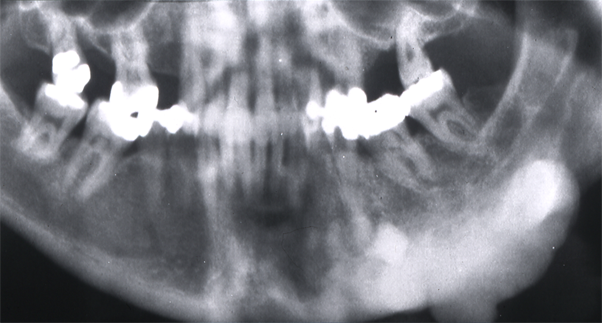
Figure 1: Radiograph of the jaw bone demonstrates a well-circumscribed, homogeneously dense lesion.
Clinics and Pathology
Etiology
The etiology of the osteoma is still unknown. The possibility of a reactive mechanism, triggered by trauma or infection, has also been suggested.
Very rarely osteomas of the facial bones may be associated with Gardners syndrome.
Gardners syndrome and Familial adenomatous polyposis (FAP) were originally described as two different syndromes. Characteristic for both syndromes is the presence of 100 or more colorectal adenomas and the development of colorectal cancer.
Patients with Gardners syndrome differ from FAP patients by also demonstrating sebaceous cysts and osteomas, forming the so-called Gardner triad of colorectal adenomas, soft and hard tissue tumors. Gardners syndrome and FAP traits map to the same chromosomal locus and may share the same somatic, as well as germline, adenomatous polyposis coli (APC) gene mutations.
Osteomas were observed in 46-93% of the patients with FAP, an incidence 4 to 20 times more frequent than in control groups (4-16%). Palpable osteomas were reported in 26 of 180 patients with FAP and 17 of them had a mutation situated within the spectrum spanning from codon 767 to codon 1513.
Very rarely osteomas of the facial bones may be associated with Gardners syndrome.
Gardners syndrome and Familial adenomatous polyposis (FAP) were originally described as two different syndromes. Characteristic for both syndromes is the presence of 100 or more colorectal adenomas and the development of colorectal cancer.
Patients with Gardners syndrome differ from FAP patients by also demonstrating sebaceous cysts and osteomas, forming the so-called Gardner triad of colorectal adenomas, soft and hard tissue tumors. Gardners syndrome and FAP traits map to the same chromosomal locus and may share the same somatic, as well as germline, adenomatous polyposis coli (APC) gene mutations.
Osteomas were observed in 46-93% of the patients with FAP, an incidence 4 to 20 times more frequent than in control groups (4-16%). Palpable osteomas were reported in 26 of 180 patients with FAP and 17 of them had a mutation situated within the spectrum spanning from codon 767 to codon 1513.
Epidemiology
Although any age may be affected, most osteomas occur in adults between the ages of 30 and 50 years.
Osteomas occur more often in women than men (3:1).
Osteomas occur more often in women than men (3:1).
Clinics
Osteomas are often incidental and asymptomatic findings. However, some present with long-standing (often years) symptomatic of sinus obstruction.
The most common anatomic site is the frontal sinus, followed by ethmoids and sphenoid sinuses.
Central osteomas are well delineated sclerotic lesions, without surface irregularities or satellite lesions. Peripheral osteomas are lesions with expansive borders that may be pedunculated.
The most common anatomic site is the frontal sinus, followed by ethmoids and sphenoid sinuses.
Central osteomas are well delineated sclerotic lesions, without surface irregularities or satellite lesions. Peripheral osteomas are lesions with expansive borders that may be pedunculated.
Pathology
Compact osteomas, on microscopic examination, are consisted of mature lamellar bone. They have no Haversian canals and no fibrous component (Image 2,3). Trabecular osteomas are composed of cancellous trabecular bone with hematopoietic elements surrounded by a cortical bone margin. They may be found centrally (endosteal) or peripherally (subperiosteal) in the bone.
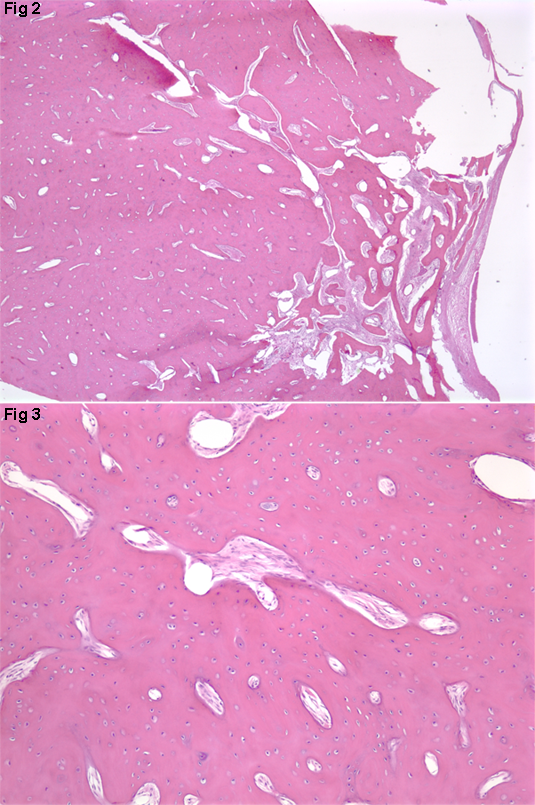
Figure 2: The lesion consists of dense and lamellar cortical bone with a focal area of active bone modeling.
Figure 3: Photomicrograph of the more solid area of the lesion to demonstrate the cellular woven character of the bone.
Treatment
Simple excision is the treatment of choice for symptomatic lesions.
Prognosis
The lesion does not recur after surgical excision and it is not associated with malignant change.
Article Bibliography
| Pubmed ID | Last Year | Title | Authors |
|---|---|---|---|
| 15111819 | 2004 | Benign osteoma with Gardner syndrome: review of the literature and report of a case. | Bilkay U et al |
| 16411234 | 2006 | Familial adenomatous polyposis (FAP): genotype correlation to FAP phenotype with osteomas and sebaceous cysts. | Bisgaard ML et al |
| 14616385 | 2003 | The concomitant occurrence of multiple epidermal cysts, osteomas and thyroid gland nodules is not diagnostic for Gardner syndrome in the absence of intestinal polyposis: a clinical and genetic report. | Herrmann SM et al |
| 8169708 | 1994 | Peripheral osteoma of the mandible: a study of 10 new cases and analysis of the literature. | Kaplan I et al |
| 18154576 | 2008 | Osteomas of the craniofacial region. Review of 106 cases. | Larrea-Oyarbide N et al |
| 15095859 | 2004 | A case of Gardner syndrome with a mutation at codon 1556 of APC: a suggested case of genotype-phenotype correlation in dental abnormality. | Oku T et al |
| 12420263 | 2002 | Peripheral osteoma of the oral and maxillofacial region: a study of 35 new cases. | Sayan NB et al |
| 17577321 | 2007 | Oral and maxillofacial manifestations of familial adenomatous polyposis. | Wijn MA et al |
Citation
Carlos Eduardo de Andrea ; Pancras CW Hogendoorn
Bone: Osteoma
Atlas Genet Cytogenet Oncol Haematol. 2009-02-01
Online version: http://atlasgeneticsoncology.org/solid-tumor/5427/bone-osteoma
