Thyroid: Papillary Carcinoma with inv(7)(q21q34) AKAP9/BRAF
2007-04-01 Raffaele Ciampi , Yuri E. Nikiforov Affiliation1.Dip. di Endocrinologia e Metabolismo, Università di Pisa, via Paradisa, 2, 56124 Pisa, Italy
Summary
Note
Intrachromosomal rearrangement.
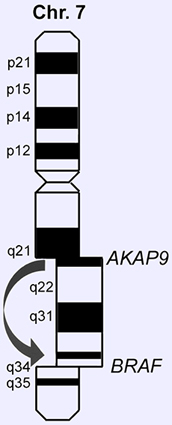
The fusion is product of a paracentric inversion of the long arm of chromosome 7.
Clinics and Pathology
Note
Papillary carcinoma is a well-differentiated tumor of thyroid follicular cell origin and is the most common thyroid malignancy, constituting about 80% of all cases. The only known etiologic factor for this type of tumor is exposure to ionizing radiation, although the history of radiation exposure is found in less than 10% of all cases. In the last year it became evident that alterations in the MAPK pathway, an intracellular cascade that regulates cell differentiation, proliferation and survival, are highly prevalent in papillary carcinomas. One type of genetic alterations found in these tumors involve the proto-oncogene RET, which encodes a receptor tyrosine kinase, and is a result of chromosomal rearrangements called RET/PTC (20-30% of cases). A small portion of cases presents with chromosomal rearrangements involving the NTRK gene, encoding another receptor tyrosine kinase. Point mutations of the RAS gene, another effector of the MAPK pathway, are found in about 15% of cases, and are particularly common in the follicular variant of papillary carcinoma. The most common alteration in these tumors is a point mutation of the serine-threonine kinase BRAF, yet another effector of the MAPK pathway (40% of cases). The point mutation typically involves nucleotide 1799 and leads to V600E substitution. The AKAP9-BRAF rearrangement is another mechanism of BRAF activation and is found in up to 11% of tumors associated with radiation exposure, but in less than 1% of sporadic tumors in the general population.
Cytogenetics
Cytogenetics molecular
Fluorescence in situ hybridization (FISH) with probes for the AKAP9 and BRAF gene can be used to detect the AKAP9-BRAF rearrangement, as it displays split of signals corresponding to both genes and fusion of signals on one chromosome.
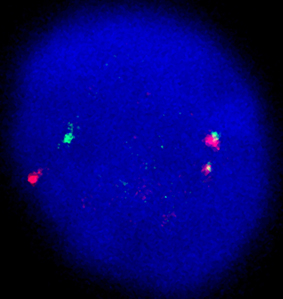
Reciprocal fusion detected by FISH with probes corresponding to the BRAF (red) and AKAP9 (green) genes.
Genes Involved and Proteins
Gene name
AKAP9 (A kinase (PRKA) anchor protein (yotiao) 9)
Location
7q21.2
Protein description
AKAP9 belongs to a family of Protein A kinase (PKA) anchor proteins that bind the regulatory subunit of the PKA and target it to different locations within the cell. AKAP9, in particular, displays a centrosomal and Golgi compartmentalization.
Gene name
BRAF (v-raf murine sarcoma viral oncogene homolog B1)
Location
7q34
Protein description
BRAF belongs to the family of RAF proteins which are effectors of the MAPK signaling cascade, a crucial pathway that regulates cell differentiation, proliferation and survival. Among 3 RAF isoforms (ARAF, BRAF, CRAF), BRAF displays the highest basal kinase activity. BRAF point mutations within the kinase domain of the protein occur in several tumor types including papillary thyroid carcinoma.
Result of the chromosomal anomaly
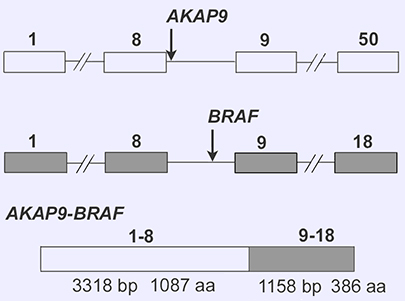
Scheme of the AKAP9-BRAF fusion. Arrows indicate breakpoints within both genes.
Description
Breakpoints occur within AKAP9 intron 8 and BRAF intron 8. The fusion transcript contains exon 1-8 of AKAP9 fused in frame with exon 9-18 of BRAF for a total open reading frame 4476 bp in size.
Detection protocole
AKAP9-BRAF rearrangement can be detected by RT-PCR using primers flanking the breakpoint area (forward: 5-AGCAAGAACAGTTGATTTTGGA-3; reverse: 5-GCAGACAAACCTGTGGTTGA-3) with the expected product of 181 bp. Amplify for 35 cycles (94C 5 min, 55C 1 min, 72C 1 min 20 sec).
Description
The AKAP9-BRAF fusion protein contains the N-terminal portion of AKAP9 (1087 aa) and the C-terminal part of BRAF (386 aa) for a total protein size of 1473 aa (MW: 172 kDa). In the fusion protein, AKAP9 lacks the region responsible for binding to the regulatory subunit of PKA and BRAF lacks the auto-inhibitory N-terminal portion of the protein and maintain intact the C-terminal tyrosine kinase domain.
Oncogenesis
The functioning of AKAP9-BRAF as an oncogene has been demonstrated by in vitro kinase assay and in vivo tumorigenesis assay. The oncogenic mechanism is probably due to the loss of the auto-inhibitory portion of BRAF in the fusion protein and fusion of the kinase domain of BRAF to the active promoter of AKAP9, resulting in constitutive activation of the BRAF tyrosine kinase and of the MAPK pathway.
Article Bibliography
| Pubmed ID | Last Year | Title | Authors |
|---|---|---|---|
| 15630448 | 2005 | Oncogenic AKAP9-BRAF fusion is a novel mechanism of MAPK pathway activation in thyroid cancer. | Ciampi R et al |
| 16946010 | 2007 | RET/PTC rearrangements and BRAF mutations in thyroid tumorigenesis. | Ciampi R et al |
| 12068308 | 2002 | Mutations of the BRAF gene in human cancer. | Davies H et al |
| 15630436 | 2005 | A new mechanism of BRAF activation in human thyroid papillary carcinomas. | Fusco A et al |
Citation
Raffaele Ciampi ; Yuri E. Nikiforov
Thyroid: Papillary Carcinoma with inv(7)(q21q34) AKAP9/BRAF
Atlas Genet Cytogenet Oncol Haematol. 2007-04-01
Online version: http://atlasgeneticsoncology.org/solid-tumor/5459/thyroid-papillary-carcinoma-with-inv(7)(q21q34)-akap9-braf
