Head and Neck: Odontogenic tumor: Ameloblastoma
2010-05-01 Punnya V Angadi Affiliation1.Department of Oral, Maxillofacial Pathology, KLE VK Institute of Dental Sciences, Hospital, Nehrunagar, Belguam-590010, Karnataka state, India
Summary
Note
Clinics and Pathology
Note
Embryonic origin
Epidemiology
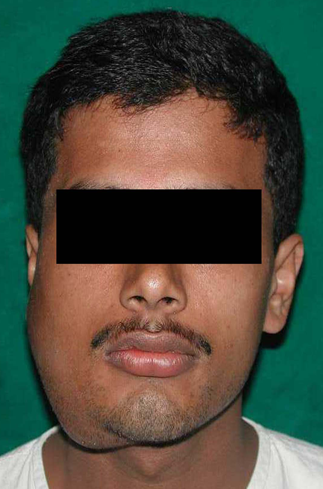
Ameloblastoma occurs in all areas of jaws, but the mandible is the most commonly affected area i.e. more than 80% of cases are seen here. Within the mandible, the molar angle ramus area is involved three times more commonly than are premolar and anterior regions combined. In the maxilla, most usually occur in the molar area, but may be seen occasionally in the anterior region, maxillary sinus and nasal cavity. Based on the clinical, radiographic, histopathologic and behavioral aspects, four subtypes of ameloblastoma are currently identified namely:
- Classic/solid/multicystic ameloblastoma
- Unicystic ameloblastoma
- Peripheral ameloblastoma
- Desmoplastic ameloblastoma
Clinics
Peripheral ameloblastoma usually presents as normal colored, smooth surfaced nodules or enlargements but occasional tumors may present with erythematous or papillary surface. They are slow growing and cause little or no bone erosion. Any saucerisation of the underlying bone is due to pressure rather than invasion.
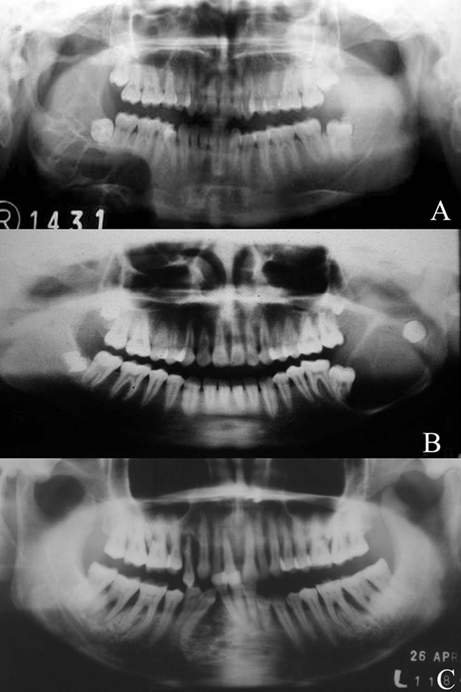
Radiology: Ameloblastoma usually present as a well defined, multilocular radiolucency with scalloped border typically described as honeycomb or soap bubble appearance. However, unicystic ameloblastoma typically presents as a unilocular radiolucency containing an impacted tooth. They typically infiltrate through the medullary bone, therefore the radiographic margins are not accurate indicators of the extent of involvement. Expansion of buccal and lingual cortical plates, displacement and root resorption may also be seen.
Desmoplastic ameloblastoma present with a ill-defined radiolucent radiopaque lesion reminiscent of a fibro-osseous lesion.
Cytology
Pathology
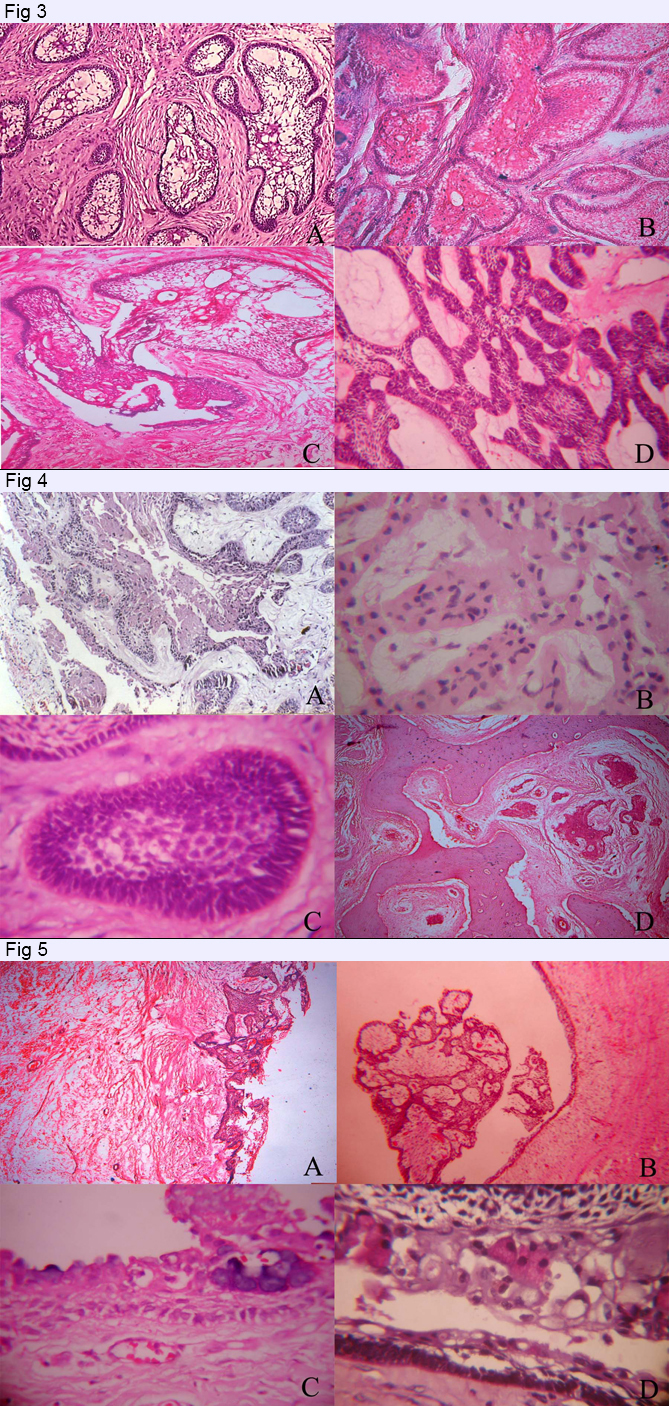
Follicular ameloblastoma: These are most readily recognizable and common type of ameloblastoma histologically. The follicular pattern consist of islands of epithelial cells with a central mass of polyhedral cells or loosely arranged angular cells resembling stellate reticulum, surrounded by well organized single layer of cuboidal or tall columnar cells with nuclei placed at the opposite pole of basement membrane resembling pre-ameloblasts. This peripheral cell layer tends to show cytoplasmic vacuolization. Cystic formation is often seen in the center of the epithelial islands due to degeneration of stellate reticulum like cells.
Plexiform ameloblastoma: The tumor epithelium is arranged in form of network/tabeculae which is bound by a layer of cuboidal or columnar cells and stellate reticulum like areas are usually minimal. Cyst formation occurs but is usually due to stromal degeneration rather than cystic change in the epithelium. The stroma consists of loose, vascular sparsely cellular connective tissue.
Acanthomatous ameloblastoma: It resembles a typical follicular ameloblastoma except it shows extensive squamous metaplasia sometimes with keratin formation within the epithelial islands.
Granular cell ameloblastoma: When the central stellate reticulum cells show extensive granular cell transformation i.e. in the form of sheets of large eosinophilic granular cells, the tumors are referred to as granular cell ameloblastoma. Sometimes this change, may be so extensive that the peripheral columnar cells may also be replaced making the diagnosis difficult especially in a small biopsy. Ultrastructurally, it is seen that the granules consist of pleomorphic, osmiophilic, lysosome like organelles.
Basal cell ameloblastoma: This variant shows predominant basaloid pattern consisting of darkly stained cells with minimal cytoplasm and little evidence of palisading at the periphery resembling those seen in basal cell carcinoma.
Desmoplastic ameloblastoma: This variant was first described in detail by Eversole et al. in 1984 and is characterized by extensive stromal collagenization or desmoplasia surrounding compressed small/irregular islands of odontogenic epithelium making it a distinct entity. Cyst formation is common and ameloblast like areas are present only in small foci. Calcification in the fibrous stroma and occasional bone formation can also be seen. Histochemical evaluation of the collagen suggests that the dense stroma is not scar tissue but represents active denovo synthesis of extracellular matrix proteins. It typically presents radiographically as a mixed radiolucency and radiopacity mimicking a fibrosseous lesion. In contrast to typical ameloblastoma, this variant frequents the maxilla and the anterior region of the jaws.
Unicystic ameloblastoma: This is considered as an in-situ or superficially invasive form of ameloblastoma and consists of a single cyst lined by ameloblastic epithelium. It presents clinically similar to a dentigerous cyst and is usually associated with an impacted tooth (usually 3rd molars). They are usually seen in younger patients with an average age of diagnosis being 22 years and generally involve the mandible.
This variant histologically presents as a single cyst lined by ameloblastomatous epithelium and is divided into several subgroups based on pattern and extent of ameloblastomatous proliferation in relation to cyst wall.
Reichart et al. classification modified from Ackermann et al.:
-1. Luminal UA: Cystic lesion lined by epithelium which exhibits columnar differentiation and reverse polarization of the basal cell layer. The connective tissue adjacent to the epithelium often exhibits a uniform, thin band like area of hyalinization.
-1.2. Luminal and intraluminal UA: Is the simple type but exhibits one or more nodules projecting into the lumen. No extension is seen into the surrounding connective tissue wall. Occasionally, this form of UA can produce an intraluminal plexiform pattern of odontogenic epithelium that lacks typical ameloblastomatous differentiation and is called as unicystic plexiform ameloblastoma.
-1.2.3. Luminal, intraluminal and intramural UA: Here there is occurrence of intramural proliferation of ameloblastoma along with subgroup 1.2 features.
-1.3. Luminal and intramural UA: exhibits a cyst with a luminal lining in combination with intramural nodules of SMA tissues. The intramural ameloblastoma tissue may be seen as an infiltration from the cyst lining or as free islands of follicular ameloblastoma.
Peripheral ameloblastoma: They present histologically with follicular or plexiform pattern as well as acanthomatous pattern. In most cases, the tumor is well separated from the overlying epithelium but many are confluent with the overlying mucosa.
Other rare variants: Clear cell variant which may contain clear PAS positive cells are localized in the stellate reticulum like areas.
Papilliferous keratoameloblastoma show occurrence of areas of ameloblastoma with keratinisation, tumor islands with papilliferrous appearance along with cystic areas resembling odontogenic keratocysts.
Mucous cells can also be demonstrated rarely in ameloblastoma.
Treatment
Ameloblastomas, although benign are relentlessly infiltrative. Conventional ameloblastoma infiltrates into surrounding bone and extends beyond the apparent radiographic boundaries seen in plain radiographs. The rate of recurrence reported varies from 20-90%. Treatment planning should take into consideration tumor size, location, histopathology, and clinical/radiographic presentation.
Treatment with curettage is clearly inadequate and may leave small islands of tumor within the bone. Marginal or en bloc resection is the most widely used form of therapy with many surgeons advocating margins of excision to include 1.5 cm of clinically normal bone. Maxillary ameloblastoma are particularly dangerous due to bony architecture and they grow upwards to involve the sinonasal passages, pterygomandibular fossa, orbit, cranium, and brain. Maxillary ameloblastomas thus warrant radical surgery as close proximity to vital structures makes recurrence potentially dangerous in this area.
Reichart et al. reveal that the overall recurrence rate is around 22% and half of them appear 5 years after the initial surgical management. Lifelong follow up is strongly recommended. Rare malignant transformation has also been documented.
For the luminal and intraluminal variants of unicystic ameloblastoma, the tumor is usually confined by the fibrous connective tissue wall of the cyst and isusually treated with complete enucleation. However, in the intramural variants which show invasion into the cyst wall is thought represent a typical ameloblastoma and warrants a more aggressive treatment. Long term follow up however remains mandatory.
Peripheral ameloblastomas are not aggressive clinically and can be managed by local excision. A recurrence rate of 8% has been reported and a further and wider local excision can be curative.
Cytogenetics
Note
Loss of tumor suppressor genes L-MYC and PTEN;
Expression of nrob1-the earliest gene in zebrafish tooth development;
Increased methylation of p16 and p21;
Aberrant CTNNB1 (beta-catenin gene) and APC (adenomatosis polyposis coli gene);
Increased expression of amelogenin gene.
Mutations of PTCH1 gene, ameloblastin (ABMN) gene and K-RAS gene have been reported.
Genetics
Note
Article Bibliography
| Pubmed ID | Last Year | Title | Authors |
|---|---|---|---|
| 19093254 | 2008 | Gorlin syndrome with ameloblastoma: a case report and review of literature. | Dalati T et al |
| 5285694 | 1971 | Histogenesis of odontogenic tumors. | Eversole LR et al |
| 2544844 | 1989 | Ameloblastoma in young persons: a clinicopathologic analysis and etiologic investigation. | Kahn MA et al |
| 16109989 | 2005 | Polymorphisms in PTCH1 affect the risk of ameloblastoma. | Kawabata T et al |
| 19679296 | 2009 | Methylation frequencies of cell-cycle associated genes in epithelial odontogenic tumours. | Moreira PR et al |
| 3858399 | 1985 | The ameloblastoma, the controversial approach to therapy. | Müller H et al |
| 15133474 | 2004 | Allelic loss of tumor suppressor genes in ameloblastic tumors. | Nodit L et al |
| 12089689 | 2002 | Ameloblastoma in children. | Ord RA et al |
| 15288841 | 2004 | Ameloblastin gene (AMBN) mutations associated with epithelial odontogenic tumors. | Perdigão PF et al |
| 9861335 | 1998 | Unicystic ameloblastoma. A review of 193 cases from the literature. | Philipsen HP et al |
| 7646869 | 1995 | Treatment of ameloblastoma of the jaws. | Pinsolle J et al |
| 19826837 | 2009 | The expression of nr0b1, the earliest gene in zebrafish tooth development, is a marker for human tooth and ameloblastoma formation. | Powers J et al |
| 19000605 | 2008 | "Ameloblastoma with mucous cells": review of literature and presentation of 2 cases. | Punnya AV et al |
| 8519197 | 1993 | Ameloblastoma of the mandible: diagnosis by fine-needle aspiration cytology. | Radhika S et al |
| 7616462 | 1995 | Infrequent clinicopathological findings in 108 ameloblastomas. | Raubenheimer EJ et al |
| 11904346 | 2002 | Odontogenic cysts, odontogenic tumors, fibroosseous, and giant cell lesions of the jaws. | Regezi JA et al |
| 18486530 | 2009 | Aberrant beta-catenin expression and adenomatous polyposis coli gene mutation in ameloblastoma and odontogenic carcinoma. | Siriwardena BS et al |
| 14356722 | 1955 | Ameloblastomas of the jaws. | SMALL IA et al |
| 1508512 | 1992 | Human ameloblastoma tumors express the amelogenin gene. | Snead ML et al |
| 12485174 | 2002 | Fine needle aspiration cytology in ameloblastoma of the mandible. | Tsamis I et al |
| 3472145 | 1987 | A histopathologic study of 116 ameloblastomas with special reference to the desmoplastic variant. | Waldron CA et al |
Citation
Punnya V Angadi
Head and Neck: Odontogenic tumor: Ameloblastoma
Atlas Genet Cytogenet Oncol Haematol. 2010-05-01
Online version: http://atlasgeneticsoncology.org/solid-tumor/5945/head-and-neck-odontogenic-tumor-ameloblastoma
