Soft Tissues: Lipoblastoma with t(2;8)(q32;q12.1) COL3A1/PLAG1
2014-10-01 Hideki Yoshida , Mitsuru Miyachi , Hajime Hosoi Affiliation1.Department of Pediatrics, Graduate School of MedicalScience, Kyoto Prefectural University of Medicine, Kajii-cho Hirokoji, Kamigyo-ku, Kyoto, Japan, E-mail address: [email protected]
Abstract
Review on lipoblastoma with t(2;8)(q32;q12.1) COL3A1/PLAG1, with data on clinics, and the genes involved.
Cytogenetics
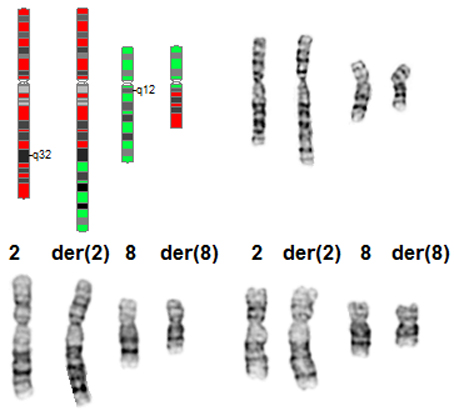
t(2;8)(q32;q12) G- banding: - Courtesy Galina Aldrete and Charles D. Bangs
Cytogenetics morphological
t(2;8)(q32;q12.1)
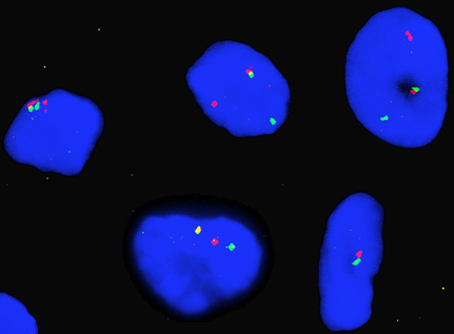
PLAG1 FISH of formalin-fixed paraffin-embedded section showing PLAG1 rearrangement: - Courtesy Gail Aldrete and Charles D. Bangs
Genes Involved and Proteins
Gene name
COL3A1 (collagen type III alpha 1 chain)
Location
2q32.2
Note
Mutations in this gene are associated with Ehlers-Danlos syndrome types IV, and with aortic and arterial aneurysms. (Lee et al., 2008; Jeong et al., 2012)
Dna rna description
The COL3A1 gene, located at chromosome 2q32, contains 51 exons spanning 38.43 kb of genomic distance. Two transcripts, resulting from the use of alternative polyadenylation sites, have been identified for this gene (GeneCards GCID:GC02P189803 (http://www.genecards.org/cgi-bin/carddisp.pl?gene=COL3A1), UniProt P02461-CO3A1_HUMAN (http://www.uniprot.org/uniprot/P02461)).
Protein description
The gene encodes a protein of 1466 amino acids (aa) (138kDa). The shorter isoform is missing 847-1149 aa. The protein is the pro-alpha1 chains of type III collagen, a fibrillar collagen that is found in extensible connective tissues such as skin, lung, uterus, intestine and the vascular system, and is frequently found in association with type I collagen. The C-terminal propeptide, also known as the COLFI domain, has crucial roles in tissue growth and repair, in which it controls both the intracellular assembly of procollagen molecules and the extracellular assembly of collagen fibrils. It binds a calcium ion which is essential for its function (GeneCards GCID:GC02P189803(http://www.genecards.org/cgi-bin/carddisp.pl?gene=COL3A1), UniProt P02461-CO3A1_HUMAN (http://www.uniprot.org/uniprot/P02461)).
Gene name
PLAG1 (Pleomorphic adenoma gene 1)
Location
8q12.1
Dna rna description
The gene spans about 50 kb and includes 5 exons. The size of the transcript is about 7 kb. It has two alternative splicing forms (one without exon 2) (GeneCards GCID:GC08M057073 (http://www.genecards.org/cgi-bin/carddisp.pl?gene=PLAG1), UniProt Q6DJT9-PLAG1_HUMAN (http://www.uniprot.org/uniprot/Q6DJT9)).
Protein description
The gene encodes a 500-aa zinc finger protein (74 kDa) with two putative nuclear localization signals (Kas et al., 1997). When activated, it acts as a transcription factor that up-regulates target genes, such as IGFII, leading to uncontrolled cell proliferation. When overexpressed in cultured cells, it increases the proliferation rate and transformation. Other target genes such as CRLF1, CRABP2, CRIP2, PIGF are strongly induced in cells with PLAG1 induction. PLAG1 is a proto-oncogene whose ectopic expression can trigger the development of lipoblastomas and pleomorphic adenomas of the salivary gland (Hensen et al., 2002; Voz et al., 2004; Zatkova et al., 2004) (GeneCards GCID:GC08M057073 (http://www.genecards.org/cgi-bin/carddisp.pl?gene=PLAG1), UniProt Q6DJT9-PLAG1_HUMAN (http://www.uniprot.org/uniprot/Q6DJT9)).
Result of the chromosomal anomaly
Note
The fusion occurs as a result of a cryptic, intrachromosomal rearrangement in tumors with apparently normal karyotypes. Comparison of the fusion gene with the wild type reveals that the fusion gene is associated with the t(2;8)(q31;q12.1) translocation. The first exon of COL3A1 is fused to either exon 2 or exon 3 of PLAG1 (Yoshida et al., 2014).
Description
PLAG1 has a genomic fusion breakpoint in intron 1 resulting in alternative splicing of exon 2. The start codon of PLAG1 is located in exon 4 (Van Dyck et al., 2007), and the coding sequence of PLAG1 is preserved (Yoshida et al., 2014). This supports the molecular mechanism of overexpression of PLAG1 through promoter swapping: as a result of the translocation, the constitutively active promoter of the partner gene drives the ectopic expression of PLAG1 (Hibbard et al., 2000)
Detection protocole
RT-PCR using total RNA extracted from frozen tumor tissue. The COL3A1/PLAG1 fusion transcript was amplified with primers 5-AGGGGAGCTGGCTACCCTCC-3 (forward), and, 5-ACGTTTCCCTGAAGGGACTT-3 (reverse). COL3A1/PLAG1-fusion transcripts of 345 bp and 450 bp were detected (Yoshida et al., 2014).
Note
No fusion protein exist for reasons the above.
Expression localisation
PLAG1 protein localizes to the nucleus (Bahrami et al.,2012).
Highly cited references
| Pubmed ID | Year | Title | Citations |
|---|---|---|---|
| 24700772 | 2014 | Identification of COL3A1 and RAB2A as novel translocation partner genes of PLAG1 in lipoblastoma. | 0 |
| 33893698 | 2021 | Novel morphologic findings in PLAG1-rearranged soft tissue tumors. | 0 |
Article Bibliography
| Pubmed ID | Last Year | Title | Authors |
|---|---|---|---|
| 22485045 | 2012 | PLAG1 alteration in carcinoma ex pleomorphic adenoma: immunohistochemical and fluorescence in situ hybridization studies of 22 cases. | Bahrami A et al |
| 11888928 | 2002 | The tumorigenic diversity of the three PLAG family members is associated with different DNA binding capacities. | Hensen K et al |
| 10987300 | 2000 | PLAG1 fusion oncogenes in lipoblastoma. | Hibbard MK et al |
| 11577778 | 2001 | Lipoblastoma and lipoblastomatosis in infancy and childhood: histopathologic, ultrastructural, and cytogenetic features. | Hicks J et al |
| 22235340 | 2012 | Loss of Col3a1, the gene for Ehlers-Danlos syndrome type IV, results in neocortical dyslamination. | Jeong SJ et al |
| 3736068 | 1986 | Lipoblastoma in infancy and childhood. | Jimenez JF et al |
| 9020842 | 1997 | Promoter swapping between the genes for a novel zinc finger protein and beta-catenin in pleiomorphic adenomas with t(3;8)(p21;q12) translocations. | Kas K et al |
| 12242528 | 2002 | Atypical lipomatous tumor in a 14-year-old patient: distinction from lipoblastoma using FISH analysis. | Kuhnen C et al |
| 18389341 | 2008 | A novel COL3A1 gene mutation in patient with aortic dissected aneurysm and cervical artery dissections. | Lee ST et al |
| 16769336 | 2006 | Surgical management of lipoblastoma. | McVay MR et al |
| 18798558 | 2009 | Differential diagnosis of lipoma-like lipoblastoma. | Morerio C et al |
| 17332914 | 2007 | PLAG1, the prototype of the PLAG gene family: versatility in tumour development (review). | Van Dyck F et al |
| 14712223 | 2004 | Microarray screening for target genes of the proto-oncogene PLAG1. | Voz ML et al |
| 8744279 | 1996 | Lipomatous tumors. | Weiss SW et al |
| 24700772 | 2014 | Identification of COL3A1 and RAB2A as novel translocation partner genes of PLAG1 in lipoblastoma. | Yoshida H et al |
| 14695992 | 2004 | Amplification and overexpression of the IGF2 regulator PLAG1 in hepatoblastoma. | Zatkova A et al |
| 18269579 | 2008 | Lipoblastoma in adolescents and young adults: report of six cases with FISH analysis. | de Saint Aubain Somerhausen N et al |
Citation
Hideki Yoshida ; Mitsuru Miyachi ; Hajime Hosoi
Soft Tissues: Lipoblastoma with t(2;8)(q32;q12.1) COL3A1/PLAG1
Atlas Genet Cytogenet Oncol Haematol. 2014-10-01
Online version: http://atlasgeneticsoncology.org/solid-tumor/6626/soft-tissues-lipoblastoma-with-t(2
