t(X;20)(q13;q13.3)
2005-01-01 Kathy Richkind , Kavita S. Reddy Affiliation1.Genzyme Genetics, Orange, CA. [email protected]
Clinics and Pathology
Disease
myelodysplastic syndromes (MDS): refractory anaemia with excess of blasts (RAEB-RAEBt), refractory anaemia (RA), MDS sideroblastic anemia and MDS pancytopenia and thrombocytopenia most often (5 cases); polycytemia vera --> acute myeloid leukemia (AML)-M1; myelofibrosis -->acute leukemia
Epidemiology
Only 7 cases to date and they are exclusively female: 0 Male/7 Female; found in older patients (Median age 61 years; range: 57-86)
Clinics
Still poorly known
Cytogenetics
Cytogenetics morphological
Sole abnormality in 5 MDS cases and accompanying changes +8, +9, del(13)(q21) and der(1;7)(q10;p10) in 2 cases that transformed to AML.
Cytogenetics molecular
By FISH the cytogenetic breakpoint was proximal to AR gene and hence the breakpoint on X chromosome is t(X;20)(q11.2q12;q13.3)
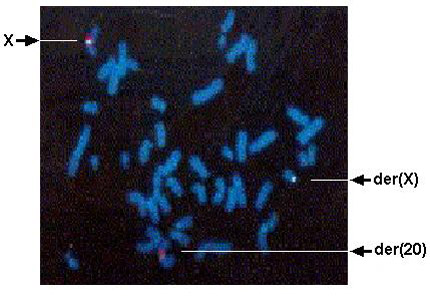
Fig 2: X-centromere probe DXZ1 (green) hybridized to the normal X and the derivative X (arrows). The androgen receptor (Xq12) AR (red) probe hybridized to derivative 20 and the normal X (arrows). The breakpoint on the X chromosome is proximal to AR. The karyotype is 46, X, t(X;20)(q13;q13.3).ish t(X;20)(q11.2q12;q13.3)(wcpX+,wcp20+,AR?;wcp20+, D20S180?,AR+,wcpX+). The revised breakpoints identified with FISH analysis are highlighted in bold.
Genes Involved and Proteins
Article Bibliography
| Pubmed ID | Last Year | Title | Authors |
|---|---|---|---|
| 12606130 | 2003 | A comprehensive karyotypic analysis on Korean hepatocellular carcinoma cell lines by cross-species color banding and comparative genomic hybridization. | Hwang HJ et al |
| 15676151 | 2005 | Translocation (X;20)(q13;q13.3): a nonrandom abnormality in four patients with myeloid disorders. | Reddy KS et al |
| 7664242 | 1995 | Renal cell carcinoma. Cytogenetic analysis of tumors and cell lines. | Zhao WP et al |
Summary
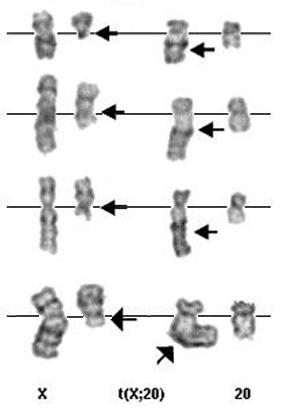
Fig. 1. Partial karyotypes of the translocation t(X;20)(q13;q13.3) for cases 14 (top to bottom; see case report section). Arrows indicate the derivatives 20 and X.
Citation
Kathy Richkind ; Kavita S. Reddy
t(X;20)(q13;q13.3)
Atlas Genet Cytogenet Oncol Haematol. 2005-01-01
Online version: http://atlasgeneticsoncology.org/haematological/1381/t(x;20)(q13;q13-3)
