AKAP12 A kinase (PRKA) anchor protein 12
2014-10-01 Irwin H Gelman AffiliationRoswell Park Cancer Institute, Elm and Carlton Streets, Buffalo, NY 14263, USA
Identity
HGNC
LOCATION
6q25.1
IMAGE

LEGEND
AKAP12 (6q24-25.2) in normal cells probed with a about 5Kb human AKAP12 probe. Courtesy of Irwin Gelman; adapted from Xia et al., Cancer Res.61:5644-5651, 2001.
LOCUSID
ALIAS
AKAP250,SSeCKS
FUSION GENES
Abstract
Review on AKAP1, with data on DNA, on the protein encoded, and where the gene is implicated.
DNA/RNA
Note
The AKAP12 gene and promoter structure is strongly conserved from fish to humans, including syntenic regions conserved in the mouse (chrom. 10) and rat (chrom. 1). No family members (homologues) other than AKAP12 exist within a given species.
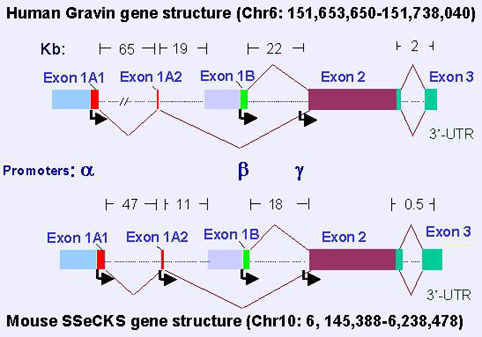
Human and mouse cells have similar exon/intron usage and spacing. AKAP12 has three independent promoters, α, β, and γ. The gamma promoter is active only in the testes while the α and β are co-active in most cells and tissues studied. Exons 1A1 and 1A2 combine to then splice to a common splice acceptor on Exon 2 used by Exon 1B. Exons 1A1 and 1A2 produce the N-terminal 103 amino acids of "AKAP12 alpha" whereas Exon 1B encodes the N-terminal 8 amino acids of "AKAP12 β"; the remaining amino acids are encoded in Exon 2. "AKAP12 gamma" is encoded by a read-through transcript starting in the intron upstream of Exon 2, utilizing an in-frame ATG in Exon 2. Therefore, the α, β, and γ transcripts encode proteins that only differ in their N-termini.
Transcription
Human and rodent AKAP12 is expressed ubiquitously, with greater expression in mesenchymal cells, expression in specific epithelial types, such as breast and prostate, and little in most endothelial cells. Several highly specialized, differentiated cells type, such as parietal cells in the glomerulus, pericytes, astrocytes and Purkinje cells, show especially strong expression.
Pseudogene
None.
Proteins
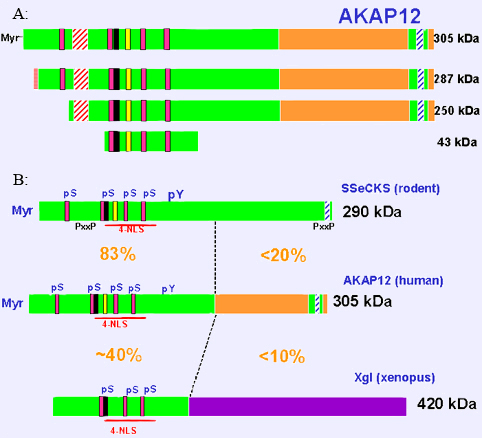
A: Except for testes, most cells express four major isoforms of AKAP12 protein. The 305 kDa isoforms is the myristylated AKAP12alpha whereas the 287 kDa isoforms is AKAP12beta. The 250 kDa and 43 kDa isoforms are proteolytic cleavage products common to the AKAP12alpha and beta isoforms.
B: Human AKAP12alpha encodes a 1,780 amino acids full-length protein. The first about 1,000 amino acids of human and rodent AKAP12 share 83% identity followed by about 600 amino acids with less than 20% identity. The N-terminal homology domain (green) shows about 40% identity to the Xgl (Xenopus gravin-like) gene in Xenopus. Both human and rodent AKAP12 share a shorter C-terminal domain containing the PKA-RII binding (AKAP) domain (green box in human AKAP12).
Expression
AKAP12 isoforms are expressed in most tissue and organ types, with high expression levels in the testes, ovary, brain, lung and heart. Most mesenchyme, smooth muscle and some epithelial cells (breast, prostate, lung, ovary) express significant AKAP12 levels. Lower levels of AKAP12 are found in endothelial cells, although express in these cells is usually associated with wounding and/or inflammation. High expression is also found in some specialized, differentiated cells such as the parietal cells of the glomerulus, pericytes, astrocytes and Purkinje cells.
Localisation
Most cell types display a cortical cytoskeletal staining pattern for AKAP12, with enrichment at the plasma membrane (associated with N-terminal myristylation and at least three N-terminal polybasic domains) and in the perinucleus. However, some staining has been observed in cell nuclei, probably directed by 4 SV40 Tag-like nuclear localization signals (NLS) found in the N-terminal third of the protein.
Function
1) Facilitates the sensitization/resensitization reaction of beta-adrenergic receptors.
2) Scaffolds protein kinase (PK) A, PKC, and SRC.
3) Autoantigen in some cases of myasthenia gravis.
4) Anti-angiogenic factor. The rodent orthologue has been shown to inhibit brain angiogenesis and induce the blood-brain barrier, and to inhibit VEGF-mediated metastasis.
5) Metastasis suppressor (see Gelman, 2012). Many studies show i) AKAP12 downregulation in metastases compared to primary-site tumors, associated with hypermethylation of promoter CpG islands, ii) AKAP12-/- mice are tumor- and metastasis-prone to skin carcinogens, iii) increased spontaneous lymph node metastasis of high-grade prostatic intraepithelial neoplasia in transgenic models, and iv) selective suppression of spontaneous and experimental metastasis following re-expression of rodent Akap12 in MAT-LyLu prostate cancer cells.
6) Effector of Polo-like kinase 1 to regulate cytokinesis.
7) Maintenance of barrier functions such as blood-brain, blood-retinal barriers and fibrotic scars in CNS repair.
8) Regulation of adhesion, chemotaxis and invasiveness through the control of actin cytoskeletal remodeling.
2) Scaffolds protein kinase (PK) A, PKC, and SRC.
3) Autoantigen in some cases of myasthenia gravis.
4) Anti-angiogenic factor. The rodent orthologue has been shown to inhibit brain angiogenesis and induce the blood-brain barrier, and to inhibit VEGF-mediated metastasis.
5) Metastasis suppressor (see Gelman, 2012). Many studies show i) AKAP12 downregulation in metastases compared to primary-site tumors, associated with hypermethylation of promoter CpG islands, ii) AKAP12-/- mice are tumor- and metastasis-prone to skin carcinogens, iii) increased spontaneous lymph node metastasis of high-grade prostatic intraepithelial neoplasia in transgenic models, and iv) selective suppression of spontaneous and experimental metastasis following re-expression of rodent Akap12 in MAT-LyLu prostate cancer cells.
6) Effector of Polo-like kinase 1 to regulate cytokinesis.
7) Maintenance of barrier functions such as blood-brain, blood-retinal barriers and fibrotic scars in CNS repair.
8) Regulation of adhesion, chemotaxis and invasiveness through the control of actin cytoskeletal remodeling.
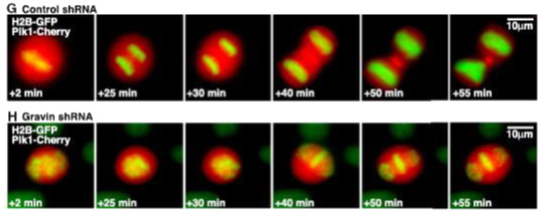
AKAP12 is phosphorylated by PLK1 on T766 during metaphase, and shRNa knockdown of AKAP12 leads to cytokinesis failure (Canton et al., 2012).
Homology
Southern blotting analysis as well as analysis of sequenced genomes indicates that vertebrates encode single AKAP12 orthologues, with no gene family members. Thus, the protein diversity of this gene stems from promoter choice, alternative splicing, proteolytic maturation and post-translational modification. AKAP12 has limited sequence homology based on short domains. For example, the C-terminal AKAP domain is homologous to the analogous domain in AKP79. Also, AKAP12 shares some so-called MARCKS protein-like effector domains- positively charged stretches of amino acids involved in plasma membrane targeting.
Mutations
Note
141 mutations (mostly point mutants and some small deletions) have been described in COSMIC, the vast majority of which are found in the major protein-coding exon ("exon 2")
ESR1-AKAP12 fusions have been recently described (Ma et al., 2014) in clinical cases of breast cancer.
. There are at least 539 single nucleotide polymorphisms (SNP). 59 study datasets for AKAP12 SNPs described in GWAS analyses For example, HGVST779 identifies AKAP12 SNPs associated with chronic myelogenous leukemia. Another study identifies AKAP12 SNPs associated with psychiatric depression (Ripke et al., 2012).
A number of QTLs have been described associated with susceptibility for prostate cancer and insulin sensitivity, and for HDL cholesterol.
ESR1-AKAP12 fusions have been recently described (Ma et al., 2014) in clinical cases of breast cancer.
. There are at least 539 single nucleotide polymorphisms (SNP). 59 study datasets for AKAP12 SNPs described in GWAS analyses For example, HGVST779 identifies AKAP12 SNPs associated with chronic myelogenous leukemia. Another study identifies AKAP12 SNPs associated with psychiatric depression (Ripke et al., 2012).
A number of QTLs have been described associated with susceptibility for prostate cancer and insulin sensitivity, and for HDL cholesterol.
Implicated in
Entity name
Prostate cancer
Note
Tumor/metastasis suppressor.
Prognosis
AKAP12 downregulation correlates with earlier time-to-onset of metastasis (Ko et al., 2014).
Cytogenetics
gene deletion at 6q24-25.1.
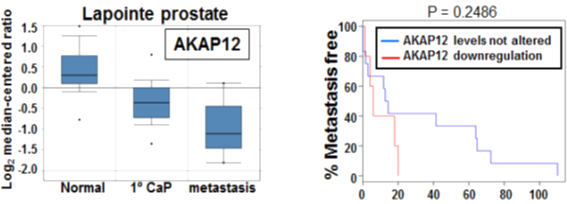
Left- Oncomine analysis (http://www.oncomine.org) of Lapointe prostate cancer expression data (Proc Natl Acad Sci U S A 2004;101:811-6) showing AKAP12 downregulation in human prostate cancer metastasis compared with levels in primary prostate cancer (1 prostate cancer) or normal prostate tissue. F, Kaplan-Meier plot analysis (http://www.cbioportal.org/public-portal/) of metastasis occurrence vs. time to onset in 37 prostate cancer metastasis cases from Taylor et al., 2010 in which 11 cases (29.7%) displayed AKAP12 downregulation compared with levels in primary prostate cancer lesions versus 26 cases with no change in AKAP12 levels.
Oncogenesis
Presumably, the loss of AKAP12s scaffolding activity for kinases such as Src and PKC result in hyperactivated pathways that contribute to oncogenic transformation, as shown in Su et al., 2010, and Su et al., 2013.
Entity name
Melanoma
Note
Tumor/metastasis suppressor/promoter.
Prognosis
Some papers identify AKAP12 downregulation as a marker human melanoma progression (Hacker et al., 2008; Bonazzi et al., 2009), or that its genetic loss in transgenic models leads to a metastasis-prone condition induced by skin carcinogens (Akakura et al., 2011). However, one paper suggests that hypoxia-induced expression of AKAP12-variant 2 (β isoform) enhances melanoma migration and invasiveness.
Oncogenesis
Presumably, the loss of AKAP12s scaffolding activity for kinases such as Src and PKC result in hyperactivated pathways that contribute to oncogenic transformation, as shown in Su et al., 2010 and Su et al., 2013.
Entity name
Ovarian cancer
Note
Possible mediator of drug-resistance.
Prognosis
AKAP12 upregulation associated with resistance to platins and taxanes (Chappell et al., 2012; Bateman et al., 2015).
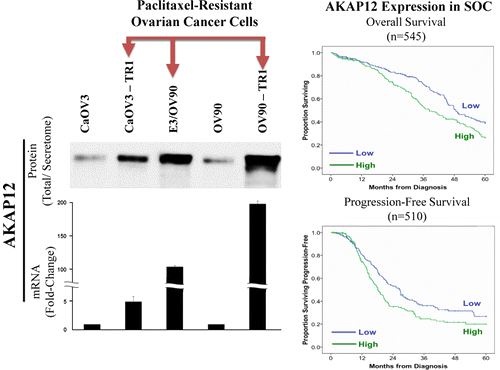
A majority of high-grade (HG) serous ovarian cancer (SOC) patients develop resistant disease despite high initial response rates to platinum/paclitaxel-based chemotherapy. We identified shed/secreted proteins in preclinical models of paclitaxel-resistant human HGSOC models and correlated these candidate proteins with patient outcomes using public data from HGSOC patients. Proteomic analyses of a HGSOC cell line secretome was compared to those from a syngeneic paclitaxel-resistant variant and from a line established from an intrinsically chemorefractory HGSOC patient. Associations between the identified candidate proteins and patient outcome were assessed in a discovery cohort of 545 patients and two validation cohorts totaling 795 independent SOC patients. Among the 81 differentially abundant proteins identified (q < 0.05) from paclitaxel-sensitive vs -resistant HGSOC cell secretomes, AKAP12 was verified to be elevated in all models of paclitaxel-resistant HGSOC. Furthermore, elevated AKAP12 transcript expression was associated with worse progression-free and overall survival. Associations with outcome were observed in three independent cohorts and remained significant after adjusted multivariate modeling. We further provide evidence to support that differential gene methylation status is associated with elevated expression of AKAP12 in taxol-resistant ovarian cancer cells and ovarian cancer patient subsets. Elevated expression and shedding/secretion of AKAP12 is characteristic of paclitaxel-resistant HGSOC cells, and elevated AKAP12 transcript expression is a poor prognostic and predictive marker for progression-free and overall survival in SOC patients. [from Bateman et al., 2015].
Oncogenesis
Presumably, the upregulation of AKAP12, and its ability to scaffold kinases such as Src and PKC, and to move them to cellular specific compartments, leads to pathways that facilitate drug resistance, as described in Le and Bast 2011.
Entity name
Pancreatic cancer
Note
Possible tumor/metastasis suppressor.
Prognosis
Whereas AKAP12 upregulation was noted in human pancreatic cells lines compared to immortalized human pancreatic ductal epithelial cells (Cao et al., Cancer Biol Ther. 2004, 3(11):1081-9), AKAP12 loss (due to promoter hypermethylation) correlated with increased liver metastasis in pancreatic ductal adenocarcinoma (Mardin et al., 2010).
Oncogenesis
Presumably, the loss of AKAP12s scaffolding activity for kinases such as Src and PKC result in hyperactivated pathways that contribute to oncogenic transformation, as shown in Su et al. 2010, and Su et al. 2013.
Entity name
Colon cancer
Note
Possible tumor/metastasis suppressor.
Prognosis
Downregulation of AKAP12 correlated with colon cancer progression (Zhu et al., J Cancer Res Ther. 2013, 9(3):467-70), especially due to promoter hypermethylation (Mori et al., 2006; Liu et al., 2010). Moreover, AKAP12 expression is positively regulated by TGFβ; in a SMAD4 -dependent manner in colon cancer cell lines (Ali et al., 2010), and given that SMAD4 is often mutated or deleted in colon cancer (Bellam and Pasche, 2010), the downregulation of AKAP12 might be related to SMAD4 loss. Re-expression of AKAP12 inhibits the metastatic potential of colorectal carcinoma cells (Liu et al., 2011).
Entity name
Lung cancer
Note
Possible tumor suppressor.
Prognosis
ownregulation of AKAP12 due to promoter hypermethylation in lung cancer as a susceptibility (Tessema et al., 2008) or progression marker (Jo et al., 2010). As in the case of ovarian cancer, AKAP12 expression increases in cisplatin-resistant variants of lung cancer cell lines (Lopez-Ayllon et al., 2014.
Oncogenesis
Presumably, the loss of AKAP12s scaffolding activity for kinases such as Src and PKC result in hyperactivated pathways that contribute to oncogenic transformation, as shown in Su et al., 2010 and Su et al., 2013.
Entity name
Gastric cancer
Note
Possible tumor suppressor.
Prognosis
Downregulation of AKAP12 due to promoter hypermethylation in gastric cancer (Choi et al., 2004) or in Barretts esophagus (Jin et al., 2008).
Oncogenesis
Presumably, the loss of AKAP12s scaffolding activity for kinases such as Src and PKC result in hyperactivated pathways that contribute to oncogenic transformation, as shown in Su et al., 2010 and Su et al., 2013.
Entity name
Liver cancer
Note
Possible tumor suppressor.
Prognosis
Downregulation of AKAP12 due to promoter hypermethylation in liver cancer (Goeppert et al., 2010; Hayashi et al., 2012).
Oncogenesis
Presumably, the loss of AKAP12s scaffolding activity for kinases such as Src and PKC result in hyperactivated pathways that contribute to oncogenic transformation, as shown in Su et al., 2010 and Su et al., 2013.
Article Bibliography
| Pubmed ID | Last Year | Title | Authors |
|---|---|---|---|
| 25402633 | 2015 | RNA interference screening identifies a novel role for PCTK1/CDK16 in medulloblastoma with c-Myc amplification. | Ćwiek P et al |
| 21074540 | 2011 | Thioredoxin 1 enhances neovascularization and reduces ventricular remodeling during chronic myocardial infarction: a study using thioredoxin 1 transgenic mice. | Adluri RS et al |
| 21128249 | 2011 | Carcinogen-induced squamous papillomas and oncogenic progression in the absence of the SSeCKS/AKAP12 metastasis suppressor correlate with FAK upregulation. | Akakura S et al |
| 22811901 | 2012 | Pivotal Role of AKAP12 in the Regulation of Cellular Adhesion Dynamics: Control of Cytoskeletal Architecture, Cell Migration, and Mitogenic Signaling. | Akakura S et al |
| 18593908 | 2008 | Loss of the SSeCKS/Gravin/AKAP12 gene results in prostatic hyperplasia. | Akakura S et al |
| 21099353 | 2010 | Rb-dependent cellular senescence, multinucleation and susceptibility to oncogenic transformation through PKC scaffolding by SSeCKS/AKAP12. | Akakura S et al |
| 20862427 | 2010 | Proteomics of Smad4 regulated transforming growth factor-beta signalling in colon cancer cells. | Ali NA et al |
| 25748058 | 2015 | Elevated AKAP12 in paclitaxel-resistant serous ovarian cancer cells is prognostic and predictive of poor survival in patients. | Bateman NW et al |
| 23580569 | 2013 | The absence of ER-β results in altered gene expression in ovarian granulosa cells isolated from in vivo preovulatory follicles. | Binder AK et al |
| 18803327 | 2009 | Identification of candidate tumor suppressor genes inactivated by promoter methylation in melanoma. | Bonazzi VF et al |
| 15287943 | 2004 | Low expression of the putative tumour suppressor gene gravin in chronic myeloid leukaemia, myelodysplastic syndromes and acute myeloid leukaemia. | Boultwood J et al |
| 25428551 | 2015 | Differential expression patterns of metastasis suppressor proteins in basal cell carcinoma. | Bozdogan O et al |
| 20568114 | 2011 | Role for transcription factor TFII-I in the suppression of SSeCKS/Gravin/Akap12 transcription by Src. | Bu Y et al |
| 17626016 | 2007 | v-Src-mediated down-regulation of SSeCKS metastasis suppressor gene promoter by the recruitment of HDAC1 into a USF1-Sp1-Sp3 complex. | Bu Y et al |
| 22249313 | 2012 | SSeCKS sequesters cyclin D1 in glomerular parietal epithelial cells and influences proliferative injury in the glomerulus. | Burnworth B et al |
| 23063527 | 2012 | Gravin is a transitory effector of polo-like kinase 1 during cell division. | Canton DA et al |
| 23462182 | 2013 | Anchoring proteins encounter mitotic kinases. | Canton DA et al |
| 25229625 | 2014 | Prompt meningeal reconstruction mediated by oxygen-sensitive AKAP12 scaffolding protein after central nervous system injury. | Cha JH et al |
| 22900918 | 2012 | Mitochondrial proteomic analysis of cisplatin resistance in ovarian cancer. | Chappell NP et al |
| 18384053 | 2008 | Spatiotemporal expression of SSeCKS in injured rat sciatic nerve. | Chen L et al |
| 18950703 | 2009 | G-protein-coupled receptor-associated A-kinase anchoring proteins AKAP5 and AKAP12: differential trafficking and distribution. | Chen MH et al |
| 20367900 | 2010 | [Induction effect of platelet-activating factor on Src-suppressed C kinase substrate gene expression in rat pulmonary microvascular endothelial cells]. | Chen S et al |
| 17551670 | 2007 | Lipopolysaccharide induces expression of SSeCKS in rat lung microvascular endothelial cell. | Cheng C et al |
| 15258566 | 2004 | AKAP12/Gravin is inactivated by epigenetic mechanism in human gastric carcinoma and shows growth suppressor activity. | Choi MC et al |
| 18579430 | 2008 | Overexpression of A-kinase anchoring protein 12A activates sterol regulatory element binding protein-2 and enhances cholesterol efflux in hepatic cells. | Choi MC et al |
| 18397319 | 2008 | AKAP12 in astrocytes induces barrier functions in human endothelial cells through protein kinase Czeta. | Choi YK et al |
| 20232114 | 2010 | SSeCKS promote beta-amyloid-induced PC12 cells neurotoxicity by up-regulating tau phosphorylation in Alzheimer's disease. | Cui Z et al |
| 19825367 | 2009 | Silencing of Cited2 and Akap12 genes in radiation-induced rat osteosarcomas. | Daino K et al |
| 19444910 | 2009 | Gene expression profiling of alpha-radiation-induced rat osteosarcomas: identification of dysregulated genes involved in radiation-induced tumorigenesis of bone. | Daino K et al |
| 20543563 | 2010 | Are DNA methylation markers ready for colorectal cancer detection? | De Paoli VM et al |
| 11309381 | 2001 | The scaffold protein gravin (cAMP-dependent protein kinase-anchoring protein 250) binds the beta 2-adrenergic receptor via the receptor cytoplasmic Arg-329 to Leu-413 domain and provides a mobile scaffold during desensitization. | Fan G et al |
| 25792458 | 2015 | Hypoxic induction of AKAP12 variant 2 shifts PKA-mediated protein phosphorylation to enhance migration and metastasis of melanoma cells. | Finger EC et al |
| 17686059 | 2007 | AKAP12, a gene with tumour suppressor properties, is a target of promoter DNA methylation in childhood myeloid malignancies. | Flotho C et al |
| 21831305 | 2011 | AKAP12 and AKAP5 form higher-order hetero-oligomers. | Gao S et al |
| 23369406 | 2013 | Short and long term gene expression variation and networking in human proximal tubule cells when exposed to cadmium. | Garrett SH et al |
| 22684366 | 2012 | Suppression of tumor and metastasis progression through the scaffolding functions of SSeCKS/Gravin/AKAP12. | Gelman IH et al |
| 24042196 | 2013 | Differential expression of the tumor suppressor A-kinase anchor protein 12 in human diffuse and pilocytic astrocytomas is regulated by promoter methylation. | Goeppert B et al |
| 1522245 | 1992 | Molecular cloning and preliminary characterization of a novel cytoplasmic antigen recognized by myasthenia gravis sera. | Gordon T et al |
| 21903576 | 2011 | Control of protein kinase C activity, phorbol ester-induced cytoskeletal remodeling, and cell survival signals by the scaffolding protein SSeCKS/GRAVIN/AKAP12. | Guo LW et al |
| 18386818 | 2008 | Reduced expression of IL-18 is a marker of ultraviolet radiation-induced melanomas. | Hacker E et al |
| 26202611 | 2015 | Scaffolding during the cell cycle by A-kinase anchoring proteins. | Han B et al |
| 23238728 | 2012 | Gravin orchestrates protein kinase A and β2-adrenergic receptor signaling critical for synaptic plasticity and memory. | Havekes R et al |
| 22052684 | 2012 | Identification of the A kinase anchor protein 12 (AKAP12) gene as a candidate tumor suppressor of hepatocellular carcinoma. | Hayashi M et al |
| 26406118 | 2015 | A mitotic kinase scaffold depleted in testicular seminomas impacts spindle orientation in germ line stem cells. | Hehnly H et al |
| 18172295 | 2008 | Genome-wide transcriptional response to 5-aza-2'-deoxycytidine and trichostatin a in multiple myeloma cells. | Heller G et al |
| 21869601 | 2011 | Unbearable stress: collapse of the SSeCKS/AKAP12 scaffold leads to senescence and transformation. | Hinds PW et al |
| 19539625 | 2010 | Light modulates the melanophore response to alpha-MSH in Xenopus laevis: an analysis of the signal transduction crosstalk mechanisms involved. | Isoldi MC et al |
| 19757038 | 2010 | SSeCKS is a suppressor in Schwann cell differentiation and myelination. | Ji Y et al |
| 18226347 | 2008 | [Expressions of src-suppressed C kinase substrate in lipopolysaccharide injured rat livers]. | Jiang W et al |
| 18199717 | 2008 | Hypermethylation of the AKAP12 promoter is a biomarker of Barrett's-associated esophageal neoplastic progression. | Jin Z et al |
| 21115911 | 2010 | Methylation of AKAP12{alpha} promoter in lung cancer. | Jo UH et al |
| 21540461 | 2011 | A genome-wide association study identifies novel loci associated with susceptibility to chronic myeloid leukemia. | Kim DH et al |
| 25534553 | 2014 | Akap12 is essential for the morphogenesis of muscles involved in zebrafish locomotion. | Kim HH et al |
| 24492704 | 2014 | A transgenic mouse model for early prostate metastasis to lymph nodes. | Ko HK et al |
| 22583680 | 2012 | "Shaping" of cell signaling via AKAP-tethered PDE4D: Probing with AKAR2-AKAP5 biosensor. | Koçer SS et al |
| 23144859 | 2012 | Integrative analysis reveals relationships of genetic and epigenetic alterations in osteosarcoma. | Kresse SH et al |
| 22192928 | 2012 | AKAP12 regulates vascular integrity in zebrafish. | Kwon HB et al |
| 19664072 | 2009 | Brain angiogenesis in developmental and pathological processes: regulation, molecular and cellular communication at the neurovascular interface. | Lee HS et al |
| 21461577 | 2011 | Inhibition of endothelial cell migration through the down‑regulation of MMP-9 by A-kinase anchoring protein 12. | Lee SW et al |
| 18279585 | 2008 | [Studies on the expression of Src-suppressed C kinase substrate mRNA in pulmonary microvascular endothelial cells induced by lipopolysaccharide]. | Li H et al |
| 20155814 | 2010 | Involvement of Src-suppressed C kinase substrate in experimental autoimmune encephalomyelitis: a link between release of astrocyte proinflammatory factor and oligodendrocyte apoptosis. | Li X et al |
| 23871804 | 2013 | Anti-cancer mechanisms of clinically acceptable colchicine concentrations on hepatocellular carcinoma. | Lin ZY et al |
| 21310466 | 2011 | Quantitative assessment of AKAP12 promoter methylation in human prostate cancer using methylation-sensitive high-resolution melting: correlation with Gleason score. | Liu W et al |
| 21918680 | 2011 | Re-expression of AKAP12 inhibits progression and metastasis potential of colorectal carcinoma in vivo and in vitro. | Liu W et al |
| 24961511 | 2014 | Cancer stem cells and cisplatin-resistant cells isolated from non-small-lung cancer cell lines constitute related cell populations. | Lopez-Ayllon BD et al |
| 25909170 | 2015 | HSPA12B: a novel facilitator of lung tumor growth. | Ma H et al |
| 21095247 | 2011 | Alternative splicing in bone following mechanical loading. | Mantila Roosa SM et al |
| 20939879 | 2010 | SERPINB5 and AKAP12 - expression and promoter methylation of metastasis suppressor genes in pancreatic ductal adenocarcinoma. | Mardin WA et al |
| 25086928 | 2014 | Identification and validation of genes with expression patterns inverse to multiple metastasis suppressor genes in breast cancer cell lines. | Marino N et al |
| 19289110 | 2009 | Src supports UDP-glucuronosyltransferase-2B7 detoxification of catechol estrogens associated with breast cancer. | Mitra PS et al |
| 23543478 | 2013 | Gravin gene expression in acute myeloid leukemia. | Mostafa MR et al |
| 9000000 | 1997 | Gravin, an autoantigen recognized by serum from myasthenia gravis patients, is a kinase scaffold protein. | Nauert JB et al |
| 24452374 | 2014 | A-kinase anchoring proteins contribute to loss of E-cadherin and bronchial epithelial barrier by cigarette smoke. | Oldenburger A et al |
| 24133572 | 2013 | Ensemble of gene signatures identifies novel biomarkers in colorectal cancer activated through PPARγ and TNFα signaling. | Pagnotta SM et al |
| 22213446 | 2012 | The macromolecular state of A-kinase anchoring protein. | Patel TR et al |
| 25132049 | 2014 | A-kinase anchoring proteins: cAMP compartmentalization in neurodegenerative and obstructive pulmonary diseases. | Poppinga WJ et al |
| 25188285 | 2014 | PKA compartmentalization via AKAP220 and AKAP12 contributes to endothelial barrier regulation. | Radeva MY et al |
| 23838009 | 2013 | Receptor-mediated Ca2+ and PKC signaling triggers the loss of cortical PKA compartmentalization through the redistribution of gravin. | Schott MB et al |
| 21573722 | 2011 | The relationship between Src-suppressed C kinase substrate and β-1,4 galactosyltransferase-I in the process of lipopolysaccharide-induced TNF-α secretion in rat primary astrocytes. | Shao B et al |
| 9880537 | 1999 | Dynamic complexes of beta2-adrenergic receptors with protein kinases and phosphatases and the role of gravin. | Shih M et al |
| 25307344 | 2014 | Detection of activated parietal epithelial cells on the glomerular tuft distinguishes early focal segmental glomerulosclerosis from minimal change disease. | Smeets B et al |
| 15496411 | 2004 | Multiple promoters direct expression of three AKAP12 isoforms with distinct subcellular and tissue distribution profiles. | Streb JW et al |
| 21483686 | 2011 | Retinoid-induced expression and activity of an immediate early tumor suppressor gene in vascular smooth muscle cells. | Streb JW et al |
| 20018890 | 2010 | SSeCKS/Gravin/AKAP12 inhibits cancer cell invasiveness and chemotaxis by suppressing a protein kinase C- Raf/MEK/ERK pathway. | Su B et al |
| 22710722 | 2013 | Adhesion-mediated cytoskeletal remodeling is controlled by the direct scaffolding of Src from FAK complexes to lipid rafts by SSeCKS/AKAP12. | Su B et al |
| 16740695 | 2006 | SSeCKS metastasis-suppressing activity in MatLyLu prostate cancer cells correlates with vascular endothelial growth factor inhibition. | Su B et al |
| 17873284 | 2007 | Src suppressed C kinase substrate regulates the lipopolysaccharide-induced TNF-alpha biosynthesis in rat astrocytes. | Sun LL et al |
| 24870731 | 2014 | Lack of relation of AKAP12 with p53 and Bcl-2 in colorectal carcinoma. | Suren D et al |
| 19055733 | 2008 | G-protein-coupled receptor-associated A-kinase anchoring proteins AKAP5 and AKAP12: differential signaling to MAPK and GPCR recycling. | Tao J et al |
| 20412577 | 2010 | AKAR2-AKAP12 fusion protein "biosenses" dynamic phosphorylation and localization of a GPCR-based scaffold. | Tao J et al |
| 19694904 | 2009 | Tumor necrosis factor-alpha inhibits Schwann cell proliferation by up-regulating Src-suppressed protein kinase C substrate expression. | Tao T et al |
| 19017733 | 2008 | Mining the epigenome for methylated genes in lung cancer. | Tessema M et al |
| 18339850 | 2008 | Promoter methylation of genes in and around the candidate lung cancer susceptibility locus 6q23-25. | Tessema M et al |
| 22584896 | 2012 | The angiogenesis suppressor gene AKAP12 is under the epigenetic control of HDAC7 in endothelial cells. | Turtoi A et al |
| 20204485 | 2010 | Involvement of SRC-suppressed C kinase substrate in neuronal death caused by the lipopolysaccharide-induced reactive astrogliosis. | Wang P et al |
| 18725198 | 2008 | Cell shape regulation by Gravin requires N-terminal membrane effector domains. | Weiser DC et al |
| 24029533 | 2014 | HIF-dependent regulation of AKAP12 (gravin) in the control of human vascular endothelial function. | Weissmüller T et al |
| 21198787 | 2011 | Examination of AKAP12 promoter methylation in skin cancer using methylation-sensitive high-resolution melting analysis. | Wu W et al |
| 19937403 | 2010 | A critical role of SRC-suppressed C kinase substrate in rat astrocytes after chronic constriction injury. | Xia Y et al |
| 18307037 | 2008 | Spatiotemporal patterns of SSeCKS expression after rat spinal cord injury. | Xiao F et al |
| 18979197 | 2009 | Essential role of SRC suppressed C kinase substrates in Schwann cells adhesion, spreading and migration. | Yan M et al |
| 17980351 | 2007 | The role of TNF-alpha and its receptors in the production of Src-suppressed C kinase substrate by rat primary type-2 astrocytes. | Yan M et al |
| 24623461 | 2014 | Expression of SRC suppressed C kinase substrate in rat neural tissues during inflammation. | Yan M et al |
| 19210988 | 2009 | Gravin dynamics regulates the subcellular distribution of PKA. | Yan X et al |
| 24065476 | 2013 | AKAP12/Gravin gene expression in colorectal cancer: clinical importance and review of the literature. | Yildirim M et al |
| 17442483 | 2007 | AKAP12 induces apoptotic cell death in human fibrosarcoma cells by regulating CDKI-cyclin D1 and caspase-3 activity. | Yoon DK et al |
| 19724895 | 2009 | Association of gene polymorphisms with chronic kidney disease in Japanese individuals. | Yoshida T et al |
| 20454828 | 2010 | Role of src-suppressed C kinase substrate in rat pulmonary microvascular endothelial hyperpermeability stimulated by inflammatory cytokines. | You QH et al |
| 21334414 | 2011 | Temporal profile of Src, SSeCKS, and angiogenic factors after focal cerebral ischemia: correlations with angiogenesis and cerebral edema. | Zan L et al |
| 24673440 | 2014 | 2,3,7,8-Tetrachlorodibenzo-p-dioxin promotes astrocyte activation and the secretion of tumor necrosis factor-α via PKC/SSeCKS-dependent mechanisms. | Zhang Y et al |
| 20111901 | 2010 | SSeCKS promotes tumor necrosis factor-alpha autocrine via activating p38 and JNK pathways in Schwann cells. | Zhou Z et al |
| 24125984 | 2013 | Expression profiling based on graph-clustering approach to determine colon cancer pathway. | Zhu XQ et al |
Other Information
Locus ID:
NCBI: 9590
MIM: 604698
HGNC: 370
Ensembl: ENSG00000131016
Variants:
dbSNP: 9590
ClinVar: 9590
TCGA: ENSG00000131016
COSMIC: AKAP12
RNA/Proteins
| Gene ID | Transcript ID | Uniprot |
|---|---|---|
| ENSG00000131016 | ENST00000253332 | Q02952 |
| ENSG00000131016 | ENST00000354675 | Q02952 |
| ENSG00000131016 | ENST00000359755 | Q02952 |
| ENSG00000131016 | ENST00000402676 | Q02952 |
Expression (GTEx)
Protein levels (Protein atlas)
References
| Pubmed ID | Year | Title | Citations |
|---|---|---|---|
| 38506047 | 2024 | AKAP12 Upregulation Associates With PDE8A to Accelerate Cardiac Dysfunction. | 0 |
| 38506047 | 2024 | AKAP12 Upregulation Associates With PDE8A to Accelerate Cardiac Dysfunction. | 0 |
| 36513585 | 2023 | Circ_0001777 Affects Triple-negative Breast Cancer Progression Through the miR-95-3p/AKAP12 Axis. | 1 |
| 37326825 | 2023 | AKAP12 promotes cancer stem cell-like phenotypes and activates STAT3 in colorectal cancer. | 1 |
| 37605556 | 2023 | AKAP12 and IGFBP4 Are Prognostic Factors for Chronic Lymphocytic Leukemia. | 0 |
| 37879503 | 2023 | AKAP12 inhibits esophageal squamous carcinoma cell proliferation, migration, and cell cycle via the PI3K/AKT signaling pathway. | 1 |
| 36513585 | 2023 | Circ_0001777 Affects Triple-negative Breast Cancer Progression Through the miR-95-3p/AKAP12 Axis. | 1 |
| 37326825 | 2023 | AKAP12 promotes cancer stem cell-like phenotypes and activates STAT3 in colorectal cancer. | 1 |
| 37605556 | 2023 | AKAP12 and IGFBP4 Are Prognostic Factors for Chronic Lymphocytic Leukemia. | 0 |
| 37879503 | 2023 | AKAP12 inhibits esophageal squamous carcinoma cell proliferation, migration, and cell cycle via the PI3K/AKT signaling pathway. | 1 |
| 34483150 | 2022 | Overexpression of miR-146a promotes cell proliferation and migration in a model of diabetic foot ulcers by regulating the AKAP12 axis. | 3 |
| 35775596 | 2022 | Physiologic and pathophysiologic roles of AKAP12. | 4 |
| 36122629 | 2022 | HDAC6-dependent deacetylation of AKAP12 dictates its ubiquitination and promotes colon cancer metastasis. | 10 |
| 36148016 | 2022 | Comprehensive Analysis of the Immune Implication of AKAP12 in Stomach Adenocarcinoma. | 0 |
| 34483150 | 2022 | Overexpression of miR-146a promotes cell proliferation and migration in a model of diabetic foot ulcers by regulating the AKAP12 axis. | 3 |
Citation
Irwin H Gelman
AKAP12 A kinase (PRKA) anchor protein 12
Atlas Genet Cytogenet Oncol Haematol. 2014-10-01
Online version: http://atlasgeneticsoncology.org/gene/607/akap12
Historical Card
2006-11-01 AKAP12 A kinase (PRKA) anchor protein 12 by Irwin H Gelman Affiliation
Roswell Park Cancer Institute, Elm and Carlton Streets, Buffalo, NY 14263, USA
