AREG (amphiregulin (schwannoma-derived growth factor))
2009-02-01 Carmen Berasain , Matias A Avila AffiliationDivision of Hepatology, Gene Therapy, CIMA, University of Navarra, Pamplona, Spain
DNA/RNA
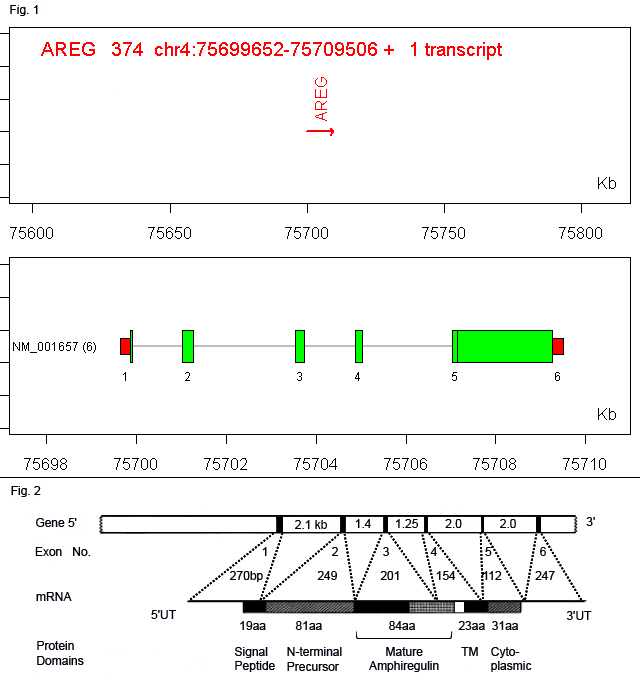
Figure 2: Map of the human AR gene showing the exon organization and protein domains. The gene is drawn to scale in a 5-to-3 orientation. Intron lengths in kilobase pairs are indicated between each exon. The six exons are shown, with the length in base pairs being listed directly under each exon. The corresponding position of each exon about the AR mRNA is shown below. Protein domains are represented by shaded boxes. The number of amino acid residues in each domain is indicated. The two dark filled boxes represent hydrophobic stretches that correspond to the signal peptide and transmembrane (TM) domains. Mature AR is represented by two boxes, the N-terminal hydrophilic heparin-binding domain and the C-terminal EGF-like motif (from Plowman et al., 1990).
Description
The AR/AREG human gene spans 10kb in the genomic DNA and it is composed of six exons.
Transcription
The transcription of the AR gene produces a 1.4 kb mRNA. AR gene shows broad constitutive expression, being more prevalent in human ovary and placenta although it is also expressed in pancreas, cardiac muscle, testis, colon, breast, lung, spleen and kidney, whereas it is undetectable in liver.
Proteins
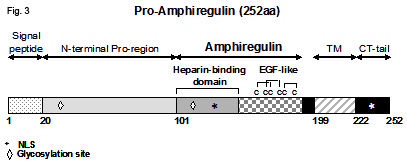
AR is synthesized as a membrane-anchored precursor (Pro-AR) of 252 amino acids. Pro-AR encompasses a signal peptide, a Pro-region, a heparin-binding domain, an EGF-like domain, a transmembrane region (TM) and a carboxy-terminal cytosolic tail (CT-tail). The nuclear localization signal (NLS) and glycosylation sites are indicated.
Description
AR is synthesized as a 252-amino acids transmembrane glycoprotein, also known as transmembrane precursor or pro-form (Pro-AR). Pro-AR consists of a hydrophilic extracellular N-terminus (or ectodomain), a hydrophobic transmembrane domain (TM) and a hydrophilic cytoplasmic C-terminus (CT-tail). In the extracellular N-terminus we can distinguish an N-terminal pro-region containing glycosylation sites followed by a heparin-binding domain and an epidermal growth factor EGF-like region. The EGF-like region is shared by other members of the EGF family of ligands. At the plasma membrane Pro-AR undergoes proteolytic cleavage to release the mature soluble factor in a process known as "ectodomain shedding". Cleavage of Pro-AR at two N-terminal sites gives rise to two major soluble forms of ~19 and ~21 kDa. Alternatively Pro-AR cleavage can produce a larger 43-kDa soluble protein corresponding to the entire extracellular domain. Cleavage of Pro-AR at the cell surface can be mediated by tumor necrosis factor-alpha converting enzyme (TACE), a member of the disintegrin and metalloproteinase (ADAM) family also known as ADAM17. Shedding of AR allows the autocrine or paracrine interaction of the mature ligand with its cognate receptor, the EGFR (also known as ErbB1), a transmembrane protein endowed with tyrosine kinase activity, although juxtacine interaction between membrane-bound Pro-AR and the EGFR has also been observed.
Expression
AR is constitutively expressed in human ovary and placenta, in pancreas, cardiac muscle, testis, colon, breast, lung, spleen and kidney, whereas it is undetectable in liver. AR gene overexpression has been frequently demonstrated in cancerous tissues like colon, breast, bladder, prostate, pancreas, lung, ovary, squamous cell carcinomas, hepatocarcinoma and myeloma cells. Besides changes in AR gene expression, different stimuli can also influence the availability of this growth factor through the stimulation of Pro-AR cleavage at the cell membrane. This is achieved by the activation of TACE/ADAM17 in response to agonists acting through G-proteins coupled receptors (GPCRs) in a process termed EGFR transactivation.
Localisation
AR is synthesized as a transmembrane precursor which is proteolytically cleaved to produce the soluble factor.
Function
Binding of AR to the epidermal growth factor receptor (EGFR/ErbB1) triggers key intracellular signaling pathways, such as the mitogenic MAPK and survival PI3K/Akt pathways, which have been demonstrated to participate in the transduction of AR-effects. AR was originally identified as a factor capable of inhibiting the growth of certain carcinoma cell lines, while stimulating the proliferation of normal cells, a fact that motivated its denomination. Actually, depending on its concentration and the nature of the target cell AR promotes the growth and survival of most cell types, both normal and transformed.
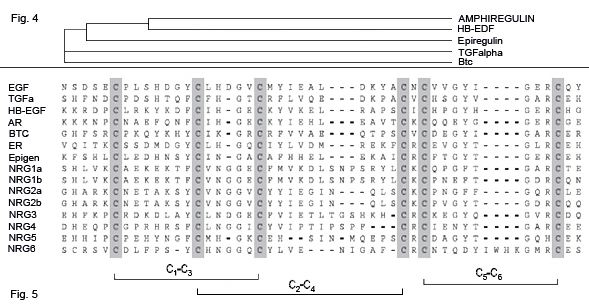
Figure 4: Cladogram
Figure 5: from Sanderson et al., 2006.
Homology
The EGF-like region characterized by a six-cysteine consensus motif, XnCX7CX4-5CX10CXCX5GX2CXn is shared by other members of the EGF family of ligands.
Mature HB-EGF and AR also have N-terminal extensions, composed of predominantly basic residues which are thought to confer their heparin-binding abilities.
Mature HB-EGF and AR also have N-terminal extensions, composed of predominantly basic residues which are thought to confer their heparin-binding abilities.
Implicated in
Entity name
Various cancers
Note
AR gene overexpression has been demonstrated in a large variety of human cancerous tissues such as colon, breast, liver, prostate, pancreas, lung, squamous cell carcinoma, bladder, ovary, skin and myeloma cells. The genetic or epigenetic alterations responsible for this overexpression are unknown. However it has been documented that the expression of AR can be induced by hormones such as androgen or 17beta-estradiol, EGF-family growth factors, such as TGF-alpha or AR itself, pro-inflammatory cytokines, such as TNF-alpha or interleukin-1 beta, prostaglandins, aryl hydrocarbon receptor agonists, bile acids, or hypoxic conditions.
In addition to these changes in AR gene expression the availability of this growth factor may be increased through the stimulation of pro-AR cleavage at the cell membrane, which result in a process termed EGFR transactivation. This is achieved through the activation of TACE/ADAM17 in response to agonists acting through GPCRs. This process has been shown in different cancer cells upon treatment with lysophosphatidic acid, gastrin-releasing peptide, cigarette smoke, or the activation of cannabinoid receptors.
In vitro studies performed in tumour cell lines upon treatment with AR, or conversely with specific siRNAs to silence AR gene expression, have shown that AR plays an important role in the proliferation and survival of transformed cells. These assays have also demonstrated that AR participates in the maintenance of the metastatic and oncogenic properties of these cells as well as in their resistance to chemotherapy.
The role of AR in cancer development and progression is also supported by clinical data. It has been established a significant correlation between elevated AR mRNA levels in bladder tumour tissue and poor patient survival. In patients with advanced non-squamous non-small cell lung cancers increased levels of circulating AR in serum are predictors of poor response to gefitinib.
In addition to these changes in AR gene expression the availability of this growth factor may be increased through the stimulation of pro-AR cleavage at the cell membrane, which result in a process termed EGFR transactivation. This is achieved through the activation of TACE/ADAM17 in response to agonists acting through GPCRs. This process has been shown in different cancer cells upon treatment with lysophosphatidic acid, gastrin-releasing peptide, cigarette smoke, or the activation of cannabinoid receptors.
In vitro studies performed in tumour cell lines upon treatment with AR, or conversely with specific siRNAs to silence AR gene expression, have shown that AR plays an important role in the proliferation and survival of transformed cells. These assays have also demonstrated that AR participates in the maintenance of the metastatic and oncogenic properties of these cells as well as in their resistance to chemotherapy.
The role of AR in cancer development and progression is also supported by clinical data. It has been established a significant correlation between elevated AR mRNA levels in bladder tumour tissue and poor patient survival. In patients with advanced non-squamous non-small cell lung cancers increased levels of circulating AR in serum are predictors of poor response to gefitinib.
Entity name
Psoriasis
Note
AR is an autocrine growth factor for keratinocytes and the expression of AR is significantly induced in psoriatic epidermis. Transgenic mice which overexpress AR in the epidermis develop a psoriasis-like cutaneous phenotype and psoriatic arthritis. These results show that AR contributes to the pathogenesis of psoriasis and present AR as a target for anti-psoriatic therapy. Indeed the use of heparin, which binds and inhibits AR activity or the administration of glucosamine which induces the synthesis of heparan sulfates, physiological AR antagonists, provide therapeutic benefits in psoriasis.
Entity name
Rheumatoid arthritis
Note
The expression of AR is increased in rheumatoid arthritis patients. AR induces the proliferation of fibroblast-like synoviocytes and the production of proinflammatory cytokines such as interleukin-8 and vascular endothelial growth factor.
Article Bibliography
| Pubmed ID | Last Year | Title | Authors |
|---|---|---|---|
| 8919027 | 1996 | Induction of anchorage-independent growth by amphiregulin. | Adam RM et al |
| 7835600 | 1995 | Epidermal growth factor-related peptides and their relevance to gastrointestinal pathophysiology. | Barnard JA et al |
| 17321672 | 2007 | Amphiregulin: a new growth factor in hepatocarcinogenesis. | Berasain C et al |
| 15793282 | 2005 | Amphiregulin and epidermal hyperplasia: amphiregulin is required to maintain the psoriatic phenotype of human skin grafts on severe combined immunodeficient mice. | Bhagavathula N et al |
| 12866037 | 2003 | Prognostic value of ERBB family mRNA expression in breast carcinomas. | Bièche I et al |
| 14633617 | 2003 | Amphiregulin overexpression results in rapidly growing keratinocytic tumors: an in vivo xenograft model of keratoacanthoma. | Billings SD et al |
| 14716741 | 2004 | Amphiregulin expression in prostatic intraepithelial neoplasia and adenocarcinoma: a study of 93 cases. | Bostwick DG et al |
| 16261397 | 2006 | Bidirectional cross talk between ERalpha and EGFR signalling pathways regulates tamoxifen-resistant growth. | Britton DJ et al |
| 11382759 | 2001 | The proamphiregulin cytoplasmic domain is required for basolateral sorting, but is not essential for constitutive or stimulus-induced processing in polarized Madin-Darby canine kidney cells. | Brown CL et al |
| 9642297 | 1998 | Cell surface ectodomain cleavage of human amphiregulin precursor is sensitive to a metalloprotease inhibitor. Release of a predominant N-glycosylated 43-kDa soluble form. | Brown CL et al |
| 9684287 | 1998 | Growth control mechanisms in normal and transformed intestinal cells. | Burgess AW et al |
| 19070973 | 2009 | The increasing role of amphiregulin in non-small cell lung cancer. | Busser B et al |
| 16778186 | 2006 | Amphiregulin contributes to the transformed phenotype of human hepatocellular carcinoma cells. | Castillo J et al |
| 15955087 | 2005 | Amphiregulin causes functional downregulation of adherens junctions in psoriasis. | Chung E et al |
| 2017164 | 1991 | A heparin sulfate-regulated human keratinocyte autocrine factor is similar or identical to amphiregulin. | Cook PW et al |
| 9410906 | 1997 | Transgenic expression of the human amphiregulin gene induces a psoriasis-like phenotype. | Cook PW et al |
| 10571748 | 1999 | Overexpression of amphiregulin in the epidermis of transgenic mice induces a psoriasis-like cutaneous phenotype. | Cook PW et al |
| 1333777 | 1992 | Colorectum cell-derived growth factor (CRDGF) is homologous to amphiregulin, a member of the epidermal growth factor family. | Culouscou JM et al |
| 12370739 | 2002 | Transforming growth factor alpha, amphiregulin and cripto-1 are frequently expressed in advanced human ovarian carcinomas. | D'Antonio A et al |
| 10024674 | 1999 | Expression of cripto and amphiregulin in colon mucosa from high risk colon cancer families. | De Angelis E et al |
| 11127817 | 2000 | Simultaneous blockage of different EGF-like growth factors results in efficient growth inhibition of human colon carcinoma xenografts. | De Luca A et al |
| 9335455 | 1997 | Anti-sense oligonucleotides directed against EGF-related growth factors enhance anti-proliferative effect of conventional anti-tumor drugs in human colon-cancer cells. | De Luca A et al |
| 16988945 | 2006 | Impact of IGF-1R/EGFR cross-talks on hepatoma cell sensitivity to gefitinib. | Desbois-Mouthon C et al |
| 15252843 | 2004 | Clinical relevance of amphiregulin and VEGF in primary breast cancers. | Desruisseau S et al |
| 10339571 | 1999 | Metalloprotease-mediated ligand release regulates autocrine signaling through the epidermal growth factor receptor. | Dong J et al |
| 8033121 | 1994 | Induction and expression of amphiregulin in human pancreatic cancer. | Ebert M et al |
| 17942395 | 2008 | Epidermal growth factor receptor pathway analysis identifies amphiregulin as a key factor for cisplatin resistance of human breast cancer cells. | Eckstein N et al |
| 9516978 | 1998 | Evaluation of epidermal growth factor-related growth factors and receptors and of neoangiogenesis in completely resected stage I-IIIA non-small-cell lung cancer: amphiregulin and microvessel count are independent prognostic indicators of survival. | Fontanini G et al |
| 11137396 | 2000 | Regulation of keratinocyte function by growth factors. | Hashimoto K et al |
| 16230376 | 2005 | Increases of amphiregulin and transforming growth factor-alpha in serum as predictors of poor response to gefitinib among patients with advanced non-small cell lung cancers. | Ishikawa N et al |
| 7929459 | 1994 | Heparan sulfate is essential to amphiregulin-induced mitogenic signaling by the epidermal growth factor receptor. | Johnson GR et al |
| 17168718 | 2006 | Targeting the EGFR pathway for cancer therapy. | Johnston JB et al |
| 15496427 | 2004 | Prediction of sensitivity of advanced non-small cell lung cancers to gefitinib (Iressa, ZD1839). | Kakiuchi S et al |
| 17664471 | 2007 | Expression of epiregulin and amphiregulin and K-ras mutation status predict disease control in metastatic colorectal cancer patients treated with cetuximab. | Khambata-Ford S et al |
| 2234093 | 1990 | Structure, expression and function of a schwannoma-derived growth factor. | Kimura H et al |
| 8407551 | 1993 | Expression of amphiregulin, a novel gene of the epidermal growth factor family, in human gastric carcinomas. | Kitadai Y et al |
| 12814936 | 2003 | TACE/ADAM17 processing of EGFR ligands indicates a role as a physiological convertase. | Lee DC et al |
| 10490105 | 1999 | The Wilms tumor suppressor WT1 encodes a transcriptional activator of amphiregulin. | Lee SB et al |
| 10597254 | 1999 | Antisense expression for amphiregulin suppresses tumorigenicity of a transformed human breast epithelial cell line. | Ma L et al |
| 7561890 | 1995 | Schwannoma-derived growth factor interacts with the epidermal growth factor receptor. | Maher PA et al |
| 15735670 | 2005 | Expression of EGF-family receptors and amphiregulin in multiple myeloma. Amphiregulin is a growth factor for myeloma cells. | Mahtouk K et al |
| 18811692 | 2008 | Clinical significance of pretreatment serum amphiregulin and transforming growth factor-alpha, and an epidermal growth factor receptor somatic mutation in patients with advanced non-squamous, non-small cell lung cancer. | Masago K et al |
| 18398673 | 2008 | Amphiregulin: role in mammary gland development and breast cancer. | McBryan J et al |
| 9185133 | 1997 | Glucosamine for psoriasis? | McCarty MF et al |
| 15685562 | 2005 | Liver regeneration, growth factors, and amphiregulin. | Michalopoulos GK et al |
| 8621250 | 1996 | Co-expression of heparin-binding EGF-like growth factor and related peptides in human gastric carcinoma. | Naef M et al |
| 10225449 | 1999 | Preneoplastic mammary tumor markers: Cripto and Amphiregulin are overexpressed in hyperplastic stages of tumor progression in transgenic mice. | Niemeyer CC et al |
| 18097582 | 2008 | Amphiregulin and epiregulin expression in neoplastic and inflammatory lesions in the colon. | Nishimura T et al |
| 18049451 | 2008 | The epidermal growth factor receptor system in skin repair and inflammation. | Pastore S et al |
| 18634036 | 2008 | The epidermal growth factor receptor ligand amphiregulin participates in the development of mouse liver fibrosis. | Perugorria MJ et al |
| 8739992 | 1996 | Overexpression of amphiregulin, a major autocrine growth factor for cultured human keratinocytes, in hyperproliferative skin diseases. | Piepkorn M et al |
| 2325643 | 1990 | The amphiregulin gene encodes a novel epidermal growth factor-related protein with tumor-inhibitory activity. | Plowman GD et al |
| 7749138 | 1995 | The role of amphiregulin in breast cancer. | Salomon DS et al |
| 16801132 | 2006 | Control of ErbB signaling through metalloprotease mediated ectodomain shedding of EGF-like factors. | Sanderson MP et al |
| 11831905 | 2002 | New strategy for antedrug application: development of metalloproteinase inhibitors as antipsoriatic drugs. | Sawa M et al |
| 3413110 | 1988 | Amphiregulin: a bifunctional growth-modulating glycoprotein produced by the phorbol 12-myristate 13-acetate-treated human breast adenocarcinoma cell line MCF-7. | Shoyab M et al |
| 2466334 | 1989 | Structure and function of human amphiregulin: a member of the epidermal growth factor family. | Shoyab M et al |
| 8114701 | 1994 | The heparin-binding domain of amphiregulin necessitates the precursor pro-region for growth factor secretion. | Thorne BA et al |
| 18437539 | 2008 | Amphiregulin as a novel target for breast cancer therapy. | Willmarth NE et al |
| 18413824 | 2008 | Amphiregulin is a promising prognostic marker for liver metastases of colorectal cancer. | Yamada M et al |
| 15154665 | 2004 | Amphiregulin and epidermal growth factor receptor expression in human malignant fibrous histiocytoma of soft tissues. | Yamamoto T et al |
| 18980991 | 2008 | Autocrine production of amphiregulin predicts sensitivity to both gefitinib and cetuximab in EGFR wild-type cancers. | Yonesaka K et al |
| 18023415 | 2008 | Validation of HB-EGF and amphiregulin as targets for human cancer therapy. | Yotsumoto F et al |
Other Information
Locus ID:
NCBI: 374
MIM: 104640
HGNC: 651
Ensembl: ENSG00000109321
Variants:
dbSNP: 374
ClinVar: 374
TCGA: ENSG00000109321
COSMIC: AREG
RNA/Proteins
| Gene ID | Transcript ID | Uniprot |
|---|---|---|
| ENSG00000109321 | ENST00000395748 | P15514 |
| ENSG00000109321 | ENST00000502307 | D6RFX5 |
Expression (GTEx)
Pathways
Protein levels (Protein atlas)
PharmGKB
| Entity ID | Name | Type | Evidence | Association | PK | PD | PMIDs |
|---|---|---|---|---|---|---|---|
| PA10040 | cetuximab | Chemical | ClinicalAnnotation, Pathway | associated | PD | 23959273 | |
| PA162373091 | panitumumab | Chemical | ClinicalAnnotation, Pathway | associated | PD | 23959273 | |
| PA166122986 | radiotherapy | Chemical | ClinicalAnnotation | associated | PD | 25026457 | |
| PA445503 | Rectal Neoplasms | Disease | ClinicalAnnotation | associated | PD | 25026457 | |
| PA446108 | Colorectal Neoplasms | Disease | ClinicalAnnotation | associated | PD | 23959273 | |
| PA448771 | capecitabine | Chemical | ClinicalAnnotation | associated | PD | 25026457 | |
| PA450085 | irinotecan | Chemical | ClinicalAnnotation | associated | PD | 23959273 |
References
| Pubmed ID | Year | Title | Citations |
|---|---|---|---|
| 37625442 | 2024 | Investigation of Serum Amphiregulin Concentrations in Pregnant Women Diagnosed with Isolated Fetal Growth Restriction in the Third Trimester. | 0 |
| 38092138 | 2024 | Granzyme K- and amphiregulin-expressing cytotoxic T cells and activated extrafollicular B cells are potential drivers of IgG4-related disease. | 2 |
| 38309273 | 2024 | Amphiregulin from regulatory T cells promotes liver fibrosis and insulin resistance in non-alcoholic steatohepatitis. | 2 |
| 38727313 | 2024 | CD133 Stimulates Cell Proliferation via the Upregulation of Amphiregulin in Melanoma. | 0 |
| 37625442 | 2024 | Investigation of Serum Amphiregulin Concentrations in Pregnant Women Diagnosed with Isolated Fetal Growth Restriction in the Third Trimester. | 0 |
| 38092138 | 2024 | Granzyme K- and amphiregulin-expressing cytotoxic T cells and activated extrafollicular B cells are potential drivers of IgG4-related disease. | 2 |
| 38309273 | 2024 | Amphiregulin from regulatory T cells promotes liver fibrosis and insulin resistance in non-alcoholic steatohepatitis. | 2 |
| 38727313 | 2024 | CD133 Stimulates Cell Proliferation via the Upregulation of Amphiregulin in Melanoma. | 0 |
| 36462647 | 2023 | AREG upregulates secreted protein acidic and rich in cysteine expression in human granulosa cells. | 0 |
| 36630919 | 2023 | Role of MR1-driven signals and amphiregulin on the recruitment and repair function of MAIT cells during skin wound healing. | 25 |
| 37544354 | 2023 | WNK1 mediates amphiregulin-induced MMP9 expression and cell invasion in human extravillous trophoblast cells. | 0 |
| 37604948 | 2023 | miR-33a-3p regulates METTL3-mediated AREG stability and alters EMT to inhibit pancreatic cancer invasion and metastasis. | 5 |
| 37686213 | 2023 | EGF, TGF-α and Amphiregulin Differently Regulate Endometrium-Derived Mesenchymal Stromal/Stem Cells. | 1 |
| 36462647 | 2023 | AREG upregulates secreted protein acidic and rich in cysteine expression in human granulosa cells. | 0 |
| 36630919 | 2023 | Role of MR1-driven signals and amphiregulin on the recruitment and repair function of MAIT cells during skin wound healing. | 25 |
Citation
Carmen Berasain ; Matias A Avila
AREG (amphiregulin (schwannoma-derived growth factor))
Atlas Genet Cytogenet Oncol Haematol. 2009-02-01
Online version: http://atlasgeneticsoncology.org/gene/690/areg
