BIN1 (Bridging Integrator 1)
2014-05-01 Sunil Thomas , Mee Young Chang , George C Prendergast AffiliationIdentity
Abstract
The BIN1 gene encodes a set of BAR adapter proteins generated by alternate RNA splicing which function in membrane and actin dynamics, cell polarity and stress signaling. In cancer cells, BIN1 functions as a tumor suppressor gene and it is commonly silenced or misspliced during malignant progression. Genetic investigations in fission yeast, flies, mice and human cells suggest that BIN1 adapter proteins exert a moonlighting function in the nucleus, integrating cell polarity signals generated by actin and vesicle dynamics with central regulators of cell cycle control, apoptosis, and immune surveillance (adapted from Prendergast et al., 2009).
DNA/RNA
Description
Transcription
Pseudogene
Proteins
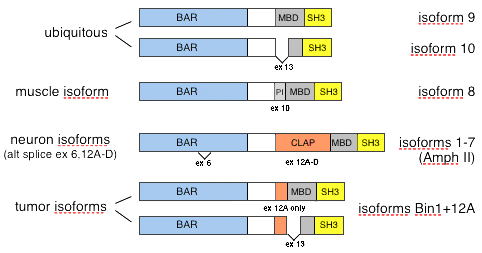
Description
Expression
Localisation
Function
Membrane binding and tubulation: The Bin1 BAR domain can mediate binding and tubulation of curved membranes (Lee et al., 2002; Wu et al., 2014). Crystal structures of the BAR domains from human BIN1 and its fruit fly homolog reveal a dimeric banana-shaped 6-alpha-helix bundle that can nestle against the charged head groups on a curved lipid bilayer. Structural studies implicate specific alpha-helices in tubulation activity. Biochemical analyses implicate Bin1 in vesicle fission and fusion processes, with the SH3 domain providing an essential contribution to these processes through the recruitment of dynamins (Ren et al., 2006).
Vesicle trafficking: Bin1 is implicated in endocytosis and intracellular endosome traffic through interactions with Rab5 guanine nucleotide exchange factors (Rab GEFs) and the sorting nexin protein Snx4. Complexes of neuronal Amph-I with neuron-specific isoforms of Bin1 (Amph-II) have been implicated in synaptic vesicle recycling in the brain. Genetic studies of the Bin1 homolog in budding yeast indicate an essential role in endocytosis, however, this role appears to be non-essential for homologs in fission yeast, fruit flies, and mice (Leprince et al., 2003).
Cell polarity: Genetic analyses of the Bin1 homologs in yeast and fruit flies suggest a integrative function in cell polarity, possibly mediated by effects on actin organization and vesicle trafficking. In budding yeast, the Bin1 homolog RVS167 lies at a central nodal point for integrating cell polarity signaling (Balguerie et al., 1999). Genetic ablation of the Bin1 homolog in fruit flies causes mislocalization of the cell polarity complex Dlg/Scr/Lgl, normally localized to the tight junction, that is implicated in epithelial polarity and suppression of tumor-like growths in flies (Humbert et al., 2003).
Transcription: Ubiquitous and muscle-specific isoforms of Bin1 that can localize to the nucleus can bind to c-Myc and suppress its transcriptional transactivation activity (Elliott et al., 1999). Tethering the BAR domain of Bin1 to DNA is sufficient to repress transcription. Genetic studies in fission yeast demonstrate that the functional homolog hob1+ is essential to silence transcription of heterochromatin at telomeric and centromeric chromosomal loci by supporting a Rad6-Set1 pathway of transcriptional repression (Ramalingam and Prendergast, 2007).
Muscle function: Mutations of the human BIN1 gene are associated with centronuclear myopathy, a disorder marked by severe muscle weakness (Nicot et al., 2007; Wu et al., 2014). In skeletal muscle, Bin1 localizes to T tubules where it appears to support ion flux (Lee et al., 2002; Butler et al., 1997). In vitro studies of terminal muscle differentiation implicate Bin1 in myoblast cell cycle arrest and fusion during tubule formation (Wechsler-Reya et al., 1998).
Cardiac function: Mouse genetic studies indicate that Bin1 is required for cardiac development (Hong et al., 2010). Bin1 levels decreases in failing hearts and low level of plasma Bin1 correlates with heart failure and predicts arrhythmia in patients with arrhythmogenic right ventricular cardiomyopathy (Hong et al., 2012).
Cognition and Memory: Bin1 is one of the candidate genes involved in Alzheimers disease. Bin1 is the most important risk locus for late onset Alzheimers disease. Bin1 affects AD risk primarily by modulating tau pathology (Tan et al., 2013; Kingwell, 2013; Chapius et al., 2013).
Immunomodulation and Barrier Function: Bin1 is a genetic modifier of experimental colitis that controls the paracellular pathway of transcellular ion transport regulated by cellular tight junctions (Chang et al., 2012).
Apoptosis and Senescence: Bin1 is crucial for the function of default pathways of classical apoptosis or senescence triggered by the Myc or Raf oncogenes in primary cells (Prendergast et al., 2009). In human tumor cells, enforced expression of Bin1 triggers a non-classical program of cell death that is caspase independent and associated with activation of serine proteases (Elliott et al., 2000).
Tumor suppression: Attenuation of Bin1 function by silencing or missplicing is a frequent event in multiple human cancers including breast, prostate, skin, lung, and colon cancers (Sakamuro et al., 1996; Ge et al., 2000b). In breast cancer, attenuated expression of Bin1 is associated with increased metastasis and poor clinical outcome (Chang et al., 2007b). In human tumor cells, ectopic expression of ubiquitous or muscle Bin1 isoforms causes growth arrest or caspase-independent cell death (Prendergast et al., 2009). A Bin1 missplicing event that occurs frequently in human cancers is sufficient to extinguish these activities. In primary rodent cells, Bin1 inhibits oncogenic co-transformation by Myc, adenovirus E1A, or mutant p53 but not SV40 T antigen (Elliott et al., 1999; Elliott et al., 2000). Mouse genetic studies establish that loss of Bin1 causes lung and liver cancers during aging (Chang et al., 2007a). In mice where breast or colon tumors are initiated by carcinogen treatment, Bin1 deletion causes progression to more aggressive malignant states (Chang et al., 2007b). Oncogenically transformed cells lacking Bin1 exhibit reduced susceptibility to apoptosis and increased proliferation, invasion, immune escape, and tumor formation (Muller et al., 2004, Muller et al., 2005). Activation of metalloproteinase MMP9 and immunosuppressive enzyme indoleamine 2,3-dioxygenase (IDO) have been implicated respectively in invasion and immune escape caused by Bin1 loss (Chang et al., 2007b). Cisplatin is the most important and efficacious chemotherapeutic agent for the treatment of advanced gastric cancer. The oncoprotein c-Myc suppresses bridging integrator 1 (BIN1), thereby releasing poly(ADP-ribose)polymerase 1, which results in increased DNA repair activity and allows cancer cells to acquire cisplatin resistance (Tanida et al., 2012).
Null phenotype in mouse: Bin1 knockout mice are perinatal lethal owing to myocardial hypertrophy where myofibrils of ventricular cardiomyocytes are severely disorganized (Muller et al., 2003). Genetic mosaic mice display increased susceptibility to inflammation, premalignant lesions in prostate and pancreas, and formation of liver and lung carcinoma. Female mosaic mice exhibit increased fecundity during aging. Tissue-specific gene ablation in skin or breast facilitates carcinogenesis (Chang et al., 2007a).
Homology
Mutations
Note
Germinal
Somatic
Implicated in
Article Bibliography
| Pubmed ID | Last Year | Title | Authors |
|---|---|---|---|
| 10393809 | 1999 | Rvs167p, the budding yeast homolog of amphiphysin, colocalizes with actin patches. | Balguerie A et al |
| 9182667 | 1997 | Amphiphysin II (SH3P9; BIN1), a member of the amphiphysin/Rvs family, is concentrated in the cortical cytomatrix of axon initial segments and nodes of ranvier in brain and around T tubules in skeletal muscle. | Butler MH et al |
| 22526583 | 2012 | Bin1 attenuation suppresses experimental colitis by enforcing intestinal barrier function. | Chang MY et al |
| 23399914 | 2013 | Increased expression of BIN1 mediates Alzheimer genetic risk by modulating tau pathology. | Chapuis J et al |
| 12532338 | 2003 | Immunohistochemical analysis of Bin1/Amphiphysin II in human tissues: diverse sites of nuclear expression and losses in prostate cancer. | DuHadaway JB et al |
| 11032017 | 2000 | The c-Myc-interacting adaptor protein Bin1 activates a caspase-independent cell death program. | Elliott K et al |
| 10380878 | 1999 | Bin1 functionally interacts with Myc and inhibits cell proliferation via multiple mechanisms. | Elliott K et al |
| 10449755 | 1999 | Mechanism for elimination of a tumor suppressor: aberrant splicing of a brain-specific exon causes loss of function of Bin1 in melanoma. | Ge K et al |
| 10652430 | 2000 | Losses of the tumor suppressor BIN1 in breast carcinoma are frequent and reflect deficits in programmed cell death capacity. | Ge K et al |
| 10738240 | 2000 | Loss of heterozygosity and tumor suppressor activity of Bin1 in prostate carcinoma. | Ge K et al |
| 11107117 | 2000 | BIN1 inhibits colony formation and induces apoptosis in neuroblastoma cell lines with MYCN amplification. | Hogarty MD et al |
| 22300662 | 2012 | Plasma BIN1 correlates with heart failure and predicts arrhythmia in patients with arrhythmogenic right ventricular cardiomyopathy. | Hong TT et al |
| 20169111 | 2010 | BIN1 localizes the L-type calcium channel to cardiac T-tubules. | Hong TT et al |
| 12766944 | 2003 | Dlg, Scribble and Lgl in cell polarity, cell proliferation and cancer. | Humbert P et al |
| 10486326 | 1999 | Investigation of a family with autosomal dominant dilated cardiomyopathy defines a novel locus on chromosome 2q14-q22. | Jung M et al |
| 23458971 | 2013 | Alzheimer disease: BIN1 variant increases risk of Alzheimer disease through tau. | Kingwell K et al |
| 17477881 | 2007 | Methylation of the BIN1 gene promoter CpG island associated with breast and prostate cancer. | Kuznetsova EB et al |
| 12183633 | 2002 | Amphiphysin 2 (Bin1) and T-tubule biogenesis in muscle. | Lee E et al |
| 12668730 | 2003 | Sorting nexin 4 and amphiphysin 2, a new partnership between endocytosis and intracellular trafficking. | Leprince C et al |
| 21678469 | 2011 | Identification of a novel effector domain of BIN1 for cancer suppression. | Lundgaard GL et al |
| 12773571 | 2003 | Targeted disruption of the murine Bin1/Amphiphysin II gene does not disable endocytosis but results in embryonic cardiomyopathy with aberrant myofibril formation. | Muller AJ et al |
| 15711557 | 2005 | Inhibition of indoleamine 2,3-dioxygenase, an immunoregulatory target of the cancer suppression gene Bin1, potentiates cancer chemotherapy. | Muller AJ et al |
| 17676042 | 2007 | Mutations in amphiphysin 2 (BIN1) disrupt interaction with dynamin 2 and cause autosomal recessive centronuclear myopathy. | Nicot AS et al |
| 18930786 | 2009 | BAR the door: cancer suppression by amphiphysin-like genes. | Prendergast GC et al |
| 17611416 | 2007 | Bin1 homolog hob1 supports a Rad6-Set1 pathway of transcriptional repression in fission yeast. | Ramalingam A et al |
| 16524918 | 2006 | The BAR domain proteins: molding membranes in fission, fusion, and phagy. | Ren G et al |
| 12569356 | 2003 | hob1+, the fission yeast homolog of Bin1, is dispensable for endocytosis or actin organization, but required for the response to starvation or genotoxic stress. | Routhier EL et al |
| 8782822 | 1996 | BIN1 is a novel MYC-interacting protein with features of a tumour suppressor. | Sakamuro D et al |
| 24549043 | 2014 | Bridging integrator 1 (Bin1) deficiency in zebrafish results in centronuclear myopathy. | Smith LL et al |
| 23871436 | 2013 | Bridging integrator 1 (BIN1): form, function, and Alzheimer's disease. | Tan MS et al |
| 22778941 | 2012 | Mechanisms of Cisplatin-Induced Apoptosis and of Cisplatin Sensitivity: Potential of BIN1 to Act as a Potent Predictor of Cisplatin Sensitivity in Gastric Cancer Treatment. | Tanida S et al |
| 9418903 | 1998 | A role for the putative tumor suppressor Bin1 in muscle cell differentiation. | Wechsler-Reya RJ et al |
| 24755653 | 2014 | Mutations in BIN1 associated with centronuclear myopathy disrupt membrane remodeling by affecting protein density and oligomerization. | Wu T et al |
Other Information
Locus ID:
NCBI: 274
MIM: 601248
HGNC: 1052
Ensembl: ENSG00000136717
Variants:
dbSNP: 274
ClinVar: 274
TCGA: ENSG00000136717
COSMIC: BIN1
RNA/Proteins
Expression (GTEx)
Pathways
Protein levels (Protein atlas)
References
| Pubmed ID | Year | Title | Citations |
|---|---|---|---|
| 38460121 | 2024 | BIN1(K358R) suppresses glial response to plaques in mouse model of Alzheimer's disease. | 1 |
| 38724689 | 2024 | BIN1 regulates actin-membrane interactions during IRSp53-dependent filopodia formation. | 0 |
| 38460121 | 2024 | BIN1(K358R) suppresses glial response to plaques in mouse model of Alzheimer's disease. | 1 |
| 38724689 | 2024 | BIN1 regulates actin-membrane interactions during IRSp53-dependent filopodia formation. | 0 |
| 37139790 | 2023 | BIN1, Myotubularin, and Dynamin-2 Coordinate T-Tubule Growth in Cardiomyocytes. | 3 |
| 37247278 | 2023 | High Indoleamine 2,3-Dioxygenase Expression along with Low Bridging Integrator-1 Expression in Hepatocellular Carcinoma Patients. | 0 |
| 37700353 | 2023 | APOE-ε4 and BIN1 increase risk of Alzheimer's disease pathology but not specifically of Lewy body pathology. | 2 |
| 37847429 | 2023 | BIN1 in the Pursuit of Ousting the Alzheimer's Reign: Impact on Amyloid and Tau Neuropathology. | 1 |
| 37139790 | 2023 | BIN1, Myotubularin, and Dynamin-2 Coordinate T-Tubule Growth in Cardiomyocytes. | 3 |
| 37247278 | 2023 | High Indoleamine 2,3-Dioxygenase Expression along with Low Bridging Integrator-1 Expression in Hepatocellular Carcinoma Patients. | 0 |
| 37700353 | 2023 | APOE-ε4 and BIN1 increase risk of Alzheimer's disease pathology but not specifically of Lewy body pathology. | 2 |
| 37847429 | 2023 | BIN1 in the Pursuit of Ousting the Alzheimer's Reign: Impact on Amyloid and Tau Neuropathology. | 1 |
| 34060233 | 2022 | The BIN1 rs744373 Alzheimer's disease risk SNP is associated with faster Aβ-associated tau accumulation and cognitive decline. | 21 |
| 34982487 | 2022 | Enrichment of rare variants of BIN1 but not APOE genes in Chinese patients with Parkinson's disease. | 0 |
| 35217605 | 2022 | BIN1 modulation in vivo rescues dynamin-related myopathy. | 0 |
Citation
Sunil Thomas ; Mee Young Chang ; George C Prendergast
BIN1 (Bridging Integrator 1)
Atlas Genet Cytogenet Oncol Haematol. 2014-05-01
Online version: http://atlasgeneticsoncology.org/gene/794/bin1
Historical Card
2008-09-01 BIN1 (Bridging Integrator 1) by Mee Young Chang,George C Prendergast Affiliation
