CDK20 (cell cycle related kinase)
2009-07-01 Marie Lin , William Cheung AffiliationDepartment of Chemistry, Open Laboratory of Chemical Biology, The University of Hong Kong, Pokfulam, Hong Kong, China.
Identity
HGNC
LOCATION
9q22.1
LOCUSID
ALIAS
CCRK,CDCH,P42,PNQALRE
FUSION GENES
DNA/RNA
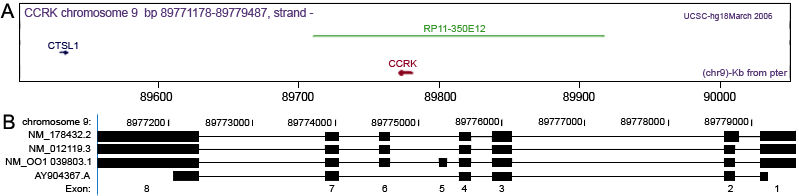
(A) Chromosomal location of human CCRK gene. (B) Genomic organization of four CCRK transcript variants.
Description
Human CCRK gene spans around 8.3kb of genomic DNA on the chromosome 9q22.2 in telomere-to-centromere orientation. This gene locates within the locus tag RP11-350E12.2. A block of hypermethylated CpGs has been identified in the CCRK promoter and is associated with its high expression in adult human brain cortex (Farcas et al., 2009).
Transcription
Four alternative spliced transcript variants of CCRK gene are known. The generic variant 3 (GenBank#: NM_001039803) consists of 8 exons, with the start codon on exon 1 and stop codon on exon 8. Both transcript variant 1 (GenBank#: NM_178432) and variant 2 (GenBank#: NM_012119) have had their exon 5 deleted. Variant 1 also differs from the other variants by an additional 39nt on exon 2. The cardiac splice variant (GenBank#: AY904367) lacks both the exons 5 and 6, and has truncated 5- and 3-untranslated regions.
Pseudogene
No pseudogenes for CCRK are known.
Proteins
Note
There has been controversy over whether CCRK functions as a second cyclin-dependent kinase (CDK)-activating kinase (CAK) (i.e., in addition to CDK7). Inconsistent with other studies, Wohlbold and colleagues (2006) reported that monomeric CCRK has no intrinsic CAK activity.
Description
The open reading frame encodes a 346-amino acid protein, with molecular weight of 42kDa. CCRK protein has a protein kinase domain extending from residues 4-288, in which typical ATP-binding region and serine/threonine kinase active site can be identified. Its interacting proteins include CDK2, cyclin H and casein kinase 2.
Expression
In human tissues, the 2.2kb CCRK transcript is expressed predominantly in the brain and kidney, and to lesser extent in the liver, heart and placenta. The cardiac CCRK isoform is detectable only in heart, liver and kidney. CCRK is also widely expressed in cell lines originating from glioblastoma (U87, U118, U138, U373 and SW1088), cervical adenocarcinoma (HeLa), colorectal carcinoma (HCT116), osteogenic sarcoma (U2OS), breast adenocarcinoma (MCF-7), ovarian carcinoma (UACC-1598, UACC-326, OVCAR-3, HO-8910 and TOV-21G), lung fibroblast (WI-38), myoblast (C2C12), and lymphocyte (GM08336).
Localisation
Mainly in nucleus and perinuclear region. Relative low expression in cytoplasm.
Function
CCRK is an important regulator of G1- to S-phase transition in cell cycle and is indispensable for cell growth. It possesses CDK-activating kinase activity that is essential for the phosphorylation of CDK2 at Thr160 (Liu et al., 2004) and male germ cell-associated kinase-related kinase (MRK) at Thr157 in mammalian cells (Fu et al., 2006). CCRK also acts as a negative regulator of apoptosis and may confer cells with drug resistance (MacKeigan et al., 2005). Moreover, CCRK splice variant expressing in the heart has been shown to promote cardiac cell growth and survival (Qiu et al., 2008).
Homology
CCRK belongs to the CDK family. Among the other 10 CDK members, human CCRK shares the highest sequence identity (43%) with a well known CAK, CDK7. Orthologs of CCRK are found in orangutans, Old World monkeys, bovine, dog, boar, mouse, rat, fishes, frog, budding yeast and fission yeast.
Implicated in
Entity name
Colorectal carcinoma
Note
Knockdown of CCRK inhibits HCT116 cell proliferation (Wohlbold et al., 2006). A small molecule kinase inhibitor (RGB-286147) that targets CCRK has been shown to promote HCT116 cell death in the absence of cell cycle progression (Caligiuri et al., 2005).
Entity name
Glioblastoma multiforme
Note
In 14 of 19 (74%) human high-grade glioblastoma multiforme patient samples, CCRK mRNA expression levels are more than 1.5-fold higher than those of 3 normal brain tissue samples. By contrast, only 2 of 7 (29%) low-grade glioma samples have elevated CCRK expression. Knockdown of CCRK suppresses glioma tumor growth in mouse xenograft model. CCRK knockdown also inhibits glioblastoma cell proliferation via G1/S-phase arrest and reduction of CDK2 phosphorylation in vitro. Overexpression of CCRK induces malignant transformation of non-tumorigenic glioblastoma cells (U138) both in vitro and in vivo (Ng et al., 2007).
Entity name
Ovarian carcinoma
Note
By CCRK immunohistochemical staining of CCRK in ovarian tissue microarray, CCRK is overexpressed in 65/122 (53%) invasive ovarian carcinoma patient samples, as compared with 22 normal ovarian surface epithelium samples. In 12 pairs of primary ovarian carcinoma and adjacent normal tissue specimens, CCRK expression is elevated in 6 (67%) ovarian carcinoma samples. Ectopic expression of CCRK promotes tumor growth in vivo and ovarian carcinoma cell proliferation in vitro via upregulation of cyclin D1 (Wu et al., 2009).
Prognosis
CCRK expression is positively correlated with ascending histological grade and advanced clinicopathologic features. It is also an independent biomarker for shortened survival time of patients with ovarian carcinoma.
Article Bibliography
| Pubmed ID | Last Year | Title | Authors |
|---|---|---|---|
| 16242653 | 2005 | A proteome-wide CDK/CRK-specific kinase inhibitor promotes tumor cell death in the absence of cell cycle progression. | Caligiuri M et al |
| 19282513 | 2009 | Differences in DNA methylation patterns and expression of the CCRK gene in human and nonhuman primate cortices. | Farcas R et al |
| 16954377 | 2006 | Identification of yin-yang regulators and a phosphorylation consensus for male germ cell-associated kinase (MAK)-related kinase. | Fu Z et al |
| 14597612 | 2004 | p42, a novel cyclin-dependent kinase-activating kinase in mammalian cells. | Liu Y et al |
| 15864305 | 2005 | Sensitized RNAi screen of human kinases and phosphatases identifies new regulators of apoptosis and chemoresistance. | MacKeigan JP et al |
| 17565152 | 2007 | Cell cycle-related kinase: a novel candidate oncogene in human glioblastoma. | Ng SS et al |
| 18508765 | 2008 | Characterization of a novel cardiac isoform of the cell cycle-related kinase that is regulated during heart failure. | Qiu H et al |
| 16552187 | 2006 | The cyclin-dependent kinase (CDK) family member PNQALRE/CCRK supports cell proliferation but has no intrinsic CDK-activating kinase (CAK) activity. | Wohlbold L et al |
| 19672860 | 2009 | Cell cycle-related kinase supports ovarian carcinoma cell proliferation via regulation of cyclin D1 and is a predictor of outcome in patients with ovarian carcinoma. | Wu GQ et al |
Other Information
Locus ID:
NCBI: 23552
MIM: 610076
HGNC: 21420
Ensembl: ENSG00000156345
Variants:
dbSNP: 23552
ClinVar: 23552
TCGA: ENSG00000156345
COSMIC: CDK20
RNA/Proteins
Expression (GTEx)
Protein levels (Protein atlas)
References
| Pubmed ID | Year | Title | Citations |
|---|---|---|---|
| 37469151 | 2023 | The Role of CDK20 Protein in Carcinogenesis. | 1 |
| 37469151 | 2023 | The Role of CDK20 Protein in Carcinogenesis. | 1 |
| 35609210 | 2022 | BROMI/TBC1D32 together with CCRK/CDK20 and FAM149B1/JBTS36 contributes to intraflagellar transport turnaround involving ICK/CILK1. | 9 |
| 35609210 | 2022 | BROMI/TBC1D32 together with CCRK/CDK20 and FAM149B1/JBTS36 contributes to intraflagellar transport turnaround involving ICK/CILK1. | 9 |
| 28939663 | 2018 | Hepatoma-intrinsic CCRK inhibition diminishes myeloid-derived suppressor cell immunosuppression and enhances immune-checkpoint blockade efficacy. | 97 |
| 28939663 | 2018 | Hepatoma-intrinsic CCRK inhibition diminishes myeloid-derived suppressor cell immunosuppression and enhances immune-checkpoint blockade efficacy. | 97 |
| 25500144 | 2015 | A CCRK-EZH2 epigenetic circuitry drives hepatocarcinogenesis and associates with tumor recurrence and poor survival of patients. | 41 |
| 25500144 | 2015 | A CCRK-EZH2 epigenetic circuitry drives hepatocarcinogenesis and associates with tumor recurrence and poor survival of patients. | 41 |
| 23743448 | 2013 | CCRK depletion inhibits glioblastoma cell proliferation in a cilium-dependent manner. | 57 |
| 23743448 | 2013 | CCRK depletion inhibits glioblastoma cell proliferation in a cilium-dependent manner. | 57 |
| 22875024 | 2012 | Functional genomics identifies drivers of medulloblastoma dissemination. | 24 |
| 22875024 | 2012 | Functional genomics identifies drivers of medulloblastoma dissemination. | 24 |
| 21747169 | 2011 | Cell cycle-related kinase is a direct androgen receptor-regulated gene that drives β-catenin/T cell factor-dependent hepatocarcinogenesis. | 61 |
| 21747169 | 2011 | Cell cycle-related kinase is a direct androgen receptor-regulated gene that drives β-catenin/T cell factor-dependent hepatocarcinogenesis. | 61 |
| 20466538 | 2010 | Functional characterisation of cell cycle-related kinase (CCRK) in colorectal cancer carcinogenesis. | 13 |
Citation
Marie Lin ; William Cheung
CDK20 (cell cycle related kinase)
Atlas Genet Cytogenet Oncol Haematol. 2009-07-01
Online version: http://atlasgeneticsoncology.org/gene/43196/cdk20
