CDH17 (cadherin 17, LI cadherin (liver-intestine))
2012-06-01 Yiping Rong , Nikki P Lee , John M Luk AffiliationpRED China Oncology, Roche R&D Center (China) Ltd, Shanghai, China (YR, JML); Department of Surgery, The University of Hong Kong, Pokfulam, Hong Kong (NPL, JML)
Identity
HGNC
LOCATION
8q22.1
LOCUSID
ALIAS
CDH16,HPT-1,HPT1
FUSION GENES
DNA/RNA

Figure 1. Cadherin 17 (CDH17) DNA with introns and exons.
Description
Human CDH17 DNA contains 90138 bp composed of 18 exons (Gessner and Tauber, 2000; Wendeler et al., 2006).
Transcription
Two transcripts (NM_001144663.1 and NM_004063.3) encode the same protein according to Entrez gene. 2499 bp open reading frame.
Proteins
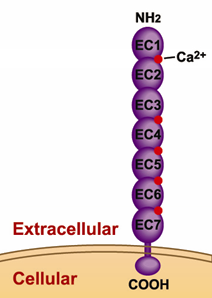
Figure 2. A schematic diagram illustrates the structural feature of cadherin-17 (CDH17) in having seven cadherin repeats (EC1-EC7) at the extracellular amino-terminus (NH2), followed by a transmembrane region and a short cytoplasmic domain at the carboxyl-terminus (COOH). Calcium ions (denoted by red dots) are located between cadherin repeats in mammalian CDH17.
Description
Cadherins are calcium-dependent cell-cell adhesion molecules which play important roles in organ development, the maintenance of tissue integrity and cancer development (Pokutta and Weis, 2007; Berx and van Roy, 2009). Cadherin 17 (CDH17) is a transmembrane glycoprotein with seven extracellular cadherin repeats. The cytoplasmic domain of human CDH17 only has 23 amino acids, whereas other classical cadherins contain 150 to 160 conserved amino acids forming complexes with catenins (Gessner and Tauber, 2000; Lee et al., 2010). CDH17 belongs to seven-domain (7D) cadherin subfamily which shares low sequence homology with the classical cadherins, such as E-cadherin. The structure difference of CDH17 makes this molecule unique among the known classical cadherin family members (Nollet et al., 2000; Angst et al., 2001). Recent work suggests its role in tumor progression and cancer prognosis (Liu et al., 2009).
Expression
In rats, CDH17 is expressed in the liver and small intestine (Berndorff et al., 1994). In mouse and human, CDH17 is highly expressed in the small intestine and colon (Angres et al., 2001; Takamura et al., 2004), but absent or very low level in other organs, such as liver, heart and kidney etc. It is also linked predominantly to a high incidence of tumorigenesis in the human liver, stomach, intestine and pancreas by displaying an aberrant expression in their cancerous state (Lee et al., 2010).
Localisation
CDH17 is mainly localized on basolateral cell membrane. Overexpressed CDH17 can also be detected throughout the cytoplasm of liver cancer, gastric cancer and colon cells (Wong et al., 2003; Grötzinger et al., 2001; Takamura et al., 2004).
Function
CDH17 was originally cloned from rat liver and identified as a novel cell adhesion molecule (Berndorff et al., 1994). Homotypic trans-interaction of CDH17 is dependent on extracellular calcium concentration. It might serve as a calcium-regulated adhesion switch (Wendeler et al., 2007). CDH17 is also reported as an intestinal peptide transporter. It facilitates the oral absorption of beta-lactam antibiotics and angiotensin-converting enzyme inhibitors from the intestine into enterocytes lining the luminal wall (Dantzig et al., 1994). Knockout CDH17 by a mutant CDH17 deficient mouse showed that CDH17 may also participate in B lymphocyte development (Ohnishi et al., 2005). Recent studies suggested CDH17 important roles in tumorigenesis. Overexpression CDH17 can promote tumor growth, while suppression of CDH17 inhibits cancer cell growth, migration and adhesion (Liu et al., 2009).
Homology
Human CDH17 shares ~20-30% sequence identity with other cadherin family members, such as cadherin-16 (30%), cadherin-13 (30%), and cadherin-1 (26%). It also shares ~79% identify with cyno-, mouse-, rat-cadherin-17.
Mutations
Note
No mutation has been reported for CDH17 so far.
Somatic
Alternative mRNA splicing isoform of CDH17 was reported in hepatocellular carcinoma patient samples. The isoform skips exon 7 which leads to open reading frame shift. The mRNA isoform is associated with shorter overall survival time. The functions or mechanisms of the isoform in cancer are unclear (Wang et al., 2005).
Implicated in
Entity name
Hepatocellular carcinoma (HCC)
Prognosis
CDH17 overexpression is detected in approximately ~80% of HCC patients (Liu et al., 2009). The elevated level of CDH17 in HCC is correlated to high serum AFP level, microvascular invasion, and advanced stage tumor, associating with shorter overall survival as well as higher incidence of tumor recurrence, of HCC patients. Over half of HCC patients have genomic amplification of CDH17 gene in their tumors. Alternative mRNA splicing of CDH17 was also reported in half of the HCC patient tumor specimens and associated with shorter overall survival time (Ding et al., 2009; Wong et al., 2003; Wang et al., 2006; Kaposi-Novak et al., 2006). The CDH17 overexpression can also be detected in other tumorigenic conditions including gastric cancer (GC). Therefore, CDH17 expression can be a potential biomarker for HCC and GC.
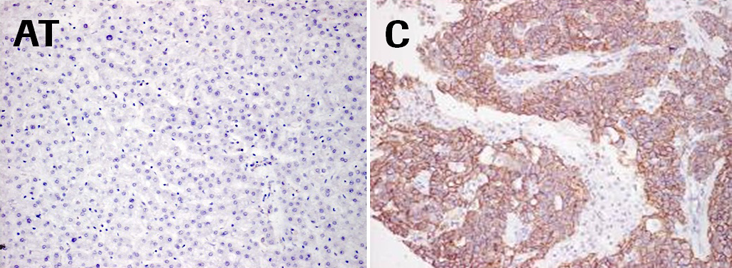
Figure 3. CDH17 expression in hepatocellular carcinoma (C) but not in adjacent non-tumor tissues (AT).
Oncogenesis
Overexpression of CDH17 can transform premalignant liver progenitor cells to liver carcinomas in mice. RNAi-mediated knockdown of CDH17 inhibited proliferation of both primary and metastatic HCC cell lines in vitro and in vivo. The HCC cell migration, invasion, colony formation and adhesion were also inhibited by CDH17 knockdown. CDH17 shRNA resulted in relocalization of β-catenin to the cytoplasm with the reduction of cyclin D1, and increased caspase 3, Bax and Bcl-xL levels. Therefore, CDH17 is a potential oncogene in HCC by regulating cell cycle and apoptosis via Wnt pathway (Liu et al., 2009).
Entity name
Gastric cancer
Prognosis
CDH17 expression level in normal human stomach epithelium cells is very low, whereas it is overexpressed in ~60-80% of gastric cancer cells (Grötzinger et al., 2001; Ko et al., 2004). CDH17 level is correlated with advanced stages of gastric cancer, and associated with a poor prognosis and lymph node metastasis. By serial analysis of gene expression (SAGE), CDH17 was found associating with an intestinal type of gastric cancer (Yasui et al., 2009). It was reported as a negative prognostic factor of pN0 gastric cancer and a new biomarker for early detection of gastric intestinal metaplasia (Wang et al., 2012; Grötzinger et al., 2001).
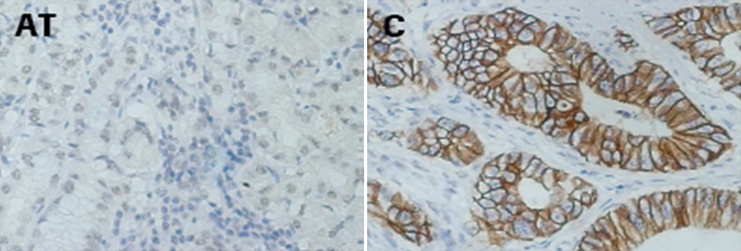
Figure 4. CDH17 expression in gastric cancer (C) but not in adjacent non-tumor tissues (AT).
Oncogenesis
CDH17 knockdown by siRNA, shRNA or miRNA in gastric cancer cell lines can inhibit the cell proliferation, migration, invasion and adhesion in vitro, as well as tumor growth in xenograft models (Zhang et al., 2011; Liu et al., 2010). Overexpression of CDH17 in gastric cancer cell line MGC-803 cells promotes tumor growth in xenograft mouse model (unpublished data).
Entity name
Pancreatic cancer
Prognosis
Unlike the normal liver and gastric tissues, CDH17 is found focally expressed in normal pancreatic ducts. In carcinoma, well-differentiated carcinoma cases expressed high level LI-cadherin, whereas less differentiated areas and poorly differentiated carcinoma cases expressed less or were negative. The high CDH17 expression correlated with good survival in pancreatic ductal adenocarcinoma (Takamura et al., 2003).
Entity name
Colorectal cancer
Prognosis
In normal colorectal epithelial cells, CDH17 immunoreactivity was present at the basolateral plasma membrane. In colorectal carcinoma, the expression of CDH17 is diminished in tumor tissues. It can be observed in well-differentiated adenocarcinoma cells with tight cell-cell adhesion, but expression was reduced in dedifferentiated adenocarcinoma cells. Reduced expression of CDH17 in colorectal cancer tissues correlated with dedifferentiation of tumors and poor survival of patients (Takamura et al., 2004; Kwak et al., 2007; Su et al., 2008). The expression patterns of CDH17 in different cancer types suggest its cell-context dependent roles in organs.
Article Bibliography
| Pubmed ID | Last Year | Title | Authors |
|---|---|---|---|
| 11376485 | 2001 | LI-cadherin gene expression during mouse intestinal development. | Angres B et al |
| 11171368 | 2001 | The cadherin superfamily: diversity in form and function. | Angst BD et al |
| 8207063 | 1994 | Liver-intestine cadherin: molecular cloning and characterization of a novel Ca(2+)-dependent cell adhesion molecule expressed in liver and intestine. | Berndorff D et al |
| 20457567 | 2009 | Involvement of members of the cadherin superfamily in cancer. | Berx G et al |
| 8153632 | 1994 | Association of intestinal peptide transport with a protein related to the cadherin superfamily. | Dantzig AH et al |
| 19626651 | 2009 | Liver-intestine cadherin predicts microvascular invasion and poor prognosis of hepatitis B virus-positive hepatocellular carcinoma. | Ding ZB et al |
| 11193569 | 2000 | Intestinal cell adhesion molecules. Liver-intestine cadherin. | Gessner R et al |
| 11413113 | 2001 | LI-cadherin: a marker of gastric metaplasia and neoplasia. | Grötzinger C et al |
| 16710476 | 2006 | Met-regulated expression signature defines a subset of human hepatocellular carcinomas with poor prognosis and aggressive phenotype. | Kaposi-Novak P et al |
| 15178443 | 2004 | Overexpression of LI-cadherin in gastric cancer is associated with lymph node metastasis. | Ko S et al |
| 17828401 | 2007 | The prognostic significance of E-cadherin and liver intestine-cadherin expression in colorectal cancer. | Kwak JM et al |
| 20580775 | 2010 | Role of cadherin-17 in oncogenesis and potential therapeutic implications in hepatocellular carcinoma. | Lee NP et al |
| 19676131 | 2009 | Targeting cadherin-17 inactivates Wnt signaling and inhibits tumor growth in liver carcinoma. | Liu LX et al |
| 20500517 | 2010 | Lentiviral-mediated miRNA against liver-intestine cadherin suppresses tumor growth and invasiveness of human gastric cancer. | Liu QS et al |
| 10835267 | 2000 | Phylogenetic analysis of the cadherin superfamily allows identification of six major subfamilies besides several solitary members. | Nollet F et al |
| 15688343 | 2005 | Lymphocyte-expressed BILL-cadherin/cadherin-17 contributes to the development of B cells at two stages. | Ohnishi K et al |
| 17539752 | 2007 | Structure and mechanism of cadherins and catenins in cell-cell contacts. | Pokutta S et al |
| 18552820 | 2008 | Cadherin-17 is a useful diagnostic marker for adenocarcinomas of the digestive system. | Su MC et al |
| 15279905 | 2004 | Reduced expression of liver-intestine cadherin is associated with progression and lymph node metastasis of human colorectal carcinoma. | Takamura M et al |
| 22009269 | 2012 | The predictive effect of cadherin-17 on lymph node micrometastasis in pN0 gastric cancer. | Wang J et al |
| 16951245 | 2006 | Liver intestine-cadherin (CDH17) haplotype is associated with increased risk of hepatocellular carcinoma. | Wang XQ et al |
| 17512947 | 2007 | Intestinal LI-cadherin acts as a Ca2+-dependent adhesion switch. | Wendeler MW et al |
| 14623315 | 2003 | Identification of liver-intestine cadherin in hepatocellular carcinoma--a potential disease marker. | Wong BW et al |
| 19261089 | 2009 | Transcriptome dissection of gastric cancer: identification of novel diagnostic and therapeutic targets from pathology specimens. | Yasui W et al |
| 20393816 | 2011 | Blockade of proliferation and migration of gastric cancer via targeting CDH17 with an artificial microRNA. | Zhang J et al |
Other Information
Locus ID:
NCBI: 1015
MIM: 603017
HGNC: 1756
Ensembl: ENSG00000079112
Variants:
dbSNP: 1015
ClinVar: 1015
TCGA: ENSG00000079112
COSMIC: CDH17
RNA/Proteins
Expression (GTEx)
Pathways
Protein levels (Protein atlas)
References
| Pubmed ID | Year | Title | Citations |
|---|---|---|---|
| 38452580 | 2024 | Cadherin-17 (CDH17) expression in human cancer: A tissue microarray study on 18,131 tumors. | 0 |
| 38452580 | 2024 | Cadherin-17 (CDH17) expression in human cancer: A tissue microarray study on 18,131 tumors. | 0 |
| 37081068 | 2023 | Molecular mechanism underlying the increased risk of colorectal cancer metastasis caused by single nucleotide polymorphisms in LI-cadherin gene. | 0 |
| 37081068 | 2023 | Molecular mechanism underlying the increased risk of colorectal cancer metastasis caused by single nucleotide polymorphisms in LI-cadherin gene. | 0 |
| 35140817 | 2022 | The Relationship between Cadherin Polymorphisms and the Risk of Delayed Encephalopathy after Acute Carbon Monoxide Poisoning in the Chinese Han Population. | 0 |
| 35140817 | 2022 | The Relationship between Cadherin Polymorphisms and the Risk of Delayed Encephalopathy after Acute Carbon Monoxide Poisoning in the Chinese Han Population. | 0 |
| 33524213 | 2021 | Clinical correlation of cadherin-17 marker with advanced tumor stages and poor prognosis of cholangiocarcinoma. | 4 |
| 33958523 | 2021 | CDH17+/CDX2+ Can be Helpful in Providing Support for Small Intestinal Origin Versus Pancreatic or Biliary Origin. | 0 |
| 34364873 | 2021 | Mechanism of dimerization and structural features of human LI-cadherin. | 2 |
| 33524213 | 2021 | Clinical correlation of cadherin-17 marker with advanced tumor stages and poor prognosis of cholangiocarcinoma. | 4 |
| 33958523 | 2021 | CDH17+/CDX2+ Can be Helpful in Providing Support for Small Intestinal Origin Versus Pancreatic or Biliary Origin. | 0 |
| 34364873 | 2021 | Mechanism of dimerization and structural features of human LI-cadherin. | 2 |
| 31932920 | 2020 | Immunophenotype analysis using CLDN18, CDH17, and PAX8 for the subcategorization of endocervical adenocarcinomas in situ: gastric-type, intestinal-type, gastrointestinal-type, and Müllerian-type. | 4 |
| 32215766 | 2020 | A panel of intestinal differentiation markers (CDX2, GPA33, and LI-cadherin) identifies gastric cancer patients with favourable prognosis. | 13 |
| 31932920 | 2020 | Immunophenotype analysis using CLDN18, CDH17, and PAX8 for the subcategorization of endocervical adenocarcinomas in situ: gastric-type, intestinal-type, gastrointestinal-type, and Müllerian-type. | 4 |
Citation
Yiping Rong ; Nikki P Lee ; John M Luk
CDH17 (cadherin 17, LI cadherin (liver-intestine))
Atlas Genet Cytogenet Oncol Haematol. 2012-06-01
Online version: http://atlasgeneticsoncology.org/gene/40020/cdh17
