CHFR (Checkpoint with fork-head associated and ring finger)
2014-12-01 Ayse E Erson-Bensan , Hesna Begum Akman , Elizabeth M Petty AffiliationIdentity
Abstract
Growing evidence in mice, primary human tumors, and mammalian cell culture models indicate that CHFR may function as a potent tumor suppressor. CHFR functions as part of an early G2\/M checkpoint, more specifically in antephase. Antephase refers to late G2 when chromosome condensation starts. This early mitotic checkpoint causes a delay in chromosome condensation in response to mitotic stresses. The human CHFR gene was originally identified during a search for novel cell cycle checkpoint proteins that have fork-head associated domains. Initial analysis indicated that the CHFR-associated G2\/M checkpoint was inactivated in a subset of cancers as demonstrated by high mitotic indices (a high percentage of cells that have condensed chromosomes) in response to exposure to the microtubule poison, nocodazole, due to lack of CHFR expression or CHFR mutations in various cancers. Many other studies showed promoter hypermethylation leading to low\/no expression of CHFR.
DNA/RNA
Description
Transcription
Alternative mRNA transcripts lacking specific exons (2, 5, and/or 6) have been described for CHFR (Toyota et al. 2003) The isoform that lacks exon 2 happens to lack the FHA domain and was also found to be highly expressed in cancer cells when compared to normal samples .
Pseudogene
Proteins
Description
Domains:
Expression
Localisation
Egeberg et al., 2012 suggested a centrosome/primary cilium axis localization of CHFR. CHFR was also shown to localize to the mitotic spindle by an interaction with TCTP, a protein involved in microtubule stabilization and ?-tubulin (Kim, 2011)
Function
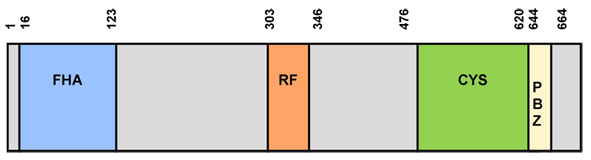
In vitro studies suggest that the RING finger domain in CHFR also facilitates ubiquitin ligase function and that it is essential for checkpoint function of CHFR (Chaturved et al., 2002).. In vitro Xenopus extract experiments suggested that CHFR specifically targets PLK1 (polo-like kinase 1) for degradation when extracts are supplemented with high ubiquitin concentrations (Kang, 2002). Thus, according to this in vitro model, CHFR is able to halt cell cycle progression early in mitosis by degrading PLK1, a major player for the activation of mitosis promoting factor. In addition, AURORA A is known to phosphorylate and activate PLK1 as well as CDC25B eventually driving CYCLIN B/CDK1 activation. Interestingly, CHFR was also found to bind via its cysteine rich C-region and ubiquitinate AURORA A, leading to its degradation (Yu et al., 2005). The auto-ubiquitylation ability of CHFR at G2 Phase was proposed to be required for the accumulation of Plk1 and mitotic entry in mammalian cells (Kim et al., 2011). Earlier, Oh et al., showed deubiquitination of Chfr, by USP7/HAUSP (deubiquitinating enzyme) also to regulate its own stability and activity (Oh et al,. 2007).
On the contrary, Summers et al. suggested PLK1 and AURORA A levels not to change when CHFR was expressed in HCT116 cells treated with Nocodazole (Summers et al., 2005).
More recently, other proteins including TOPK and PTEN have been shown to play a role in the CHFR related mitotic spindle checkpoing (Shinde et al. 2013)
Furthermore, Bothos et al., showed that CHFR was able to activate the p38 stress kinase pathway, which reverses chromosome condensation and induces a mitotic arrest and suggested that the ubiquitin ligase function of CHFR may be different than the current in vitro model and that instead of Lys48 ubiquitination, CHFR may link ubiquitin to target protein or proteins via Ly63 due to its interaction with the heteromeric ubiquitin conjugating enzyme complex, Ubc13-Mms2 (Bothos et al., 2003). In the canonical ubiquitin/proteasome pathway, Lys48 is a signal for degradation of target proteins whereas Lys63 ubiquitination functions as a non-proteolytic tag for protein targets. Lys63 ubiquitination is thought to be involved in DNA repair mechanisms. Indeed, CHFR appears to have important roles in DNA damage response (Shtivelman et al., 2003). CHFR and RNF8 (A ubiquin ligase) ubiquitinate histones (H2A and H2B) upon ioinizing radiation (Al-Hakim et al., 2010; Wu et al., 2011). These ubiquitinations seem to be important for the eventual activation of the key DNA damage checkpoint effector, ATM (Derks et al., 2006; Lavin and Kozlov, 2007). Recently, CHFR was reported to interact with MAD2, an important component of the spindle assembly checkpoint. CHFR knockdown resulted in mislocalization of MAD2 and disruption of the MAD2/CDC20 interaction. The cysteine-rich region of CHFR appears to be the essential domain for the CHFR/MAD2 interaction and for promoting interaction between MAD2 and CDC20 to inhibit the anaphase-promoting complex (Privette et al., 2008; Keller and Petty, 2011).
Homology
Mutations
Germinal
Somatic
Epigenetics
Implicated in
Article Bibliography
| Pubmed ID | Last Year | Title | Authors |
|---|---|---|---|
| 18172500 | 2008 | Poly(ADP-ribose)-binding zinc finger motifs in DNA repair/checkpoint proteins. | Ahel I et al |
| 21056014 | 2010 | The ubiquitous role of ubiquitin in the DNA damage response. | Al-Hakim A et al |
| 17786301 | 2007 | Epigenetic inactivation of the CHFR gene in cervical cancer contributes to sensitivity to taxanes. | Banno K et al |
| 14562038 | 2003 | The Chfr mitotic checkpoint protein functions with Ubc13-Mms2 to form Lys63-linked polyubiquitin chains. | Bothos J et al |
| 18504434 | 2008 | Chfr interacts and colocalizes with TCTP to the mitotic spindle. | Burgess A et al |
| 24928946 | 2014 | CHFR promoter methylation indicates poor prognosis in stage II microsatellite stable colorectal cancer. | Cleven AH et al |
| 12538348 | 2003 | Frequent hypermethylation of the 5' CpG island of the mitotic stress checkpoint gene Chfr in colorectal and non-small cell lung cancer. | Corn PG et al |
| 17167178 | 2006 | Promoter methylation precedes chromosomal alterations in colorectal cancer development. | Derks S et al |
| 23351307 | 2012 | Primary cilia and aberrant cell signaling in epithelial ovarian cancer. | Egeberg DL et al |
| 14694445 | 2004 | CHFR-associated early G2/M checkpoint defects in breast cancer cells. | Erson AE et al |
| 15146058 | 2004 | Functional characterization of Dma1 and Dma2, the budding yeast homologues of Schizosaccharomyces pombe Dma1 and human Chfr. | Fraschini R et al |
| 19690386 | 2009 | Deficiencies in Chfr and Mlh1 synergistically enhance tumor susceptibility in mice. | Fu Z et al |
| 16201259 | 2005 | Methylation of gene CHFR promoter in acute leukemia cells. | Gong H et al |
| 17971771 | 2007 | Sequential gene promoter methylation during HPV-induced cervical carcinogenesis. | Henken FE et al |
| 20300977 | 2011 | Pathobiologic implications of methylation and expression status of Runx3 and CHFR genes in gastric cancer. | Hu SL et al |
| 22337872 | 2012 | CHFR protein regulates mitotic checkpoint by targeting PARP-1 protein for ubiquitination and degradation. | Kashima L et al |
| 23415374 | 2013 | CHFR aberrant methylation involves a subset of human lung adenocarcinoma associated with poor clinical outcomes. | Koga T et al |
| 19326084 | 2009 | Nuclear localization of Chfr is crucial for its checkpoint function. | Kwon YE et al |
| 17457059 | 2007 | ATM activation and DNA damage response. | Lavin MF et al |
| 24748501 | 2015 | Predictive value of CHFR and MLH1 methylation in human gastric cancer. | Li Y et al |
| 21864295 | 2012 | Promoter hypermethylation of DNA damage response genes in hepatocellular carcinoma. | Li Z et al |
| 14612512 | 2003 | Inactivating mutations targeting the chfr mitotic checkpoint gene in human lung cancer. | Mariatos G et al |
| 11948416 | 2002 | Aberrant hypermethylation of the CHFR prophase checkpoint gene in human lung cancers. | Mizuno K et al |
| 18633460 | 2008 | CHFR: A Novel Mitotic Checkpoint Protein and Regulator of Tumorigenesis. | Privette LM et al |
| 16334792 | 2005 | Aberrant methylation of the CHFR gene in advanced hepatocellular carcinoma. | Sakai M et al |
| 14695171 | 2003 | Epigenetic inactivation of CHFR and sensitivity to microtubule inhibitors in gastric cancer. | Satoh A et al |
| 20683729 | 2011 | Genomic profiling of cell-free DNA in blood and bone marrow of prostate cancer patients. | Schwarzenbach H et al |
| 10935642 | 2000 | Chfr defines a mitotic stress checkpoint that delays entry into metaphase. | Scolnick DM et al |
| 12376479 | 2002 | Chfr expression is downregulated by CpG island hypermethylation in esophageal cancer. | Shibata Y et al |
| 24012691 | 2013 | TOPK and PTEN participate in CHFR mediated mitotic checkpoint. | Shinde SR et al |
| 14638868 | 2003 | Promotion of mitosis by activated protein kinase B after DNA damage involves polo-like kinase 1 and checkpoint protein CHFR. | Shtivelman E et al |
| 20564104 | 2010 | Epigenetic and genetic silencing of CHFR in esophageal adenocarcinomas. | Soutto M et al |
| 12121644 | 2002 | Crystal structure of the FHA domain of the Chfr mitotic checkpoint protein and its complex with tungstate. | Stavridi ES et al |
| 15674323 | 2005 | The CHFR mitotic checkpoint protein delays cell cycle progression by excluding Cyclin B1 from the nucleus. | Summers MK et al |
| 24348823 | 2014 | Epigenetic silencing of checkpoint with fork-head associated and ring finger gene expression in esophageal cancer. | Suzuki Y et al |
| 20855974 | 2010 | Alternative efficacy-predicting markers for paclitaxel instead of CHFR in non-small-cell lung cancer. | Takeshita M et al |
| 16502017 | 2006 | Aberrant hypermethylation of the promoter region of the CHFR gene is rare in primary breast cancer. | Tokunaga E et al |
| 12810945 | 2003 | Epigenetic inactivation of CHFR in human tumors. | Toyota M et al |
| 12121642 | 2002 | FHA: a signal transduction domain with diverse specificity and function. | Tsai MD et al |
| 24639283 | 2014 | Association between CHFR methylation and chemosensitivity of paclitaxel in advanced gastric cancer. | Wang M et al |
| 21706008 | 2011 | Chfr and RNF8 synergistically regulate ATM activation. | Wu J et al |
| 20860434 | 2011 | Simultaneous methylation profiling of tumor suppressor genes in head and neck cancer. | Yalniz Z et al |
| 15793587 | 2005 | Chfr is required for tumor suppression and Aurora A regulation. | Yu X et al |
Other Information
Locus ID:
NCBI: 55743
MIM: 605209
HGNC: 20455
Ensembl: ENSG00000072609
Variants:
dbSNP: 55743
ClinVar: 55743
TCGA: ENSG00000072609
COSMIC: CHFR
RNA/Proteins
Expression (GTEx)
Protein levels (Protein atlas)
References
| Pubmed ID | Year | Title | Citations |
|---|---|---|---|
| 37024798 | 2023 | CHFR promotes metastasis of human gastric carcinoma by activating AKT and ERK via NRF2- ROS axis. | 1 |
| 37024798 | 2023 | CHFR promotes metastasis of human gastric carcinoma by activating AKT and ERK via NRF2- ROS axis. | 1 |
| 34842180 | 2022 | Circ-CHFR modulates the proliferation, migration, and invasion of ox-LDL-induced human aorta vascular smooth muscle cells through the miR-214-3p/PAPPA axis. | 5 |
| 35093868 | 2022 | CHFR-Promoter-Methylation Status Is Predictive of Response to Irinotecan-based Systemic Chemotherapy in Advanced Colorectal Cancer. | 2 |
| 34842180 | 2022 | Circ-CHFR modulates the proliferation, migration, and invasion of ox-LDL-induced human aorta vascular smooth muscle cells through the miR-214-3p/PAPPA axis. | 5 |
| 35093868 | 2022 | CHFR-Promoter-Methylation Status Is Predictive of Response to Irinotecan-based Systemic Chemotherapy in Advanced Colorectal Cancer. | 2 |
| 33508027 | 2021 | Kaposi's sarcoma-associated herpesvirus processivity factor (PF-8) recruits cellular E3 ubiquitin ligase CHFR to promote PARP1 degradation and lytic replication. | 10 |
| 33880594 | 2021 | CHFR‑mediated epithelial‑to‑mesenchymal transition promotes metastasis in human breast cancer cells. | 0 |
| 34388456 | 2021 | CHFR-mediated degradation of RNF126 confers sensitivity to PARP inhibitors in triple-negative breast cancer cells. | 4 |
| 34462429 | 2021 | CHFR regulates chemoresistance in triple-negative breast cancer through destabilizing ZEB1. | 7 |
| 33508027 | 2021 | Kaposi's sarcoma-associated herpesvirus processivity factor (PF-8) recruits cellular E3 ubiquitin ligase CHFR to promote PARP1 degradation and lytic replication. | 10 |
| 33880594 | 2021 | CHFR‑mediated epithelial‑to‑mesenchymal transition promotes metastasis in human breast cancer cells. | 0 |
| 34388456 | 2021 | CHFR-mediated degradation of RNF126 confers sensitivity to PARP inhibitors in triple-negative breast cancer cells. | 4 |
| 34462429 | 2021 | CHFR regulates chemoresistance in triple-negative breast cancer through destabilizing ZEB1. | 7 |
| 32271446 | 2020 | Circ_CHFR expedites cell growth, migration and inflammation in ox-LDL-treated human vascular smooth muscle cells via the miR-214-3p/Wnt3/β-catenin pathway. | 22 |
Citation
Ayse E Erson-Bensan ; Hesna Begum Akman ; Elizabeth M Petty
CHFR (Checkpoint with fork-head associated and ring finger)
Atlas Genet Cytogenet Oncol Haematol. 2014-12-01
Online version: http://atlasgeneticsoncology.org/gene/526/chfr
Historical Card
2004-06-01 CHFR (Checkpoint with fork-head associated and ring finger) by Ayse E Erson,Elizabeth M Petty Affiliation
