FKBP5 (FK506 binding protein 5)
2013-10-01 Katarzyna Anna Ellsworth , Liewei Wang AffiliationDivision of Clinical Pharmacology, Department of Molecular Pharmacology, Experimental Therapeutics, Mayo Clinic, Rochester, Minnesota, USA
Identity
HGNC
LOCATION
6p21.31
LOCUSID
ALIAS
AIG6,FKBP51,FKBP54,P54,PPIase,Ptg-10
FUSION GENES
DNA/RNA
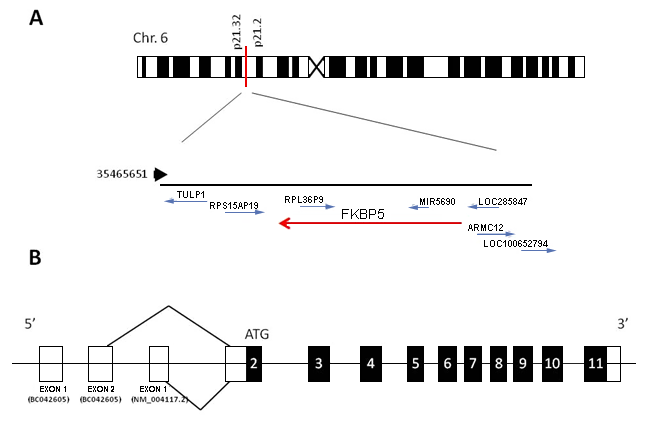
Figure 1. (A) Schematic diagram of FKBP5 location on chromosome 6. FKBP5 localizes to chromosome 6p21.31, which is represented graphically. FKBP5 gene spans over 154 kbp from 35541362 to 35696360 on reverse strand. The region surrounding FKBP5 gene is enlarged. (B) Schematic representation of FKBP5 mRNA structure, with indicated ATG translation start site in exon 2.
Description
FKBP5 gene is located on short arm of chromosome 6 (6p21.31). FKBP5 gene ranges from 35541362 to 35696360 on reverse strand with a total length of 154999 bp including 10 coding exons.
Transcription
This gene has been found to have multiple polyadenylation sites. Transcription of FKBP5 gene produces 4 different transcript variants due to alternative splicing (RefSeq, Mar 2009). NM_004117 is the transcript most widely referred to, and its mRNA is 3803 bp long.
Proteins
Note
Protein name: FK506 binding protein 51, FKBP51, Peptidyl-prolyl cis-trans isomerase (PPIase). It is encoded by the FKBP5 gene (Nair et al., 1997).
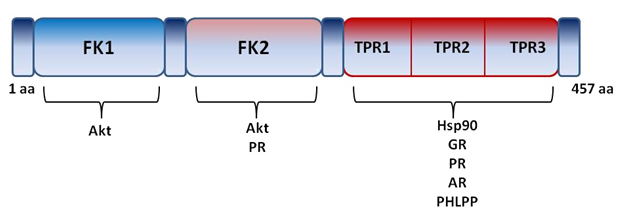
Figure 2. Functional domains of FKBP51. FKBP1 consists of 457 amino acids with three functional domains, as shown. FKBP51 binding proteins are indicated and listed by domain they interact with.
Description
FKBP51 is a member of immunophilin family, proteins characterized by their ability to bind immunosuppresive drugs. Additionally, immunophilins are peptidylprolyl isomerases (PPIase) that catalyze the cis-trans conversion of peptidylprolyl bonds, a reaction important for protein folding (Fischer et al., 1984). Sinars et al. (Sinars et al., 2003) initially showed the structure of FKBP51 and the orientation of its domains. The N-terminal domain, FK1, is an active rotamase domain (peptidyl-prolyl isomerase; PPIase) which is required to bind immunosuppressive drugs, such as FK506 (tacrolimus). In addition, it is responsible for binding to the kinase Akt (Pei et al., 2009). The FK2 domain, needed for interaction with some binding partners (Figure 2), does not show measurable PPIase activity. The TRP domain consists of three highly degenerate 34 amino acid repeats TPR repeats, and is responsible for multiple protein-protein interactions (figure 2), for example with Hsp90 (Cheung-Flynn et al., 2003), progesterone receptor (PR) (Barent et al., 1998), PH domain and leucine rich repeat protein phosphatase (PHLPP) (Pei et al., 2009).
Expression
FKBP5 is ubiquitously expressed with different levels of distribution in various tissues. Tissue examples include amygdala, kidney, heart, hippocampus, liver skeletal muscle, peripheral blood, placenta, thymus, testis, uterus, and others, with lower levels of expression in pancreas, spleen, and stomach (Baughman et al., 1997). Up to date it has been established that FKBP5 expression is regulated by glucocorticoids, progestins, and androgens (Hubler et al., 2003; Hubler and Scammell, 2004; Makkonen et al., 2009; Paakinaho et al., 2010).
Localisation
FKBP5 localizes to cytoplasm and nucleus.
Function
FKBP5 plays multiple important roles in cellular process. Since it has peptidyl-prolyl isomerase (PPIase) activity, it regulates protein folding (Galat, 1993; Fruman et al., 1994). In addition, FKBP5 can associate with chaperones, thus playing a role in cell trafficking (Schiene-Fischer and Yu, 2001). Also, it influences steroid receptor signaling (Denny et al., 2000; Barent et al., 1998; Ni et al., 2010), NFκB pathway (Bouwmeester et al., 2004), as well as Akt pathway (Pei et al., 2009). Moreover, FKBP5 plays a role in regulating drug responses (Jiang et al., 2008; Li et al., 2008; Hou and Wang, 2012; Binder et al., 2004).
Mutations
Note
Next Generation resequencing of FKBP5 gene was performed using 96 Caucasian American samples and identified 657 single nucleotide polymorphisms (SNPs) (Ellsworth et al., 2013b). In addition, Next Generation resequencing was also performed using 60 samples from pancreatic cancer patients and identified 404 SNPs (Ellsworth et al., 2013a). All of these polymorphisms are germinal SNPs.
Somatic
It has been reported that four confirmed somatic mutations in various cancer tissues has been identified (V37V: silent (ovary) M97I: missense (breast) (Cancer Genome Atlas Research Network, 2011), Y113Y: silent (pancreas) (Biankin et al., 2012), S309L: missense (endometrium, lung, large intestine) (Liu et al., 2012).
Implicated in
Entity name
Cancer and response to chemotherapy
Note
FKBP51 is an important protein involved in the regulation of many key signaling cascades in the cell, such as Akt (Pei et al., 2009), NFκB (Bouwmeester et al., 2004), and androgen receptor pathways (Ni et al., 2010). All of these signalling pathways are implicated in tumorigenesis and response to drug treatment. It has been suggested that the contribution of FKBP5 in tumorgenesis and antineoplastic therapy is tissue-specific. Depending on the cellular context, FKBP5 can either promote or inhibit tumor progression and chemoresistance.
Entity name
Pancreatic cancer
Note
The Akt pathway is one of the most important signaling pathways, playing a role in regulation of many cellular processes, including cell proliferation, growth, and other processes that crucial for cell survival (Manning and Cantley, 2007). Akt is a serine/threonine kinase that in order to become fully activated needs its residues: Ser473 and Thr308 to be phosphorylated. This is facilitated by phosphoinositide 3-kinase (PIP3), as well as PDK1, and mTOR complex 2 (Alessi et al., 1996; Engelman et al., 2006; Sarbassov et al., 2005). Conversely, phosphatases, such as PP2 holoenzymes and PHLPP de-phosphorylate Akt, halting its activity (Brognard et al., 2007; Carracedo and Pandolfi, 2008; Gao et al., 2005; Padmanabhan et al., 2009). The balance in phosphorylation levels of Akt determines its pathway activity, therefore affecting all the downstream cellular events. If Akt pathway becomes highly up-regulated, it potentially could lead to tumor development, progression and eventually to chemotherapy resistance (Pei et al., 2010). Genome-wide association studies of cytidine analogues identified FKBP5 low expression levels to be associated with resistance to many chemotherapeutic drugs (Li et al., 2008; Pei et al., 2009). Functional studies of FKBP5 demonstrated that FKBP51 acts as a scaffolding protein increasing interaction between Akts phosphatase - PHLPP and Akt, thus decreasing the phosphorylation of Akt-Ser473 (Pei et al., 2009). It was shown, that in pancreatic and breast cancer cells FKBP5 expression levels are decreased, while the phosphorylation of Akt-Ser473 is increased, which could lead to chemoresistance. Also, it suggested that FKBP5 might function as a tumor suppressor gene through the down-regulation of Akt activation (Pei et al., 2009, Hou and Wang, 2012).
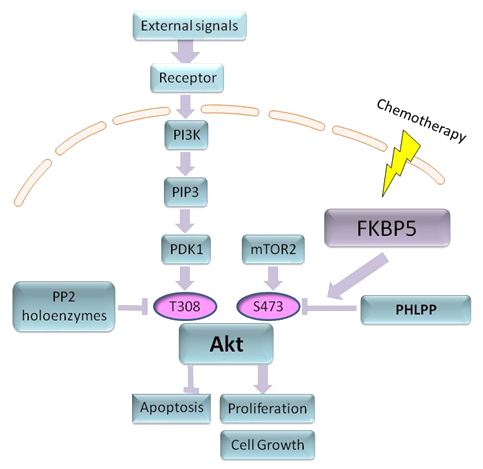
Figure 3. Importance of FKBP5 in regulating activity of Akt pathway. FKBP5 acts as a scaffolding protein, enhancing the interaction of PHLPP and Akt, therefore promoting de-phosphorylation of Akts Serine residue 473. That in turn eventually leads to inactivation of Akt pathway. FKBP5 expression and interaction with PHLPP is especially important upon chemotherapy treatment, because it inactivation of Akt leads to chemotoxic stress and directs cells towards apoptosis, rather than survival pathway.
Entity name
Acute lymphoblastic leukemia, glioma, melanoma
Note
FKBP5 plays a pivotal role in regulating NF-κB pathway (Bouwmeester et al., 2004). Specifically, FKBP51 interacts with several members of the NF-κB pathway including inhibitors of NF-κB kinase: IKKα, IKKε, TAK1 and MEKK1. It was shown, that FKBP51 enzymatic activity is required for IKK activation, which suggested that FKBP5 plays an important role in this pathway. Avellino et al. demonstrated, that the addition of rapamycin, a known inhibitor of FKBP51 enzymatic (PPIase) activity, to anthracycline treatment of blasts from chronic childhood acute lymphoblastic leukemia (ALL) patients would sensitize these cells to anthracyclines (Avellino et al., 2005). These experiments suggested that the combination treatment of rapamycin and doxorubicin inhibits the activation of the NF-κB pathway, which leads to an increase in apoptosis, and, in turn, an increase in sensitivity to chemotherapy (Avellino et al., 2005). Since NF-κB pathway activation leads to anti-apoptotic signals, therefore, in this case, FKBP5 plays a role in chemoresistance to drugs such as anthracyclines. In addition, in glioma cells, FKBP5 expression contributes to glioma cells growth and sensitivity to rapamycin through regulation of the NF-κB pathway (Jiang et al., 2008). FKBP5 was also described to influence radioresistance in melanoma cells (Romano et al., 2010). Specifically, it was found that in melanoma samples FKBP51 controlled radioresistance through the activation of NF-κB pathway, and by silencing expression of FKBP5 in tumors in vitro and in vivo, it contributed to an increase in apoptosis after irradiation.
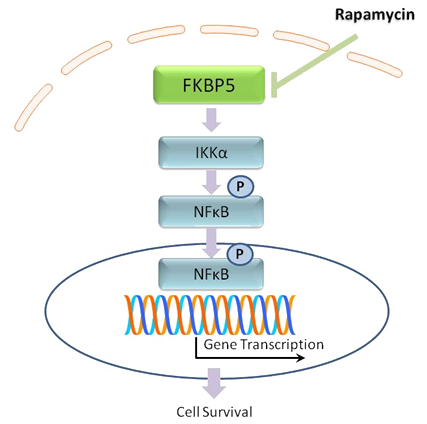
Figure 4. FKBP5 enzymatic activity regulates NF-κB pathway activation. Peptidylprolyl isomerase enzymatic activity of FKBP5 is required for IKKa activation and further phosphorylation of NFκB, which promotes cell survival and chemoresistance. Rapamycin can specifically inhibit FKBP5 enzymatic activity, which leads to decrease in NFκB pathway activation and increase in apoptosis upon chemotherapy treatment.
Entity name
Prostate cancer
Note
FKBP5 influences androgen receptor signaling in prostate cancer. Androgen receptor (AR) is a transcription factor, regulating expression of multiple genes, including FKBP5 (Makkonen et al., 2009). Additionally, FKBP5 is a part of a positive feedback loop that not only is having its expression regulated by AR and androgen binding, but it also facilitates androgen-dependent transcription. Ni et al. (Ni et al., 2010) reported that FKBP5 forms a superchaperone complex with ATP-bound Hsp90 and p23 that increases binding of androgen to its receptor. This allows for androgen-dependent gene transcription activation and promotes cell growth, which is especially important during prostate cancer progression to the androgen-independent state during disease progression and tumor growth (Ni et al., 2010).
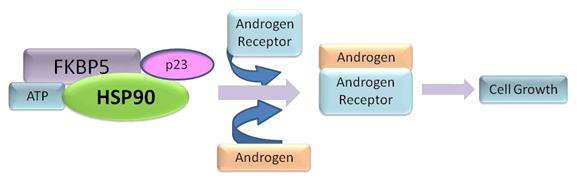
Figure 5. Prostate cancer cell growth promotion under low-androgen conditions. Formation of ATP-bound Hsp90-FKBP5-p23 superchaperone complex allows for increased androgen and androgen receptor binding which promotes cell growth.
Entity name
Depression, post-traumatic stress disorder
Note
It has been established that one of the major functions of FKBP51 is to co-chaperone with HSP family members steroid receptors: glucocorticoid (GR) (Denny et al., 2000), progesterone (PR) (Barent et al., 1998), and androgen (AR) (Ni et al., 2010). In addition, FKBP5 intronic regions contain hormone response elements (HRE) that upon GR, PR, or AR activation bind their respective hormones. That, in turn, induces the FKBP5 gene transcription (Hubler et al., 2003; Hubler and Scammell, 2004; Makkonen et al., 2009; Paakinaho et al., 2010) leading to increases in the amount of FKBP51 protein in the cell. FKBP5 modulates steroid hormones binding affinity; therefore it affects their signaling pathways. For example FKBP51 plays an important role in regulating the activity of the glucocorticoid receptor (Davies et al., 2005). When FKBP51 is bound to the GR-complex, the receptor has lower affinity for glucocorticoids, which causes an increase of glucocorticoids in the intercellular environment. On the other hand, once glucocorticoid is bound, FKBP51 dissociate from the complex and is exchanged with FKBP52. That allows for the translocation of GR into the nucleus and interaction with DNA. Once, in the nucleus GR acts as a transcription factor and by binding to glucocorticoid receptor response elements (GRE) of FKBP5 increases its transcription. That leads to increased concentrations of FKBP51 that contribute to higher GR resistance, completing a negative feedback loop on GR sensitivity (Binder, 2009). Since GR plays a role in regulating a stress response, if FKBP5 expression is altered, it could potentially contribute to development of mood disorders, such as depression or post-traumatic stress disorder (Binder, 2009; Binder et al., 2008; Binder et al., 2004).
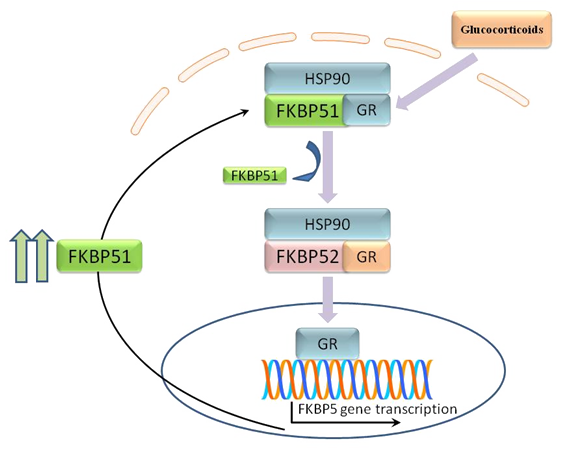
Figure 6. Negative feedback loop on GR sensitivity. When HSP90-GR is bound to the FKBP51, it has a lower affinity for GR ligand (glucocorticoids). However, once glucocorticoids bind to the complex, FKBP51 dissociates from the complex and FKBP52 binds instead. That allows for the GR translocation into the nucleus and exertion of its action as a transcription factor. GR also acts on FKBP5 via its glucocorticoid response elements (GREs), increasing its transcription, which leads to an increase in amount of FKBP51 protein in the cell. That, in turn, decreases the GR affinity for its ligand, completing this negative feedback loop on GR sensitivity.
Article Bibliography
| Pubmed ID | Last Year | Title | Authors |
|---|---|---|---|
| 8978681 | 1996 | Mechanism of activation of protein kinase B by insulin and IGF-1. | Alessi DR et al |
| 15878982 | 2005 | Rapamycin stimulates apoptosis of childhood acute lymphoblastic leukemia cells. | Avellino R et al |
| 9514152 | 1998 | Analysis of FKBP51/FKBP52 chimeras and mutants for Hsp90 binding and association with progesterone receptor complexes. | Barent RL et al |
| 9125197 | 1997 | Tissue distribution and abundance of human FKBP51, and FK506-binding protein that can mediate calcineurin inhibition. | Baughman G et al |
| 23103869 | 2012 | Pancreatic cancer genomes reveal aberrations in axon guidance pathway genes. | Biankin AV et al |
| 18349090 | 2008 | Association of FKBP5 polymorphisms and childhood abuse with risk of posttraumatic stress disorder symptoms in adults. | Binder EB et al |
| 15565110 | 2004 | Polymorphisms in FKBP5 are associated with increased recurrence of depressive episodes and rapid response to antidepressant treatment. | Binder EB et al |
| 19560279 | 2009 | The role of FKBP5, a co-chaperone of the glucocorticoid receptor in the pathogenesis and therapy of affective and anxiety disorders. | Binder EB et al |
| 14743216 | 2004 | A physical and functional map of the human TNF-alpha/NF-kappa B signal transduction pathway. | Bouwmeester T et al |
| 17386267 | 2007 | PHLPP and a second isoform, PHLPP2, differentially attenuate the amplitude of Akt signaling by regulating distinct Akt isoforms. | Brognard J et al |
| 21720365 | 2011 | Integrated genomic analyses of ovarian carcinoma. | |
| 18794886 | 2008 | The PTEN-PI3K pathway: of feedbacks and cross-talks. | Carracedo A et al |
| 12611898 | 2003 | C-terminal sequences outside the tetratricopeptide repeat domain of FKBP51 and FKBP52 cause differential binding to Hsp90. | Cheung-Flynn J et al |
| 15697228 | 2005 | Differential control of glucocorticoid receptor hormone-binding function by tetratricopeptide repeat (TPR) proteins and the immunosuppressive ligand FK506. | Davies TH et al |
| 11089542 | 2000 | Squirrel monkey immunophilin FKBP51 is a potent inhibitor of glucocorticoid receptor binding. | Denny WB et al |
| 23324805 | 2013 | FKBP5 genetic variation: association with selective serotonin reuptake inhibitor treatment outcomes in major depressive disorder. | Ellsworth KA et al |
| 16847462 | 2006 | The evolution of phosphatidylinositol 3-kinases as regulators of growth and metabolism. | Engelman JA et al |
| 6395866 | 1984 | [Determination of enzymatic catalysis for the cis-trans-isomerization of peptide binding in proline-containing peptides]. | Fischer G et al |
| 7513288 | 1994 | Immunophilins in protein folding and immunosuppression. | Fruman DA et al |
| 8404888 | 1993 | Peptidylproline cis-trans-isomerases: immunophilins. | Galat A et al |
| 15808505 | 2005 | PHLPP: a phosphatase that directly dephosphorylates Akt, promotes apoptosis, and suppresses tumor growth. | Gao T et al |
| 22590527 | 2012 | FKBP5 as a selection biomarker for gemcitabine and Akt inhibitors in treatment of pancreatic cancer. | Hou J et al |
| 12746298 | 2003 | The FK506-binding immunophilin FKBP51 is transcriptionally regulated by progestin and attenuates progestin responsiveness. | Hubler TR et al |
| 15544162 | 2004 | Intronic hormone response elements mediate regulation of FKBP5 by progestins and glucocorticoids. | Hubler TR et al |
| 18320068 | 2008 | FK506 binding protein mediates glioma cell growth and sensitivity to rapamycin treatment by regulating NF-kappaB signaling pathway. | Jiang W et al |
| 18757419 | 2008 | Gemcitabine and cytosine arabinoside cytotoxicity: association with lymphoblastoid cell expression. | Li L et al |
| 23033341 | 2012 | Genome and transcriptome sequencing of lung cancers reveal diverse mutational and splicing events. | Liu J et al |
| 19433513 | 2009 | Long-range activation of FKBP51 transcription by the androgen receptor via distal intronic enhancers. | Makkonen H et al |
| 17604717 | 2007 | AKT/PKB signaling: navigating downstream. | Manning BD et al |
| 9001212 | 1997 | Molecular cloning of human FKBP51 and comparisons of immunophilin interactions with Hsp90 and progesterone receptor. | Nair SC et al |
| 20048054 | 2010 | FKBP51 promotes assembly of the Hsp90 chaperone complex and regulates androgen receptor signaling in prostate cancer cells. | Ni L et al |
| 20093418 | 2010 | Glucocorticoid receptor activates poised FKBP51 locus through long-distance interactions. | Paakinaho V et al |
| 19249087 | 2009 | A PP2A regulatory subunit regulates C. elegans insulin/IGF-1 signaling by modulating AKT-1 phosphorylation. | Padmanabhan S et al |
| 19732725 | 2009 | FKBP51 affects cancer cell response to chemotherapy by negatively regulating Akt. | Pei H et al |
| 20016266 | 2010 | Emerging role of FKBP51 in AKT kinase/protein kinase B signaling. | Pei H et al |
| 19696786 | 2010 | Role of FK506-binding protein 51 in the control of apoptosis of irradiated melanoma cells. | Romano S et al |
| 15718470 | 2005 | Phosphorylation and regulation of Akt/PKB by the rictor-mTOR complex. | Sarbassov DD et al |
| 11322937 | 2001 | Receptor accessory folding helper enzymes: the functional role of peptidyl prolyl cis/trans isomerases. | Schiene-Fischer C et al |
| 12538866 | 2003 | Structure of the large FK506-binding protein FKBP51, an Hsp90-binding protein and a component of steroid receptor complexes. | Sinars CR et al |
Other Information
Locus ID:
NCBI: 2289
MIM: 602623
HGNC: 3721
Ensembl: ENSG00000096060
Variants:
dbSNP: 2289
ClinVar: 2289
TCGA: ENSG00000096060
COSMIC: FKBP5
RNA/Proteins
| Gene ID | Transcript ID | Uniprot |
|---|---|---|
| ENSG00000096060 | ENST00000357266 | Q13451 |
| ENSG00000096060 | ENST00000536438 | Q13451 |
| ENSG00000096060 | ENST00000539068 | Q13451 |
| ENSG00000096060 | ENST00000542713 | Q13451 |
Expression (GTEx)
Pathways
| Pathway | Source | External ID |
|---|---|---|
| Estrogen signaling pathway | KEGG | hsa04915 |
| Estrogen signaling pathway | KEGG | ko04915 |
Protein levels (Protein atlas)
PharmGKB
| Entity ID | Name | Type | Evidence | Association | PK | PD | PMIDs |
|---|---|---|---|---|---|---|---|
| PA10074 | escitalopram | Chemical | ClinicalAnnotation | associated | PD | ||
| PA10832 | corticosteroids | Chemical | ClinicalAnnotation | associated | PD | 21788965 | |
| PA164713257 | Selective serotonin reuptake inhibitors | Chemical | ClinicalAnnotation | associated | PD | 15565110, 20709156 | |
| PA443815 | Crohn Disease | Disease | ClinicalAnnotation | associated | PD | 21788965 | |
| PA447207 | Depressive Disorder | Disease | ClinicalAnnotation | associated | PD | 15565110, 20709156 | |
| PA447209 | Mood Disorders | Disease | ClinicalAnnotation | associated | PD | 15565110, 20709156 | |
| PA447216 | Schizophrenia | Disease | ClinicalAnnotation | associated | PD | 25751398 | |
| PA447278 | Depression | Disease | ClinicalAnnotation | associated | PD | 15565110, 17467808, 18597649, 19676097, 20709156, 21449676, 23733030 | |
| PA447321 | Depressive Disorder, Major | Disease | ClinicalAnnotation | associated | PD | 15565110, 20709156, 22947179 | |
| PA448687 | bupropion | Chemical | ClinicalAnnotation | associated | PD | 22947179 | |
| PA449015 | citalopram | Chemical | ClinicalAnnotation | associated | PD | 15565110, 17467808, 18597649, 19676097, 20709156, 21449676, 23733030 | |
| PA449048 | clomipramine | Chemical | ClinicalAnnotation | associated | PD | 15565110, 17467808, 18597649, 19676097, 20709156, 21449676, 23733030 | |
| PA449061 | clozapine | Chemical | ClinicalAnnotation | associated | PD | 25751398 | |
| PA449673 | fluoxetine | Chemical | ClinicalAnnotation | associated | PD | 15565110, 20709156 | |
| PA449748 | gemcitabine | Chemical | ClinicalAnnotation | associated | 23936393 | ||
| PA450243 | lithium | Chemical | ClinicalAnnotation | associated | PD | 15565110, 17467808, 18597649, 19676097, 20709156, 21449676, 23733030 | |
| PA450522 | mirtazapine | Chemical | ClinicalAnnotation | associated | PD | 15565110, 20709156 | |
| PA450603 | nefazodone | Chemical | ClinicalAnnotation | associated | PD | 15565110, 17467808, 18597649, 19676097, 20709156, 21449676, 23733030 | |
| PA450801 | paroxetine | Chemical | ClinicalAnnotation | associated | PD | 15565110, 17467808, 18597649, 19676097, 20709156, 21449676, 23733030 | |
| PA451866 | venlafaxine | Chemical | ClinicalAnnotation | associated | PD | 15565110, 17467808, 18597649, 19676097, 20709156, 21449676, 23733030 | |
| PA452229 | antidepressants | Chemical | ClinicalAnnotation | associated | PD | 15565110, 17467808, 18597649, 19676097, 20709156, 21449676, 23733030 |
References
| Pubmed ID | Year | Title | Citations |
|---|---|---|---|
| 38199409 | 2024 | Blood mRNA expression levels of glucocorticoid receptors and FKBP5 are associated with depressive disorder and altered HPA axis. | 1 |
| 38310934 | 2024 | HPA flexibility and FKBP5: promising physiological targets for conservation. | 1 |
| 38338761 | 2024 | Methylation Patterns of the FKBP5 Gene in Association with Childhood Maltreatment and Depressive Disorders. | 1 |
| 38609904 | 2024 | The association of FKBP5 gene polymorphism with genetic susceptibility to depression and response to antidepressant treatment- a systematic review. | 0 |
| 38676353 | 2024 | Differential impact of prenatal PTSD symptoms and preconception trauma exposure on placental NR3C1 and FKBP5 methylation. | 0 |
| 38199409 | 2024 | Blood mRNA expression levels of glucocorticoid receptors and FKBP5 are associated with depressive disorder and altered HPA axis. | 1 |
| 38310934 | 2024 | HPA flexibility and FKBP5: promising physiological targets for conservation. | 1 |
| 38338761 | 2024 | Methylation Patterns of the FKBP5 Gene in Association with Childhood Maltreatment and Depressive Disorders. | 1 |
| 38609904 | 2024 | The association of FKBP5 gene polymorphism with genetic susceptibility to depression and response to antidepressant treatment- a systematic review. | 0 |
| 38676353 | 2024 | Differential impact of prenatal PTSD symptoms and preconception trauma exposure on placental NR3C1 and FKBP5 methylation. | 0 |
| 36624283 | 2023 | Epigenetic differences in stress response gene FKBP5 among children with abusive vs accidental injuries. | 3 |
| 36743961 | 2023 | Association of job stress, FK506 binding protein 51 (FKBP5) gene polymorphisms and their interaction with sleep disturbance. | 2 |
| 36769373 | 2023 | LncRNA CASC19 Enhances the Radioresistance of Nasopharyngeal Carcinoma by Regulating the miR-340-3p/FKBP5 Axis. | 6 |
| 36781843 | 2023 | Methylation and expression of glucocorticoid receptor exon-1 variants and FKBP5 in teenage suicide-completers. | 6 |
| 36825897 | 2023 | Potential role of FKBP5 single-nucleotide polymorphisms in functional seizures. | 7 |
Citation
Katarzyna Anna Ellsworth ; Liewei Wang
FKBP5 (FK506 binding protein 5)
Atlas Genet Cytogenet Oncol Haematol. 2013-10-01
Online version: http://atlasgeneticsoncology.org/gene/40578/fkbp5
