GRB10 (growth factor receptor-bound protein 10)
2002-08-01 Sébastien Degot AffiliationI.G.B.M.C, 1, rue Laurent FRIES, BP 163 67404 ILLKIRH, France
Identity
HGNC
LOCATION
7p12.1
LOCUSID
ALIAS
GRB-IR,Grb-10,IRBP,MEG1,RSS
FUSION GENES
DNA/RNA
Description
at least 16 exons spanning approximately 50 kb
Transcription
Four splicing variants are known for human Grb10 gene :
hGrb10 beta alias Grb-IR (accession number U34355)
hGrb10 gamma alias Grb10/IR-SV1 or hGrb-IRbeta/hGrb10
hGrb10 epsilon alias KIAA0207 (accession number D86962)
hGrb10 zeta alias hGrb10 gamma
This nomenclature is a new nomenclature for Grb10 splice variants that was agreed by several researchers
Grb10 gene has a broad expression profile with different size of transcripts depending on the isoforms. Moreover, Grb10 is imprinted in a highly isoform- and tissue-specific manner.
hGrb10 beta alias Grb-IR (accession number U34355)
hGrb10 gamma alias Grb10/IR-SV1 or hGrb-IRbeta/hGrb10
hGrb10 epsilon alias KIAA0207 (accession number D86962)
hGrb10 zeta alias hGrb10 gamma
This nomenclature is a new nomenclature for Grb10 splice variants that was agreed by several researchers
Grb10 gene has a broad expression profile with different size of transcripts depending on the isoforms. Moreover, Grb10 is imprinted in a highly isoform- and tissue-specific manner.
Proteins
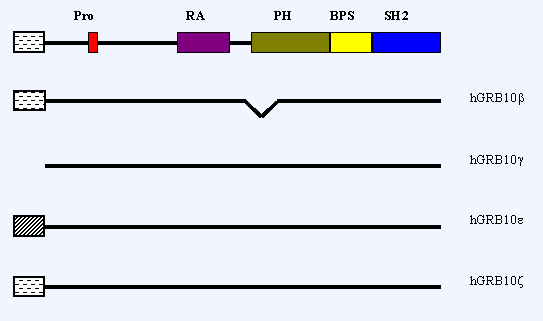
Description
isoform beta: 548 aa, 62 kDa (aa: amino acids)
isoform gamma: 536 aa, 61 kDa
isoform epsilon: 588 aa, 66 kDa
isoform zeta: 594 aa, 67 kDa
The different splice variants share a similar structure with :
a small proline-rich sequence (11 aa) close to the amino-terminus that can interact with SH3 domain of c-Abl in vitro (domain named Pro on the figure above).
a Ras-associated-like domain (84 aa) homologous to the C. elegans MIG-10 protein raising the possibility that Grb10 could directly interact with Ras-like GTP-binding protein (domain named RA on the figure above).
a central Pleckstrin homology domain of 124 aa except for the isoform alpha which contains only 85 aa (domain named PH on the figure above).This domain was proposed to play an important role in targeting Grb10 to the mitochondria.
the BPS (Between PH and SH2) domain is composed of 48 aa and binds to the activated insulin and/or IGF-1 receptors.
an SH2 domain (104 aa) which interacts with phosphotyrosine of several proteins.
PH domain, BPS domain and SH2 domain compose a region of 300 aa termed GM (Grb/Mig). Grb10 is able to dimerize/oligomerize through interaction between the N-terminal domain of one molecule and the GM region of another one
isoform gamma: 536 aa, 61 kDa
isoform epsilon: 588 aa, 66 kDa
isoform zeta: 594 aa, 67 kDa
The different splice variants share a similar structure with :
Expression
Grb10 protein has been detected in most human cell lines using a highly specific antibody.
Localisation
Most of the endogenous Grb10 is peripherally associated with the mitochondria where it interacts with pools of Raf-1. Treatment with serum or IGF-I is able to induce the relocalization of a small proportion of the endogenous Grb10 to the plasma membrane.
Function
Grb10 is able to interact with a lot of proteins (Insulin receptor, IGF-1 receptor, ELK receptor, PDGFRB, GHR, EGFR, RET, HGFR, FGFR, RAF-1, MEK1, JAK2, BCR-Abl TEC kinase, NEDD4, cABL, AKT, c-KIT).
Several studies suggest a role for Grb10 in cell proliferation. However, despite the clear involvement of Grb10 in pathways activated by IR and IGF-R, there is still some controversy about whether its effect is inhibitory or stimulatory. One report showed that stable overexpression of mGRB10 alpha inhibits IGF-1 mediated cell proliferation, whereas another report demonstrated that overexpression of the same mGrb10 alpha increased DNA synthesis upon growth factor stimulation (PDGFBB, IG-1, or insulin). These contradictions might be explained by the use of different cell lines or experimental procedures.
Grb10 seems to have also a role in apoptosis regulation. Grb10 SH2 domain is able to interact with Raf1 and MEK1. Transfection of SH2 domain Grb10 mutants induces apoptosis in HTC-IR and COS-7 cells suggesting that Grb10 may influence the equilibrium between ERK and JNK pathways and determine the choice between proliferation and programmed cell death. As Grb10 is located at the mitochondrial membrane it may be involved in communication between plasma membrane receptors and apoptosis regulators located on the mitochondrial outer membrane.
Grb10 interacts with Akt and is proposed to be a positive regulator of the Akt pathway downstream of PI3-K. By acting as an adaptator involved in the relocalization of Akt to the cell membrane, Grb10 may contribute to Akt activation and regulation of different biological processes such as proliferation, apoptosis and growth.
Several studies suggest a role for Grb10 in cell proliferation. However, despite the clear involvement of Grb10 in pathways activated by IR and IGF-R, there is still some controversy about whether its effect is inhibitory or stimulatory. One report showed that stable overexpression of mGRB10 alpha inhibits IGF-1 mediated cell proliferation, whereas another report demonstrated that overexpression of the same mGrb10 alpha increased DNA synthesis upon growth factor stimulation (PDGFBB, IG-1, or insulin). These contradictions might be explained by the use of different cell lines or experimental procedures.
Grb10 seems to have also a role in apoptosis regulation. Grb10 SH2 domain is able to interact with Raf1 and MEK1. Transfection of SH2 domain Grb10 mutants induces apoptosis in HTC-IR and COS-7 cells suggesting that Grb10 may influence the equilibrium between ERK and JNK pathways and determine the choice between proliferation and programmed cell death. As Grb10 is located at the mitochondrial membrane it may be involved in communication between plasma membrane receptors and apoptosis regulators located on the mitochondrial outer membrane.
Grb10 interacts with Akt and is proposed to be a positive regulator of the Akt pathway downstream of PI3-K. By acting as an adaptator involved in the relocalization of Akt to the cell membrane, Grb10 may contribute to Akt activation and regulation of different biological processes such as proliferation, apoptosis and growth.
Homology
Grb10 is a member of the Grb7 family of adapter molecules which contains three member Grb7, Grb10 and Grb14. Grb10 counterparts are found in mouse, rat, fly and worm.
Implicated in
Disease
The mapping of Grb10 gene to 7p made it a candidate gene for Russel-Silver Syndrome (RSS). But recent data suggest that Grb10 is unlikely to be the gene responsible for RSS.
Article Bibliography
| Pubmed ID | Last Year | Title | Authors |
|---|---|---|---|
| 9360986 | 1997 | Cloning, chromosome localization, expression, and characterization of an Src homology 2 and pleckstrin homology domain-containing insulin receptor binding protein hGrb10gamma. | Dong LQ et al |
| 9651371 | 1998 | Inhibition of hGrb10 binding to the insulin receptor by functional domain-mediated oligomerization. | Dong LQ et al |
| 9006901 | 1997 | Human GRB-IRbeta/GRB10. Splice variants of an insulin and growth factor receptor-binding protein with PH and SH2 domains. | Frantz JD et al |
| 11607834 | 2001 | The Grb7 family proteins: structure, interactions with other signaling molecules and potential cellular functions. | Han DC et al |
| 11809791 | 2002 | Role for the adaptor protein Grb10 in the activation of Akt. | Jahn T et al |
| 9070953 | 1997 | Assignment of growth factor receptor-bound protein 10 (GRB10) to human chromosome 7p11.2-p12. | Jerome CA et al |
| 7479769 | 1995 | Grb-IR: a SH2-domain-containing protein that binds to the insulin receptor and inhibits its function. | Liu F et al |
| 11527390 | 2001 | Evidence against GRB10 as the gene responsible for Silver-Russell syndrome. | McCann JA et al |
| 9334212 | 1997 | The role of mGrb10alpha in insulin-like growth factor I-mediated growth. | Morrione A et al |
| 10585452 | 1999 | Localization of endogenous Grb10 to the mitochondria and its interaction with the mitochondrial-associated Raf-1 pool. | Nantel A et al |
| 9553107 | 1998 | Interaction of the Grb10 adapter protein with the Raf1 and MEK1 kinases. | Nantel A et al |
| 8798417 | 1996 | Interaction of a GRB-IR splice variant (a human GRB10 homolog) with the insulin and insulin-like growth factor I receptors. Evidence for a role in mitogenic signaling. | O'Neill TJ et al |
| 10454568 | 1999 | Grb10, a positive, stimulatory signaling adapter in platelet-derived growth factor BB-, insulin-like growth factor I-, and insulin-mediated mitogenesis. | Wang J et al |
| 10334925 | 1999 | Sequence analysis identifies a ras-associating (RA)-like domain in the N-termini of band 4.1/JEF domains and in the Grb7/10/14 adapter family. | Wojcik J et al |
| 10856193 | 2000 | Imprinting of human GRB10 and its mutations in two patients with Russell-Silver syndrome. | Yoshihashi H et al |
Other Information
Locus ID:
NCBI: 2887
MIM: 601523
HGNC: 4564
Ensembl: ENSG00000106070
Variants:
dbSNP: 2887
ClinVar: 2887
TCGA: ENSG00000106070
COSMIC: GRB10
RNA/Proteins
Expression (GTEx)
Pathways
Protein levels (Protein atlas)
References
| Pubmed ID | Year | Title | Citations |
|---|---|---|---|
| 37179120 | 2023 | GRB10 is a novel factor associated with gastric cancer proliferation and prognosis. | 0 |
| 37179120 | 2023 | GRB10 is a novel factor associated with gastric cancer proliferation and prognosis. | 0 |
| 33038264 | 2021 | GRB10 sustains AR activity by interacting with PP2A in prostate cancer cells. | 2 |
| 33969901 | 2021 | Circ_0009910 shuttled by exosomes regulates proliferation, cell cycle and apoptosis of acute myeloid leukemia cells by regulating miR-5195-3p/GRB10 axis. | 22 |
| 33038264 | 2021 | GRB10 sustains AR activity by interacting with PP2A in prostate cancer cells. | 2 |
| 33969901 | 2021 | Circ_0009910 shuttled by exosomes regulates proliferation, cell cycle and apoptosis of acute myeloid leukemia cells by regulating miR-5195-3p/GRB10 axis. | 22 |
| 31794259 | 2020 | Role of Grb10 in mTORC1-dependent regulation of insulin signaling and action in human skeletal muscle cells. | 8 |
| 31794259 | 2020 | Role of Grb10 in mTORC1-dependent regulation of insulin signaling and action in human skeletal muscle cells. | 8 |
| 30379590 | 2019 | Proproliferative function of adaptor protein GRB10 in prostate carcinoma. | 6 |
| 30379590 | 2019 | Proproliferative function of adaptor protein GRB10 in prostate carcinoma. | 6 |
| 29544736 | 2018 | Patient-derived Hormone-naive Prostate Cancer Xenograft Models Reveal Growth Factor Receptor Bound Protein 10 as an Androgen Receptor-repressed Gene Driving the Development of Castration-resistant Prostate Cancer. | 14 |
| 29544736 | 2018 | Patient-derived Hormone-naive Prostate Cancer Xenograft Models Reveal Growth Factor Receptor Bound Protein 10 as an Androgen Receptor-repressed Gene Driving the Development of Castration-resistant Prostate Cancer. | 14 |
| 28295264 | 2017 | The adaptors Grb10 and Grb14 are calmodulin-binding proteins. | 5 |
| 28476045 | 2017 | High throughput sequencing identifies an imprinted gene, Grb10, associated with the pluripotency state in nuclear transfer embryonic stem cells. | 2 |
| 28295264 | 2017 | The adaptors Grb10 and Grb14 are calmodulin-binding proteins. | 5 |
Citation
Sébastien Degot
GRB10 (growth factor receptor-bound protein 10)
Atlas Genet Cytogenet Oncol Haematol. 2002-08-01
Online version: http://atlasgeneticsoncology.org/gene/278/grb10
