NRCAM (neuronal cell adhesion molecule)
2009-02-01 Justyna Janik , Barbara Czarnocka AffiliationDepartment of Biochemistry, Molecular Biology, Medical Centre of Postgraduate Education, ul. Marymoncka 99\\\/103, 01-813 Warsaw, Poland
DNA/RNA
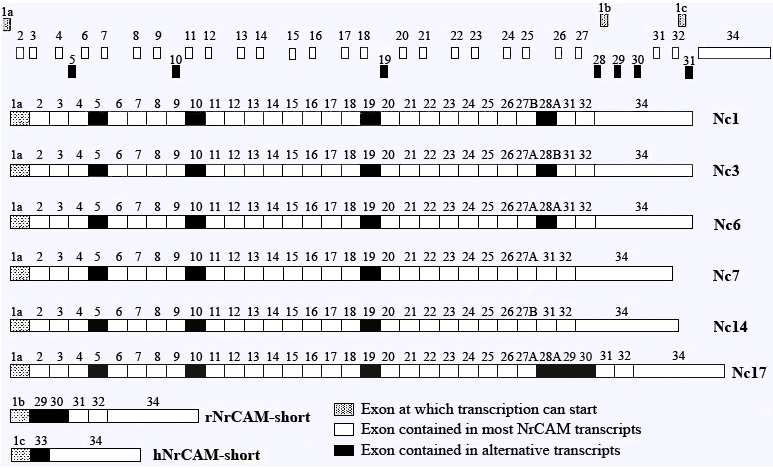
Cartoon of the distribution of NrCAM exons, including those used in most transcripts (open boxes) and those that are alternatively spliced (filled boxes). Most exons are conserved in human, mouse and rat. Exons 1b and 33 have not been identified in humans. The candidate alternatively transcribed exons produce the shorter rat and human isoforms are shown in the bottom two rows. (Rows 3-8) NrCAM clones (Nc)1, 3, 6, 7, 14, 17 that represent splice variant isoforms identified in rat brain cDNAs. (Rows 9-10) Shorter NrCAM gene product expressed isoforms that are identified from ESTs in rat and human databases (from Ishiguro et al., 2006).
Description
The NrCAM gene is about 316 kb in length, consisting of 34 exons.
Transcription
NrCAM is transcribed from a single gene and the mRNA may be alternatively processed into multiple species (Grumet et al., 1991). Different transcripts of NRCAM are produced by alternative splicing of exons 10, 19 and 27-29.
There are three main alternative spliced mRNA according to Entrez: variant A - NM_001037132.1, variant B - NM_005010.3, variant C - NM_001037133.1.
There are three main alternative spliced mRNA according to Entrez: variant A - NM_001037132.1, variant B - NM_005010.3, variant C - NM_001037133.1.
Proteins

Cartoon of NrCAMs structure with fibronectin, immunoglobulin, transmembrane, and intracellular (C-terminal) domains indicated. Arrows indicate sites where splice variants encode additional inserted additional amino acids. These NrCAM structures are conserved in human, mouse, and rat. (from Ishiguro et al., 2006).
Description
NrCAM is a cell surface protein of the immunoglobulin superfamily, L1/neurofascin/NgCAM subgroup. The molecule is 200-220kDa transmembrane protein, which contains 5 fibronectin type-III domains, 6 Ig-like C2-type (immunoglobulin-like) domains in the extracellular region and a highly conserved cytoplasmic tail. (Grumet et al., 1991; Kayyem et al., 1992; Lane et al., 1996).
Human NrCAM has few alternatively spliced regions: AE19 adds 19 amino acids to the region between Ig domain 2 and 3; AE10 lies clearly between Ig domain 6 and the beginning of the Fn repeats; AE10K2 encompasses part of the G strand of Ig 5 and most of the A strand of Ig 6; AE12 affects the G strand of Fn III domain 4; AE93 corresponds to the entire Fn type III domain (Grumet et al.,1991; Lane et al., 1996; Wang et al., 1998).
Human NrCAM has few alternatively spliced regions: AE19 adds 19 amino acids to the region between Ig domain 2 and 3; AE10 lies clearly between Ig domain 6 and the beginning of the Fn repeats; AE10K2 encompasses part of the G strand of Ig 5 and most of the A strand of Ig 6; AE12 affects the G strand of Fn III domain 4; AE93 corresponds to the entire Fn type III domain (Grumet et al.,1991; Lane et al., 1996; Wang et al., 1998).
Expression
Central and peripheral nervous system, and other tissues, endothelial cells, and certain tumor cell lines and human cancers including pancreatic cancer, melanoma, renal and colon carcinoma, adrenal gland, placenta, thyroid and testis (Wang et al., 1998; Glienke et al, 2000; Dhodapkar et al., 2001; Aitkenhead et al, 2002; Conacci-Sorrell et al., 2002).
Nervous system: NrCAM is expressed in structures in the developing brain. In the floor plate NrCAM has been implicated in axonal guidance trough interaction with TAG-1/axonin-1 (Lustig et al., 2001). Moreover, NrCAM induces neurite outgrowth from dorsal root ganglia neurons. It also operates as a receptor for several different neuronal recognition molecules. NrCAM protein promotes directional signaling during nervous system development in several different regions as the spinal cord, the visual system, and the cerebellum (Lustig et al., 2001; Hutcheson et al., 2004).
Nervous system: NrCAM is expressed in structures in the developing brain. In the floor plate NrCAM has been implicated in axonal guidance trough interaction with TAG-1/axonin-1 (Lustig et al., 2001). Moreover, NrCAM induces neurite outgrowth from dorsal root ganglia neurons. It also operates as a receptor for several different neuronal recognition molecules. NrCAM protein promotes directional signaling during nervous system development in several different regions as the spinal cord, the visual system, and the cerebellum (Lustig et al., 2001; Hutcheson et al., 2004).
Localisation
Various cell compartments: external side of plasma membrane, integral to plasma membrane, neuron projection, cytoplasm, nucleus.
Function
NrCAM is engaged in such biological processes as axonal fasciculation, cell-cell adhesion, central nervous system development, clustering of voltage-gated sodium channels, neuron migration, positive regulation of neuron differentiation, regulation of axon extension, and synaptogenesis. It also may play a role in the molecular assembly of the nodes of Ranvier. NrCAM effects are also linked with different recognition processes and signal transduction pathways regulating cell differentiation, proliferation, or migration (Gumbiner, 1996; Cavallaro and Christofori, 2004).
Homology
- NRCAM, neuronal cell adhesion molecule, Homo sapiens
- NRCAM, neuronal cell adhesion molecule, Bos taurus
- Nrcam, neuron-glia-CAM-related cell adhesion molecule, Mus musculus
- Nrcam, neuron-glia-CAM-related cell adhesion molecule, Rattus norvegicus
- NRCAM, neuronal cell adhesion molecule, Gallus gallus
- si:dkey-240a12.1, si:dkey-240a12.1, Danio rerio
- Nrg, Neuroglian, Drosophila melanogaster
- AgaP_AGAP000720, AGAP000720-PA, Anopheles gambiae
- lad-2, L1 CAM ADhesion molecule homolog, Caenorhabditis elegans
- NRCAM, neuronal cell adhesion molecule, Pan troglodytes
- LOC475881, similar to Neuronal cell adhesion m..., Canis lupus familiaris.
- NRCAM, neuronal cell adhesion molecule, Bos taurus
- Nrcam, neuron-glia-CAM-related cell adhesion molecule, Mus musculus
- Nrcam, neuron-glia-CAM-related cell adhesion molecule, Rattus norvegicus
- NRCAM, neuronal cell adhesion molecule, Gallus gallus
- si:dkey-240a12.1, si:dkey-240a12.1, Danio rerio
- Nrg, Neuroglian, Drosophila melanogaster
- AgaP_AGAP000720, AGAP000720-PA, Anopheles gambiae
- lad-2, L1 CAM ADhesion molecule homolog, Caenorhabditis elegans
- NRCAM, neuronal cell adhesion molecule, Pan troglodytes
- LOC475881, similar to Neuronal cell adhesion m..., Canis lupus familiaris.
Mutations
Somatic
According to UniProt database there are two known somatic mutations of NrCAM gene, both related to breast cancer (Sjoblom et al., 2006). First mutation results in amino-acids change from medium size and polar His to hydrophobic Pro (H1093P) in the Fn-III 5 domain, and in consequence missing in isoform 3 and 5 NrCAM protein. Second leads to another amino-acids substitution G1116V in the Fn-III 5 domain and effects in missing of 3 and 4 isoforms.
Implicated in
Entity name
Brain tumor
Disease
NrCAM is over-expressed in high-grade astrocytoma, glioma and glioblastoma tumor tissues. High expression of NrCAM was also observed in cell lines derived from tumors mentioned above. Low levels of NrCAM expression were observed in neuroblastoma and meningioma. Northern blot analysis showed an alternatively spliced mRNA of 1.4 kb that could translate into a small variant of the NRCAM protein, which may be tumor-specific. Analysis of DNA from brain tumor cell lines showed that over-expression of NrCAM was not due to gene amplification. The results suggest that NrCAM is over-expressed in malignant brain tumors and can serve as a novel marker for brain tumor detection and perhaps therapy (Sehgal et al., 1998).
Entity name
Colon cancer
Disease
NrCAM expression is induced by beta-catenin and plakoglobin in complex with LEF/TCF through activation the NrCAM promoter where several LEF/TCF binding sites are localized. Excessive activation of beta-catenin signaling is characteristic for colon cancer. Significant expression of NrCAM was demonstrated in the human colon cancer cell lines, and more importantly in colon carcinoma tissue samples but not in normal colon. The results indicate that NrCAM, as a target gene of the beta-catenin-TCF/LEF-1 pathway, may play a key role in the colon cancer tumorigenesis, probably by promoting cell growth and motility (Conacci-Sorrell at al., 2002).
Entity name
Melanoma
Disease
Melanoma cell lines from advanced stages of human melanoma, which express high levels of NrCAM, stimulate cell growth, enhance motility, induce transformation, and produce rapidly growing tumors in nude mice, while those lacking NrCAM do not. NrCAM was found in complex with alpha4 integrin and beta1 integrin in melanoma cells, indicating that it can mediate heterophilic adhesion with extracellular matrix receptors. Suppression of NrCAM levels by small interfering RNA (siRNA) inhibits the adhesive and tumorigenic capacities of these cells, and implies that NrCAM expression is necessary for these cellular processes in melanoma cells. (Conacci-Sorrell et al., 2002 and 2005).
Entity name
Pancreatic carcinoma
Disease
NrCAM is expressed by nonneuronal elements of human pancreas and is dysregulated in various stages of pancreatic cancer. In normal tissue, NrCAM is expressed predominantly on the surface of acinal cells, and very weekly on normal ducts. In most poorly differentiated tumors as well as human pancreatic adenocarcinoma cell lines decreased or no expression of the protein is seen, whereas the well and moderately differentiated carcinomas show elevated expression. The data indicate expression of NrCAM in normal pancreas and loss in pancreatic adenocarcinoma. Taken together, this differential tissue- and cell-specific regulation of NrCAM expression suggests that this molecule may be involved in the pathogenesis and invasive/metastatic behavior of pancreatic cancers (Dhodapkar et al., 2001).
Entity name
Papillary thyroid carcinoma
Disease
NrCAM is over-expressed in papillary thyroid carcinoma (PTC) on both gene and protein levels. The upregulation of NrCAM gene is not related to the primary tumor stage (TNM) and size (Gorka et al., 2007). NrCAM gene over-expression in papillary thyroid carcinoma was also shown by DNA microarrays study (Jarzab et al., 2005; Delys et al., 2007). Moreover, artificially raised expression of RET/PTC1) in normal human thyrocytes, directly induces many inflammatory and tumor invasion genes including the NrCAM (Borello et al., 2005). NrCAM induction and over-expression in PTC cells regardless of the primary tumor stage suggests that this is an early event during PTC development.
Entity name
Autism
Disease
Results from various genomic screens provide evidence for an autism susceptibility region on chromosome 7q31, which contains NRCAM gene.
According to Hutcheson et al. (2004) none of the individual polymorphisms in or surrounding NRCAM demonstrated evidence for allelic association to autism. The distinct results have been reported by Bonora et al. in 2005. Screening for mutations in unrelated individuals with autism led to identification of polymorphisms in the promoter and untranslated region of NRCAM. Results suggest that alterations in expression of NRCAM gene may be linked to autism susceptibility, and association was more significant when considering the haplotype transmission (Bonora et al., 2005).
According to Hutcheson et al. (2004) none of the individual polymorphisms in or surrounding NRCAM demonstrated evidence for allelic association to autism. The distinct results have been reported by Bonora et al. in 2005. Screening for mutations in unrelated individuals with autism led to identification of polymorphisms in the promoter and untranslated region of NRCAM. Results suggest that alterations in expression of NRCAM gene may be linked to autism susceptibility, and association was more significant when considering the haplotype transmission (Bonora et al., 2005).
Article Bibliography
| Pubmed ID | Last Year | Title | Authors |
|---|---|---|---|
| 11866539 | 2002 | Identification of endothelial cell genes expressed in an in vitro model of angiogenesis: induction of ESM-1, (beta)ig-h3, and NrCAM. | Aitkenhead M et al |
| 15523497 | 2005 | Mutation screening and association analysis of six candidate genes for autism on chromosome 7q. | Bonora E et al |
| 16203990 | 2005 | Induction of a proinflammatory program in normal human thyrocytes by the RET/PTC1 oncogene. | Borrello MG et al |
| 15153420 | 2004 | Multitasking in tumor progression: signaling functions of cell adhesion molecules. | Cavallaro U et al |
| 16357171 | 2005 | The shed ectodomain of Nr-CAM stimulates cell proliferation and motility, and confers cell transformation. | Conacci-Sorrell M et al |
| 17621275 | 2007 | Gene expression and the biological phenotype of papillary thyroid carcinomas. | Delys L et al |
| 11331956 | 2001 | Differential expression of the cell-adhesion molecule Nr-CAM in hyperplastic and neoplastic human pancreatic tissue. | Dhodapkar KM et al |
| 10785405 | 2000 | Differential gene expression by endothelial cells in distinct angiogenic states. | Glienke J et al |
| 17667921 | 2007 | NrCAM, a neuronal system cell-adhesion molecule, is induced in papillary thyroid carcinomas. | Górka B et al |
| 2045418 | 1991 | Structure of a new nervous system glycoprotein, Nr-CAM, and its relationship to subgroups of neural cell adhesion molecules. | Grumet M et al |
| 8608588 | 1996 | Cell adhesion: the molecular basis of tissue architecture and morphogenesis. | Gumbiner BM et al |
| 15128462 | 2004 | Examination of NRCAM, LRRN3, KIAA0716, and LAMB1 as autism candidate genes. | Hutcheson HB et al |
| 16123759 | 2006 | NrCAM in addiction vulnerability: positional cloning, drug-regulation, haplotype-specific expression, and altered drug reward in knockout mice. | Ishiguro H et al |
| 15735049 | 2005 | Gene expression profile of papillary thyroid cancer: sources of variability and diagnostic implications. | Jarzab B et al |
| 1512296 | 1992 | Bravo/Nr-CAM is closely related to the cell adhesion molecules L1 and Ng-CAM and has a similar heterodimer structure. | Kayyem JF et al |
| 8812479 | 1996 | Characterization of a highly conserved human homolog to the chicken neural cell surface protein Bravo/Nr-CAM that maps to chromosome band 7q31. | Lane RP et al |
| 11329126 | 2001 | Nr-CAM expression in the developing mouse nervous system: ventral midline structures, specific fiber tracts, and neuropilar regions. | Lustig M et al |
| 9590116 | 1998 | Cell adhesion molecule Nr-CAM is over-expressed in human brain tumors. | Sehgal A et al |
| 16959974 | 2006 | The consensus coding sequences of human breast and colorectal cancers. | Sjöblom T et al |
| 9618219 | 1998 | Alternative Splicing of Human NrCAM in Neural and Nonneural Tissues. | Wang B et al |
Other Information
Locus ID:
NCBI: 4897
MIM: 601581
HGNC: 7994
Ensembl: ENSG00000091129
Variants:
dbSNP: 4897
ClinVar: 4897
TCGA: ENSG00000091129
COSMIC: NRCAM
RNA/Proteins
Expression (GTEx)
Pathways
Protein levels (Protein atlas)
References
| Pubmed ID | Year | Title | Citations |
|---|---|---|---|
| 38485895 | 2024 | CircNRCAM up-regulates NRCAM to promote papillary thyroid carcinoma progression. | 0 |
| 38485895 | 2024 | CircNRCAM up-regulates NRCAM to promote papillary thyroid carcinoma progression. | 0 |
| 36181733 | 2023 | Stress-induced headache in the general working population is moderated by the NRCAM rs2300043 genotype. | 2 |
| 37993901 | 2023 | Liver cancer stem cell dissemination and metastasis: uncovering the role of NRCAM in hepatocellular carcinoma. | 1 |
| 36181733 | 2023 | Stress-induced headache in the general working population is moderated by the NRCAM rs2300043 genotype. | 2 |
| 37993901 | 2023 | Liver cancer stem cell dissemination and metastasis: uncovering the role of NRCAM in hepatocellular carcinoma. | 1 |
| 35220890 | 2022 | LncRNA RUNX1-IT1 affects the differentiation of Th1 cells by regulating NrCAM transcription in Graves' disease. | 6 |
| 35763884 | 2022 | NRCAM acts as a prognostic biomarker and promotes the tumor progression in gastric cancer via EMT pathway. | 2 |
| 35220890 | 2022 | LncRNA RUNX1-IT1 affects the differentiation of Th1 cells by regulating NrCAM transcription in Graves' disease. | 6 |
| 35763884 | 2022 | NRCAM acts as a prognostic biomarker and promotes the tumor progression in gastric cancer via EMT pathway. | 2 |
| 32588424 | 2020 | Recent insights into the role of L1CAM in cancer initiation and progression. | 11 |
| 32588424 | 2020 | Recent insights into the role of L1CAM in cancer initiation and progression. | 11 |
| 31322225 | 2019 | miR‑505 suppresses prostate cancer progression by targeting NRCAM. | 9 |
| 31322225 | 2019 | miR‑505 suppresses prostate cancer progression by targeting NRCAM. | 9 |
| 30076541 | 2018 | Investigating the possible causal association of coffee consumption with osteoarthritis risk using a Mendelian randomization analysis. | 17 |
Citation
Justyna Janik ; Barbara Czarnocka
NRCAM (neuronal cell adhesion molecule)
Atlas Genet Cytogenet Oncol Haematol. 2009-02-01
Online version: http://atlasgeneticsoncology.org/gene/41578/nrcam
