HNF4A (Hepatocyte Nuclear Factor 4 alpha)
2016-06-01 Sinem Tunçer , Sreeparna Banerjee AffiliationDepartment of Biological Sciences, Middle East Technical University, Ankara, Turkey
Identity
Abstract
Hepatocyte nuclear factor 4 alpha (HNF4A) also known as NR2A1 (Nuclear Receptor Subfamily 2, group A, member 1) is a member of the nuclear receptor (NR) superfamily of ligand-dependent transcription factors. The encoded protein controls the expression of several genes, especially those that play distinct roles in development, differentiation, embryogenesis and organogenesis.
DNA/RNA
Description
Transcription
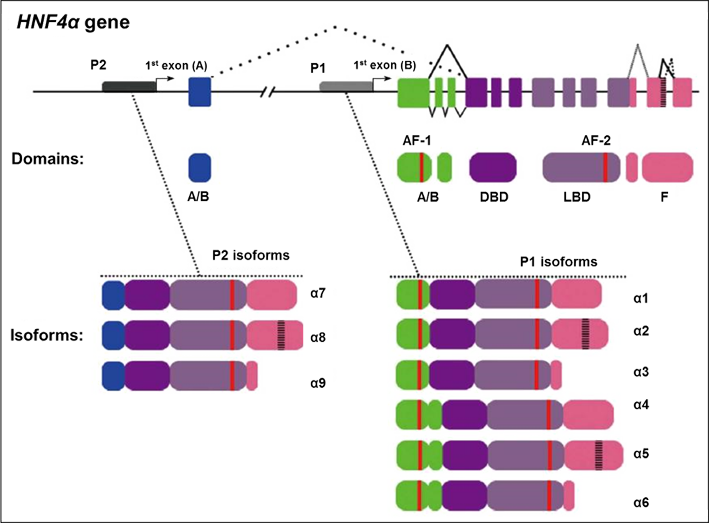
The different promoters are used in different tissues and at different times during development, and the encoded protein controls the expression of several genes. Multiple isoforms are proposed to exist in mammals and are thought to have different physiological roles in development and differentiation (Walesky and Apte, 2015).
Proteins
Description
HNF4A consists of six structural domains named A-F that are responsible for specific functions: an N-terminal activation domain (AF-1, also referred to as A/B domain); a zinc finger domain that serves as the DNA-binding domain (DBD; C domain) which is highly conserved among NRs; a putative ligand binding domain (LBD; E domain); and a C-terminal domain which functions in homodimerization and activation (AF-2), and a repressor region (F domain) that inhibits access of coactivators to AF-2, and possibly to other regions (Walesky and Apte, 2015). The DBD consists of two zinc fingers, and 12 alpha helices that create a hydrophobic pocket for ligand binding (Duda et al., 2004) (Figure 2).
HNF4A binds DNA regulatory elements as a homodimer. E domain (Ligand Binding Domain-LBD) appears to be critical for homodimerization and to play a role in preventing heterodimerization with other NRs such as RXR or RAR (Bogan et al., 2000). HNF4A binds DNA response elements consisting of direct repeats. It can also bind several different co-activators (such as GRIP1, NCOA1, NCOA2, NCOA3, (SRC1, 2 and 3), CREBBP (CBP/P300), PPARGC1A (PGC1)) (MartÍnez-Jiménez et al., 2006).

Expression
Localisation
Function
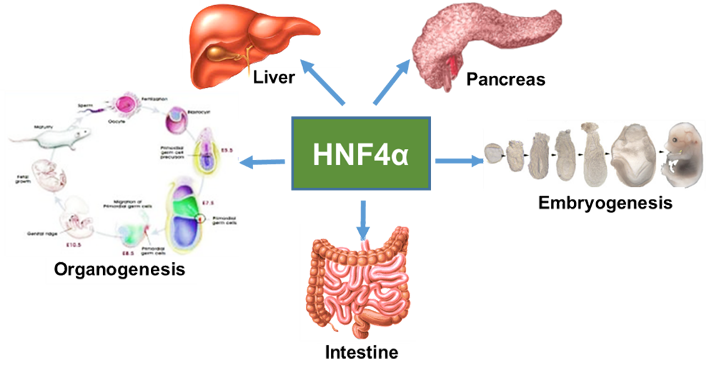
Figure 3 HNF4A can regulate different cell functions. HNF4A is an important regulator with a strong impact on endodermal development, organ differentiation and metabolism. Methylation and SUMOylation are the other post-translational mechanisms that regulate HNF4A activity. Methylation of the DNA-binding domain of HNF4A by PRMT1 (Protein Arginine Methyltransferase 1), whose methylation activity on HIST4H4 (histone H4 )strongly correlates with the induction of HNF4A target genes in differentiating enterocytes, increased transcriptional activity of HNF4A (Barrero and Malik, 2006). SUMOylation is the other mechanism that regulates HNF4A protein stability and potentially DNA binding activity (Zhou et al., 2012).
As a transcription factor, HNF4A was first identified to be bound to DNA sites required for the transcription of two liver-specific genes: TTR (transthyretin) and APO3 (apolipoprotein CIII) (Sladek et al., 1990). An increasing number of studies implicate a vital role of HNF4A in the development of the liver, intestine and pancreas, differentiation and homeostasis (Figure 3).
Liver
HNF4A has been shown to be required for hepatocyte differentiation and development of the liver. The expression of HNF4A mRNA in post-implantation mouse embryos was found in the primary endoderm starting at day 4.5. From day 8.5, HNF4A mRNA was detected in embryonic tissues in the liver diverticulum and the hindgut. At later times, HNF4A transcripts were found in the mesonephric tubules, pancreas, stomach, intestine, and in the metanephric tubules of the developing kidney (Duncan et al., 1994). Additionally, conditional genetic removal of HNF4A in the liver resulted in disorganization of morphological and functional differentiation in the hepatic epithelium (Parviz et al., 2003). In hepatocyte-specific knock-out model, lack of HNF4A expression in the liver caused impaired lipid metabolism and gluconeogenesis (Hayhurst et al., 2001), indicating that HNF4A controls genes involved in hepatic lipid and glucose metabolism, hereby influencing the hepatocyte metabolome (Parviz et al., 2003). On the other hand, homozygous loss of HNF4A gene resulted in embryonic lethality (Chen et al., 1994.). HNF4A was also found to be related to epithelial cell adhesion and junction formation in the fetal liver (Battle et al., 2006). Re-expression of HNF4A was shown to induce cells to reform junctions and express hepatocyte marker genes in a dedifferentiated hepatoma cell line (Späth and Weiss, 1997; Späth and Weiss, 1998). More recently, HNF4A was implicated in the differentiation of hepatic stellate cells into hepatocyte-like cells (Liu et al., 2015). Furthermore, in non-hepatic cells, ectopic over expression of HNF4A in fibroblasts induced mesenchymal to epithelial transition (EMT), indicating that HNF4A is a dominant regulator of the morphogenetic parameters that form the epithelial phenotype (Parviz et al., 2003.).
More recently, Yang et al. showed that during EMT, there is a negative feedback loop between Wnt-β-catenin signaling and HNF4A, both in vivo and in vitro. Restoring HNF4A expression was suggested as a method to inhibit invasion in hepatocellular carcinoma by preventing EMT (Yang et al., 2013).
Intestine
HNF4A plays essential roles in the intestine, particularly in epithelial cell function, differentiation and normal colon physiology (Chellappa et al., 2012).
To directly address the role of HNF4A in development of the colon, an epithelial-specific knockout model of HNF4A was created in mice by using the Cre-loxP system. Examination of the embryos revealed that HNF4A ablation disrupts development of normal crypt topology in fetal colons, and reduced goblet cell maturation (Garrison et al., 2006). In adult small intestine, HNF4A was shown to play a critical role in the homeostasis of intestinal epithelium, in the epithelial cell architecture, and in the barrier function of the intestine. Loss of intestinal HNF4A affected the Wnt/β-catenin signaling pathway, and destabilized adherens and tight junctions (Cattin et al., 2009). Recently, Vuong et al. suggested that HNF4A isoforms play distinct roles in colon cancer, which could be caused by differential interactions with the Wnt/β-catenin/TCF4 and AP-1 pathways (Vuong et al., 2015).
Importance of HNF4A in the formation of tight epithelial barrier to exert a selective barrier function in relation to apical-to-basal transport was also shown in a coculture system (Lussier et al., 2008). Besides nutrient metabolism (Black, 2007) and protection against pathogens (Laukoetter et al., 2006), another function of the epithelial barrier is the control of appropriate ion selectivity. Loss of this function can lead to deregulation of colonic inflammatory homeostasis and inflammatory bowel disease (IBD) (Darsigny et al., 2009).
HNF4A appears to play a protective role against IBD, an important risk factor for colorectal cancer. In patients with IBD, HNF4A expression was significantly decreased. Accordingly, intestine specific HNF4A-null mice exhibited increased susceptibility to dextran sulfate sodium (DSS) induced IBD with increased intestinal permeability, suggesting that HNF4A was required to protect the epithelium during experimental colitis (Ahn et al., 2008).
HNF4A was also addressed as a crucial transcription factor in the differentiation of intestinal cells. Intestine specific knockout of HNF4A in the adult mouse enhanced proliferation in crypts, and increased number of mucus secreting cells (Cattin et al., 2009). HNF4A was also shown to be involved in the regulation of genes involved in the enterocyte differentiation and in lipid metabolism (Béaslas et al., 2008; Stegmann et al. 2006; Cattin et al., 2009). To address the role of HNF4A in differentiation dependent transcription in human colonic epithelial cells, Boyd et al. performed a genome-wide identification of promoters that are occupied by HNF4A in vivo. The analysis revealed that HNF4A was mostly associated with the promoter regions involved in transport and metabolism. HNF4A was found to regulate differentiation dependent transcription by regulating the expression of HNF1A and CDX2, transcription factors necessary for the expression of many intestinal genes important in the development and differentiation program in the colon (Boyd et al., 2009).
Pancreas
HNF4A activity is essential for β-cell function through the regulation of several genes, including those involved in metabolism-secretion coupling, such as glucose transporter-2, L-pyruvate kinase, aldolase B, 2-oxoglutarate dehydrogenase E1 subunit, mitochondrial uncoupling protein-2 (Wang et al., 2000) and the potassium channel subunit Kir6.2 (Gupta et al., 2005), as well as the INS (insulin gene) (Wang et al, 2000; Bartoov-Shifman et al., 2002). In pancreatic β-cells, HNF4A maintains glucose homeostasis (Marcil et al., 2015; Wang et al., 2000). Gene expression analysis in type 2 diabetes (T2D) patients compared to normal glucose-tolerant controls revealed that HNF4A mRNA level decreased in pancreatic β-cells of T2D patients (Gunton et al., 2005). Moreover, HNF4A mutations were implicated in Mature-Onset Diabetes of the Young 1 (MODYI), a dominantly inherited atypical subgroup of T2D characterized by decreased glucose stimulated insulin secretion in pancreatic β-cells (Yamagata et al., 1996). More recently, it was suggested lack of HNF4A function disrupts Ca2+ signaling and insulin release in β-cells of patients with MODYI through altered endoplasmic reticulum (ER) Ca2+ homeostasis (Moore et al., 2016).
Homology

Mutations
Note
Germinal
In early disease onset, three mutations affecting HNF4A function were identified (D126Y; D126H; R154Q) (Aguilar-Salinas et al., 2001). In late onset, missense mutations were identified in the LBD (R323H) (Price et al., 2000) and the F domain (V393I); the latter resulted in a reduced transactivational activity (Hani et. al., 1998). V255M mutation has also been shown to reduce transactivation, albeit modestly (Mohlke and Boehnke, 2005).
Thirteen single nucleotide polymorphisms (SNPs) in the P2 promoter, three of which were identified in Pima Indians, have also been associated with T2D (Muller et al. 2005). A 7 bp deletion in the Sp1 site of the P1 promoter was identified in type II diabetic nephropathic Caucasian patients (Price et al., 2000).
Factor VII deficiency:
Homozygous mutation for a T to G transversion at nucleotide -61 position in the factor VII promoter was shown to disrupt HNF4A binding and result in a significant reduction in factor VII promoter activity (Arbini et al., 1997).
Maturity-onset diabetes of the young, type 1 (MODY1):
Mutations in the HNF4A coding region and promoter were shown to be directly implicated in MODY1 in several different human populations (Ryffel, 2001).
Two deletion mutations (F75fsdelT and K99fsdelAA) generate truncated proteins lacking part of the zinc finger domain essential for DNA binding. An in-frame insertion mutation, V328ins, located in the LBD, was suggested to alter the highly conserved structural organization of the protein. R154X and Q268X nonsense mutants retain the DNA binding domain but lack a substantial portion of the potential ligand binding part (Ryffel, 2001). R127W and E276Q missense mutations were reported to result in a significant loss of HNF4A activity (Lausen et al., 2000). The HNF4A mutations G115S (Oxombre et al., 2004.); R127W (Furuta et al., 1997); R244Q (Hara et al., 2002.); R324H (Price et al., 2000.); IVS5-2delA (Barrio et al., 2002) have also been associated with MODY1. Of note, -146T->C in the P2 promoter region was reported to be associated with MODY1 by affecting PDX1 (IPF-1) binding to DNA (Thomas et al., 2001).
Familial Hyperinsulinism due to HNF4A deficiency (FHI-HNF4A):
Familial hyperinsulinism due to HNF4A deficiency is a form of diazoxide-sensitive diffuse hyperinsulinism (DHI), characterized by macrosomia, transient or persistent hyperinsulinemic hypoglycemia (HH), responsiveness to the diazoxide and a propensity to develop MODY1 (Glaser, 2013). The transmission is autosomal dominant with variable penetrance (Pearson et al., 2007; Kapoor et al., 2008).
Implicated in
Article Bibliography
| Pubmed ID | Last Year | Title | Authors |
|---|---|---|---|
| 8978290 | 1997 | Severe factor VII deficiency due to a mutation disrupting a hepatocyte nuclear factor 4 binding site in the factor VII promoter. | Arbini AA et al |
| 18755805 | 2008 | Transcriptome response of enterocytes to dietary lipids: impact on cell architecture, signaling, and metabolism genes. | Béaslas O et al |
| 17052457 | 2006 | Two functional modes of a nuclear receptor-recruited arginine methyltransferase in transcriptional activation. | Barrero MJ et al |
| 12050210 | 2002 | Nine novel mutations in maturity-onset diabetes of the young (MODY) candidate genes in 22 Spanish families. | Barrio R et al |
| 22085832 | 2011 | Nuclear receptor HNF4α binding sequences are widespread in Alu repeats. | Bolotin E et al |
| 19761587 | 2009 | Mapping of HNF4alpha target genes in intestinal epithelial cells. | Boyd M et al |
| 19898610 | 2009 | Loss of hepatocyte-nuclear-factor-4alpha affects colonic ion transport and causes chronic inflammation resembling inflammatory bowel disease in mice. | Darsigny M et al |
| 14982928 | 2004 | Structural basis for HNF-4alpha activation by ligand and coactivator binding. | Duda K et al |
| 17214554 | 2007 | Tissue-specific transcription factor HNF4alpha inhibits cell proliferation and induces apoptosis in the pancreatic INS-1 beta-cell line. | Erdmann S et al |
| 9313765 | 1997 | Organization and partial sequence of the hepatocyte nuclear factor-4 alpha/MODY1 gene and identification of a missense mutation, R127W, in a Japanese family with MODY. | Furuta H et al |
| 16096055 | 2005 | Loss of ARNT/HIF1beta mediates altered gene expression and pancreatic-islet dysfunction in human type 2 diabetes. | Gunton JE et al |
| 16351573 | 2006 | Phosphorylation of Ser158 regulates inflammatory redox-dependent hepatocyte nuclear factor-4alpha transcriptional activity. | Guo H et al |
| 15761495 | 2005 | The MODY1 gene HNF-4alpha regulates selected genes involved in insulin secretion. | Gupta RK et al |
| 12413008 | 2002 | Maturity-onset diabetes of the young resulting from a novel mutation in the HNF-4alpha gene. | Hara K et al |
| 18356407 | 2008 | The diabetic phenotype in HNF4A mutation carriers is moderated by the expression of HNF4A isoforms from the P1 promoter during fetal development. | Harries LW et al |
| 22340507 | 2012 | Inhibition of hepatitis B Virus replication by hepatocyte nuclear factor 4-alpha specific short hairpin RNA. | He F et al |
| 9126270 | 1997 | Serine/threonine phosphorylation of orphan receptor hepatocyte nuclear factor 4. | Jiang G et al |
| 18268044 | 2008 | Persistent hyperinsulinemic hypoglycemia and maturity-onset diabetes of the young due to heterozygous HNF4A mutations. | Kapoor RR et al |
| 16462161 | 2006 | Regulation of the intestinal epithelial barrier by the apical junctional complex. | Laukoetter MG et al |
| 10606640 | 2000 | Naturally occurring mutations in the human HNF4alpha gene impair the function of the transcription factor to a varying degree. | Lausen J et al |
| 16891307 | 2006 | Underexpressed coactivators PGC1alpha and SRC1 impair hepatocyte nuclear factor 4 alpha function and promote dedifferentiation in human hepatoma cells. | Martínez-Jiménez CP et al |
| 15794920 | 2005 | The role of HNF4A variants in the risk of type 2 diabetes. | Mohlke KL et al |
| 16186411 | 2005 | Variants in hepatocyte nuclear factor 4alpha are modestly associated with type 2 diabetes in Pima Indians. | Muller YL et al |
| 15233628 | 2004 | The G115S mutation associated with maturity-onset diabetes of the young impairs hepatocyte nuclear factor 4alpha activities and introduces a PKA phosphorylation site in its DNA-binding domain. | Oxombre B et al |
| 17407387 | 2007 | Macrosomia and hyperinsulinaemic hypoglycaemia in patients with heterozygous mutations in the HNF4A gene. | Pearson ER et al |
| 10551874 | 1999 | Mitogen-activated protein kinase regulates transcription of the ApoCIII gene. Involvement of the orphan nuclear receptor HNF4. | Reddy S et al |
| 19406499 | 2009 | Interaction between HNF4A polymorphisms and physical activity in relation to type 2 diabetes-related traits: results from the Quebec Family Study. | Ruchat SM et al |
| 11463573 | 2001 | Mutations in the human genes encoding the transcription factors of the hepatocyte nuclear factor (HNF)1 and HNF4 families: functional and pathological consequences. | Ryffel GU et al |
| 2279702 | 1990 | Liver-enriched transcription factor HNF-4 is a novel member of the steroid hormone receptor superfamily. | Sladek FM et al |
| 16868071 | 2006 | Metabolome, transcriptome, and bioinformatic cis-element analyses point to HNF-4 as a central regulator of gene expression during enterocyte differentiation. | Stegmann A et al |
| 17389749 | 2007 | Phosphorylation of a conserved serine in the deoxyribonucleic acid binding domain of nuclear receptors alters intracellular localization. | Sun K et al |
| 16938803 | 2006 | Unraveling the complex genetics of familial combined hyperlipidemia. | Suviolahti E et al |
| 25700366 | 2015 | Role of hepatocyte nuclear factor 4α (HNF4α) in cell proliferation and cancer. | Walesky C et al |
| 8945471 | 1996 | Mutations in the hepatocyte nuclear factor-4alpha gene in maturity-onset diabetes of the young (MODY1). | Yamagata K et al |
| 21708125 | 2011 | Multiple post-translational modifications in hepatocyte nuclear factor 4α. | Yokoyama A et al |
| 11811951 | 2002 | Transcriptional control of the human aldehyde dehydrogenase 2 promoter by hepatocyte nuclear factor 4: inhibition by cyclic AMP and COUP transcription factors. | You M et al |
| 22505616 | 2012 | SUMOylation of HNF4α regulates protein stability and hepatocyte function. | Zhou W et al |
Other Information
Locus ID:
NCBI: 3172
MIM: 600281
HGNC: 5024
Ensembl: ENSG00000101076
Variants:
dbSNP: 3172
ClinVar: 3172
TCGA: ENSG00000101076
COSMIC: HNF4A
RNA/Proteins
Expression (GTEx)
Pathways
Protein levels (Protein atlas)
PharmGKB
| Entity ID | Name | Type | Evidence | Association | PK | PD | PMIDs |
|---|---|---|---|---|---|---|---|
| PA24684 | AKT1 | Gene | Pathway | associated | |||
| PA443340 | Anemia | Disease | ClinicalAnnotation | associated | PD | 24193570 | |
| PA444065 | Epilepsy | Disease | ClinicalAnnotation | associated | PK | PD | 24384557, 26213157, 27610747, 28837897 |
| PA445046 | Nasopharyngeal Neoplasms | Disease | ClinicalAnnotation | associated | PD | 24193570 | |
| PA447230 | HIV | Disease | ClinicalAnnotation | associated | PK | 26774523 | |
| PA448785 | carbamazepine | Chemical | ClinicalAnnotation | associated | PK | PD | 24384557, 28837897 |
| PA449383 | docetaxel | Chemical | ClinicalAnnotation | associated | PD | 24193570 | |
| PA449441 | efavirenz | Chemical | ClinicalAnnotation | associated | PK | 26774523 | |
| PA450164 | lamotrigine | Chemical | ClinicalAnnotation | associated | PK | PD | 26213157, 27610747 |
| PA451906 | warfarin | Chemical | ClinicalAnnotation | associated | PD | 25356900 |
References
| Pubmed ID | Year | Title | Citations |
|---|---|---|---|
| 37820926 | 2024 | Insulin Determines Transforming Growth Factor β Effects on Hepatocyte Nuclear Factor 4α Transcription in Hepatocytes. | 0 |
| 38058101 | 2024 | Association between HNF4A rs1800961 polymorphisms and gallstones in a Taiwanese population. | 0 |
| 38237865 | 2024 | TRIB3-TRIM8 complex drives NAFLD progression by regulating HNF4α stability. | 0 |
| 38433330 | 2024 | Functional characterization of HNF4A gene variants identify promoter and cell line specific transactivation effects. | 0 |
| 38582490 | 2024 | Krüppel-like factor 10 protects against metabolic dysfunction-associated steatohepatitis by regulating HNF4α-mediated metabolic pathways. | 0 |
| 38855865 | 2024 | Molecular mechanism of HNF-1A-mediated HNF4A gene regulation and promoter-driven HNF4A-MODY diabetes. | 0 |
| 38965210 | 2024 | Transposable elements-mediated recruitment of KDM1A epigenetically silences HNF4A expression to promote hepatocellular carcinoma. | 0 |
| 37820926 | 2024 | Insulin Determines Transforming Growth Factor β Effects on Hepatocyte Nuclear Factor 4α Transcription in Hepatocytes. | 0 |
| 38058101 | 2024 | Association between HNF4A rs1800961 polymorphisms and gallstones in a Taiwanese population. | 0 |
| 38237865 | 2024 | TRIB3-TRIM8 complex drives NAFLD progression by regulating HNF4α stability. | 0 |
| 38433330 | 2024 | Functional characterization of HNF4A gene variants identify promoter and cell line specific transactivation effects. | 0 |
| 38582490 | 2024 | Krüppel-like factor 10 protects against metabolic dysfunction-associated steatohepatitis by regulating HNF4α-mediated metabolic pathways. | 0 |
| 38855865 | 2024 | Molecular mechanism of HNF-1A-mediated HNF4A gene regulation and promoter-driven HNF4A-MODY diabetes. | 0 |
| 38965210 | 2024 | Transposable elements-mediated recruitment of KDM1A epigenetically silences HNF4A expression to promote hepatocellular carcinoma. | 0 |
| 36872411 | 2023 | TUBB2B facilitates progression of hepatocellular carcinoma by regulating cholesterol metabolism through targeting HNF4A/CYP27A1. | 1 |
Citation
Sinem Tunçer ; Sreeparna Banerjee
HNF4A (Hepatocyte Nuclear Factor 4 alpha)
Atlas Genet Cytogenet Oncol Haematol. 2016-06-01
Online version: http://atlasgeneticsoncology.org/gene/44014/hnf4a-(hepatocyte-nuclear-factor-4-alpha)
