Bone: Angiosarcoma
2008-02-01 Sofie LJ Verbeke , Judith VMG Bovée Affiliation1.Department of Pathology, Leiden University Medical Center, Leiden, The Netherlands
2.Department of Pathology, Leiden University Medical Center, Leiden, The Netherlands. [email protected]
Summary
Note
Variable proliferation of tumour cells which show an endothelial phenotype
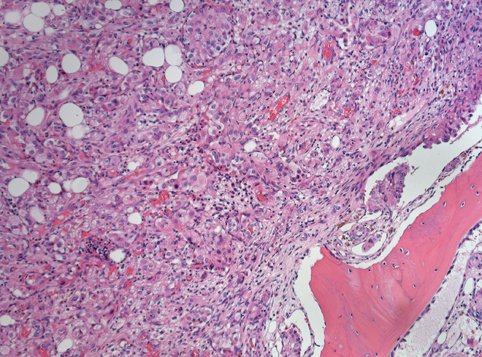
Microscopy - PMVTB: epithelioid morphology - HE (10x)
Abstract
Review on Angiosarcoma of bones, with data on clinics, and the genes involved.
Classification
Note
Angiosarcoma is a high grade primary malignant vascular tumour of bone as recognized in the 2013 World Health Organization (WHO) classification. It can sometimes be difficult to histologically distinguish angiosarcoma from Epithelioid haemangioendothelioma as they can show overlapping morphology , but recently multiple fusion genes and mutations have been identified that can help in the differential diagnosis. The prognosis for angiosarcoma is generally very poor.
Clinics and Pathology
Etiology
Although there is in a very small percentage an association between angiosarcoma and radiation, the etiology of the majority of angiosarcomas remains unknown.
Epidemiology
Angiosarcoma is extremely rare and represent less than 1% of primary malignant bone tumours.
Clinics
Angiosarcomas of bone arise in adults and have a wide, nearly equal age distribution from the second till eighth decade. In contrast to epithelioid haemangioendotheliomas have a tendency to occur in young adults (second - third decade). It seems that males are slightly more affected than females.
Angiosarcomas of bone have a wide skeletal distribution; however, they have a tendency to occur in the short and long tubular bones of the extremities of which the femur, tibia and humerus are most often affected. In contrast to the soft tissue counterpart, one third of the tumours are multifocal, involving two or more distant bones.
In general, malignant vascular tumours of bone present as a painful mass. Depending on the size and localization of the tumour, neurological deficit or other symptoms can occur.
Angiosarcomas of bone have a wide skeletal distribution; however, they have a tendency to occur in the short and long tubular bones of the extremities of which the femur, tibia and humerus are most often affected. In contrast to the soft tissue counterpart, one third of the tumours are multifocal, involving two or more distant bones.
In general, malignant vascular tumours of bone present as a painful mass. Depending on the size and localization of the tumour, neurological deficit or other symptoms can occur.
Pathology
Similar to the soft tissue counterpart ( Angiosarcoma of the soft tissue), malignant vascular tumours of bone have variable histological features, varying from well differentiated to poor differentiated lesions. To a certain extent, the formation of vascular channels is one of the most common referred hallmarks of this tumour. These lesions show a variable amount of mitotic features, atypical mitotic figures, necrosis and cytonuclear atypia. Cells can have a spindle cell or an epithelioid morphology.
Treatment
Prefered therapy, whenever possible, is surgical intervention (wide en bloc resection or amputation). Moreover radiotherapy is also applied, although there is no general rule for treatment. Treatment depends upon multiple factors, such as age, size, location of the tumour, and the extent of disease. Chemotherapy is used, although its usefulness is not well documented.
Prognosis
Angiosarcoma of bone has 33% 5 year overall survival. When primary angiosarcoma of bone exhibits more than 3 mitosis per 10 HPF with prominent nucleolus and fewer than five eosinophilic granulocytes per 10 HPF they will likely have a worse prognosis.
Genetics
Note
Recently mutations and amplifications have been described for angiosarcoma, most of these aberrations occur in the tyrosine-kinase pathways specific for vascular receptors. Currently PTPRB, PLCG1, CIC, KDR, and FLT4 mutations and MYC amplifications. have been described for angiosarcoma. There is no evidence that there is a molecular genetic difference between angiosarcoma of bone and angiosarcoma occurring in soft tissue.
Article Bibliography
| Pubmed ID | Last Year | Title | Authors |
|---|---|---|---|
| 24384851 | 2014 | Malignant vascular tumors--an update. | Antonescu C et al |
| 24633157 | 2014 | Recurrent PTPRB and PLCG1 mutations in angiosarcoma. | Behjati S et al |
| 12874764 | 2003 | Vascular tumors of bone: A study of 17 cases other than ordinary hemangioma, with an evaluation of the relationship of hemangioendothelioma of bone to epithelioid hemangioma, epithelioid hemangioendothelioma, and high-grade angiosarcoma. | Evans HL et al |
| 11287811 | 2001 | Total resection of an intracerebral hemangioendothelioma in an infant. Case report and review of the literature. | Hodaie M et al |
| 26735859 | 2016 | Recurrent CIC Gene Abnormalities in Angiosarcomas: A Molecular Study of 120 Cases With Concurrent Investigation of PLCG1, KDR, MYC, and FLT4 Gene Alterations. | Huang SC et al |
| 17998731 | 2007 | Post-irradiation angiosarcoma of bone. | Mittal S et al |
| 11236956 | 2001 | Epithelioid vascular tumors of bone: a review and proposal of a classification scheme. | O'Connell JX et al |
| 16938576 | 2006 | Chromosome analysis and molecular cytogenetic investigations of an epithelioid hemangioendothelioma. | Tsarouha H et al |
| 21323951 | 2011 | Distinct histological features characterize primary angiosarcoma of bone. | Verbeke SL et al |
| 11201031 | 2000 | Malignant vascular lesions of bone: radiologic and pathologic features. | Wenger DE et al |
Citation
Sofie LJ Verbeke ; Judith VMG Bovée
Bone: Angiosarcoma
Atlas Genet Cytogenet Oncol Haematol. 2008-02-01
Online version: http://atlasgeneticsoncology.org/solid-tumor/5359/bone-angiosarcoma
Historical Card
0000-00-00 Bone: Angiosarcoma by David G.P. van Ijzendoorn,Judith V.M.G. Bovée Affiliation
Department of Pathology, Leiden University Medical Center, Leiden, The Netherlands. [email protected]
