Uterus: Leiomyoma
2007-05-01 Allison M. Lynch , Cynthia C Morton Affiliation1.Clinical Research Assistant, Brigham, Womens Hospital, Harvard New Research Building, 77 Avenue Louis Pasteur, Boston, MA 02115.
2.Dip. Scienze e Tecnologie Biomediche, Sezione di Biologia e Genetica, Università di Cagliari, Cittadella Universitaria, 09142 Monserrato (CA), Italy
Summary
Note
Uterine Leiomyomata (UL), benign smooth muscle tumors of the uterus, are the most common pelvic tumors in women. UL are symptomatic in approximately 25% of reproductive age females and are the primary indicator for hysterectomy in the United States accounting for over 200,000 procedures annually. Careful pathologic examination of the uterus shows over 75% of reproductive age females have UL with the average affected uterus containing six to seven fibroids. UL are frequent in women older than 30 years of age, very rare in woman below the age of 18, and tend to regress after menopause. Rarely are UL estimated to become malignant leiomyosarcoma. They are steroid-hormone dependent tumors and especially sensitive to estrogen and progesterone actively impacting their overall growth and development.
Classification
Note
Classification of leiomyomas is based on location within the uterus (see figures below).
Uterine Layer
Subserous: located just beneath the serosal surface. They grow out toward the peritoneal cavity, and can be sessile (broad-based) or pedunculated (attached to the surface by a narrow stalk). The pedunculated ones may attach themselves to adjacent structures like the bowel, omentum or mesentery, and develop a secondary blood supply, loosing its primary uterine blood supply (parasitic leiomyoma). Subserous leiomyomas may also extend into the broad ligament (intraligamentary leiomyomas). Intramural: are the most common type of UL, found primarily within the thick myometrium. Submucous: are the most symptomatic form of UL, located beneath the endometrium (uterine mucosa). Like subserosal UL, they may be sessile or pedunculated. The pedunculated nodules may protrude through the cervical os, and may undergo torsion, infarction, and separation from the uterus. Submucous leiomyoma are often associated with an abnormality of the endometrium, resulting in a disturbed bleeding pattern.
Uterine Layer
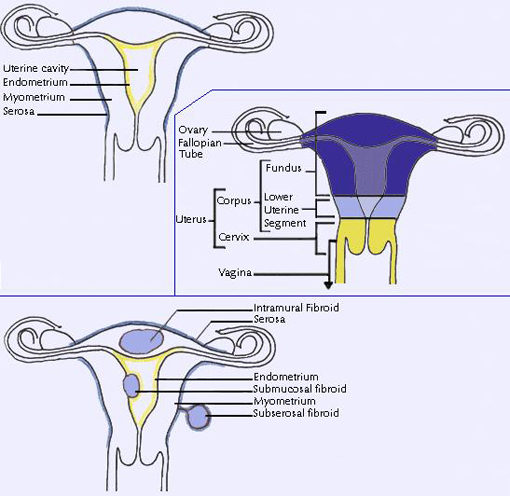
(Source of images: http://www.fibroids.net/aboutfibroids.html#basic )
Clinics and Pathology
Epidemiology
Ethnic predisposition studies show leiomyomas are more frequent (from three to nine fold) in women of African origin than women of other ethnic groups. African American women are reported to have an earlier age of UL diagnosis, larger and more abundant tumors, greater symptom severity and higher rates of hysterectomy. Risk factors for UL include early age of menarche, nulliparity, oral contraceptive use and obesity.
Clinics
Clinical presentation depends upon size, location and number of lesions. UL may occur singly but often are multiple, with variations in size. They may manifest with profuse menstrual bleeding, pelvic pain and pressure, and reproductive dysfunction causing significant medical and social morbidity. UL may be a cause of pregnancy complications, such as abortion, hemorragic degeneration, disseminated intravascular coagulation, hemoperitoneum, premature rupture of membranes, dystocia, inversion of the uterus, antepartum and postpartum hemorrhage, breech presentation, placental abruption and postpartum sepsis. They are steroid-hormone dependent and have high estrogen concentrations, elevated numbers of estrogen receptors and more bound estrogen. UL increase in size when exposed to high estrogen levels, such as during the reproductive years and diminish in the presence of low estrogen levels, following menopause or during GnRH agonist therapy. Having more progesterone receptors than normal myometrium, UL also grow in the presence of high progesterone concentrations. Growth hormone (GH) and prolactin (PRL) are thought to promote UL growth, but require further investigation.
Pathology
Leiomyomas are dense, well-circumscribed nodules consisting of myometrial-derived smooth muscle cells and extracellular matrix (e.g. collagen, fibronectin, proteoglycan). The cut surfaces are white to tan in color, with a whorled trabecular pattern. The appearance is often altered by degenerative changes.
Microscopically, they consist of whorled, anastomosing fascicles of uniform, spindle-shaped, smooth muscle cells. Cells have indistinct borders and abundant fibrillar, eosinophilic cytoplasm. The nuclei are elongated and have finely dispersed chromatin. They may show areas of hemorrage, as well as cystic degeneration and microcalcification in a minority of lesions.
Despite the variety in the histologic subtypes of leiomyomas, all are grossly similar. In addition to histologically typical UL, several other specific subtypes are distinguished, some of which are very rare:
Cellular leiomyoma (composed of densely cellular fascicles of smooth muscle with little intervening collagene). Atypical leiomyoma (containing atypical cells, clustered or distributed through the lesion). Epithelioid leiomyoma (composed of round or poligonal cells rather than spindle-shaped. This subtype includes leiomyoblastoma, clear cell leiomyoma, plexyform leiomyoma). Myxoid leiomyoma (containing abundant amorphous myxoid substance between the smooth muscle cells). Vascular leiomyoma (containing dense proliferations of large, caliber, thick-walled vessels). Lipoleiomyoma (consisting of a mixture of mature adipocytes and smooth muscle cells). Leiomyoma with tubules (containing tubular structures). Benign metastasizing leiomyoma (occurrence of multiple smooth-muscle nodules, most often located in the lung after previous hysterectomy).
Microscopically, they consist of whorled, anastomosing fascicles of uniform, spindle-shaped, smooth muscle cells. Cells have indistinct borders and abundant fibrillar, eosinophilic cytoplasm. The nuclei are elongated and have finely dispersed chromatin. They may show areas of hemorrage, as well as cystic degeneration and microcalcification in a minority of lesions.
Despite the variety in the histologic subtypes of leiomyomas, all are grossly similar. In addition to histologically typical UL, several other specific subtypes are distinguished, some of which are very rare:
microscopic pathology: see WebPath leiomyoma
Treatment
Only UL that are symptomatic, enlarge rapidly, or pose diagnostic problems, are typically removed. The traditional and most definitive treatment for UL is hysterectomy (surgical removal of the uterus). Myomectomy is another surgical option for women with fewer and smaller tumors wanting to remove UL, yet maintain fertility. Uterine Artery Embolization (UAE) is a radiological alternative especially effective at treating intramural UL that are difficult to access surgically, yet the impact on pregnancy and future fertility is unclear. Despite being expensive and having limited availability, a noninvasive thermoablative procedure known as MRI-guided focused ultrasound (MRIgFUS) has recently been shown to target specific UL effectively and decrease recovery time. Certain medications, such as gonadotropin releasing hormone agonists (GnRHa), can alleviate UL symptoms by decreasing estrogen levels to a menopausal-like state. However, current medical therapies cannot prevent recurrence.
Cytogenetics
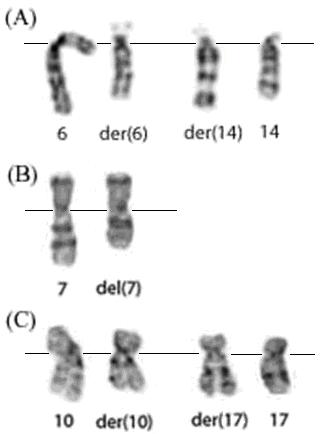
Karyotypic representation of specific chromosomal aberrations in UL. (Modified from Lobel et al., 2006) .
(A): t(6;14)(p21;q24) has been observed in UL and other mesenchymal tumors, and implicates HMGA1 at band 6p21.
(B): Tumors with del(7)(q22q32) abnormalities are generally smaller in size than tumors with t(12;14) translocations.
(C): A minor cytogenetic subgroup of UL, t(10;17)(q22-q24;q21-q22), has been observed in a subset of tumors and involved the MORF gene at the 10q22 breakpoint.
Cytogenetics morphological
It is found in approximately 20% of the abnormal cases.
The t(12;14)(q14-15;q22-24) translocation is the first chromosome alteration reported in uterine leiomyoma.
It may be observed as the sole cytogenetic abnormality, or together with other clonal changes, such as del(7q).
The chromosome segment 12q14-15 may be rearranged with other translocation partners (such as chromosomes X, 2, 8, 9, 10, 22) or may undergo pericentric inversion.
Myoma cells with this abnormality are responsive to the immortalization by the early region of the SV40 genome.
In this subgroup dysregulation of the HMGA2 (formerly HMGIC) gene located at 12q15 has been observed.
Chromosome 12 breakpoint is often located 10 kb up to 100 kb 5 to HMGA2, and in a majority of cases there is no fusion transcript. However, in a number of cases the gene is altered:
It is found in approximately 17% of the karyotypically abnormal cases.
It may be observed as the sole cytogenetic abnormality, or together with other changes. It is often associated with t(12;14) or alterations of the chromosome segment 12q14-15.
The del(7q) clone is almost invariably found together with a normal clone.
A few cases with translocations involving 7q22 have been described.
Myoma cells with del(7q) are not responsive to the immortalization by the early region SV40 virus, unless they also contain 12q14-15 abnormalities.
Myoma with del(7q) tend to be smaller than those showing 12q14-15 abnormalities.
Conflicting minimal deletion regions have been proposed by multiple loss-of-heterozygosity (LOH) analyses using polymorphic microsatellite markers. The resultant tumor suppressor candidate genes, including CUTL1, ORL5L, PAI1, PCOLCE and LHFPL3, were not consistently altered in expression. Most recently, a study using 7q tiling path CGH microarrays confined the minimal deletion region to 2.79 Mb at 7q22 and also proposed a second region of loss at 7q34. However, no pathogenic coding variation was detected in the genes encompassed by the proposed region. At the present time the tumor-suppressor gene(s) responsible for del(7q) fibroid growth has not been identified despite much effort. This raises the possibility that a mechanism other than loss of tumor-suppressor gene function could be responsible for development of del(7q) fibroid tumors.
Aberrations of the 6p21, including deletions, translocations, and inversions are found in less than 10% of the abnormal cases.
6p21 rearrangements may be observed as the sole cytogenetic abnormality, or together with other clonal changes. Simple and complex rearrangements of 6p21 have been observed. Complex rearrangements are sometimes definable only by FISH analysis.
The most frequent translocation partners are chromosomes 1, 2, 4, 10 and 14 with rearrangements including t(1;6)(q23;p21), t(6;14)(p21;q24), and t(6;10)(p21;q22).
HMGA1 (formerly HMGIY) (6p21.3) is the pathogenic sequence. No hybrid gene has been described yet.
A genomic PAC clone containing the gene spans the 6p21.3 breakpoint. The breakpoint seems to be extragenic, located within an 80 kb region 3 of HMGA1.
One case of aberrant transcript with truncation of 1295 bp from the 3 UTR has been described.
This subgroup is characterized by an almost complete loss of the short arm of chromosome 1. Rearrangements are often observed with additional cytogenetic abnormalities such as the loss of chromosomes 19 and/or 22.
Transcriptional profiles with loss of 1p in UL resemble those of leiomyosarcoma suggesting a similar pathway for tumorigenesis. LOH analysis of polymorphic microsatellites confirmed deletion of the 1p region.
Note
Correlations between cytogenetics and clinical phenotype:
Myoma location / incidence of abnormal karyotype: intramural - 35%; subserosal - 29%; submucosal - 12%. Type of chromosome abnormality / tumor mean size: tumors with normal karyotype - 5.4 cm; tumors with del(7q) - 5cm; tumors with t(12; 14) rearrangements - 8.5 cm.
Genetics
Note
Familial aggregation and twin studies support the heritability of these tumors. First-degree relatives of women with UL are 2.5 times more likely to develop these tumors than women with unaffected relatives, suggesting a possible predisposition. Glucose-6-phosphate dehydrogenase isoenzyme and androgen receptor polymorphism studies have demonstrated that UL develop as independent clonal lesions. Accordingly, UL may be found with different chromosomal aberrations in the same uterus.
Genes Involved and Proteins
Note
Elevated levels of HMGA expression have been observed in tumor cells and during embryonic tissue development suggesting that HMGA proteins influence cell growth. Dysregulation of HMGA2 (12q15) and HMGA1 (6p21.3) genes have been observed in uterine leiomyomas. Mechanisms leading to dysregulation include fusion transcript formation, HMGA2 truncation, and disruption of HMGA2 regulatory sequences.
It has been suggested that the expression of HMGA1 and HMGA2 is controlled by regulatory elements within their 3UTR: luciferase assays with HMGA1 3UTRs of different length show an increase in luciferase activity by truncation of the 3UTR. Of interest, HMGA1 and HMGA2 have been shown to contain multiple sites in their 3UTRs predicted to be targets of micro RNAs, which likely play an important role in their regulation.
UL are also associated with insufficiency of FH (fumarate hydratase). FH encodes fumarase, involved in the key metabolic pathway of the Krebs cycle and may play a role in tumor development as a tumor suppressor gene. Structural rearrangements of 1q42.1 leading to missense mutations and various deletions (i.e., protein-truncating, large germline and in-frame) of FH can lead to haploinsufficiency and subsequent absent expression if the other FH allele is mutated.
It has been suggested that the expression of HMGA1 and HMGA2 is controlled by regulatory elements within their 3UTR: luciferase assays with HMGA1 3UTRs of different length show an increase in luciferase activity by truncation of the 3UTR. Of interest, HMGA1 and HMGA2 have been shown to contain multiple sites in their 3UTRs predicted to be targets of micro RNAs, which likely play an important role in their regulation.
UL are also associated with insufficiency of FH (fumarate hydratase). FH encodes fumarase, involved in the key metabolic pathway of the Krebs cycle and may play a role in tumor development as a tumor suppressor gene. Structural rearrangements of 1q42.1 leading to missense mutations and various deletions (i.e., protein-truncating, large germline and in-frame) of FH can lead to haploinsufficiency and subsequent absent expression if the other FH allele is mutated.
Article Bibliography
| Pubmed ID | Last Year | Title | Authors |
|---|---|---|---|
| 11746973 | 2001 | Cumulative dosage effect of a RAD51L1/HMGA2 fusion and RAD51L1 loss in a case of pseudo-Meigs' syndrome. | Amant F et al |
| 3165693 | 1988 | An interstitial deletion of chromosome 7 may characterize a subgroup of uterine leiomyoma. | Boghosian L et al |
| 11494149 | 2001 | The expression of HMGA genes is regulated by their 3'UTR. | Borrmann L et al |
| 9496334 | 1998 | Clinical significance of cytogenetic abnormalities in uterine myomas. | Brosens I et al |
| 8751732 | 1996 | Analysis of the karyotype and desoxyribonucleic acid content of uterine myomas in premenopausal, menopausal, and gonadotropin-releasing hormone agonist-treated females. | Brosens I et al |
| 16320247 | 2006 | Uterine leiomyomata with deletions of Ip represent a distinct cytogenetic subgroup associated with unusual histologic features. | Christacos NC et al |
| 2220671 | 1990 | The frequency of uterine leiomyomas. | Cramer SF et al |
| 3355997 | 1988 | Clonal chromosome rearrangements in a uterine myoma. | Gibas Z et al |
| 3355995 | 1988 | A specific translocation, t(12;14)(q14-15;q23-24), characterizes a subgroup of uterine leiomyomas. | Heim S et al |
| 10587370 | 1999 | Chromosomal translocations affecting 12q14-15 but not deletions of the long arm of chromosome 7 associated with a growth advantage of uterine smooth muscle cells. | Hennig Y et al |
| 10565301 | 1999 | hREC2, a RAD51-like gene, is disrupted by t(12;14) (q15;q24.1) in a uterine leiomyoma. | Ingraham SE et al |
| 9218996 | 1997 | Two discrete regions of deletion at 7q in uterine leiomyomas. | Ishwad CS et al |
| 9824199 | 1998 | HMGIY is the target of 6p21.3 rearrangements in various benign mesenchymal tumors. | Kazmierczak B et al |
| 10550310 | 1999 | Misexpression of wild-type and truncated isoforms of the high-mobility group I proteins HMGI-C and HMGI(Y) in uterine leiomyomas. | Klotzbücher M et al |
| 11135440 | 2001 | Three aberrant splicing variants of the HMGIC gene transcribed in uterine leiomyomas. | Kurose K et al |
| 10862029 | 2000 | Genetics of uterine leiomyomata. | Ligon AH et al |
| 16504804 | 2006 | The genetic heterogeneity of uterine leiomyomata. | Lobel MK et al |
| 11450849 | 2001 | Gene fusion involving HMGIC is a frequent aberration in uterine leiomyomas. | Mine N et al |
| 9765232 | 1998 | ORC5L, a new member of the human origin recognition complex, is deleted in uterine leiomyomas and malignant myeloid diseases. | Quintana DG et al |
| 9510016 | 1998 | Cytogenetic abnormalities in uterine myomas are associated with myoma size. | Rein MS et al |
| 7923086 | 1994 | Translocations in 7q22 define a critical region in uterine leiomyomata. | Sargent MS et al |
| 9892177 | 1999 | Allelic knockout of novel splice variants of human recombination repair gene RAD51B in t(12;14) uterine leiomyomas. | Schoenmakers EF et al |
| 10526529 | 1999 | Expression of HMGIY in three uterine leiomyomata with complex rearrangements of chromosome 6. | Sornberger KS et al |
| 8674071 | 1996 | Plasminogen activator inhibitor 1 messenger RNA expression and molecular evidence for del(7)(q22) in uterine leiomyomas. | Sourla A et al |
| 1884354 | 1991 | Leiomyoma cells with 12q15 aberrations can be transformed in vitro and show a relatively stable karyotype during precrisis period. | Stern C et al |
| 11135437 | 2001 | Evidence for RAD51L1/HMGIC fusion in the pathogenesis of uterine leiomyoma. | Takahashi T et al |
| 10665925 | 2000 | Benign metastasizing leiomyoma: a cytogenetically balanced but clonal disease. | Tietze L et al |
| 17285575 | 2007 | Definition of a minimal region of deletion of chromosome 7 in uterine leiomyomas by tiling-path microarray CGH and mutation analysis of known genes in this region. | Vanharanta S et al |
| 3355999 | 1988 | Involvement of the long arm of chromosome 12 in chromosome rearrangements of uterine leiomyoma. | Vanni R et al |
| 9071567 | 1997 | Molecular cytogenetic characterization of del(7q) in two uterine leiomyoma-derived cell lines. | Vanni R et al |
| 10484989 | 1999 | Deletion 7q in uterine leiomyoma: fluorescence in situ hybridization characterization on primary cytogenetic preparations. | Vanni R et al |
| 17243163 | 2007 | A micro-RNA signature associated with race, tumor size, and target gene activity in human uterine leiomyomas. | Wang T et al |
| 9087575 | 1997 | Hidden paracentric inversions of chromosome arm 12q affecting the HMGIC gene. | Wanschura S et al |
| 9178912 | 1997 | Loss of heterozygosity and reduced expression of the CUTL1 gene in uterine leiomyomas. | Zeng WR et al |
| 9869453 | 1998 | Allelotype analysis of uterine leiomyoma: localization of a potential tumor suppressor gene to a 4-cM region of chromosome 7q. | van der Heijden O et al |
Citation
Allison M. Lynch ; Cynthia C Morton
Uterus: Leiomyoma
Atlas Genet Cytogenet Oncol Haematol. 2007-05-01
Online version: http://atlasgeneticsoncology.org/solid-tumor/5031/uterus-leiomyoma
Historical Card
2002-02-01 Uterine corpus : Uterus: Leiomyoma by Roberta Vanni Affiliation
Dip. Scienze e Tecnologie Biomediche, Sezione di Biologia e Genetica, Università di Cagliari, Cittadella Universitaria, 09142 Monserrato (CA), Italy
