ADRB2 (adrenoceptor beta 2, surface)
2014-02-01 Denise Tostes Oliveira , Diego Mauricio Bravo-Calderón AffiliationDepartment of Stomatology, Area of Pathology, Bauru School of Dentistry - University of Sao Paulo, Bauru, Brazil
DNA/RNA
Description
ADBR2 gene spans about 2,04 kb and consists of one exon.
Transcription
ADBR2 no has introns in either their coding or untranslated sequences. The primary transcripts are processed at their 5 and 3 ends like other premessenger RNAs, but no splicing is needed.
Pseudogene
No pseudogenes have been reported.
Proteins
Description
β2 adrenergic receptor is a member of the superfamily of G-protein coupled receptors (GPCRs) (McGraw and Liggett, 2005; Johnson, 2006). The receptor is comprised of 413 amino acid residues of approximately 46500 daltons (Johnson, 2006). β2 adrenergic receptor is N-glycosylated at amino acids 6, 15, and 187; these are important for roper insertion of the receptor into the membrane as well as for agonist trafficking (McGraw and Liggett, 2005; Johnson, 2006).
Expression
β2 adrenergic receptor is widely distributed, this protein is expressed by airway smooth muscle (30-40000 per cell), epithelial and endothelial cells of the lung, smooth muscle of blood vessels, skeletal muscle, mast cells, lymphocytes, oral and skin keratinocytes and also by diverse cancer cells (Kohm and Sanders, 2001; Lutgendorf et al., 2003; Johnson, 2006; Sood et al., 2006; Thaker et al., 2006; Yang et al., 2006; Sastry et al., 2007; Yu et al., 2007; Liu et al., 2008a; Liu et al., 2008b; Shang et al., 2009; Sivamani et al., 2009; Yang et al., 2009; Bernabé et al., 2011; Bravo-Calderón et al., 2011-2012; Steenhuis et al., 2011; Zhang et al., 2011; Loenneke et al., 2012).
Localisation
β2 adrenergic receptor is a transmembrane protein. Like all GPCRs, the β2 adrenergic receptor has seven transmembrane a domains that form a pocket containing binding sites for agonists and competitive antagonists (McGraw and Liggett, 2005; Johnson, 2006). There are 3 extracellular loops, with one being the amino terminus, and 3 intracellular loops, with a carboxy terminus (McGraw and Liggett, 2005; Johnson, 2006).
Function
Agonist binding of β2 adrenergic receptor results in activation of Gs protein. The Gs protein a subunit stimulates adenylyl cyclase to generate cyclic 3-5-adenosine monophosphate (cAMP), which in sequence activates the cAMP-dependent protein kinase A (PKA) and the agonist-occupied receptor is phosphorylated. After phosphorylation, the receptor switches its coupling specificity to Gi. GTP-bound Giα dissociates from the heterodimeric Gβγ, and free Gβγ subunits mediate activation of the MAP kinase signaling pathway in the same way as Gi-coupled receptors. Increase of intracellular cAMP levels leads diverse cell functions as cell proliferation, differentiation, angiogenesis and migration (Daaka et al., 1997).
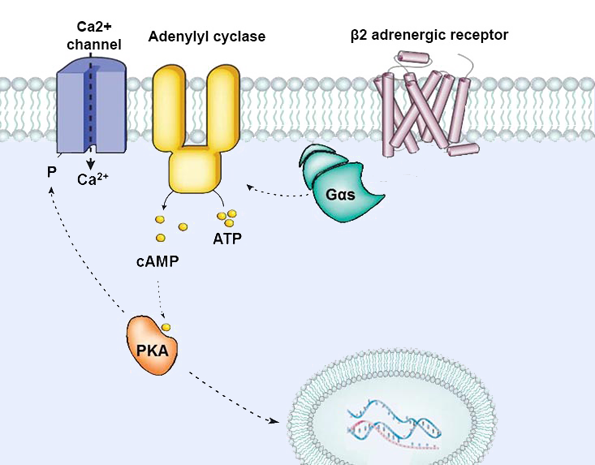
Activation of protein kinase A (PKA) by signal transduction of β2 adrenergic receptor (adapted of Rosenbaum et al., 2009).
Implicated in
Entity name
Ovarian carcinoma
Note
Reverse transcriptase-PCR studies indicated constitutive expression of β2 adrenergic receptor on ovarian carcinoma cell lines (Lutgendorf et al., 2003). Lutgendorf et al. (Lutgendorf et al., 2003) investigated the effects of norepinephrine and isoproterenol (a nonspecific-adrenergic agonist) on the production of vascular endothelial growth factor (VEGF) by ovarian cancer cell lines; and found that both, norepinephrine and isoproterenol, significantly enhanced VEGF production. These effects were blocked by thenon-specific β antagonist propranolol, supporting a role foradrenergic receptors in these experimental effects.
Norepinephrine was later found to increase the in vitro invasive potential of ovarian cancer cells, an effect that was blocked by propranolol (Sood et al., 2006). Norepinephrine also increased tumor cell expression of matrix metalloproteinase-2 (MMP-2) and MMP-9, and pharmacologic blockade of MMPs abrogated the effects of norepinephrine on tumor cell invasive potential (Sood et al., 2006).
In the same way, Thaker et al. (Thaker et al., 2006) correlated chronic behavioral stress with higher levels of tissue catecholamines and more invasive growth of ovarian carcinoma cells in an orthotopic mouse model. These effects were mediated through β2 adrenergic receptor activation of PKA signaling pathway (Thaker et al., 2006). Tumors in stressed animals showed increased vascularization and enhanced expression of VEGF, MMP2 and MMP9; these effects could be abrogated by propranolol (Thaker et al., 2006).
Norepinephrine was later found to increase the in vitro invasive potential of ovarian cancer cells, an effect that was blocked by propranolol (Sood et al., 2006). Norepinephrine also increased tumor cell expression of matrix metalloproteinase-2 (MMP-2) and MMP-9, and pharmacologic blockade of MMPs abrogated the effects of norepinephrine on tumor cell invasive potential (Sood et al., 2006).
In the same way, Thaker et al. (Thaker et al., 2006) correlated chronic behavioral stress with higher levels of tissue catecholamines and more invasive growth of ovarian carcinoma cells in an orthotopic mouse model. These effects were mediated through β2 adrenergic receptor activation of PKA signaling pathway (Thaker et al., 2006). Tumors in stressed animals showed increased vascularization and enhanced expression of VEGF, MMP2 and MMP9; these effects could be abrogated by propranolol (Thaker et al., 2006).
Entity name
Prostate cancer
Note
β2 adrenergic receptor signaling was related to prostate cancer cell progression (Sastry et al., 2007; Zhang et al., 2011). β2 adrenergic receptor activation of PKA signaling pathway has been associated with reduction of sensitivity of prostate cancer cells to apoptosis (Sastry et al., 2007) and promotion of cell proliferation and cell migration (Zhang at al., 2011).
Contrastingly, other investigation demonstrated that the genetic silencing of β2 adrenergic receptor increases cell migration and invasion of normal prostate cells and that the weak expression of this protein is associated with metastases and with worst survival rates in prostate cancer patients (Yu et al., 2007).
Contrastingly, other investigation demonstrated that the genetic silencing of β2 adrenergic receptor increases cell migration and invasion of normal prostate cells and that the weak expression of this protein is associated with metastases and with worst survival rates in prostate cancer patients (Yu et al., 2007).
Entity name
Esophageal squamous cell carcinoma
Note
Liu et al. (Liu et al., 2008b) demonstrated that stimulation of β2 adrenergic receptor with epinephrine significantly increase the esophageal cancer cell proliferation accompanied by elevation of the expression of VEGF, VEGF receptor VEGFR-1 and VEGFR-2. In addition, it has been shown that the epidermal growth factor mediates the mitogenic signals in esophageal cancer cells through transactivation of β2 adrenergic receptor (Liu et al., 2008a).
Entity name
Oral squamous cell carcinoma (OSCC)
Note
Genetic and protein expression of β2 adrenergic receptor was demonstrated in OSCC by using RT-PCR assay, Western blot and immunohistochemistry (Shang et al., 2009; Bernabé et al., 2011; Bravo-Calderón et al., 2011-2012). Investigations performed in different oral cancer cell lines demonstrated that β2 adrenergic receptor signaling by norepinephrine increases cell proliferation and invasion, and upregulates interleukin-6 (IL-6) gene expression and protein release (Shang et al., 2009; Bernabé et al., 2011). Furthermore, Shang et al. (Shang et al., 2009) reported that malignant cell positive immunoexpression of β2-AR was significantly correlated with age, tumor size, clinical stage and cervical lymph node metastasis in OSCC patients, and that β2-AR may play an important role in the formation and metastasis of oral cancer. However, a retrospective clinical study of a large number of patients showed that patients with OSCC who exhibited strong β2-AR immunohistochemical expression by malignant epithelial cells demonstrated higher survival rates compared to patients with weak/negative β2-AR expression (Bravo-Calderón et al., 2011-2012). Therefore, further clinical and laboratory studies are warranted to elucidate the role of β2 adrenergic receptor activation in oral squamous cell carcinoma.
Entity name
Various cancers
Note
β2 adrenergic receptor was also immunohistochemically identified in nasopharyngeal carcinoma (Yang et al., 2006) and in melanoma (Yang et al., 2009). Norepinephrine treatment increased MMP-2, MMP-9, and VEGF levels in culture supernatants of nasopharyngeal carcinoma cells lines (Yang et al., 2006); as well upregulated the production of VEGF, interleukin (IL)-8, and IL-6 in human melanoma tumor cell lines (Yang et al., 2009).
Article Bibliography
| Pubmed ID | Last Year | Title | Authors |
|---|---|---|---|
| 21187140 | 2011 | Stress hormones increase cell proliferation and regulates interleukin-6 secretion in human oral squamous cell carcinoma cells. | Bernabé DG et al |
| 22297552 | 2011 | Prognostic significance of beta-2 adrenergic receptor in oral squamous cell carcinoma. | Bravo-Calderón DM et al |
| 9363896 | 1997 | Switching of the coupling of the beta2-adrenergic receptor to different G proteins by protein kinase A. | Daaka Y et al |
| 16387578 | 2006 | Molecular mechanisms of beta(2)-adrenergic receptor function, response, and regulation. | Johnson M et al |
| 11734616 | 2001 | Norepinephrine and beta 2-adrenergic receptor stimulation regulate CD4+ T and B lymphocyte function in vitro and in vivo. | Kohm AP et al |
| 18452159 | 2008 | Epinephrine stimulates esophageal squamous-cell carcinoma cell proliferation via beta-adrenoceptor-dependent transactivation of extracellular signal-regulated kinase/cyclooxygenase-2 pathway. | Liu X et al |
| 22638833 | 2012 | β2 Adrenoceptor signaling-induced muscle hypertrophy from blood flow restriction: is there evidence? | Loenneke JP et al |
| 14555525 | 2003 | Stress-related mediators stimulate vascular endothelial growth factor secretion by two ovarian cancer cell lines. | Lutgendorf SK et al |
| 16267351 | 2005 | Molecular mechanisms of beta2-adrenergic receptor function and regulation. | McGraw DW et al |
| 19458711 | 2009 | The structure and function of G-protein-coupled receptors. | Rosenbaum DM et al |
| 17353197 | 2007 | Epinephrine protects cancer cells from apoptosis via activation of cAMP-dependent protein kinase and BAD phosphorylation. | Sastry KS et al |
| 19141064 | 2009 | Expression of beta2-adrenergic receptor in oral squamous cell carcinoma. | Shang ZJ et al |
| 19143471 | 2009 | Stress-mediated increases in systemic and local epinephrine impair skin wound healing: potential new indication for beta blockers. | Sivamani RK et al |
| 16428474 | 2006 | Stress hormone-mediated invasion of ovarian cancer cells. | Sood AK et al |
| 21127260 | 2011 | Adrenergic signaling in human oral keratinocytes and wound repair. | Steenhuis P et al |
| 16862152 | 2006 | Chronic stress promotes tumor growth and angiogenesis in a mouse model of ovarian carcinoma. | Thaker PH et al |
| 18996182 | 2009 | Norepinephrine upregulates VEGF, IL-8, and IL-6 expression in human melanoma tumor cell lines: implications for stress-related enhancement of tumor progression. | Yang EV et al |
| 17079456 | 2006 | Norepinephrine up-regulates the expression of vascular endothelial growth factor, matrix metalloproteinase (MMP)-2, and MMP-9 in nasopharyngeal carcinoma tumor cells. | Yang EV et al |
| 17996646 | 2007 | Integrative genomics analysis reveals silencing of beta-adrenergic signaling by polycomb in prostate cancer. | Yu J et al |
| 21833475 | 2011 | β-arrestin2 mediates β-2 adrenergic receptor signaling inducing prostate cancer cell progression. | Zhang P et al |
Other Information
Locus ID:
NCBI: 154
MIM: 109690
HGNC: 286
Ensembl: ENSG00000169252
Variants:
dbSNP: 154
ClinVar: 154
TCGA: ENSG00000169252
COSMIC: ADRB2
RNA/Proteins
| Gene ID | Transcript ID | Uniprot |
|---|---|---|
| ENSG00000169252 | ENST00000305988 | P07550 |
| ENSG00000169252 | ENST00000305988 | X5DQM5 |
Expression (GTEx)
Pathways
Protein levels (Protein atlas)
PharmGKB
| Entity ID | Name | Type | Evidence | Association | PK | PD | PMIDs |
|---|---|---|---|---|---|---|---|
| PA10079 | fenoterol | Chemical | Pathway | associated | |||
| PA10832 | corticosteroids | Chemical | ClinicalAnnotation | associated | PD | 19932356, 24279851, 26774659 | |
| PA134687907 | formoterol | Chemical | Pathway | associated | |||
| PA151249535 | diuretics | Chemical | ClinicalAnnotation | associated | PD | 22543981 | |
| PA164712308 | Ace Inhibitors, Plain | Chemical | ClinicalAnnotation | associated | PD | 22543981 | |
| PA164712372 | Angiotensin II Antagonists | Chemical | ClinicalAnnotation | associated | PD | 22543981 | |
| PA164712535 | Beta Blocking Agents | Chemical | ClinicalAnnotation, VipGene | associated | PD | 16189366, 22543981 | |
| PA164712541 | Beta blocking agents, non-selective | Chemical | Pathway | associated | |||
| PA164769056 | tiotropium | Chemical | ClinicalAnnotation | associated | PD | 19183167 | |
| PA165108401 | Acute coronary syndrome | Disease | VipGene | associated | 16189366 | ||
| PA165958348 | indacaterol | Chemical | LabelAnnotation | associated | |||
| PA165958382 | methacholine | Chemical | ClinicalAnnotation | associated | PD | 23384627 | |
| PA166156748 | rs1042713 | Variant | VipGene | associated | 10340917, 10785504, 10934093, 11016907, 11358945, 11586955, 12077726, 12390345, 12900437, 14693408, 15153795, 15464701, 15500895, 15557128, 15861037, 15867853, 15976384, 15987731, 16054001, 16142389, 16153394, 16263254, 16596417, 17221209, 17223428, 18219297, 18247304, 18569231, 18702968, 19186333, 7598936, 7915137, 10027586 | ||
| PA166156749 | rs1042714 | Variant | VipGene | associated | 10323412, 10886486, 11380082, 11586955, 11718682, 12077726, 12111048, 12390345, 12835612, 12900437, 15464701, 15672110, 15861037, 15931235, 16027735, 16082424, 16142389, 16189366, 17221209, 17671401, 17885618, 18219297, 18393130, 19186333, 7598936, 7915137, 10027586 | ||
| PA166156773 | rs1800888 | Variant | VipGene | associated | 11516429, 16041242, 16142389, 18068431, 18940527, 7901205, 11222464 | ||
| PA172 | GNAI1 | Gene | Pathway | associated | |||
| PA173 | GNAI3 | Gene | Pathway | associated | |||
| PA175 | GNAS | Gene | Pathway | associated | |||
| PA24347 | GNAI2 | Gene | Pathway | associated | |||
| PA27745 | ELF2 | Gene | Pathway | associated | |||
| PA33384 | PLCB1 | Gene | Pathway | associated | |||
| PA33385 | PLCB2 | Gene | Pathway | associated | |||
| PA33386 | PLCB3 | Gene | Pathway | associated | |||
| PA33387 | PLCB4 | Gene | Pathway | associated | |||
| PA33759 | PRKCA | Gene | Pathway | associated | |||
| PA33761 | PRKCB | Gene | Pathway | associated | |||
| PA33763 | PRKCD | Gene | Pathway | associated | |||
| PA33764 | CAVIN3 | Gene | Pathway | associated | |||
| PA33765 | PRKCE | Gene | Pathway | associated | |||
| PA33766 | PRKCG | Gene | Pathway | associated | |||
| PA33767 | PRKCH | Gene | Pathway | associated | |||
| PA33773 | PRKCQ | Gene | Pathway | associated | |||
| PA33775 | PRKCZ | Gene | Pathway | associated | |||
| PA40 | GRK2 | Gene | Pathway | associated | |||
| PA41 | GRK3 | Gene | Pathway | associated | |||
| PA443450 | Asthma | Disease | ClinicalAnnotation, VipGene | associated | PD | 15867853, 15987731, 15153795, 15500895, 18156033, 19183167, 19800676, 19932356, 23126384, 23384627, 24279851, 26774659 | |
| PA443796 | Coronary Artery Disease | Disease | VipGene | associated | 18940527, 16189366 | ||
| PA444370 | Heart Failure | Disease | ClinicalAnnotation, VipGene | associated | PD | 18068431, 18702968, 12835612, 15861037, 17223428, 20352314, 21599570, 22543981 | |
| PA444552 | Hypertension | Disease | ClinicalAnnotation, VipGene | associated | PD | 16027735, 18219297 | |
| PA444584 | Hypotension | Disease | ClinicalAnnotation | associated | PD | 26771271 | |
| PA444797 | Liver Cirrhosis | Disease | ClinicalAnnotation | associated | PD | ||
| PA445802 | Tachycardia | Disease | ClinicalAnnotation | associated | PD | ||
| PA446479 | Hypertrophy, Left Ventricular | Disease | ClinicalAnnotation | associated | PD | 17178264 | |
| PA447216 | Schizophrenia | Disease | ClinicalAnnotation | associated | PD | ||
| PA447288 | Essential hypertension | Disease | ClinicalAnnotation | associated | PD | 15554460 | |
| PA448068 | salbutamol | Chemical | ClinicalAnnotation, Pathway, VariantAnnotation, VipGene | associated | PD | 15500895, 18156033, 19800676, 23126384, 24279851, 29053759 | |
| PA448499 | atenolol | Chemical | ClinicalAnnotation, Pathway | associated | PD | 16027735 | |
| PA448561 | benazepril | Chemical | ClinicalAnnotation | associated | PD | 15554460 | |
| PA448817 | carvedilol | Chemical | ClinicalAnnotation, Pathway | associated | PD | 12835612, 15861037, 20352314, 21599570 | |
| PA449319 | digoxin | Chemical | ClinicalAnnotation | associated | PD | 22543981 | |
| PA449456 | enalapril | Chemical | ClinicalAnnotation | associated | PD | 17178264 | |
| PA449466 | ephedrine | Chemical | ClinicalAnnotation | associated | PK | PD | 25730298, 26771271 |
| PA449470 | epinephrine | Chemical | Pathway | associated | |||
| PA449599 | fentanyl | Chemical | ClinicalAnnotation | associated | PD | 26771271, 30281924 | |
| PA450121 | isoproterenol | Chemical | ClinicalAnnotation | associated | 11586955 | ||
| PA450390 | orciprenaline | Chemical | Pathway | associated | |||
| PA450480 | metoprolol | Chemical | ClinicalAnnotation, Pathway | associated | PD | 16027735 | |
| PA450935 | phenylephrine | Chemical | ClinicalAnnotation | associated | PK | PD | 25730298, 26771271 |
| PA450966 | pindolol | Chemical | Pathway | associated | |||
| PA451141 | propofol | Chemical | ClinicalAnnotation | associated | PD | 26771271 | |
| PA451145 | propranolol | Chemical | ClinicalAnnotation, Pathway | associated | PD | ||
| PA451232 | remifentanil | Chemical | ClinicalAnnotation | associated | PD | 26771271 | |
| PA451257 | risperidone | Chemical | ClinicalAnnotation | associated | PD | ||
| PA451258 | ritodrine | Chemical | Pathway | associated | |||
| PA451300 | salmeterol | Chemical | ClinicalAnnotation, Pathway | associated | PD | 15500895, 18156033, 19800676, 19932356, 23126384, 24279851 | |
| PA451341 | sevoflurane | Chemical | ClinicalAnnotation | associated | PD | 26771271 | |
| PA451483 | spironolactone | Chemical | ClinicalAnnotation | associated | PD | 22543981 | |
| PA451616 | terbutaline | Chemical | ClinicalAnnotation, Pathway, VariantAnnotation | ambiguous | PK | PD | 12563174 |
| PA59 | ARRB1 | Gene | Pathway | associated | |||
| PA60 | ARRB2 | Gene | Pathway | associated |
References
| Pubmed ID | Year | Title | Citations |
|---|---|---|---|
| 37906648 | 2024 | Evaluation of ADRB2 and OATP2A1 genetic polymorphisms in Indian patients with primary open-angle glaucoma. | 0 |
| 38036078 | 2024 | Genetic association between ADRB2 rs1042713 and elite athletic performances in the Korean population. | 0 |
| 38043362 | 2024 | The association of gene polymorphisms in catechol-O'methyltransferase (COMT) and β2-adrenergic receptor (ADRB2) with temporomandibular joint disorders. | 1 |
| 38157624 | 2024 | Reduction of IL-6, IL-8 and β2-ADRENOCEPTOR mRNA levels in circulating polymorphonuclear leukocytes after adenotonsillectomy in children with Obstructive Sleep Apnea Syndrome. | 1 |
| 38194225 | 2024 | Biased Signaling in Mutated Variants of β(2)-Adrenergic Receptor: Insights from Molecular Dynamics Simulations. | 0 |
| 38331165 | 2024 | Chronic stress promotes gastric cancer progression via the adrenoceptor beta 2/PlexinA1 pathway. | 0 |
| 38547061 | 2024 | The β2-adrenergic receptor associates with CXCR4 multimers in human cancer cells. | 1 |
| 37906648 | 2024 | Evaluation of ADRB2 and OATP2A1 genetic polymorphisms in Indian patients with primary open-angle glaucoma. | 0 |
| 38036078 | 2024 | Genetic association between ADRB2 rs1042713 and elite athletic performances in the Korean population. | 0 |
| 38043362 | 2024 | The association of gene polymorphisms in catechol-O'methyltransferase (COMT) and β2-adrenergic receptor (ADRB2) with temporomandibular joint disorders. | 1 |
| 38157624 | 2024 | Reduction of IL-6, IL-8 and β2-ADRENOCEPTOR mRNA levels in circulating polymorphonuclear leukocytes after adenotonsillectomy in children with Obstructive Sleep Apnea Syndrome. | 1 |
| 38194225 | 2024 | Biased Signaling in Mutated Variants of β(2)-Adrenergic Receptor: Insights from Molecular Dynamics Simulations. | 0 |
| 38331165 | 2024 | Chronic stress promotes gastric cancer progression via the adrenoceptor beta 2/PlexinA1 pathway. | 0 |
| 38547061 | 2024 | The β2-adrenergic receptor associates with CXCR4 multimers in human cancer cells. | 1 |
| 36822159 | 2023 | The impact of ADRB2 polymorphisms on immune responses and norepinephrine-induced immunosuppression. | 0 |
Citation
Denise Tostes Oliveira ; Diego Mauricio Bravo-Calderón
ADRB2 (adrenoceptor beta 2, surface)
Atlas Genet Cytogenet Oncol Haematol. 2014-02-01
Online version: http://atlasgeneticsoncology.org/gene/43818/adrb2
