Fanconi anemia
2016-04-01 Filippo Rosselli AffiliationUMR8200 CNRS, Gustave Roussy Institute, Université Paris-Saclay - Université Paris-Sud; [email protected]
Abstract
Fanconi anemia (FA) is a rare human recessive syndrome featuring bone marrow failure, myelodysplasia, and predisposition to cancer as well as chromosome fragility and hypersensitivity to DNA interstrands crosslinking agents. FA was described in 1927
Identity
Name
Fanconi anemia
Alias
Fanconi pancytopenia
Note
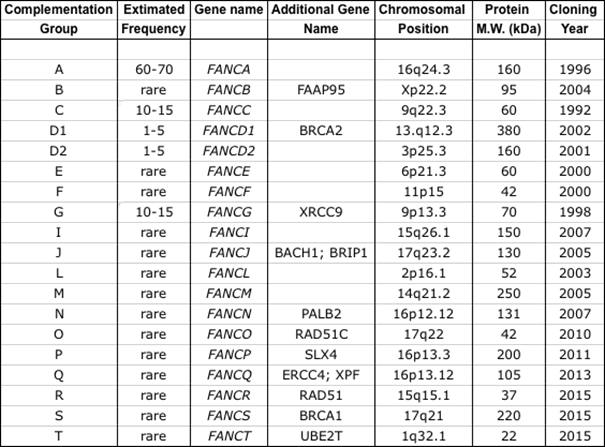
:\tNineteen genes currently involved (for which bi-allelic inactivating mutations are retrieved in affected individual): FANCA, FANCB, FANCC, BRCA2 (FANCD1), FANCD2, FANCE, FANCF, FANCG (XRCC9), FANCI, BRIP1 (BACH1\/FANCJ) FANCL, FANCM, PALB2 (FANCN), RAD51C (FANCO), SLX4 (FANCP), ERCC4 (FANCQ\/XPF) RAD51 (FANCR), BRCA1 (FANCS), UBE2T (FANCT)
Inheritance
Autosomal recessive and X-linked (for FANCB); the estimated prevalence is 1 to 5 cases for million people; with a heterozygous carrier frequency of around 1\/300 people.
Omim
227650 , 227645
Mesh
D005199
Orphanet
84 Fanconi anemia
Umls
C0015625
Clinics
Phenotype and clinics
Differential diagnosis
Diagnosis is based on standard, ie on Giemsa stained metaphases, cytogenetic analysis of the level of chromosome fragility following exposure to a DNA crosslinking agent exposure. Due to the risk of mosaicism linked to the spontaneous reversion of the mutation in the highly replicative hematopoietic precursors, cytogenetic analysis must be performed on fibroblasts and not simply on lymphocytes culture stimulated in vitro. An eventual confirmation of the diagnosis could be realized at molecular level thanks to the identification of the complementation group and, eventually, of the mutation(s) in the involved gene.
Neoplastic risk
acute myeloid leukemia (AML) in around 15% of cases; i.e. a 15000 fold increased risk. It has been assumed that it is reasonable to regard the Fanconi anemia genotype as \"preleukemia\"; mean age at diagnosis: 13-15 yrs
Treatment
Androgens and steroids to improve hematopoietic function. Bone marrow transplantation to palliate the BMF and in the case of AML.
Evolution
The BMF, which is the central characteristic of the syndrome, is progressive and culminate in pancytopenia and, in a fraction of the cases, in AML.
Prognosis
The clinical presentation of the FA is extremely heterogenous. It is generally admitted that BMF appears at around 7 years. Most patients die from marrow aplasia (haemorrhage, sepsis), and others from malignancies; MDS and AML in FA bear a very poor prognosis (median survival of about 6 mths); survival is also poor in the case of a squamous cell carcinoma.
Significant phenotypic differences were found between the various complementation groups. In FA group A, patients homozygous for null mutations had an earlier onset of anemia and a higher incidence of leukemia than those with mutations producing an altered protein. FA group G patients had more severe cytopenia and a higher incidence of leukemia. FA group C patients had less somatic abnormalities, which, in reverse, were more frequent in the rare groups FA-D, FA-E, and FA-F. FA group G patients patients and patients homozygous for null mutations in FANCA are high-risk groups with a poor hematologic outcome and should be considered as candidates both for frequent monitoring and early therapeutic intervention.
There may also be a certain degree of clinical heterogeneity.according to the degree of mosaicism. Therefore, clinical manifestations may be variable within a given family, according to the stage of embryonic development at which the somatic reverse mutation occurred.
Significant phenotypic differences were found between the various complementation groups. In FA group A, patients homozygous for null mutations had an earlier onset of anemia and a higher incidence of leukemia than those with mutations producing an altered protein. FA group G patients had more severe cytopenia and a higher incidence of leukemia. FA group C patients had less somatic abnormalities, which, in reverse, were more frequent in the rare groups FA-D, FA-E, and FA-F. FA group G patients patients and patients homozygous for null mutations in FANCA are high-risk groups with a poor hematologic outcome and should be considered as candidates both for frequent monitoring and early therapeutic intervention.
There may also be a certain degree of clinical heterogeneity.according to the degree of mosaicism. Therefore, clinical manifestations may be variable within a given family, according to the stage of embryonic development at which the somatic reverse mutation occurred.
Cytogenetics
Inborn condition
Spontaneous elevated levels of chromatid and chromosome gaps and breaks, presence of abnormal figures, in particular triradials and quadriradials.
Hypersensitivity to the clastogenic effects of DNA crosslinking agents, like mitomycin C, diepoxybutane or cis-Platin.
Hypersensitivity to the clastogenic effects of DNA crosslinking agents, like mitomycin C, diepoxybutane or cis-Platin.
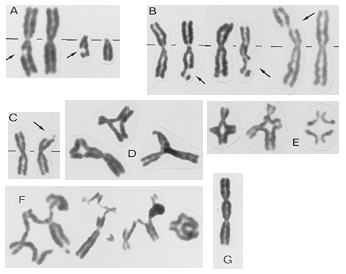
IMAGE A: gaps; B: breaks; C: deletion; D: triradials; E: quadriradials; F: complex figures; G: dicentric. Giemsa staining - Jean Loup Huret.
Acquired condition
Clonal abnormalities were reported in MDS and AML: in particular: -5\/del(5q) and -7\/del(7q) .
Other Findings
Note
Genes involved and Proteins
Note
In response to DNA damage and together with several other partners involved in DNA damage signaling and cell cycle checkpoint activation, the FANC proteins work long a linear pathway to cope with the replication stress induced by the presence of DNA lesions and help in the replication rescue by homologous recombination based mechanism. Briefly, FANCA, FANCB, FANCC, FANCE, FANCF, FANCG and FANCL (with other companion proteins) assemble on FANCM and meet UBE2T to monoubiquitinate FANCD2 and FANCI. Following their monoubiquitination, the FANCD2\/FANCI heterodimer assembles into subnuclear foci where in a yet undetermined manner participates to and\/or coordinates the elimination of the lesions and the restart of the stalled replication fork thanks to the action of the other component of the FANC pathway, which include structure specific endonucleases (XPF, SLX4) and homologous recombination proteins (RAD51, BRCA1, BRCA2, ...)
The pathway, or some of its components, participate also to transcription regulation, epigentics, production\/response to inflammatory and stress induced cytokines and interferons.
The pathway, or some of its components, participate also to transcription regulation, epigentics, production\/response to inflammatory and stress induced cytokines and interferons.
Note
The gene spans 80kB and contains 43 exons. FANCA is the most frequently mutated among the 19 known FANC genes: it accounts for more than 60% of the FA patients worldwide. Alternative splice results in the production of several transcripts variants encoding different protein isoforms. The most representative protein is a polypeptide of 1455-amino acids weighting approximatively 163 kDa. Present in both cytoplasms and nucleus, the protein possesses a nuclear localization signal but lacks of other known regulatory motifs and any biochemical function was ascribed to it. FANCA participates to the nuclear FANCcore complex that hosts the E3 ligase (FANCL) activity that, in collaboration with the E2 UBE2T, monoubiquitinates FANCD2 and FANCI in response to DNA damage. FANCA interacts directly with FANCG and FAAP20.
Alias
FAAP95
Note
FANCB is constituted by 10 exons spanning 77kB. Alternative splicing results in two transcript variants encoding a same protein of 859-amino acids with a MW of 98 kDa. Any biochemical function was reported for the protein. FANCB aggregates with FANCL and FAAP100 in a sub-complex that participates to the FANCcore complex to mediate FANCD2 and FANCI monoubiquitination in response to DNA damage. FANCB stabilizes FANCL and needs FANCA to translocate into thAe nucleus. Mutations in FANCB are associated to both Fanconi anemia and X linked VACTERL with hydrocephalus syndromes.
Note
FANCC has been the first FANC gene to be cloned. It contains 14 exons and codes an ORF of 1677 bp which translation results in a protein of 558aa, weighting about 63kDa. The protein, present in both cytoplasm and nucleus, interacts with FANCE and FANCF, a subgroup participating to the FANCcore complex. Any direct biochemical function was reported for FANCC.
Alias
FANCD1, XRCC11
Note
The gene contains 27 exons, coding a mRNA which translation results in a protein of 3418aa, weighting about 385kDa. The protein is involved in the homologous recombination process. FANCD1\/BRCA2 contains several repetitions of a 70 aa motif called the BRC motif that mediate RAD51 interaction. Indeed, FANCD1\/BRCA2 is the cargo that target RAD51 to ssDNA stretches covered by RPA at DBS. It interacts with several proteins involved in DNA metabolism, including FANCD2, FANCN\/PALB2, POLH and some components of the TREX-2 complex. FANCD1\/BRCA2 inherited mutations are associated to the recessive syndrome Fanconi anemia while carriers of one inactivated allele are at risk for breast and ovarian cancer predisposition following the somatic loss-of-function of the wild-type allele.
Note
The gene contains 44 exons. FANCD2 encodes a 1,451-amino acid nuclear protein. As several other FANC proteins, FANCD2 had no known functional domains. With its major partner, FANCI, FANCD2 is the target of the Ubiquitin-ligase activity of the the FANCcore complex. In presence of DNA damage or replication stress, FANCD2 is monoubiquitinated on K561 and targeted to subnuclear foci where it colocalize with several DNA repair proteins. It is phosphorylated by both ATM and ATR. The protein participate to both replication safeguard and chromosome fragile sites integrity maintenance. Interacts directly or indirectly with several proteins, including, FANCI, FANCE. USP1, MEN1, BRCA1, BRCA2, phosphorylated FANCG, FAN1 and DCLRE1B\/Apollo.
Note
The gene contains 10 exons. FANCE protein is constituted by 536 amino-acids weighting approximatively 59kDa. It contains two Nuclear Localization Signal (NLS). FANCE forms with FANCC and FANCF a FANCcore complex sub-complex. It is required for FANCC nuclear accumulation and connects the FANCcore complex to FANCD2 allowing the FANCL\/UBE2T-mediated FANCD2 monoubiquitination. It is phosphorylated by CHK1 in response to DNA damage. As several other FANC proteins, FANCE had no known biochemical functions.
Note
FANCF is an intron-less gene. The protein, long of 374aa, weights 42kDa. FANCF is predominantly nuclear, where it interacts with FANCE and FANCC, a subgroup participating to the FANCcore complex. As a FANCcore complex participant, FANCF is involved in FANCD2 and FANCI monoubiquitination. FANCF had no known biochemical functions.
Alias
XRCC9
Note
The gene codes at least two mRNA of 2.2 and 2.5 kb, which translation results in a major proteins of 622 aa, weighting 68kDa. It participates to the FANCcore complex and its phosphorylation on serine 7 is mandatory for its function inside the complex. Nevertheless, as for several other FANC proteins any biochemical function has been attributed to FANCG. As for the other components of the FANCcore complex, its presence inside the complex is mandatory for FANCD2 and FANCI monoubiquitination and targeting to subnuclear foci.
Note
The gene contains 38 exons. The FANCI protein is long of 1328aa, weights 50kDa and contains 3 NLS. FANCI is phosphorylated by ATM\/ATR and is monoubiquitinated by the FANCcore complex on the lys523. It is considered as a functional homolog of FANCD2. The two proteins forms a heterodimer that, following their DNA damage- or replication stress -induced monoubiquitination, relocalizes to subnuclear foci to optimally restore DNA and rescue replication in a yet undetermined manner.
Note
The gene encodes a protein of 1249aa with a molecular mass de 141kDa. Memeber of the RecQ DEAH helicase family, FANCJ interact with BRCA1 participating to the DNA double-strand breaks repair by homologous recombination. Germline mutations in FANCJ are associated to breast and ovarian cancer susceptibility. Biallelic inheritance results in a Fanconi anemia-like phenotype.
Alias
FANCJ
Note
The gene encodes a protein of 1249aa with a molecular mass de 141kDa. Member of the RecQ DEAH helicase family, FANCJ interact with BRCA1 participating to the DNA double-strand breaks repair by homologous recombination. Germline mutations in FANCJ are associated to breast and ovarian cancer susceptibility. Biallelic inheritance results in a Fanconi anemia-like phenotype
Alias
PHF9, FAAP43
Note
It codes a proteins of 373 aa, weighting 43 kDa, containing 3 putative WD40 motifs and a PHD zync finger motif. The protein could be retrieved in both cytoplasm and nucleus. FANCL is the catalytic subunit of the FANCore complex. It has the E3 ubiquitin ligase activity necessary for FANCD2 and FANCI monoubiquitination. It mediate ubiquitin release from UBE2T and UBE2W.
Alias
FAAP250
Note
It code for a protein of 2048aa. Contains an N-terminal helicase domain ans possess the ability to translocate on duplex DNA. It belongs to the DEAD box helicase family. It is hyperphosphorylated by ATR in response of DNA damage FANCM is thought be the transporter of the FANCcore complex along the DNA and, so, it participates de facto to both FANCD2 and FANCI optimal monoubiquitination.
Alias
FANCN
Note
FANCN contains 13 exons and encodes for a protein of 1186 aa having a molecular mass of about 130kDa. The protein participates to homologous recombination in collaboration with its major partner BRCA2. It interacts also with BRCA1, RAD51, RAD51C and POLH. Monoallelic PALB2 mutations confer predisposition to breast and pancreatic cancers. hereditary bi-allelic mutations in FANCN result in Fanconi anemia.
Alias
FANCO
Note
Member of the RAD51 gene family, involved in homologous recombination repair of damaged DNA and in meiotic recombination. RAD51C encodes a major 1.3 kB mRNA translated in a protein of 376 aa, weighting approximatively 45kDa. It interact with several DNA repair proteins, including RAD51 and PALB2. It participates to several complexes with RAD51B, RAD51D and XRCC2 or with XRCC3. The monoallelic inheritance of RAD51C is associated to breast and ovarian cancers predispostion. The biallelic, recessive, inheritance of RAD51C mutations result in a Fanconi anemia-like syndrome.
Alias
FANCP
Note
The protein is constituted by 1834 aa which weights about 200kDa. Component of the SLX1-SLX4 structure-specific endonuclease, it is the docking platform of a complex assembling two other structure specific enducleases: XPF-ERCC1 and MUS81-EME1. SLX4 is also associated to MSH2\/MSH3, the telomere binding complex TRF2-RAP1 and the kinase PLK1. FANCP is required DNA repair, chromosome fragile sites maintenance and for replication fork failure rescue.
Alias
FANCQ, XPF
Note
The gene contains 11 exons spanning more than 28 kb. The gene encodes 3 mRNA of 2.4, 3.8 and 7 kb, which translation results in a protein of 905 aa, having a mass of about 110 kDa. The protein interacts primarily with with ERCC1 making up the ERCC1-XPF-5 structure specific endonuclease. The protein also interacst with FANCP\/SLX4. Biallelic inactivating mutation in this gene have been associated to Fanconi anemia, xeroderma pigmentosum, cockayne syndrome and XFE progeroid syndrome.
Alias
FANCR, RAD51A
Note
Belonging to the RAD51 family, this gene is encodes several transcript variant, the major being a 1.8kb mRNA which translation results in a protein of 339aa weighting 37kDa which plays a central role in homologous recobination repair and in meiotic recombination. It interacts with BRCA1, BRCA2, RPA, and several other DNA repair proteins. The only Fanconi anemia patient associated to RAD51 mutation bears a de novo mutation which created a dominant-negative variant. Mutations in RAD51 have been also associated to breast cancer suceptibility and to the congenital Mirror Movements 2 syndrome.
Alias
FANCS
Alias
FANCT
Note
The gene contains 7 exons. Two transcript variants encodes different protein isoforms, the major is a protein of 197 amino acids weighting approximatively 22kDa. UBE2T is an E2-conjugating enzyme that collaborates with FANCL, the E3 ubiquitin ligase hosted by the FANC core complex, for the monoubiquitination of FANCD2 and FANCI. It interact with FANCL and BRCA1.
To be noted
Registry
http:\/\/clinfo.rockefeller.edu\/fanconi\/ptrecrt.html International Fanconi Anemia Registry (IFAR)
Associations
http:\/\/www.fanconi.org\/ Fanconis Anemia International Registryhttp:\/\/asso.orpha.net\/AFMF\/AFMF.html Association Francaise de la Maladie de Fanconi
Article Bibliography
| Pubmed ID | Last Year | Title | Authors |
|---|---|---|---|
| 23623386 | 2013 | Mutations in ERCC4, encoding the DNA-repair endonuclease XPF, cause Fanconi anemia. | Bogliolo M et al |
| 26254775 | 2015 | Fanconi anemia: a model disease for studies on human genetics and advanced therapeutics. | Bogliolo M et al |
| 21240276 | 2011 | Disruption of mouse Slx4, a regulator of structure-specific nucleases, phenocopies Fanconi anemia. | Crossan GP et al |
| 17452773 | 2007 | Identification of the Fanconi anemia complementation group I gene, FANCI. | Dorsman JC et al |
| 26512453 | 2015 | What is the DNA repair defect underlying Fanconi anemia? | Duxin JP et al |
| 8896564 | 1996 | Positional cloning of the Fanconi anaemia group A gene. | |
| 12065746 | 2002 | Biallelic inactivation of BRCA2 in Fanconi anemia. | Howlett NG et al |
| 21240275 | 2011 | Mutations of the SLX4 gene in Fanconi anemia. | Kim Y et al |
| 17036037 | 2006 | Guido Fanconi (1892-1979): a jack of all trades. | Lobitz S et al |
| 16116422 | 2005 | A human ortholog of archaeal DNA repair protein Hef is defective in Fanconi anemia complementation group M. | Meetei AR et al |
| 12973351 | 2003 | A novel ubiquitin ligase is deficient in Fanconi anemia. | Meetei AR et al |
| 19278965 | 2009 | Diagnosis of Fanconi anemia in patients with bone marrow failure. | Pinto FO et al |
| 17200671 | 2007 | Biallelic mutations in PALB2 cause Fanconi anemia subtype FA-N and predispose to childhood cancer. | Reid S et al |
| 26119737 | 2015 | Deficiency of UBE2T, the E2 Ubiquitin Ligase Necessary for FANCD2 and FANCI Ubiquitination, Causes FA-T Subtype of Fanconi Anemia. | Rickman KA et al |
| 25472942 | 2015 | Biallelic mutations in BRCA1 cause a new Fanconi anemia subtype. | Sawyer SL et al |
| 17460694 | 2007 | FANCI is a second monoubiquitinated member of the Fanconi anemia pathway. | Sims AE et al |
| 17412408 | 2007 | Identification of the FANCI protein, a monoubiquitinated FANCD2 paralog required for DNA repair. | Smogorzewska A et al |
| 22160080 | 2011 | Fanconi anemia. | Soulier J et al |
| 21240277 | 2011 | SLX4, a coordinator of structure-specific endonucleases, is mutated in a new Fanconi anemia subtype. | Stoepker C et al |
| 11239453 | 2001 | Positional cloning of a novel Fanconi anemia gene, FANCD2. | Timmers C et al |
| 20400963 | 2010 | Mutation of the RAD51C gene in a Fanconi anemia-like disorder. | Vaz F et al |
| 24773018 | 2014 | The Fanconi anemia DNA repair pathway: structural and functional insights into a complex disorder. | Walden H et al |
| 26253028 | 2015 | A Dominant Mutation in Human RAD51 Reveals Its Function in DNA Interstrand Crosslink Repair Independent of Homologous Recombination. | Wang AT et al |
| 10615118 | 2000 | The Fanconi anaemia gene FANCF encodes a novel protein with homology to ROM. | de Winter JP et al |
External Links
Citation
Filippo Rosselli
Fanconi anemia
Atlas Genet Cytogenet Oncol Haematol. 2016-04-01
Online version: http://atlasgeneticsoncology.org/cancer-prone-disease/10001/fanconi-anemia
Historical Card
2002-06-01 Fanconi anemia by Jean-Loup Huret Affiliation
Genetics, Dept Medical Information, University of Poitiers, CHU Poitiers Hospital, F-86021 Poitiers, France
1998-02-01 Fanconi anemia by Jean-Loup Huret Affiliation
Genetics, Dept Medical Information, University of Poitiers, CHU Poitiers Hospital, F-86021 Poitiers, France
