del(5q) in myeloid neoplasms
2009-04-01 Kazunori Kanehira Affiliation1.FACMG, Cytogenetics Laboratory, Mayo Clinic, Rochester, Minnesota, USA
2.Service dHematologie, Hopital Edouard Herriot, Lyon, France
Clinics and Pathology
Disease
5q- syndrome
Note
The World Health Organization (WHO) defined the 5q- syndrome as a specific type of MDS, restricting diagnosis to the cases with isolated interstitial del(5q), without excess blasts in the bone marrow (
Clinics
As described above, cases of MDS with isolated del(5q) show female predominance (M:F=1:1.5-4), anemia, macrocytosis, normal or moderately decreased WBC, normal or moderately decreased platelet count, and dysmegakaryopoiesis.
Treatment
Supportive care including RBC transfusion for anemia is the mainstay of treatment. It is not infrequent that transfusions are needed for years, causing iron overload, and increasing the risk of blood-borne infections. Anemia of 5q- syndrome does not respond well to erythropoietin. Leanalidomide, a Thalidomide derivative, has been investigated for treatment of MDS with 5q-. Lenalidomide has immunomodulatory properties, including the suppression of pro-inflammatory cytokine production by monocytes, enhancement of T-cell and NK-cell activation, and inhibition of angiogenesis. In Phase II trials in transfusion-dependent MDS with 5q-, 168 patients were enrolled, of whom 76% had isolated 5q- and 29% had the 5q- syndrome. Transfusion independence was obtained in 67%. A complete cytogenetic response was achieved in 45% of patients. Cytogenetic response rate was not significantly different in isolated del(5q), del(5q) + 1 and del(5q) + >1 additional chromosome abnormalities. Although the results of lenalidomide treatment seem promising, it is not yet clear if the treatment will affect the natural disease course and prolongs survival.
Prognosis
The impact of lenalidomide on the prognosis of MDS patients with 5q- is unknown at this point. Progression to AML is rare (10%). With the supportive therapy, the prognosis of 5q- syndrome is favorable, with reported median survival ranging from 53 to 146 months. MDS patients with 5q- plus one additional chromosome abnormality seem to have significantly shorter survival (with exception of loss of the Y chromosome). MDS with 5q- as part of a complex karyotype (3 or more abnormalities) have an unfavorable prognosis.
Disease
AML (Acute Myeloid Leukemia)
Clinics
Deletion of 5q can be observed in both de novo and therapy related AML. It is also seen as monosomy 5. In AML, 5q deletion is usually associated with a complex karyotype.
Prognosis
Prognosis of AML with 5q-/-5 is generally unfavorable, associated with rapid disease progression and poor outcome and survival, especially when it is seen as a part of complex karyotype.
Cytogenetics
Cytogenetics morphological
The most commonly observed interstitial deletions are del(5)(q13q31), del(5)(q13q33), and del(5)(q22q33), forming a commonly deleted region (CDR) at 5q31-q32.
Cytogenetics molecular
The CDR is the approximately 1.5 Mb interval between D5S413 and GLRA1 gene, containing around 40 genes. No cases of 5q- syndrome have been reported to have biallelic deletion within the CDR, and no point mutations have been found in the genes in the region. Recently, it is suggested that haploinsufficienty (a gene dosage effect) of one or more of the genes mapping to the CDR is the pathogenetic basis of the 5q- syndrome. Ebert et al. demonstrated that impaired function of the ribosomal subunit protein RPS14 recapitulated the characteristic phenotype of the 5q- syndrome, a severe decrease in the production of erythroid cells with relative preservation of megakaryocytic cells, in normal CD34+ human hematopoietic progenitor cells. In addition, forced expression of RPS14 rescued the disease phenotype in patient-derived bone marrow cells.
Germline heterozygous mutation for two other ribosomal proteins, RPS19 and RPS24, have recently been described in the congenital disorder known as Diamond-Blackfan anemia. The congenital anemia is characterized by sever anemia, macrocytosis, relative preservation of the platelet and neutrophil count, erythroid hypoplasia in the bone marrow and an increased risk of leukemia. The erythroid specificity of 5q- syndrome and Diamond-Blackfan anemia in ribosomal expression is noteworthy.
Germline heterozygous mutation for two other ribosomal proteins, RPS19 and RPS24, have recently been described in the congenital disorder known as Diamond-Blackfan anemia. The congenital anemia is characterized by sever anemia, macrocytosis, relative preservation of the platelet and neutrophil count, erythroid hypoplasia in the bone marrow and an increased risk of leukemia. The erythroid specificity of 5q- syndrome and Diamond-Blackfan anemia in ribosomal expression is noteworthy.
Additional anomalies
By definition, an interstitial deletion of 5q must be the sole abnormality for 5q- syndrome. However, 5q deletion can be seen with other accompanying abnormalities. Review of the recent Mayo Clinic cases shows that major abnormalities include -7, +8, -20, 20q-, -13/13q-, and abnormalities in 12p, in the descending order.
Genes Involved and Proteins
Article Bibliography
| Pubmed ID | Last Year | Title | Authors |
|---|---|---|---|
| 17531775 | 2007 | Impact of cytogenetics on outcome of de novo and therapy-related AML and MDS after allogeneic transplantation. | Armand P et al |
| 7803280 | 1994 | Translocation t(5;12)(q31-q33;p12-p13): a non-random translocation associated with a myeloid disorder with eosinophilia. | Baranger L et al |
| 17261783 | 2006 | Clinical relevance of cytogenetics in myelodysplastic syndromes. | Bernasconi P et al |
| 7773164 | 1995 | Chromosomal deletions in myelodysplasia. | Boultwood J et al |
| 16522543 | 2006 | The genetics of the myelodysplastic syndromes: classical cytogenetics and recent molecular insights. | Cherian S et al |
| 15621734 | 2004 | The 5q- syndrome. | Giagounidis AA et al |
| 18414863 | 2008 | Cytogenetic features in myelodysplastic syndromes. | Haase D et al |
| 18217896 | 2008 | The role of lenalidomide in the management of myelodysplasia with del 5q. | Kelaidi C et al |
| 1347709 | 1992 | Chromosomal loss and deletion are the most common mechanisms for loss of heterozygosity from chromosomes 5 and 7 in malignant myeloid disorders. | Neuman WL et al |
| 16196520 | 2005 | Myelodysplastic syndromes: clinicopathologic features, pathobiology, and molecular pathogenesis. | Nishino HT et al |
| 2072742 | 1991 | Clinical and prognostic implications of chromosome 5q deletions: 96 high resolution studied patients. | Pedersen B et al |
| 1954385 | 1991 | Therapy-related myelodysplastic syndrome and acute myeloid leukemia in children: correlation between chromosomal abnormalities and prior therapy. | Rubin CM et al |
| 9078284 | 1997 | 5q-, twenty-five years later: a synopsis. | Van den Berghe H et al |
Summary
Note
Interstitial del(5q) was first reported as a type of refractory anemia with characteristic clinical features; female predominance (unlike other MDS), macrocytosis, erythroid hypoplasia, frequent thrombocytosis and dysmegakaryopoiesis. It is one of the most common structural rearrangements in MDS (10%), seen as an isolated abnormality or with additional karyotypic anomalies. It is also observed in AML, with important prognostic significance.
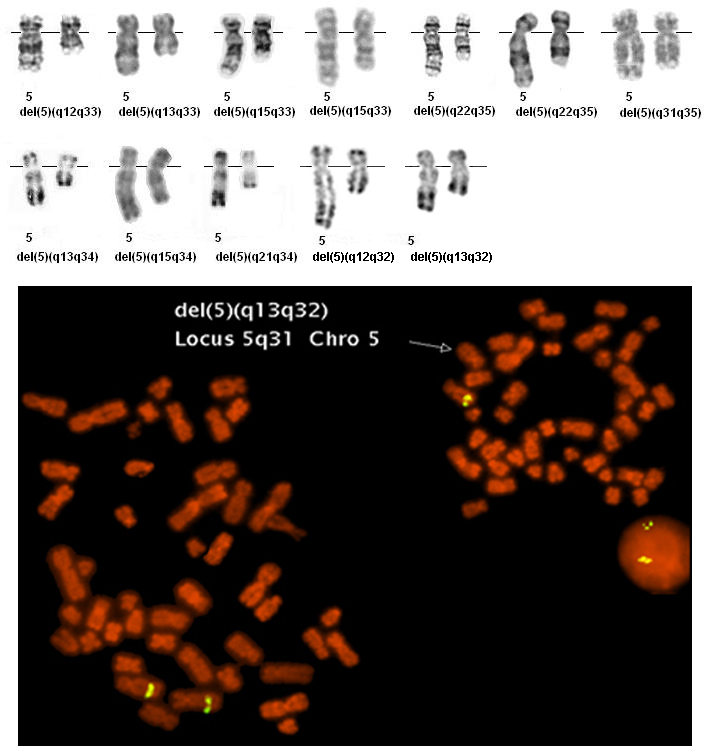
del(5q) G-banding (top) - Courtesy Diane H. Norback, Eric B. Johnson, Sara Morrison-Delap Cytogenetics at theWaisman Center (1 and 5 from the left), Kazunori Kanehira, Rhett P. Ketterling, Daniel L. Van Dyke (2, 4, 6, and 7), and Jean-Luc Lai (3); R-banding (bottom), Courtesy Christiane Charrin (1 and 3), Jean Loup Huret (2), Hossein Mossafa (4 and 5, and FISH).
Citation
Kazunori Kanehira
del(5q) in myeloid neoplasms
Atlas Genet Cytogenet Oncol Haematol. 2009-04-01
Online version: http://atlasgeneticsoncology.org/haematological/1092/del(5q)-in-myeloid-neoplasms
Historical Card
1998-03-01 del(5q) in myeloid neoplasms by Christiane Charrin Affiliation
Service dHematologie, Hopital Edouard Herriot, Lyon, France
