VHL (von Hippel-Lindau tumor suppressor)
2002-01-01 Stéphane Richard AffiliationGénétique Oncologique EPHE, Faculté de Médecine Paris-Sud, 63 av Gabriel Péri, 94276 LE KREMLIN BICETRE, France
Identity
HGNC
LOCATION
3p25.3
LOCUSID
ALIAS
HRCA1,RCA1,VHL1,pVHL
FUSION GENES
DNA/RNA
Description
The VHL gene spans 10 kb and is composed of three exons.
Transcription
The VHL gene encodes a 4.7 kb mRNA which is widely expressed in both foetal and adult tissues. An alternatively spliced VHL transcript has been detected reflecting the absence of exon 2 (isoform II) but no endogenous associated protein has been reported.
Proteins
Description
The full-length VHL protein, pVHL, contains 213 amino-acids (28-30 kDa) ("pVHL30") A second major VHL-gene product arises by internal translation initiation from the codon 54 methionine, producing a 160 amino-acid protein (18-19 kDa) ("pVHL19").
Expression
pVHL is widely expressed in both foetal and adult human tissues.
Localisation
The pVHL is largely a cytoplasmic protein but appears to shuttle between the cytoplasm and nucleus.
Function
pVHL interacts with three other proteins, elongin C and B and Cullin 2 (CUL2), in a complex referred to as VCB-CUL2. pVHL has two main structural domains: an N-terminal domain composed mainly of b-sheets (the b domain) and a smaller C-terminal domain between aminoacids 155-192 composed mainly of a helices (a-domain). The a domain consists of three a helices that combines with a fourth a helice donated by elongin C. The b-domain is on the opposite side of the a domain and is free to contact other protein.
VHL and angiogenesis
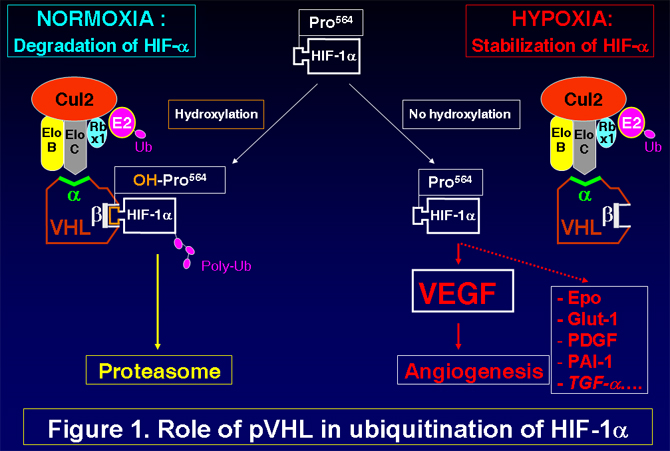
A main function of the pVHL is to negatively regulate hypoxia-inducible mRNAs such as the mRNA encoding VEGF, EPO, PDGF and the glucose-transporter GLUT-1. pVHL plays a critical role in targeting the hypoxia-inducible transcription factor HIF-1a for degradation by the proteasome. HIF-1a contribute to form the HIF-1 transcriptional complex responsible for activation of genes involved in metabolism, angiogenesis and apoptosis. The VCB-CUL2 complex has been demonstrated as a ubiquitin-ligase system presenting many similarities with the SCF system ("Skp1-CUL1-Fbox protein"). HIF is normally degraded under normoxic conditions and binding to VHL is dependent on hydroxylation of Pro 564 in HIF-1a (Figure 1). When the VHL gene is mutated, absence of HIF degradation is responsible for abnormal accumulation of VEGF and other hypoxia-inducible mRNA explaining the angiogenic phenotype of VHL tumours.
pVHL may also downregulate VEGF production by direct binding and inhibiting to the transcriptional activator SP1.
In homozygous VHL knock-out mice, embryos will die early because of a major disorder of placental vasculogenesis . Other functions
pVHL plays a role in
1- ability of cells to exit the cell cycle and enter the quiescent state.
2- assembly of extracellular fibronectin matrix.
3- degradation of TGFa LYT10, TGFb, and carbonic anhydrases CA9 and CA12.
4- regulation of the urokinase-type plasminogen activator system.
5- inhibition of the hepatocyte growth factor-induced invasion in renal cell carcinoma.
6- a direct interaction with atypical protein kinase C (PKC) z and l has also recently been demonstrated.
Thus, VHL appears as a multifunctional gene and may play a gatekeeper role specially in kidney.
A main function of the pVHL is to negatively regulate hypoxia-inducible mRNAs such as the mRNA encoding VEGF, EPO, PDGF and the glucose-transporter GLUT-1. pVHL plays a critical role in targeting the hypoxia-inducible transcription factor HIF-1a for degradation by the proteasome. HIF-1a contribute to form the HIF-1 transcriptional complex responsible for activation of genes involved in metabolism, angiogenesis and apoptosis. The VCB-CUL2 complex has been demonstrated as a ubiquitin-ligase system presenting many similarities with the SCF system ("Skp1-CUL1-Fbox protein"). HIF is normally degraded under normoxic conditions and binding to VHL is dependent on hydroxylation of Pro 564 in HIF-1a (Figure 1). When the VHL gene is mutated, absence of HIF degradation is responsible for abnormal accumulation of VEGF and other hypoxia-inducible mRNA explaining the angiogenic phenotype of VHL tumours.
pVHL may also downregulate VEGF production by direct binding and inhibiting to the transcriptional activator SP1.
In homozygous VHL knock-out mice, embryos will die early because of a major disorder of placental vasculogenesis .
pVHL plays a role in
1- ability of cells to exit the cell cycle and enter the quiescent state.
2- assembly of extracellular fibronectin matrix.
3- degradation of TGFa LYT10, TGFb, and carbonic anhydrases CA9 and CA12.
4- regulation of the urokinase-type plasminogen activator system.
5- inhibition of the hepatocyte growth factor-induced invasion in renal cell carcinoma.
6- a direct interaction with atypical protein kinase C (PKC) z and l has also recently been demonstrated.
Thus, VHL appears as a multifunctional gene and may play a gatekeeper role specially in kidney.
Homology
The primary sequence structure of pVHL shows minimal homology to any know protein but evolutionary conservation of the pVHL is very strong except for the first 53 amino acids.
Mutations
Germinal
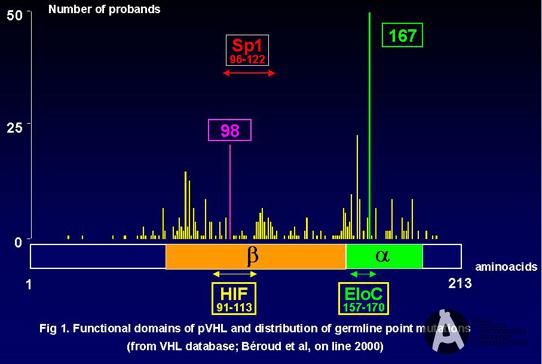
Germline mutations cause von Hippel-Lindau disease. VHL mutations are heterogeneous and distributed widely throughout the coding sequence except 5 for the translation initiation site for pVHL19. There is a few recurrent mutations and only one founder effect is known, originating from Germany (T292C resulting in a Tyr98His substitution).
Point mutations occur in about 60% of cases (Figure 2) and large deletions in about 40%. VHL 1 (without pheochromocytoma) is mainly produced by mutations responsible for truncated protein (deletions, frameshift mutations and nonsense mutations). VHL type 2 (with high risk of pheochromocytoma) is mainly produced by missense mutations. Type 2B is the potentially "full" form of the disease (frequent mutations: Arg167Gln, Arg167Trp). Type 2A is associated with a very low risk of clear cell renal cell cancer (RCC) (common mutation: Tyr98His). Type 2C is characterized by the occurrence of pheochromocytoma only (example: Leu188Val).
Between 10 and 15% of cryptic VHL cases could be explained by de novo mutations and there are some cases of germline mosaicism.
There is some evidence that genetic modifiers may influence the phenotypic expression of the disease.
Point mutations occur in about 60% of cases (Figure 2) and large deletions in about 40%. VHL 1 (without pheochromocytoma) is mainly produced by mutations responsible for truncated protein (deletions, frameshift mutations and nonsense mutations). VHL type 2 (with high risk of pheochromocytoma) is mainly produced by missense mutations. Type 2B is the potentially "full" form of the disease (frequent mutations: Arg167Gln, Arg167Trp). Type 2A is associated with a very low risk of clear cell renal cell cancer (RCC) (common mutation: Tyr98His). Type 2C is characterized by the occurrence of pheochromocytoma only (example: Leu188Val).
Between 10 and 15% of cryptic VHL cases could be explained by de novo mutations and there are some cases of germline mosaicism.
There is some evidence that genetic modifiers may influence the phenotypic expression of the disease.
Somatic
Mutations are encountered in 60 % of sporadic clear cell RCC. In addition, 15% of tumours show evidence of inactivation by methylation. VHL alterations have been associated with occupational exposure to trichlorethylene.
Somatic mutations are also frequent in CNS sporadic hemangioblastoma but rarer in sporadic endolymphatic sac tumours, pancreatic serous cystadenomas and endocrine tumours, epididymal cystadenomas and pheochromocytomas.
Somatic mutations are also frequent in CNS sporadic hemangioblastoma but rarer in sporadic endolymphatic sac tumours, pancreatic serous cystadenomas and endocrine tumours, epididymal cystadenomas and pheochromocytomas.
Implicated in
Entity name
Disease
Von Hippel-Lindau (VHL) disease is a hereditary devastating cancer syndrome, predisposing to the development of various benign and malignant tumours ( Central nervous system hemangioblastomas and Retinal hemangioblastomas , endolymphatic sac tumours, clear cell renal cell cancer and/or renal cysts, pheochromocytoma, pancreatic cysts and neuroendocrine tumours, epididymal and broad ligament cystadenomas). VHL disease is the first cause of hereditary kidney cancer.
Entity name
Sporadic renal cell carcinomas
Entity name
Sporadic hemangioblastomas
Article Bibliography
| Pubmed ID | Last Year | Title | Authors |
|---|---|---|---|
| 9399847 | 1998 | Software and database for the analysis of mutations in the VHL gene. | Béroud C et al |
| 11420685 | 2001 | Tumor suppressor protein VHL is induced at high cell density and mediates contact inhibition of cell growth. | Baba M et al |
| 11585776 | 2001 | Effects of ras and von Hippel-Lindau (VHL) gene mutations on hypoxia-inducible factor (HIF)-1alpha, HIF-2alpha, and vascular endothelial growth factor expression and their regulation by the phosphatidylinositol 3'-kinase/Akt signaling pathway. | Blancher C et al |
| 11024059 | 2001 | Role of exon 2-encoded beta -domain of the von Hippel-Lindau tumor suppressor protein. | Bonicalzi ME et al |
| 7759077 | 1995 | Von Hippel-Lindau (VHL) disease with pheochromocytoma in the Black Forest region of Germany: evidence for a founder effect. | Brauch H et al |
| 10766184 | 2000 | VHL alterations in human clear cell renal cell carcinoma: association with advanced tumor stage and a novel hot spot mutation. | Brauch H et al |
| 11331613 | 2001 | Contrasting effects on HIF-1alpha regulation by disease-causing pVHL mutations correlate with patterns of tumourigenesis in von Hippel-Lindau disease. | Clifford SC et al |
| 10581162 | 1999 | An important von Hippel-Lindau tumor suppressor domain mediates Sp1-binding and self-association. | Cohen HT et al |
| 10725953 | 2000 | von Hippel-Lindau disease. | Couch V et al |
| 11154273 | 2001 | VHL induces renal cell differentiation and growth arrest through integration of cell-cell and cell-extracellular matrix signaling. | Davidowitz EJ et al |
| 9062583 | 1997 | The von Hippel-Lindau tumor suppressor gene. A rare and intriguing disease opening new insight into basic mechanisms of carcinogenesis. | Decker HJ et al |
| 11257110 | 2001 | Genotype-phenotype correlation in von Hippel-Lindau syndrome. | Friedrich CA et al |
| 10408776 | 1999 | Mutations of the VHL gene in sporadic renal cell carcinoma: definition of a risk factor for VHL patients to develop an RCC. | Gallou C et al |
| 11505222 | 2001 | Association of GSTT1 non-null and NAT1 slow/rapid genotypes with von Hippel-Lindau tumour suppressor gene transversions in sporadic renal cell carcinoma. | Gallou C et al |
| 11171994 | 2001 | Vascular tumors in livers with targeted inactivation of the von Hippel-Lindau tumor suppressor. | Haase VH et al |
| 11331612 | 2001 | von Hippel-Lindau protein mutants linked to type 2C VHL disease preserve the ability to downregulate HIF. | Hoffman MA et al |
| 8855223 | 1996 | Negative regulation of hypoxia-inducible genes by the von Hippel-Lindau protein. | Iliopoulos O et al |
| 11163147 | 2001 | The von Hippel-Lindau tumor suppressor protein. | Ivan M et al |
| 11238039 | 2001 | Expression of hypoxia-inducible cell-surface transmembrane carbonic anhydrases in human cancer. | Ivanov S et al |
| 9770531 | 1998 | Down-regulation of transmembrane carbonic anhydrases in renal cell carcinoma cell lines by wild-type von Hippel-Lindau transgenes. | Ivanov SV et al |
| 11278694 | 2001 | Regulation of STRA13 by the von Hippel-Lindau tumor suppressor protein, hypoxia, and the UBC9/ubiquitin proteasome degradation pathway. | Ivanova AV et al |
| 10535940 | 1999 | Identification of the von Hippel-lindau tumor-suppressor protein as part of an active E3 ubiquitin ligase complex. | Iwai K et al |
| 9820032 | 1998 | The VHL tumour-suppressor gene paradigm. | Kaelin WG Jr et al |
| 11285365 | 2001 | VHL tumor suppressor regulates Cl-/HCO3- exchange and Na+/H+ exchange activities in renal carcinoma cells. | Karumanchi SA et al |
| 11283670 | 2001 | Histone deacetylases induce angiogenesis by negative regulation of tumor suppressor genes. | Kim MS et al |
| 11409863 | 2001 | DHPLC-based germline mutation screening in the analysis of the VHL tumor suppressor gene: usefulness and limitations. | Klein B et al |
| 9443397 | 1998 | Transforming growth factor alpha is a target for the von Hippel-Lindau tumor suppressor. | Knebelmann B et al |
| 11237528 | 2001 | The von Hippel-Lindau tumor suppressor gene. | Kondo K et al |
| 10454537 | 1999 | The von Hippel-Lindau tumor suppressor gene inhibits hepatocyte growth factor/scatter factor-induced invasion and branching morphogenesis in renal carcinoma cells. | Koochekpour S et al |
| 10514498 | 1999 | von Hippel-Lindau protein induces hypoxia-regulated arrest of tyrosine hydroxylase transcript elongation in pheochromocytoma cells. | Kroll SL et al |
| 8493574 | 1993 | Identification of the von Hippel-Lindau disease tumor suppressor gene. | Latif F et al |
| 8765323 | 1996 | Expression pattern of the von Hippel-Lindau protein in human tissues. | Los M et al |
| 10485495 | 1999 | Regulation of the urokinase-type plasminogen activator system by the von Hippel-Lindau tumor suppressor gene. | Los M et al |
| 11536052 | 2001 | VHL gene alterations in renal cell carcinoma patients: novel hotspot or founder mutations and linkage disequilibrium. | Ma X et al |
| 9413424 | 1997 | von Hippel-Lindau disease. | Maher ER et al |
| 11641274 | 2001 | FIH-1: a novel protein that interacts with HIF-1alpha and VHL to mediate repression of HIF-1 transcriptional activity. | Mahon PC et al |
| 11423722 | 2001 | Insights into the role of the von Hippel-Lindau gene product. A key player in hypoxic regulation. | Maxwell PH et al |
| 11550286 | 2001 | Role of disease-causing genes in sporadic pancreatic endocrine tumors: MEN1 and VHL. | Moore PS et al |
| 10612832 | 2000 | Somatic mosaicism in von Hippel-Lindau Disease. | Murgia A et al |
| 9751329 | 1998 | Prevalence, morphology and biology of renal cell carcinoma in von Hippel-Lindau disease compared to sporadic renal cell carcinoma. | Neumann HP et al |
| 10366821 | 1999 | The von Hippel-Lindau tumour suppressor protein: new perspectives. | Ohh M et al |
| 10587522 | 1999 | Synthetic peptides define critical contacts between elongin C, elongin B, and the von Hippel-Lindau protein. | Ohh M et al |
| 9651579 | 1998 | The von Hippel-Lindau tumor suppressor protein is required for proper assembly of an extracellular fibronectin matrix. | Ohh M et al |
| 10491320 | 1999 | Direct interaction of the beta-domain of VHL tumor suppressor protein with the regulatory domain of atypical PKC isotypes. | Okuda H et al |
| 9829912 | 1998 | Germline mutation profile of the VHL gene in von Hippel-Lindau disease and in sporadic hemangioblastoma. | Olschwang S et al |
| 10554035 | 1999 | Constitutional von Hippel-Lindau (VHL) gene deletions detected in VHL families by fluorescence in situ hybridization. | Pack SD et al |
| 9448273 | 1998 | The von Hippel-Lindau tumor suppressor gene is required for cell cycle exit upon serum withdrawal. | Pause A et al |
| 11517223 | 2001 | The von Hippel-Lindau protein interacts with heteronuclear ribonucleoprotein a2 and regulates its expression. | Pioli PA et al |
| 9106522 | 1997 | Somatic inactivation of the VHL gene in Von Hippel-Lindau disease tumors. | Prowse AH et al |
| 10809480 | 2000 | Central nervous system hemangioblastomas, endolymphatic sac tumors, and von Hippel-Lindau disease. | Richard S et al |
| 10631138 | 2000 | Mosaicism in von Hippel-Lindau disease: lessons from kindreds with germline mutations identified in offspring with mosaic parents. | Sgambati MT et al |
| 10205047 | 1999 | Structure of the VHL-ElonginC-ElonginB complex: implications for VHL tumor suppressor function. | Stebbins CE et al |
| 9829911 | 1998 | Improved detection of germline mutations in the von Hippel-Lindau disease tumor suppressor gene. | Stolle C et al |
| 11406557 | 2001 | VHL and FHIT locus loss of heterozygosity is common in all renal cancer morphotypes but differs in pattern and prognostic significance. | Velickovic M et al |
| 11085513 | 2000 | Somatic von Hippel-Lindau gene mutations detected in sporadic endolymphatic sac tumors. | Vortmeyer AO et al |
| 9758595 | 1998 | An analysis of phenotypic variation in the familial cancer syndrome von Hippel-Lindau disease: evidence for modifier effects. | Webster AR et al |
| 11431362 | 2001 | Constitutive activation of hypoxia-inducible genes related to overexpression of hypoxia-inducible factor-1alpha in clear cell renal carcinomas. | Wiesener MS et al |
| 10857749 | 2000 | Comparative sequence analysis of the VHL tumor suppressor gene. | Woodward ER et al |
| 11727931 | 2001 | The HIF pathway: implications for patterns of gene expression in cancer. | Wykoff CC et al |
| 11358837 | 2001 | Dynamic, site-specific interaction of hypoxia-inducible factor-1alpha with the von Hippel-Lindau tumor suppressor protein. | Yu F et al |
| 10232616 | 1999 | Third International Meeting on von Hippel-Lindau disease. | Zbar B et al |
| 8956040 | 1996 | Germline mutations in the Von Hippel-Lindau disease (VHL) gene in families from North America, Europe, and Japan. | Zbar B et al |
| 11171960 | 2001 | Role of transforming growth factor-alpha in von Hippel--Lindau (VHL)(-/-) clear cell renal carcinoma cell proliferation: a possible mechanism coupling VHL tumor suppressor inactivation and tumorigenesis. | de Paulsen N et al |
Other Information
Locus ID:
NCBI: 7428
MIM: 608537
HGNC: 12687
Ensembl: ENSG00000134086
Variants:
dbSNP: 7428
ClinVar: 7428
TCGA: ENSG00000134086
COSMIC: VHL
RNA/Proteins
| Gene ID | Transcript ID | Uniprot |
|---|---|---|
| ENSG00000134086 | ENST00000256474 | P40337 |
| ENSG00000134086 | ENST00000256474 | A0A024R2F2 |
| ENSG00000134086 | ENST00000345392 | P40337 |
| ENSG00000134086 | ENST00000345392 | A0A0S2Z4K1 |
Expression (GTEx)
Pathways
Protein levels (Protein atlas)
PharmGKB
| Entity ID | Name | Type | Evidence | Association | PK | PD | PMIDs |
|---|---|---|---|---|---|---|---|
| PA444477 | von Hippel-Lindau Disease | Disease | Literature, MultilinkAnnotation | associated | 23788249 |
References
| Pubmed ID | Year | Title | Citations |
|---|---|---|---|
| 38360997 | 2024 | VHL suppresses autophagy and tumor growth through PHD1-dependent Beclin1 hydroxylation. | 1 |
| 38618952 | 2024 | Von Hippel Lindau tumor suppressor controls m6A-dependent gene expression in renal tumorigenesis. | 1 |
| 38618953 | 2024 | VHL governs m6A modification and PIK3R3 mRNA stability in clear cell renal cell carcinomas. | 1 |
| 38618956 | 2024 | VHL loss reprograms the immune landscape to promote an inflammatory myeloid microenvironment in renal tumorigenesis. | 0 |
| 38866867 | 2024 | REST-dependent downregulation of von Hippel-Lindau tumor suppressor promotes autophagy in SHH-medulloblastoma. | 0 |
| 38914543 | 2024 | VHL suppresses UBE3B-mediated breast tumor growth and metastasis. | 0 |
| 39047034 | 2024 | Induction of the Mdm2 gene and protein by kinase signaling pathways is repressed by the pVHL tumor suppressor. | 0 |
| 38360997 | 2024 | VHL suppresses autophagy and tumor growth through PHD1-dependent Beclin1 hydroxylation. | 1 |
| 38618952 | 2024 | Von Hippel Lindau tumor suppressor controls m6A-dependent gene expression in renal tumorigenesis. | 1 |
| 38618953 | 2024 | VHL governs m6A modification and PIK3R3 mRNA stability in clear cell renal cell carcinomas. | 1 |
| 38618956 | 2024 | VHL loss reprograms the immune landscape to promote an inflammatory myeloid microenvironment in renal tumorigenesis. | 0 |
| 38866867 | 2024 | REST-dependent downregulation of von Hippel-Lindau tumor suppressor promotes autophagy in SHH-medulloblastoma. | 0 |
| 38914543 | 2024 | VHL suppresses UBE3B-mediated breast tumor growth and metastasis. | 0 |
| 39047034 | 2024 | Induction of the Mdm2 gene and protein by kinase signaling pathways is repressed by the pVHL tumor suppressor. | 0 |
| 36357669 | 2023 | Inhibiting von Hippel‒Lindau protein-mediated Dishevelled ubiquitination protects against experimental parkinsonism. | 2 |
Citation
Stéphane Richard
VHL (von Hippel-Lindau tumor suppressor)
Atlas Genet Cytogenet Oncol Haematol. 2002-01-01
Online version: http://atlasgeneticsoncology.org/gene/132
