HMGA1 (High mobility group protein (non histone chromosomal) isoform I and Y)
2000-11-01 Gilka JF Gattas , Florence Pedeutour AffiliationLaboratoire de Génétique des Tumeurs Solides, 5öme étage, Faculté de Médecine, 28 avenue de Valombrose, 06107 Nice cedex 2, France
Identity
HGNC
LOCATION
6p21.31
IMAGE

LEGEND
Probe(s) - Courtesy Mariano Rocchi, Resources for Molecular Cytogenetics
LOCUSID
ALIAS
HMG-R,HMGA1A,HMGIY
FUSION GENES
DNA/RNA
Description
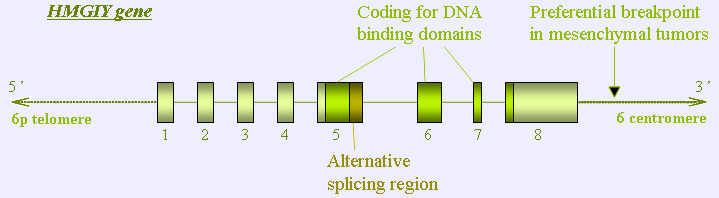
10 144 bp; 8 exons, 7 introns
Transcription
HMGI and HMGY are encoded by the same gene and are generated trough alternative splicing; exons 1-4 are not transcribed, exons 5-7 encode three DNA binding domains; exon 5 contains a 33 bp segment subject to alternative splicing; exon 8 encodes the acidic carboxy-terminal end; RNA length: 1.85 kb.
Proteins
Description
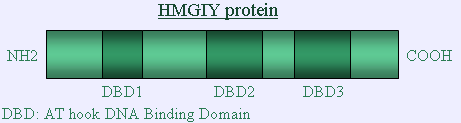
107 amino acids; three DNA binding domains (AT hooks)
Expression
expressed in embryonal cells; expressed in a variety of normal human adult tissues such as heart, brain, lung, skeletal muscle, kidney, pancreas, spleen, thymus, testis, ovary, small intestine, submandibular gland and leukocytes; expressed in transformed cells with a malignant phenotype and in human malignant tumors such as prostate, thyroid carcinoma and colorectal carcinomas and a subset of benign lipomas.
Localisation
nuclear
Function
Homology
member of the HMGI protein family, structural (but not expression pattern) homology with HMGIC
Mutations
Somatic
HMGIY is found involved in chromosome rearrangements in benign tumours, mainly mesenchymal tumors
Implicated in
Entity name
Pulmonary chondroid hamartoma
Disease
benign tumor of the lung
Prognosis
good
Cytogenetics
the most frequent rearrangement is a reciprocal balanced translocation t(6;14) (p21.3; q24); the rearrangement between chromosomes 6 and 14 can sometimes be complex, identifiable by FISH; molecular results also suggest that the translocations might be more complex than shown by conventional cytogenetics, with the presence of additional cryptic rearrangements; translocations involving partner chromosomes other than chromosome 14, such as chromosomes 1, 3, 4, 5, 10, 12, 17 have also been reported; inversions inv(6)(p21q21) or inv(6)(p21.3q26) have been described
Hybrid gene
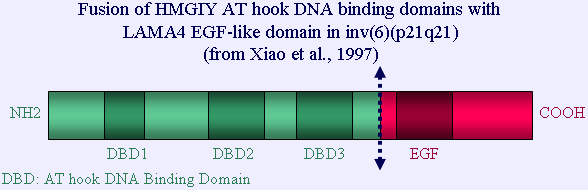
in most cases, the breakpoint was extragenic, located within a 80 kb region 3 of HMGIY; aberrant transcripts with truncation of sequences from the 3 UTR have been described; in only one case with inversion inv(6)(p21q21), a hybrid intragenic fusion has been reported: HMGIY was fused to the LAMA4 (laminin a4 chain) gene
Fusion protein
the HMGIY-LAMA4 resulted from the fusion of the three HMGIY DNA-binding domains with the LAMA4 EGF-like domain
Oncogenesis
the exact role of HMGI(Y)-LAMA4 fusion is not established yet
Entity name
Lipomas
Disease
benign adipocyte tumors
Prognosis
good
Cytogenetics
a small subset (5-8%) of ordinary lipomas is characterized by 6p21 rearrangements, the most frequent of which being a reciprocal translocation t(3;6)(q28;p21); in contrast to other benign mesenchymal tumors with 6p21 rearrangement, there is no evidence of HMGIY rearrangements in ordinary lipomas yet; however, to be noticed, the breakpoint on 6p21 was shown to be located whithin a 80 kb region surrounding HMGIY in one lipoma case and HMGIY expression was correlated with 6p rearrangements in two ordinary lipomas and two spindle cell lipomas
Entity name
Uterine leiomyoma
Disease
benign mesenchymal tumors
Prognosis
good
Cytogenetics
approximately 40% of uterine leiomyomas present structural chromosomal rearrangements, 5% of which involve 6p abnormalities; they include t(1;6)(q23;p21), t(6;14)(p21;q24) and t(6;10)(p21;q22) as well as inversions and translocations involving other chromosomal partners; the rearrangements are sometimes complex, only identifiable by FISH analysis
Hybrid gene
no hybrid gene has been described yet; as for other mesenchymal tumors, the breakpoint was extragenic, located within a 80 kb region 3 of HMGIY; one case of aberrant transcript with truncation of 1295 bp from the 3 UTR has been described
Fusion protein
HMGIY mRNA and protein levels do not always correlate, suggesting that post-transcriptional mechanisms are involved in the regulation of HMGIY
Entity name
Endometrial polyps
Disease
uterine benign tumors
Prognosis
good
Cytogenetics
several chromosomal abnormalities involving the 6p21.3 region, including translocations, deletions, inversions have been described; various chromosomal partner regions, such as 14q24, 20q13, 2q35, 10q22, 8q12, 1p32, 7p15, 15q21, have been described to be associated with 6p21.3 in reciprocal translocations.
Hybrid gene
no hybrid gene has been described yet; as for other mesenchymal tumors, the breakpoint is extragenic, located within a 80 kb region 3 of HMGIY
Entity name
Hamartoma of the breast
Disease
benign tumor-like nodule of the breast, also called adenolipoma
Prognosis
good
Cytogenetics
one case with a t(1 ;6)(p21 ;21), involving the HMGIY gene has been described
Entity name
Microfollicular adenoma of the thyroid
Disease
epithelial tumors
Prognosis
favorable
Cytogenetics
one case with a t(1;6)(p35;21) correlated with an overexpression of HMGIY has been described
Article Bibliography
| Pubmed ID | Last Year | Title | Authors |
|---|---|---|---|
| 9458084 | 1998 | Expression of HMGI(Y) proteins in squamous intraepithelial and invasive lesions of the uterine cervix. | Bandiera A et al |
| 10889043 | 2000 | Differential in vivo modifications of the HMGI(Y) nonhistone chromatin proteins modulate nucleosome and DNA interactions. | Banks GC et al |
| 8957086 | 1996 | High level expression of the HMGI (Y) gene during embryonic development. | Chiappetta G et al |
| 10451711 | 1999 | Involvement of the HMGI(Y) gene in a microfollicular adenoma of the thyroid. | Dal Cin P et al |
| 9290959 | 1997 | Hamartoma of the breast with involvement of 6p21 and rearrangement of HMGIY. | Dal Cin P et al |
| 8414980 | 1993 | Organization, inducible-expression and chromosome localization of the human HMG-I(Y) nonhistone protein gene. | Friedmann M et al |
| 9495195 | 1998 | Chromosomal translocations in benign tumors: the HMGI proteins. | Hess JL et al |
| 10469450 | 1999 | A high frequency of tumors with rearrangements of genes of the HMGI(Y) family in a series of 191 pulmonary chondroid hamartomas. | Kazmierczak B et al |
| 10550310 | 1999 | Misexpression of wild-type and truncated isoforms of the high-mobility group I proteins HMGI-C and HMGI(Y) in uterine leiomyomas. | Klotzbücher M et al |
| 9632746 | 1998 | Intranuclear distribution of HMGI/Y proteins. An immunocytochemical study. | Martelli AM et al |
| 10586108 | 1999 | [Genetics of uterine leiomyomata]. | Pedeutour F et al |
| 9797468 | 1998 | A role for the architectural transcription factors HMGI(Y) in cytokine gene transcription in T cells. | Shannon MF et al |
| 10526529 | 1999 | Expression of HMGIY in three uterine leiomyomata with complex rearrangements of chromosome 6. | Sornberger KS et al |
| 9212729 | 1997 | Expression of HMGI-C and HMGI(Y) in ordinary lipoma and atypical lipomatous tumors: immunohistochemical reactivity correlates with karyotypic alterations. | Tallini G et al |
| 10744071 | 2000 | HMGI-C and HMGI(Y) immunoreactivity correlates with cytogenetic abnormalities in lipomas, pulmonary chondroid hamartomas, endometrial polyps, and uterine leiomyomas and is compatible with rearrangement of the HMGI-C and HMGI(Y) genes. | Tallini G et al |
| 9187132 | 1997 | Misexpression of disrupted HMGI architectural factors activates alternative pathways of tumorigenesis. | Tkachenko A et al |
| 9060829 | 1997 | HMGI(Y) expression in human uterine leiomyomata. Involvement of another high-mobility group architectural factor in a benign neoplasm. | Williams AJ et al |
| 9060828 | 1997 | HMGI(Y) activation by chromosome 6p21 rearrangements in multilineage mesenchymal cells from pulmonary hamartoma. | Xiao S et al |
| 10357819 | 1999 | The role of HMG I(Y) in the assembly and function of the IFN-beta enhanceosome. | Yie J et al |
Other Information
Locus ID:
NCBI: 3159
MIM: 600701
HGNC: 5010
Ensembl: ENSG00000137309
Variants:
dbSNP: 3159
ClinVar: 3159
TCGA: ENSG00000137309
COSMIC: HMGA1
RNA/Proteins
Expression (GTEx)
Pathways
Protein levels (Protein atlas)
References
| Pubmed ID | Year | Title | Citations |
|---|---|---|---|
| 37815624 | 2024 | Hsa_circ_0054220 Upregulates HMGA1 by the Competitive RNA Pattern to Promote Neural Impairment in MPTP Model of Parkinson's Disease. | 0 |
| 38725843 | 2024 | HMGA1 sensitizes esophageal squamous cell carcinoma to mTOR inhibitors through the ETS1-FKBP12 axis. | 0 |
| 38758230 | 2024 | HMGA1 regulates trabectedin sensitivity in advanced soft-tissue sarcoma (STS): A Spanish Group for Research on Sarcomas (GEIS) study. | 0 |
| 37815624 | 2024 | Hsa_circ_0054220 Upregulates HMGA1 by the Competitive RNA Pattern to Promote Neural Impairment in MPTP Model of Parkinson's Disease. | 0 |
| 38725843 | 2024 | HMGA1 sensitizes esophageal squamous cell carcinoma to mTOR inhibitors through the ETS1-FKBP12 axis. | 0 |
| 38758230 | 2024 | HMGA1 regulates trabectedin sensitivity in advanced soft-tissue sarcoma (STS): A Spanish Group for Research on Sarcomas (GEIS) study. | 0 |
| 36352838 | 2023 | Mast cells impair melanoma cell homing and metastasis by inhibiting HMGA1 secretion. | 1 |
| 36470235 | 2023 | HMGA1 Aggravates Oxidative Stress Injury and Inflammatory Responses in IL-1β-Induced Primary Chondrocytes through the JMJD3/ZEB1 Axis. | 0 |
| 36635290 | 2023 | ST8SIA6-AS1 contributes to hepatocellular carcinoma progression by targeting miR-142-3p/HMGA1 axis. | 2 |
| 36705364 | 2023 | Association between HMGA1 and immunosuppression in hepatocellular carcinoma: A comprehensive bioinformatics analysis. | 1 |
| 36776216 | 2023 | Long non-coding RNA MYU promotes ovarian cancer cell proliferation by sponging miR-6827-5p and upregulating HMGA1. | 1 |
| 36919699 | 2023 | HMGA1 induces FGF19 to drive pancreatic carcinogenesis and stroma formation. | 5 |
| 37146833 | 2023 | Targeting HMGA1 contributes to immunotherapy in aggressive breast cancer while suppressing EMT. | 3 |
| 37423548 | 2023 | Proteomics screening uncovers HMGA1 as a promising negative regulator for γ-globin expression in response to decreased β-globin levels. | 0 |
| 37586214 | 2023 | TFAP2A activates HMGA1 to promote glycolysis and lung adenocarcinoma progression. | 2 |
Citation
Gilka JF Gattas ; Florence Pedeutour
HMGA1 (High mobility group protein (non histone chromosomal) isoform I and Y)
Atlas Genet Cytogenet Oncol Haematol. 2000-11-01
Online version: http://atlasgeneticsoncology.org/gene/221
