RAD52 (RAD52 homolog (S. cerevisiae))
2014-02-01 Benjamin H Lok , Simon N Powell AffiliationMemorial Sloan-Kettering Cancer Center, New York, New York 10065, USA
DNA/RNA
Note
The human and murine RAD52 gene is composed of 12 exons. Kito et al. identified three RAD52 isoforms designated RAD52β (226 amino acids), RAD52γ (139 amino acids), and RAD52δ (118 amino acids) which were able to bind ssDNA and dsDNA much like reference RAD52 (RAD52α). However, these isoforms lacked the ability to associate with RAD52α (Kito et al., 1999).
Thorpe and colleagues describe two splice variants that conferred increased homology-directed repair in the murine RAD52 gene RAD52Δexon4 and RAD52+intron8 (Thorpe et al., 2006).
Thorpe and colleagues describe two splice variants that conferred increased homology-directed repair in the murine RAD52 gene RAD52Δexon4 and RAD52+intron8 (Thorpe et al., 2006).
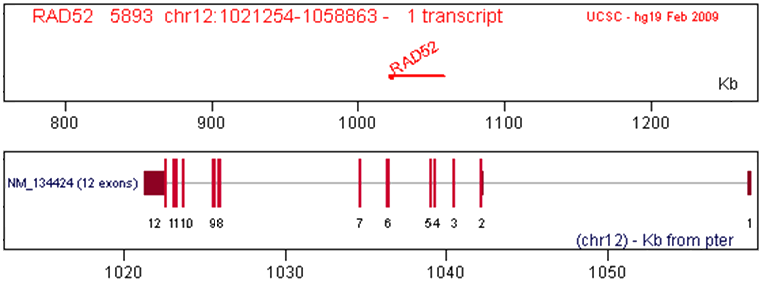
Proteins
Note
The human RAD52 (hRAD52) protein is similar to the Saccharomyces cerevisiae RAD52 protein (ScRAD52) both structurally and biochemically. However the phenotypic properties of RAD52, particularly in mediating homologous recombination varies amongst the evolutionary spectrum.
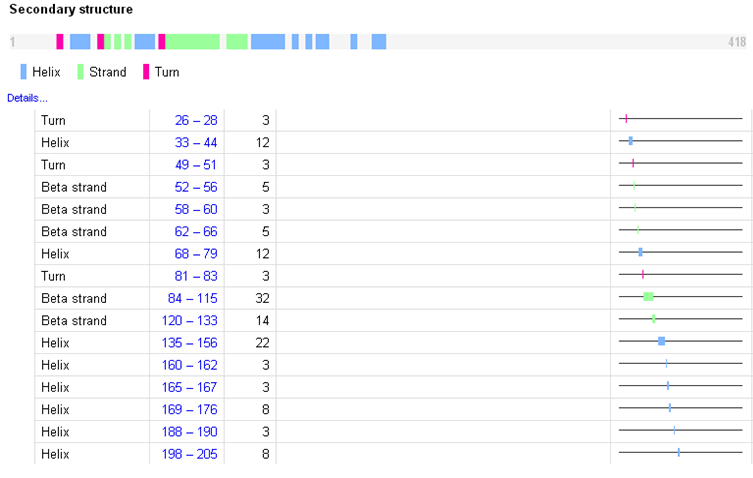
Secondary structure of the hRAD52 protein. From Uniprot.org (Creative Commons License).
Description
hRAD52 protein is comprised of 418 amino acids and forms a heptameric ring (Stasiak et al., 2000), which is mediated by the N-terminus (Ranatunga et al., 2001). This N-terminal portion binds ssDNA (Mortensen et al., 1996).
The well-studied hRAD521-212 is the N-terminal portion which forms an undecameric ringed polymer (Kagawa et al., 2002). DNA binding properties are linked to various amino acids, including, Arg-55, Tyr-65, Lys-152, Arg-153, Arg-156. Arg-55 and Lys-152 are necessarily for ssDNA binding, whereas Tyr-65, Arg-152, and Arg-156 are essential for binding both ssDNA and dsDNA (Kagawa et al., 2002). Phe-79 and Lys-102 have also shown a role in ssDNA and dsDNA binding, respectively (Lloyd et al., 2005). Interfering with the Phe-79 of hRAD52 was recently demonstrated to disrupt the RAD52-DNA interaction leading to an accumulation of DNA double-strand breaks (DSBs) particularly in BRCA1/2 deficient cells (Cramer-Morales et al., 2013). Further study is required to decipher the hierarchy of these respective sites and study additional novel binding sites.
Please see the following diagram for the location of several of these amino acid sites.
The well-studied hRAD521-212 is the N-terminal portion which forms an undecameric ringed polymer (Kagawa et al., 2002). DNA binding properties are linked to various amino acids, including, Arg-55, Tyr-65, Lys-152, Arg-153, Arg-156. Arg-55 and Lys-152 are necessarily for ssDNA binding, whereas Tyr-65, Arg-152, and Arg-156 are essential for binding both ssDNA and dsDNA (Kagawa et al., 2002). Phe-79 and Lys-102 have also shown a role in ssDNA and dsDNA binding, respectively (Lloyd et al., 2005). Interfering with the Phe-79 of hRAD52 was recently demonstrated to disrupt the RAD52-DNA interaction leading to an accumulation of DNA double-strand breaks (DSBs) particularly in BRCA1/2 deficient cells (Cramer-Morales et al., 2013). Further study is required to decipher the hierarchy of these respective sites and study additional novel binding sites.
Please see the following diagram for the location of several of these amino acid sites.
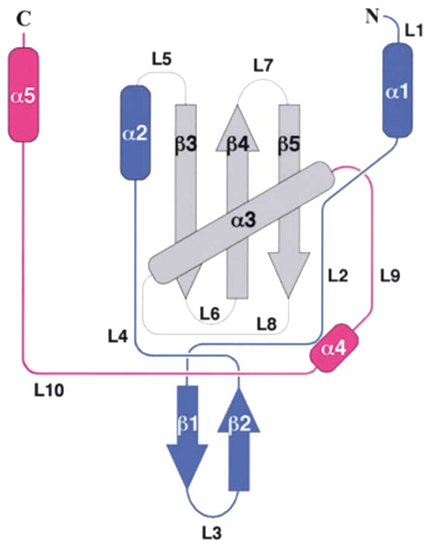
Secondary structure of the hRAD52 protein. From Kagawa et al. 2002, with permission from Elsevier.
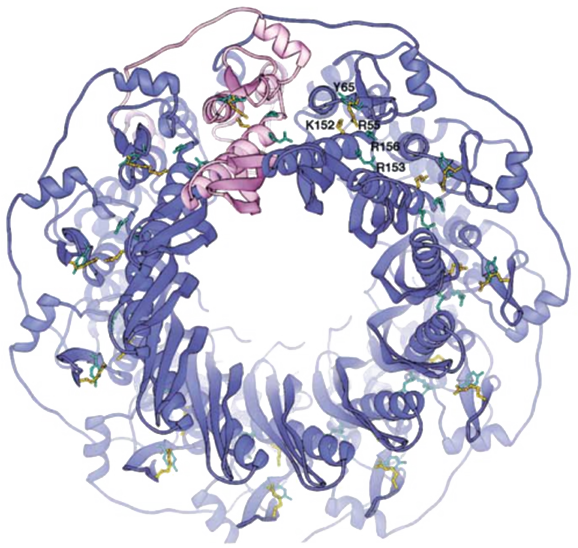
The hRAD521-212 undecameric polymer with principal DNA binding amino acid residues labeled residing in the predominantly positively charged groove. From Kagawa et al. 2002, with permission from Elsevier.
Localisation
ScRAD52 is a nuclear protein and predominantly recruited into sub-nuclear foci during the S-phase of the cell cycle (Lisby et al., 2001). hRAD52 sub-nuclear foci formation after exposure to ionizing radiation is dependent on c-Abl-mediated phosphorylation (Kitao and Yuan, 2002).
Function
ScRAD52 mediates RAD51 recombination activity and thus homology-directed repair (Milne and Weaver, 1993). hRAD52 also demonstrates this ability to stimulate homologous pairing by hRAD51 (Benson et al., 1998). The interaction of ScRAD52 and hRAD52 with replication protein A (RPA) is important for the binding with ssDNA by RAD52 (Hays et al., 1998; Shinohara et al., 1998; Jackson et al., 2002). hRAD52 binds directly to DSBs, protects them from exonuclease resection, and facilitates end-to-end interaction (Van Dyck et al., 1999). Furthermore, capture of the second DNA end in homologous recombination appears to involve RAD52-mediated annealing of RPA-ssDNA strands in biochemical reactions (Sugiyama et al., 2006).
Although, ScRAD52 and hRAD52 does not stimulate RAD51 DNA strand exchange with RPA-ssDNA complexes in biochemical assays (Jensen et al., 2010), under certain conditions, hRAD52 does promote RAD51-mediated homologous DNA pairing (Baumann and West, 1999).
hRAD52 mediates RAD51 recombination function in human cancer cells deficient in BRCA1 (Cramer-Morales et al., 2013; Lok et al., 2013), PALB2 (Lok et al., 2013) or BRCA2 (Feng et al., 2011). RAD52 is able to mediate RAD51-mediated homology-directed repair when the predominant BRCA1-PALB2-BRCA2 homologous recombination pathway is perturbed (see figure below). The RAD52-RAD51 pathway also appears to function independently of the RAD51 paralogs RAD51B/RAD51C/RAD51D-XRCC2 (Chun et al., 2013).
ScRAD52 is required for RAD51-independent single-strand annealing (SSA) (Singleton et al., 2002; Symington, 2002) and break-induced replication (BIR) (Malkova et al., 1996; Ira and Haber, 2002; McEachern and Haber, 2006).
Although, ScRAD52 and hRAD52 does not stimulate RAD51 DNA strand exchange with RPA-ssDNA complexes in biochemical assays (Jensen et al., 2010), under certain conditions, hRAD52 does promote RAD51-mediated homologous DNA pairing (Baumann and West, 1999).
hRAD52 mediates RAD51 recombination function in human cancer cells deficient in BRCA1 (Cramer-Morales et al., 2013; Lok et al., 2013), PALB2 (Lok et al., 2013) or BRCA2 (Feng et al., 2011). RAD52 is able to mediate RAD51-mediated homology-directed repair when the predominant BRCA1-PALB2-BRCA2 homologous recombination pathway is perturbed (see figure below). The RAD52-RAD51 pathway also appears to function independently of the RAD51 paralogs RAD51B/RAD51C/RAD51D-XRCC2 (Chun et al., 2013).
ScRAD52 is required for RAD51-independent single-strand annealing (SSA) (Singleton et al., 2002; Symington, 2002) and break-induced replication (BIR) (Malkova et al., 1996; Ira and Haber, 2002; McEachern and Haber, 2006).
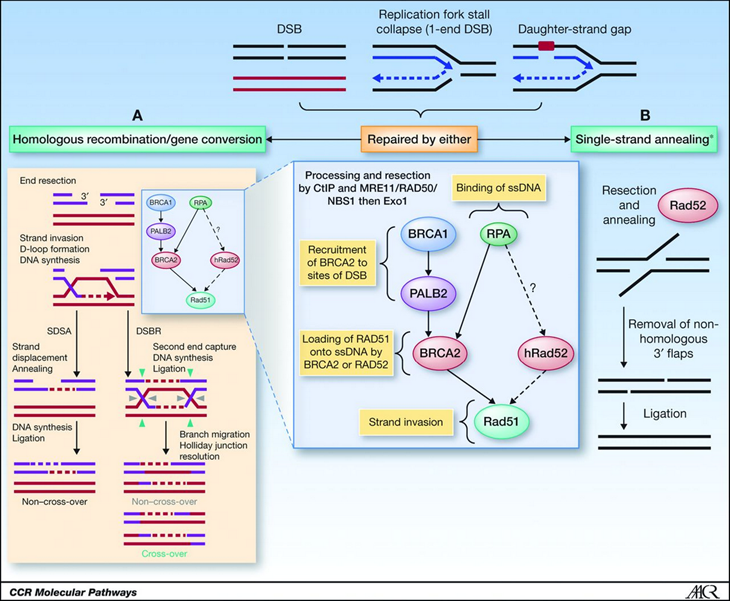
The BRCA and RAD52 pathways of DNA double-strand break repair. *There is currently no well-defined evidence that single-end DSBs or daughter-strand gaps are repaired by single strand annealing. From Lok and Powell, 2012.
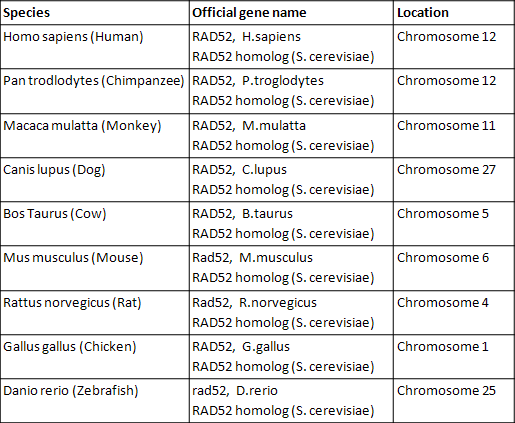
Modified from HomoloGene.
Mutations
Note
Currently, there are no known mutations of RAD52 that lead to human disease, including none associated with breast cancer (Bell et al., 1999), ovarian cancer (Tong et al., 2003; Beesley et al., 2007) or chronic lymphocytic leukemia (Sellick et al., 2008).
Implicated in
Entity name
Resistance to platinum-based chemotherapy
Prognosis
There is a report of uncertain significance by Shi et al. that may link certain RAD52 variants and RAD52 protein expression levels to resistance to platinum-based chemotherapy (Shi et al., 2012), however no other published studies have demonstrated a similar association.
Article Bibliography
| Pubmed ID | Last Year | Title | Authors |
|---|---|---|---|
| 10438626 | 1999 | Heteroduplex formation by human Rad51 protein: effects of DNA end-structure, hRP-A and hRad52. | Baumann P et al |
| 18086758 | 2007 | Association between single-nucleotide polymorphisms in hormone metabolism and DNA repair genes and epithelial ovarian cancer: results from two Australian studies and an additional validation set. | Beesley J et al |
| 10463575 | 1999 | Common nonsense mutations in RAD52. | Bell DW et al |
| 9450758 | 1998 | Synergistic actions of Rad51 and Rad52 in recombination and DNA repair. | Benson FE et al |
| 23149936 | 2013 | Rad51 paralog complexes BCDX2 and CX3 act at different stages in the BRCA1-BRCA2-dependent homologous recombination pathway. | Chun J et al |
| 23836560 | 2013 | Personalized synthetic lethality induced by targeting RAD52 in leukemias identified by gene mutation and expression profile. | Cramer-Morales K et al |
| 21148102 | 2011 | Rad52 inactivation is synthetically lethal with BRCA2 deficiency. | Feng Z et al |
| 9632824 | 1998 | Studies of the interaction between Rad52 protein and the yeast single-stranded DNA binding protein RPA. | Hays SL et al |
| 12192038 | 2002 | Characterization of RAD51-independent break-induced replication that acts preferentially with short homologous sequences. | Ira G et al |
| 12139939 | 2002 | Analysis of the human replication protein A:Rad52 complex: evidence for crosstalk between RPA32, RPA70, Rad52 and DNA. | Jackson D et al |
| 20729832 | 2010 | Purified human BRCA2 stimulates RAD51-mediated recombination. | Jensen RB et al |
| 12191481 | 2002 | Crystal structure of the homologous-pairing domain from the human Rad52 recombinase in the undecameric form. | Kagawa W et al |
| 12379650 | 2002 | Regulation of ionizing radiation-induced Rad52 nuclear foci formation by c-Abl-mediated phosphorylation. | Kitao H et al |
| 10673031 | 1999 | Identification of novel isoforms of human RAD52. | Kito K et al |
| 11459964 | 2001 | Rad52 forms DNA repair and recombination centers during S phase. | Lisby M et al |
| 15571718 | 2005 | Identification of residues important for DNA binding in the full-length human Rad52 protein. | Lloyd JA et al |
| 22964643 | 2013 | RAD52 inactivation is synthetically lethal with deficiencies in BRCA1 and PALB2 in addition to BRCA2 through RAD51-mediated homologous recombination. | Lok BH et al |
| 23071261 | 2012 | Molecular pathways: understanding the role of Rad52 in homologous recombination for therapeutic advancement. | Lok BH et al |
| 8692957 | 1996 | Double-strand break repair in the absence of RAD51 in yeast: a possible role for break-induced DNA replication. | Malkova A et al |
| 16756487 | 2006 | Break-induced replication and recombinational telomere elongation in yeast. | McEachern MJ et al |
| 8370524 | 1993 | Dominant negative alleles of RAD52 reveal a DNA repair/recombination complex including Rad51 and Rad52. | Milne GT et al |
| 8855248 | 1996 | DNA strand annealing is promoted by the yeast Rad52 protein. | Mortensen UH et al |
| 11278978 | 2001 | Human RAD52 exhibits two modes of self-association. | Ranatunga W et al |
| 18203022 | 2008 | Germline mutations in RAD51, RAD51AP1, RAD51B, RAD51C,RAD51D, RAD52 and RAD54L do not contribute to familial chronic lymphocytic leukemia. | Sellick G et al |
| 23209746 | 2012 | RAD52 variants predict platinum resistance and prognosis of cervical cancer. | Shi TY et al |
| 9619627 | 1998 | Rad52 forms ring structures and co-operates with RPA in single-strand DNA annealing. | Shinohara A et al |
| 12370410 | 2002 | Structure of the single-strand annealing domain of human RAD52 protein. | Singleton MR et al |
| 10744977 | 2000 | The human Rad52 protein exists as a heptameric ring. | Stasiak AZ et al |
| 17093500 | 2006 | Rad52-mediated DNA annealing after Rad51-mediated DNA strand exchange promotes second ssDNA capture. | Sugiyama T et al |
| 12456786 | 2002 | Role of RAD52 epistasis group genes in homologous recombination and double-strand break repair. | Symington LS et al |
| 16648471 | 2006 | Cells expressing murine RAD52 splice variants favor sister chromatid repair. | Thorpe PH et al |
| 12883740 | 2003 | Rad52 gene mutations in breast/ovarian cancer families and sporadic ovarian carcinoma patients. | Tong D et al |
| 10227297 | 1999 | Binding of double-strand breaks in DNA by human Rad52 protein. | Van Dyck E et al |
Other Information
Locus ID:
NCBI: 5893
MIM: 600392
HGNC: 9824
Ensembl: ENSG00000002016
Variants:
dbSNP: 5893
ClinVar: 5893
TCGA: ENSG00000002016
COSMIC: RAD52
RNA/Proteins
Expression (GTEx)
Pathways
PharmGKB
| Entity ID | Name | Type | Evidence | Association | PK | PD | PMIDs |
|---|---|---|---|---|---|---|---|
| PA445204 | Ovarian Neoplasms | Disease | ClinicalAnnotation | associated | PD | 24533712 | |
| PA449014 | cisplatin | Chemical | ClinicalAnnotation | associated | PD | 24533712 | |
| PA449165 | cyclophosphamide | Chemical | ClinicalAnnotation | associated | PD | 24533712 |
References
| Pubmed ID | Year | Title | Citations |
|---|---|---|---|
| 38081641 | 2024 | Human RAD52 stimulates the RAD51-mediated homology search. | 1 |
| 38625790 | 2024 | RAD52-dependent mitotic DNA synthesis is required for genome stability in Cyclin E1-overexpressing cells. | 0 |
| 38658755 | 2024 | Mechanism of single-stranded DNA annealing by RAD52-RPA complex. | 0 |
| 38081641 | 2024 | Human RAD52 stimulates the RAD51-mediated homology search. | 1 |
| 38625790 | 2024 | RAD52-dependent mitotic DNA synthesis is required for genome stability in Cyclin E1-overexpressing cells. | 0 |
| 38658755 | 2024 | Mechanism of single-stranded DNA annealing by RAD52-RPA complex. | 0 |
| 36470428 | 2023 | DNA repair protein RAD52 is required for protecting G-quadruplexes in mammalian cells. | 2 |
| 36709426 | 2023 | Elevated PAF1-RAD52 axis confers chemoresistance to human cancers. | 3 |
| 36811351 | 2023 | Biochemical characterization of the RNA-binding and RNA-DNA strand exchange activities of the human RAD52 protein. | 0 |
| 37470997 | 2023 | Different SWI/SNF complexes coordinately promote R-loop- and RAD52-dependent transcription-coupled homologous recombination. | 10 |
| 36470428 | 2023 | DNA repair protein RAD52 is required for protecting G-quadruplexes in mammalian cells. | 2 |
| 36709426 | 2023 | Elevated PAF1-RAD52 axis confers chemoresistance to human cancers. | 3 |
| 36811351 | 2023 | Biochemical characterization of the RNA-binding and RNA-DNA strand exchange activities of the human RAD52 protein. | 0 |
| 37470997 | 2023 | Different SWI/SNF complexes coordinately promote R-loop- and RAD52-dependent transcription-coupled homologous recombination. | 10 |
| 35190531 | 2022 | Rad52 mediates class-switch DNA recombination to IgD. | 9 |
Citation
Benjamin H Lok ; Simon N Powell
RAD52 (RAD52 homolog (S. cerevisiae))
Atlas Genet Cytogenet Oncol Haematol. 2014-02-01
Online version: http://atlasgeneticsoncology.org/gene/349/rad52-(rad52-homolog-(s-cerevisiae))
