CLU (clusterin)
2009-10-01 Hanna Rauhala , Tapio Visakorpi AffiliationInstitute of Medical Technology, University of Tampere, Tampere University Hospital, Tampere, Finland
Identity
HGNC
LOCATION
8p21.1
LOCUSID
ALIAS
AAG4,APO-J,APOJ,CLI,CLU1,CLU2,KUB1,NA1/NA2,SGP-2,SGP2,SP-40,TRPM-2,TRPM2
FUSION GENES
DNA/RNA
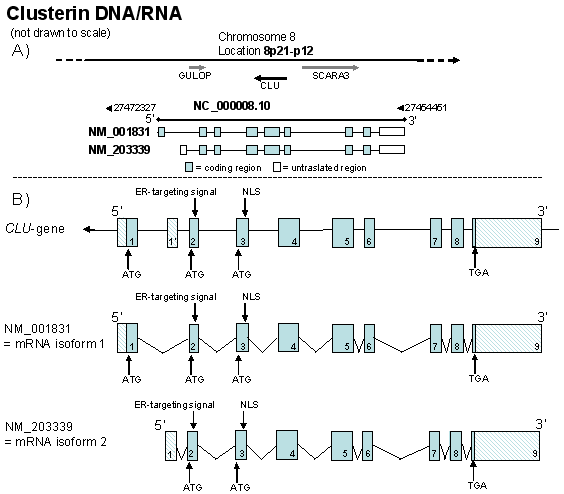
A) Clusterin gene genomic location at chromosome 8p21-p12 (minus strand) and annotated transcripts. B) Exons are numbered and presented by boxes. Shaded areas represent untranslated regions (UTR). Endoplastic reticulum (ER)-targeting signal in exon 2 and nuclear localization signal (NLS) in exon 3 are marked. Three in-frame translation start sites in exons 1, 2 and 3 are marked (ATG).
Description
Clusterin gene is 17876 bp long and contains 10 exons in total. First two exons are alternative (designated 1 and 1) used by two different transcript isoforms. Other exons (2-9) are shared with both isoforms. CLU gene resides in minus strand and is transcribed in reverse orientation (from centromere to p-telomere).
Transcription
Clusterin gene is transcribed into 2 mRNA isoforms (NM-001831, 2859 bp; and NM-203339, 2979 bp). They result from the use of alternative first exons (1 and 1) and shared exons 2 to 9.
Proteins
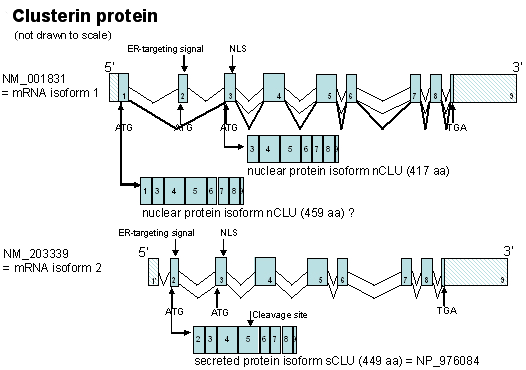
Clusterin transcripts contain 3 different translation start sites (ATG), all in-frame. The best characterized protein isoform is produced from transcript isoform 2, where translation starts at the second ATG present in exon 2, right before ER-targeting signal. This protein (NP-976084) consists of 449 amino acids. The mechanism by which the protein products are translated from isoform 1 is not as well understood. There is evidence suggesting that two nuclear protein isoforms can be produced from this transcript isoform, one in which translation starts at ATG in exon 3 (417 aa), and another with translation starting from ATG in exon 1 (459 aa).
Description
Secreted clusterin is produced from the transcript isoform 2. The initial protein precursor, presecretory psCLU (~60 kDa), becomes heavily glycosylated and cleaved in the ER, and the resulting alpha and beta peptide chains are held together by 5 disulfide bonds in the mature secreted heterodimer protein form, sCLU (~75-80 kDa).
Also the nuclear clusterin is first translated as a non-glycosylated protein precursor, pnCLU (~49 kDa), that is then translocated into nucleus. There is evidence of two distinct sized nuclear clusterin proteins (~50 kDa and ~60 kDa, Pajak et al., 2007), that could results from translation started either at ATG present in exon 3 or in exon 1, respectively.
Clusterin proteins have never been crystallized, so the suggested protein structures are based on computational modeling.
Also the nuclear clusterin is first translated as a non-glycosylated protein precursor, pnCLU (~49 kDa), that is then translocated into nucleus. There is evidence of two distinct sized nuclear clusterin proteins (~50 kDa and ~60 kDa, Pajak et al., 2007), that could results from translation started either at ATG present in exon 3 or in exon 1, respectively.
Clusterin proteins have never been crystallized, so the suggested protein structures are based on computational modeling.
Expression
Ubiquitous expression in various tissue types.
Localisation
The different clusterin protein isoforms localize to different cellular compartments. The nuclear clusterin translocated to nucleus after translation and glycosylation. The secreted clusterin is initially targeted to ER, and the glycosylated protein is eventually secreted. There is also evidence of stress-caused retention of sCLU in the cytosol instead of secretion (Nizard et al., 2007).
Function
The functions of clusterin in cells are not fully known. The controversiality of clusterin functions mainly results from the not well-established role of the two different protein isoforms with distinct subcellular localization and somewhat opposing functionalities.
Some known functions include involvement in apoptosis through complexing with Ku70 autoantigen (nCLU, proapoptotic) or interfering with Bax-activation (sCLU, antiapoptotic) (Yang et al., 2000; Leskov et al., 2003; Zhang et al., 2005; Zhang et al., 2006). Clusterin has also been linked to spermatogenesis (Roberts et al., 1991), lipid transport (Jenne et al., 1991; Calero et al., 1994; Gelissen et al., 1998), epithelial cell differentiation (French et al., 1993; Schedin et al., 2000; Kim et al., 2007), TGF-beta signaling through Smad2/Smad3 (Lee et al., 2008), complement activation (Kirszbaum et al., 1992) and tumorigenesis (see below).
Some known functions include involvement in apoptosis through complexing with Ku70 autoantigen (nCLU, proapoptotic) or interfering with Bax-activation (sCLU, antiapoptotic) (Yang et al., 2000; Leskov et al., 2003; Zhang et al., 2005; Zhang et al., 2006). Clusterin has also been linked to spermatogenesis (Roberts et al., 1991), lipid transport (Jenne et al., 1991; Calero et al., 1994; Gelissen et al., 1998), epithelial cell differentiation (French et al., 1993; Schedin et al., 2000; Kim et al., 2007), TGF-beta signaling through Smad2/Smad3 (Lee et al., 2008), complement activation (Kirszbaum et al., 1992) and tumorigenesis (see below).
Homology
Homolog to murine Clu (75%),
Homolog to rat Clu (77%),
Low level homology to human clusterin-like 1 (retinal) (25%).
Homolog to rat Clu (77%),
Low level homology to human clusterin-like 1 (retinal) (25%).
Mutations
Somatic
6316delT, an insertion (I)/deletion (D) polymorphism, has been studied in Japanese population (Miwa et al., 2005). D/D genotype was shown to associate with significantly higher total cholesterol levels and low-density lipoprotein (LDL) levels in hypertensive females, and the D allele was an independent predictor of plaque prevalence.
Several SNPs have also been found in CLU-gene, both at coding regions and at UTRs and introns. See SNP database at NCBI.
Several SNPs have also been found in CLU-gene, both at coding regions and at UTRs and introns. See SNP database at NCBI.
Implicated in
Entity name
Prostate cancer
Note
Several studies have shown decreased clusterin levels in prostate cancer (Bettuzzi et al., 2000; Scaltriti et al., 2004; Rauhala et al., 2008). On the other hand, there are also reports on increased expression of clusterin in prostate cancer, specifically after androgen ablation therapy (July et al., 2002). These opposing results have been explained by the different isoforms of clusterin, i.e. proapoptotic nCLU being decreased, while antiapoptotic, pro-survival sCLU could be increased. Antisense oligonucleotide (ASO) therapy against clusterin is currently tested in clinical trials to evaluate its efficacy in improving androgen deprivation therapy, as well as to prevent chemoresistance (reviewed in Gleave and Miyake, 2005; Sowery et al., 2008). Data supporting the tumor suppressive role for clusterin include reports on epigenetic regulation of clusterin expression in prostate cancer cell lines (Rauhala et al., 2008) and a recently developed TRAMP/cluKO mouse clusterin knock-out model that develops more poorly differentiated and metastatic tumors (Bettuzzi et al., 2008).
Entity name
Breast cancer
Note
Clusterin expression has been shown to increase in breast cancer (Redondo et al., 2000; Kruger et al., 2007). Similarly to prostate cancer, clusterin ASO therapy is being tested also for breast cancer. Recent results from phase II trial did not support show significant increase in treatment response when docetaxel was combined with anti-clusterin therapy (Chia et al., 2009).
Entity name
Ovarian cancer
Note
Cytoplasmic clusterin expression has been shown to increase in ovarian cancer in stage-specific manner and in response to chemotherapy as a cell-survival promoter (Xie et al., 2007; Wei et al., 2009).
Entity name
Colorectal cancer
Note
Increased cytoplasmic clusterin expression has also been found in colorectal cancers (Xie et al., 2005), and the increased clusterin levels were shown to associate with poor prognosis of stage II colon cancers (Kevans et al., 2009). Clusterin has also been suggested to be a potential stool biomarker for colon cancer screening (Pucci et al., 2009).
Entity name
Pancreatic cancer
Note
In pancreatic cancer the reports of clusterin expression are controversial, with both high and low expression reported for cancers (Xie et al., 2002; Jhala et al., 2006). Lack of clusterin expression was also suggested as a potential discriminator factor for distinguishing pancreatic adenocarcinomas from pancreatic patients from fine-needle aspirations (Jhala et al., 2006). In pancreatic cancers, clusterin expression was associated with longer survival, supporting the idea of clusterin down-regulation in tumor progression (Xie et al., 2002).
Entity name
Alzheimers disease
Note
Increased clusterin levels are shown in Alzheimers disease, mostly in astrocytes. Clusterin can bind to amyloid-beta peptides stabilizing them leading to their clearance from the brain. Fibrillized amyloid deposits can be masked by clusterin so that they are not recognized by the host defense system, thus preventing excessive inflammation reaction. Additional protection of neural cells is achieved by inhibiting the complement activation. Furthermore, clusterin can function antiapoptotically through Bax-interference and potentiate survival mediated through TGF-beta signaling. (Reviewed in Nuutinen et al., 2009).
Entity name
Nephrotic syndrome
Note
Clusterin expression is decreased in glomerular diseases causing nephrotic syndrome, with hypercholesterolemia appearing as the unifying feature (Ghiggeri et al., 2002).
Article Bibliography
| Pubmed ID | Last Year | Title | Authors |
|---|---|---|---|
| 10567218 | 1999 | Functional and structural properties of lipid-associated apolipoprotein J (clusterin). | Calero M et al |
| 19147778 | 2009 | Phase II trial of OGX-011 in combination with docetaxel in metastatic breast cancer. | Chia S et al |
| 8354695 | 1993 | Murine clusterin: molecular cloning and mRNA localization of a gene associated with epithelial differentiation processes during embryogenesis. | French LE et al |
| 9512484 | 1998 | Apolipoprotein J (clusterin) induces cholesterol export from macrophage-foam cells: a potential anti-atherogenic function? | Gelissen IC et al |
| 12427144 | 2002 | Depletion of clusterin in renal diseases causing nephrotic syndrome. | Ghiggeri GM et al |
| 15770517 | 2005 | Use of antisense oligonucleotides targeting the cytoprotective gene, clusterin, to enhance androgen- and chemo-sensitivity in prostate cancer. | Gleave M et al |
| 1904058 | 1991 | Clusterin (complement lysis inhibitor) forms a high density lipoprotein complex with apolipoprotein A-I in human plasma. | Jenne DE et al |
| 17019794 | 2006 | Biomarkers in Diagnosis of pancreatic carcinoma in fine-needle aspirates. | Jhala N et al |
| 11813210 | 2002 | Clusterin expression is significantly enhanced in prostate cancer cells following androgen withdrawal therapy. | July LV et al |
| 19155441 | 2009 | High clusterin expression correlates with a poor outcome in stage II colorectal cancers. | Kevans D et al |
| 17512083 | 2007 | Functional association of the morphogenic factors with the clusterin for the pancreatic beta-cell differentiation. | Kim SY et al |
| 1551440 | 1992 | SP-40,40, a protein involved in the control of the complement pathway, possesses a unique array of disulphide bridges. | Kirszbaum L et al |
| 17203891 | 2007 | Prognostic significance of clusterin immunoreactivity in breast cancer. | Krüger S et al |
| 18082619 | 2008 | Clusterin, a novel modulator of TGF-beta signaling, is involved in Smad2/3 stability. | Lee KB et al |
| 15883054 | 2005 | Insertion/deletion polymorphism in clusterin gene influences serum lipid levels and carotid intima-media thickness in hypertensive Japanese females. | Miwa Y et al |
| 19651157 | 2009 | Clusterin: a forgotten player in Alzheimer's disease. | Nuutinen T et al |
| 19623170 | 2009 | Clusterin in stool: a new biomarker for colon cancer screening? | Pucci S et al |
| 18649357 | 2008 | Clusterin is epigenetically regulated in prostate cancer. | Rauhala HE et al |
| 10934144 | 2000 | Overexpression of clusterin in human breast carcinoma. | Redondo M et al |
| 1954915 | 1991 | Regulation of Sertoli cell transferrin and sulfated glycoprotein-2 messenger ribonucleic acid levels during the restoration of spermatogenesis in the adult hypophysectomized rat. | Roberts KP et al |
| 14618611 | 2004 | Clusterin (SGP-2, ApoJ) expression is downregulated in low- and high-grade human prostate cancer. | Scaltriti M et al |
| 11149574 | 2000 | Estrous cycle regulation of mammary epithelial cell proliferation, differentiation, and death in the Sprague-Dawley rat: a model for investigating the role of estrous cycling in mammary carcinogenesis. | Schedin P et al |
| 18336596 | 2008 | Clusterin knockdown using the antisense oligonucleotide OGX-011 re-sensitizes docetaxel-refractory prostate cancer PC-3 cells to chemotherapy. | Sowery RD et al |
| 19391138 | 2009 | Roles of clusterin in progression, chemoresistance and metastasis of human ovarian cancer. | Wei L et al |
| 15578711 | 2005 | Up-regulated expression of cytoplasmic clusterin in human ovarian carcinoma. | Xie D et al |
| 15929184 | 2005 | Oncogenic role of clusterin overexpression in multistage colorectal tumorigenesis and progression. | Xie D et al |
| 12370533 | 2002 | Expression of clusterin in human pancreatic cancer. | Xie MJ et al |
Other Information
Locus ID:
NCBI: 1191
MIM: 185430
HGNC: 2095
Ensembl: ENSG00000120885
Variants:
dbSNP: 1191
ClinVar: 1191
TCGA: ENSG00000120885
COSMIC: CLU
RNA/Proteins
Expression (GTEx)
Pathways
Protein levels (Protein atlas)
References
| Pubmed ID | Year | Title | Citations |
|---|---|---|---|
| 38125724 | 2024 | Clusterin protects mature dendritic cells from reactive oxygen species mediated cell death. | 0 |
| 38319453 | 2024 | Clusterin: a marker and mediator of chemoresistance in colorectal cancer. | 1 |
| 38447939 | 2024 | CLU (clusterin) and PPARGC1A/PGC1α coordinately control mitophagy and mitochondrial biogenesis for oral cancer cell survival. | 0 |
| 38851158 | 2024 | Decoding CLU (Clusterin): Conquering cancer treatment resistance and immunological barriers. | 0 |
| 38125724 | 2024 | Clusterin protects mature dendritic cells from reactive oxygen species mediated cell death. | 0 |
| 38319453 | 2024 | Clusterin: a marker and mediator of chemoresistance in colorectal cancer. | 1 |
| 38447939 | 2024 | CLU (clusterin) and PPARGC1A/PGC1α coordinately control mitophagy and mitochondrial biogenesis for oral cancer cell survival. | 0 |
| 38851158 | 2024 | Decoding CLU (Clusterin): Conquering cancer treatment resistance and immunological barriers. | 0 |
| 36959561 | 2023 | Influence of clusterin genetic variants on IOP elevation in pseudoexfoliation syndrome and pseudoexfoliative glaucoma in Turkish population. | 1 |
| 37047762 | 2023 | Neuronal Hyperactivation in EEG Data during Cognitive Tasks Is Related to the Apolipoprotein J/Clusterin Genotype in Nondemented Adults. | 0 |
| 37211336 | 2023 | GABAergic signaling abnormalities in a novel CLU mutation Alzheimer's disease mouse model. | 3 |
| 37378824 | 2023 | Differential Sperm Proteomics Reveals the Significance of Fatty Acid Synthase and Clusterin in Idiopathic Recurrent Pregnancy Loss. | 2 |
| 37479568 | 2023 | Elevated ApoE, ApoJ and lipoprotein-bound α-synuclein levels in cerebrospinal fluid from Parkinson's disease patients - Validation in the BioFIND cohort. | 1 |
| 37494190 | 2023 | Astrocytic response mediated by the CLU risk allele inhibits OPC proliferation and myelination in a human iPSC model. | 9 |
| 37652361 | 2023 | Role of clusterin gene 3'-UTR polymorphisms and promoter hypomethylation in the pathogenesis of pseudoexfoliation syndrome and pseudoexfoliation glaucoma. | 0 |
Citation
Hanna Rauhala ; Tapio Visakorpi
CLU (clusterin)
Atlas Genet Cytogenet Oncol Haematol. 2009-10-01
Online version: http://atlasgeneticsoncology.org/gene/40107/clu
