FAT1 (FAT tumor suppressor homolog 1 (Drosophila))
2011-02-01 Kunzang Chosdol , Bhawana Dikshit , Subrata Sinha AffiliationDepartment of Biochemistry, All India Institute of Medical Sciences, Ansari Nagar, New Delhi-110029, India
Identity
HGNC
LOCATION
4q35.2
LOCUSID
ALIAS
CDHF7,CDHR8,FAT,ME5,hFat1
FUSION GENES
DNA/RNA
Description
FAT1 gene is located on the chromosome 4q35.2 (Accession: NC_000004.11). The total length of the gene is 136050 bases (187509746 bp to 187630981 bp from pter) of reverse strand. There are 27 exons.
An alternate assembly suggested to be starting from 187745931 bp to 187881981 bp from pter.
An alternate assembly suggested to be starting from 187745931 bp to 187881981 bp from pter.
Transcription
The length of the transcript is 14773 bps made from 27 exons (Accession: NM_005245.3).
Pseudogene
FAT tumor suppressor homolog 1 (Drosophila) pseudogene 1 (FAT1P1).
Other name: dJ697P8.1; sequence accession ID: AL050403; location chromosome: 20p12.2.
Other name: dJ697P8.1; sequence accession ID: AL050403; location chromosome: 20p12.2.
Proteins
Note
Known protein coding gene.
Protein names
Recommended name: protocadherin Fat 1.
Alternative names: Cadherin-related tumor suppressor homolog, Protein fat homolog, Cadherin family member 7.
Description
4588 aa (Accession: NP_005236.2).
Expression
Expressed in epithelial, endothelial and smooth muscle cells.
Localisation
Cell membrane; single-pass type I membrane protein.
Function
Could function as a cell-adhesion molecule, cell signalling molecule, and have a role in cell migration.
Fat in Drosophila acts via SWH signalling pathway as tumour suppressor gene. Homolog of SWH pathway molecules are present in human, so there is a possibility of acting FAT1 as an upstream regulator of SWH pathway in human.
In human, FAT1 expression is highest at the embryonic stages and diminishes later in adult life. In human fetal tissues, high levels of FAT1 transcripts were found in kidney, lungs, and eye epithelia, and the expression was found to be down regulated in the corresponding adult tissues, indicating the role of FAT1 in organ development. FAT1 also has a role in cell migration (Moeller et al., 2004; Tanoue and Takeichi, 2004) and found to be up-regulated in migrating cells, also crucial for efficient wound healing (Braun et al., 2007).
In Drosophila, fat is an upstream regulator of the Salvador-Wart-Hippo (SWH) signaling pathway (Cho et al., 2006; Bennett and Harvey, 2006). The signalling molecules of SWH pathway are conserved in mammals (figure below) but the role of FAT1 as an apical regulator of SWH pathway in human has not yet been established.
Fat in Drosophila acts via SWH signalling pathway as tumour suppressor gene. Homolog of SWH pathway molecules are present in human, so there is a possibility of acting FAT1 as an upstream regulator of SWH pathway in human.
In human, FAT1 expression is highest at the embryonic stages and diminishes later in adult life. In human fetal tissues, high levels of FAT1 transcripts were found in kidney, lungs, and eye epithelia, and the expression was found to be down regulated in the corresponding adult tissues, indicating the role of FAT1 in organ development. FAT1 also has a role in cell migration (Moeller et al., 2004; Tanoue and Takeichi, 2004) and found to be up-regulated in migrating cells, also crucial for efficient wound healing (Braun et al., 2007).
In Drosophila, fat is an upstream regulator of the Salvador-Wart-Hippo (SWH) signaling pathway (Cho et al., 2006; Bennett and Harvey, 2006). The signalling molecules of SWH pathway are conserved in mammals (figure below) but the role of FAT1 as an apical regulator of SWH pathway in human has not yet been established.
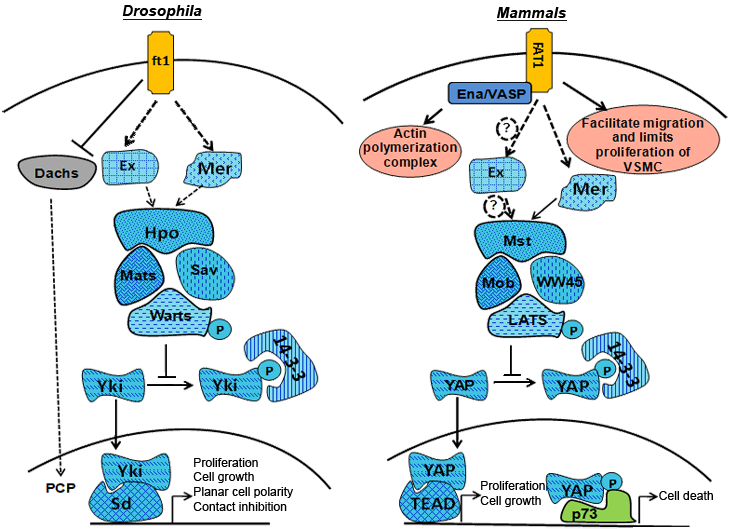
Salvador-Warts-Hippo pathway. Mammalian hippo signaling pathway shows homology with Drosophila pathway proteins (depicted in similar color and shape).
In Drosophila fat (ft) interacts with core kinase cascade via Expanded (Ex). The core kinase cascade includes kinase Hippo (hpo), adaptor proteins mats and Salvador (Sav) and kinase Warts. The core kinase cascade inhibits phosphorylation of transcriptional co-activator Yorkie (Yki) causing its translocation to nucleus where it binds to transcriptional activator Scalloped (Sd) and modulates gene expression.
In mammals, whether FAT1 is involved in hippo pathway regulation is not clear. The effector molecule, phospho-YAP, is reported to interact with p73 in the nucleus and promotes cell death. There is no p73 homolog known to be reported in Drosophila. YAP is also found to interact with other transcription factors and modulate gene expression, thus, the outcome of hippo pathway is context dependent.
Homology
Paralogs for FAT1 gene: FAT2, FAT3, FAT4.
Orthologs for FAT1 gene from other species.
| Organism | Gene | Locus | Description | Similarity to human FAT1 |
| Dog (Canis familiaris) | FAT1 | Chr. 16 | FAT tumor suppressor homolog 1 (Drosophila) | 86.95(n), 91.17(a) |
| Pig (Sus scrofa) | FAT1 | Chr. 17 | FAT tumor suppressor homolog 1 (Drosophila) | 86(n), 90(a) |
| Cow (Bos Taurus) | FAT1 | Chr. 27 | FAT tumor suppressor homolog 1 (Drosophila) | 84.18(n) 89.93(a) |
| Rat (Rattus norvegicus) | Fat1 | Chr. 16q11 | FAT tumor suppressor homolog 1 (Drosophila) | 82.93(n) 88.16(a) |
| Mouse (Mus musculus) | Fat1 | Chr. 8 (25.00 cM) | FAT tumor suppressor homolog 1 (Drosophila) | 82.51(n) 88.14(a) |
| Chicken (Gallus gallus) | FAT | Chr. 4 | FAT tumor suppressor homolog 1 (Drosophila) | 76.35(n) 81.43(a) |
| Zebrafish (Danio rerio) | fat1 | Chr. 1 | FAT tumor suppressor homolog 1 | 64.68(n) 64.82(a) |
| Fruit fly (Drosophila melanogaster) | ft and fat2 | Chr. 2L (ft) Chr. 3L (fat2) | fat and fat2 | ft - 42.8(n) 42(a), fat2 - 47.99(n) 39.02(a) |
| Worm (Caenorhabditis elegans) | cdh-4 | Chr. III | Cadherin family | 44.19(n) 30.89(a) |
| African malaria mosquito (Anopheles gambiae) | AgaP_AGAP011526 | Chr. 3L | AGAP011526-PA | 48.06(n) 39.5(a) |
Mutations
Note
No known mutations. Single nucleotide polymorphism (SNPs): gene: FAT1 (ENSG00000083857).
Implicated in
Entity name
Various cancers
Note
FAT1, a member of the cadherin gene family, is homologue of Drosophila tumour suppressor gene fat. In Drosophila, fat gene is important in controlling cell proliferation during development and any defect in the expression of fat would lead to tumor development (Bryant et al., 1988). Dunne et al. (1995) have identified the human homologue and studied the tissue distribution of FAT transcripts in adult and fetal tissues.
Loss of heterozygosity and altered expression of FAT1 has been found in human glial tumors (Chosdol et al., 2009). Homozygous deletion of FAT1 gene was detected in oral cancer (Nakaya et al., 2007). Kwaepila et al. (2006) found higher FAT1 expression in more malignant form of breast cancer tissues by immunohistochemistry (IHC). There are studies showing LOH and/or deletion of the chromosome 4q34-35 region (which harbors FAT gene) in many tumors including gliomas. LOH was found in grade IV gliomas using microsatellite markers (Hu et al., 2002), though the gene itself has not been implicated. Other tumors like small cell lung carcinoma (Cho et al., 2002), hepatocellular carcinoma (Zhang et al., 2005; Chang et al., 2002) and cervical carcinoma (Backsch et al., 2005) etc showed alterations/LOH in the chromosomal 4q34-q35 locus and significant association of 4q34-q35 region with increased risk of progression of these tumors was suggested. Since the FAT gene is located in this region it may have an important role to play in the development and progression of these tumors.
Loss of heterozygosity and altered expression of FAT1 has been found in human glial tumors (Chosdol et al., 2009). Homozygous deletion of FAT1 gene was detected in oral cancer (Nakaya et al., 2007). Kwaepila et al. (2006) found higher FAT1 expression in more malignant form of breast cancer tissues by immunohistochemistry (IHC). There are studies showing LOH and/or deletion of the chromosome 4q34-35 region (which harbors FAT gene) in many tumors including gliomas. LOH was found in grade IV gliomas using microsatellite markers (Hu et al., 2002), though the gene itself has not been implicated. Other tumors like small cell lung carcinoma (Cho et al., 2002), hepatocellular carcinoma (Zhang et al., 2005; Chang et al., 2002) and cervical carcinoma (Backsch et al., 2005) etc showed alterations/LOH in the chromosomal 4q34-q35 locus and significant association of 4q34-q35 region with increased risk of progression of these tumors was suggested. Since the FAT gene is located in this region it may have an important role to play in the development and progression of these tumors.
Entity name
Astrocytic tumour
Note
Loss of heterozygosity and altered expression of FAT1 in astrocytic tumors (Chosdol et al., 2009).
Entity name
Breast cancer
Note
Increased FAT1 expression contributes to loss of duct formation, and increased cell migration and invasion in breast cancer (Kwaepila et al., 2006).
Entity name
Oral cancer
Note
Homozygous deletion of FAT in the cell lines and in primary oral cancers was studied. Homozygous deletion hot spots were observed in exon 1 (9/20, 45%) and exon 4 (7/20, 35%). The methylation status of the FAT CpG island in squamous cell carcinomas correlated negatively with its expression. Mutations in FAT is suggested as an important factor in the development of oral cancer. Moreover, loss of gene expression was identified in other types of squamous cell carcinoma (Nakaya et al., 2007).
Entity name
Psychiatric disorders
Note
Bipolar disorder: a positional cloning strategy, combined with association analysis have provided evidence that a cadherin gene, FAT, confers susceptibility to bipolar disorder (Blair et al., 2006).
Entity name
Cell migration
Note
FAT1 is known to play role in cell migration. FAT1 knockdown decreases cell migration in vascular smooth muscle cells (Hou et al., 2006; Hou and Sibinga, 2009). FAT1 plays an integrative role in regulating cell migration by participating in Ena/VASP-dependent regulation of cytoskeletal dynamics (Moeller et al., 2004).
Article Bibliography
| Pubmed ID | Last Year | Title | Authors |
|---|---|---|---|
| 15838843 | 2005 | A region on human chromosome 4 (q35.1-->qter) induces senescence in cell hybrids and is involved in cervical carcinogenesis. | Backsch C et al |
| 17045801 | 2006 | Fat cadherin modulates organ size in Drosophila via the Salvador/Warts/Hippo signaling pathway. | Bennett FC et al |
| 16402135 | 2006 | Positional cloning, association analysis and expression studies provide convergent evidence that the cadherin gene FAT contains a bipolar disorder susceptibility allele. | Blair IP et al |
| 17500054 | 2007 | Differentially spliced isoforms of FAT1 are asymmetrically distributed within migrating cells. | Braun GS et al |
| 3417051 | 1988 | Mutations at the fat locus interfere with cell proliferation control and epithelial morphogenesis in Drosophila. | Bryant PJ et al |
| 12048165 | 2002 | Assessment of chromosomal losses and gains in hepatocellular carcinoma. | Chang J et al |
| 16980976 | 2006 | Delineation of a Fat tumor suppressor pathway. | Cho E et al |
| 11971207 | 2002 | Identification of tumor suppressor loci on the long arm of chromosome 4 in primary small cell lung cancers. | Cho ES et al |
| 19126244 | 2009 | Frequent loss of heterozygosity and altered expression of the candidate tumor suppressor gene 'FAT' in human astrocytic tumors. | Chosdol K et al |
| 10741417 | 2000 | Cloning and expression throughout mouse development of mfat1, a homologue of the Drosophila tumour suppressor gene fat. | Cox B et al |
| 15749076 | 2005 | Cloning and expression of the large zebrafish protocadherin gene, Fat. | Down M et al |
| 8586420 | 1995 | Molecular cloning and tissue expression of FAT, the human homologue of the Drosophila fat gene that is located on chromosome 4q34-q35 and encodes a putative adhesion molecule. | Dunne J et al |
| 16682528 | 2006 | The Fat1 cadherin integrates vascular smooth muscle cell growth and migration signals. | Hou R et al |
| 19131340 | 2009 | Atrophin proteins interact with the Fat1 cadherin and regulate migration and orientation in vascular smooth muscle cells. | Hou R et al |
| 12215292 | 2002 | Chromosome 14q may harbor multiple tumor suppressor genes in primary glioblastoma multiforme. | Hu J et al |
| 16865240 | 2006 | Comparative integromics on FAT1, FAT2, FAT3 and FAT4. | Katoh Y et al |
| 16581652 | 2006 | Immunohistological localisation of human FAT1 (hFAT) protein in 326 breast cancers. Does this adhesion molecule have a role in pathogenesis? | Kwaepila N et al |
| 15922730 | 2005 | Processing of the human protocadherin Fat1 and translocation of its cytoplasmic domain to the nucleus. | Magg T et al |
| 15343270 | 2004 | Protocadherin FAT1 binds Ena/VASP proteins and is necessary for actin dynamics and cell polarization. | Moeller MJ et al |
| 17325662 | 2007 | Identification of homozygous deletions of tumor suppressor gene FAT in oral cancer using CGH-array. | Nakaya K et al |
| 10072790 | 1999 | Expression of the rat homologue of the Drosophila fat tumour suppressor gene. | Ponassi M et al |
| 16979624 | 2006 | The intracellular domain of the human protocadherin hFat1 interacts with Homer signalling scaffolding proteins. | Schreiner D et al |
| 15148305 | 2004 | Mammalian Fat1 cadherin regulates actin dynamics and cell-cell contact. | Tanoue T et al |
| 15918185 | 2005 | Clinicopathological significance of loss of heterozygosity and microsatellite instability in hepatocellular carcinoma in China. | Zhang SH et al |
Other Information
Locus ID:
NCBI: 2195
MIM: 600976
HGNC: 3595
Ensembl: ENSG00000083857
Variants:
dbSNP: 2195
ClinVar: 2195
TCGA: ENSG00000083857
COSMIC: FAT1
RNA/Proteins
Expression (GTEx)
Protein levels (Protein atlas)
References
| Pubmed ID | Year | Title | Citations |
|---|---|---|---|
| 36941137 | 2024 | Association of FAT1 with focal epilepsy and correlation between seizure relapse and gene expression stage. | 1 |
| 37952564 | 2024 | FAT1 inhibits AML autophagy and proliferation via downregulating ATG4B expression. | 0 |
| 38364976 | 2024 | Clinical value of FAT1 mutations to indicate the immune response in colorectal cancer patients. | 0 |
| 38640981 | 2024 | STAT1 mediated downregulation of the tumor suppressor gene PDCD4, is driven by the atypical cadherin FAT1, in glioblastoma. | 0 |
| 36941137 | 2024 | Association of FAT1 with focal epilepsy and correlation between seizure relapse and gene expression stage. | 1 |
| 37952564 | 2024 | FAT1 inhibits AML autophagy and proliferation via downregulating ATG4B expression. | 0 |
| 38364976 | 2024 | Clinical value of FAT1 mutations to indicate the immune response in colorectal cancer patients. | 0 |
| 38640981 | 2024 | STAT1 mediated downregulation of the tumor suppressor gene PDCD4, is driven by the atypical cadherin FAT1, in glioblastoma. | 0 |
| 35524544 | 2023 | Oncogenic LINC00857 recruits TFAP2C to elevate FAT1 expression in gastric cancer. | 5 |
| 36511103 | 2023 | Analysis of scRNA-seq and bulk RNA-seq demonstrates the effects of EVI2B or CD361 on CD8(+) T cells in osteosarcoma. | 1 |
| 36653435 | 2023 | FAT1 expression in T-cell acute lymphoblastic leukemia (T-ALL) modulates proliferation and WNT signaling. | 1 |
| 37371091 | 2023 | The FAT1 Cadherin Drives Vascular Smooth Muscle Cell Migration. | 4 |
| 37931687 | 2023 | Predictive capacity of FAT1 transcriptional expression in patients with head and neck squamous cell carcinomas treated with radiotherapy. | 0 |
| 35524544 | 2023 | Oncogenic LINC00857 recruits TFAP2C to elevate FAT1 expression in gastric cancer. | 5 |
| 36511103 | 2023 | Analysis of scRNA-seq and bulk RNA-seq demonstrates the effects of EVI2B or CD361 on CD8(+) T cells in osteosarcoma. | 1 |
Citation
Kunzang Chosdol ; Bhawana Dikshit ; Subrata Sinha
FAT1 (FAT tumor suppressor homolog 1 (Drosophila))
Atlas Genet Cytogenet Oncol Haematol. 2011-02-01
Online version: http://atlasgeneticsoncology.org/gene/40533
