GPX1 (Glutathione Peroxidase 1)
2013-11-01 Mikhail V Kulak , Ronald J Weigel AffiliationDepartment of Surgery, University of Iowa, 200 Hawkins Drive, 1509 JCP, Iowa City, IA, 52242, United States
Identity
HGNC
LOCATION
3p21.31
IMAGE

LOCUSID
ALIAS
GPXD,GSHPX1
FUSION GENES
DNA/RNA
Description
According to hg19/GRCh37-Feb_2009:
- Start: chr3:49394609 bp from pter
- End: chr3:49395791 bp from pter
- Size: 1183 bases
- Orientation: minus strand
- Start: chr3:49394609 bp from pter
- End: chr3:49395791 bp from pter
- Size: 1183 bases
- Orientation: minus strand
Transcription
Two alternatively spliced transcript variants encoding distinct isoforms have been shown for this gene Nucleotide.
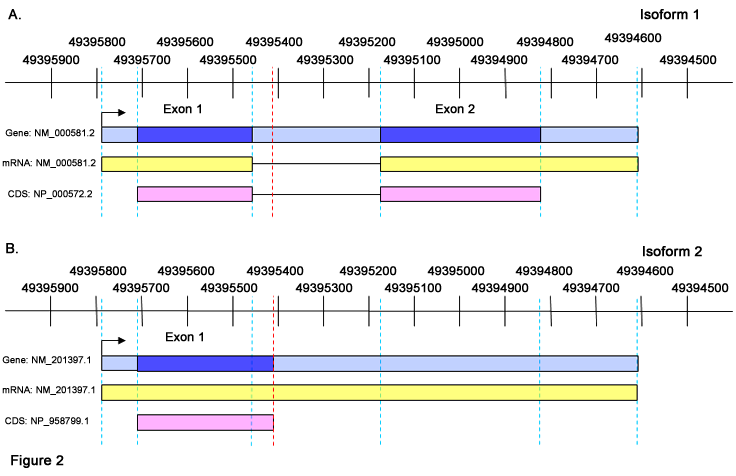
Isoform 1 represents the shorter transcript (921 bases), RefSeq: NM_000581.2, which is comprised of 2 exons and coding the longer isoform (Figure 2A).
Isoform 2 is 1200 bases, RefSeq: NM_201397.1, also this variant is intronless. Due to the fact that this variant is not spliced the open reading frame is shifted and the protein is shorter from C-terminus compared to isoform 1 (Figure 2B).
Isoform 1 represents the shorter transcript (921 bases), RefSeq: NM_000581.2, which is comprised of 2 exons and coding the longer isoform (Figure 2A).
Isoform 2 is 1200 bases, RefSeq: NM_201397.1, also this variant is intronless. Due to the fact that this variant is not spliced the open reading frame is shifted and the protein is shorter from C-terminus compared to isoform 1 (Figure 2B).
Pseudogene
Two pseudogenes have been found so far. GPX1P1 glutathione peroxidase pseudogene 1 (other names: GPXL2, GPXP1) is located at the locus Xp22.2 (HGNC:4560). GPX1P2 glutathione peroxidase pseudogene 2 (other names: GPXP2, GPXP2P) is located at the locus 21q21.3 (HGNC:4561).
Proteins
Description
203 aa (Accession: NM_000581.2) isoform 1; 98 aa (Accession: NM_201397.1) isoform 2.
GPX1 belongs to the family of glutathione peroxidases (Kryukov et al., 2003). GPX1, GPX2, GPX3, GPX4 and GPX6 utilize a UGA codon that specifies insertion of a selenocysteine residue which is critical to protein function (Arthur, 2000). Both isoforms contain selenocysteine at the position 49 (Mullenbach et al., 1988).
GPX1 belongs to the family of glutathione peroxidases (Kryukov et al., 2003). GPX1, GPX2, GPX3, GPX4 and GPX6 utilize a UGA codon that specifies insertion of a selenocysteine residue which is critical to protein function (Arthur, 2000). Both isoforms contain selenocysteine at the position 49 (Mullenbach et al., 1988).
Expression
GPX1 is found at high levels in tissues exposed to high oxygen tensions such as in the lungs, at the cellular elements of blood, liver, kidney and pancreas, and also at moderate levels in heart, muscle and brain (Esposito et al., 2000; Moscow et al., 1992).
Regulation: Aberrant promotor methylation and consequence silencing has been shown for GPX1 expression during several pathological conditions in breast (Kulak et al., 2012) and gastric cancer (Min et al., 2012); whereas, induction of GPX1 gene expression was associated with transcription factors such TFAP2C in breast cancer (Kulak et al., 2012) and ZNF143 transcription factor under the mitochondrial respiratory dysfunction (Lu et al., 2012).
Regulation: Aberrant promotor methylation and consequence silencing has been shown for GPX1 expression during several pathological conditions in breast (Kulak et al., 2012) and gastric cancer (Min et al., 2012); whereas, induction of GPX1 gene expression was associated with transcription factors such TFAP2C in breast cancer (Kulak et al., 2012) and ZNF143 transcription factor under the mitochondrial respiratory dysfunction (Lu et al., 2012).
Localisation
The protein is detected in cytoplasm and mitochondria but the ratio may vary and be dependent on cellular function (Chiu et al., 1976; Timcenko-Youssef et al., 1985; Reeves et al., 2009).
Function
GPX1 is an enzyme of mammals and birds which protects against the damaging effects of various endogenously formed hydroperoxides and hydrogen peroxide as follows: H2O2+ 2 GSH - 2 H2O + GSS and RGOH + 2 GSH - GSSG + ROH + H2O where ROOH represents lipid hydroperoxides, membrane associated phospholipid hydroperoxides (Ursini et al., 1985; Reeves et al., 2009).
Homology
The GPX1 gene is present in vertebrates and across all mammals demonstrates homology of about 70% at the nucleotide level (Mariotti et al., 2012).
Mutations
Note
Single nucleotide and ALA polymorphism have been shown for GPX1.
The 5-UTR of GPX1 was found to contain a single nucleotide C/T polymorphism rs 1800668 located at the position ch3:49395757. The CC genotype demonstrates relatively high activity of GPX1 compared to CT or TT variant of alleles; however, the polymorphism does not alter the protein structure so differences in activity might be associated with transcriptional regulation since rs 1080668 site is located within promoter of GPX1 (Najafi et al., 2012).
A single nucleotide polymorphism rs 1050450 at the position ch3:49394834 leads to Pro198->Leu (C->T) substitution in GPX1. Many publications suggested an associated increased risk of cancer with the TT (Leu) genotype. However, extended meta-analysis failed to find a significant correlation of the polymorphism (rs 1050450) with cancer risk, although the TT GPX1 genotype examined in erythrocytes demonstrated significantly lower functional activity (Hong et al., 2012).
ALA N-terminal polymorphism has been shown for the GPX1 gene. In this variant, the number of GCG repeats is altered resulting in a protein with a variable number of alanines 5, 6, or 7 (Shen et al., 1994). Some association between 5-ALA genotype and high risk of breast cancer have been shown (Knight et al., 2004). However, associations between specific genotypes and the risk of prostate cancer have not been found (Kote-Jarai et al., 2002).
The 5-UTR of GPX1 was found to contain a single nucleotide C/T polymorphism rs 1800668 located at the position ch3:49395757. The CC genotype demonstrates relatively high activity of GPX1 compared to CT or TT variant of alleles; however, the polymorphism does not alter the protein structure so differences in activity might be associated with transcriptional regulation since rs 1080668 site is located within promoter of GPX1 (Najafi et al., 2012).
A single nucleotide polymorphism rs 1050450 at the position ch3:49394834 leads to Pro198->Leu (C->T) substitution in GPX1. Many publications suggested an associated increased risk of cancer with the TT (Leu) genotype. However, extended meta-analysis failed to find a significant correlation of the polymorphism (rs 1050450) with cancer risk, although the TT GPX1 genotype examined in erythrocytes demonstrated significantly lower functional activity (Hong et al., 2012).
ALA N-terminal polymorphism has been shown for the GPX1 gene. In this variant, the number of GCG repeats is altered resulting in a protein with a variable number of alanines 5, 6, or 7 (Shen et al., 1994). Some association between 5-ALA genotype and high risk of breast cancer have been shown (Knight et al., 2004). However, associations between specific genotypes and the risk of prostate cancer have not been found (Kote-Jarai et al., 2002).
Implicated in
Entity name
Various cancers
Oncogenesis
GPX1 involvment in certain cancers has been shown by several line of evidence.
Entity name
Lung cancer
Note
The expression of GPX1 may be altered through LOH (loss of heterozygosity) of GPX1 which leads to decrease gene activity and increased risk of lung cancer (Hardie et al., 2000). Up-regulation of GPX1 in erythrocytes may be seen under several conditions such as hypoxia or with treatment with chemicals such as alcohol (Raaschou-Nielsen et al., 2006) but GPX1 activity tended to be significantly lower in smokers compared to non-smokers (Ravn-Haren et al., 2006) and these differences have been hypothesized to account for increased risk of lung cancer in smokers (Ratnasinghe et al., 2000). However high level of GPX1 was shown in lung cancer compared to non-malignant tissue (Blomquist et al., 2009).
Entity name
Breast cancer
Note
Decrease GPX1 activity due to LOH (Hu et al., 2003; Hu et al., 2005) or aberrant hypermethylation of the GPX1 gene promotor (Kulak et al., 2012) leads to high risk of breast cancer.
Entity name
Renal cancer
Note
Selenium consumption plays a dramatic role on GPX1 activity. Selenium in the diet altered both the mRNA and protein levels of GPX1 in mice (Sunde et al., 2009) whereas in pigs selenoprotein gene expression and/or protein production is not dependent on prolonged dietary selenium deficiency or excess (Liu et al., 2012). In humans no association was found between the Se status and breast or colorectal cancer risk (Dennert et al., 2011), but poor Se status was indicative of high mortality rate in renal cancer patients (Jean-Claude et al., 2012; Meyer et al., 2012).
Entity name
Gastric cancer
Note
Aberrant hypermethylation of the GPX1 gene promotor may decrease GPX1 expression and has been described as a mechanism of GPX1 silencing in gastric cancer (Jee et al., 2009).
Entity name
Bladder cancer
Note
Relatively high level of GPX1 was observed in bladder cancer (Reszka, 2012).
Entity name
Anticancer drug resistance
Note
One hypothesis proposes that when damaged cells have progressed to a precancerous status, increased GPX1 activity may become procarcinogenic, presumably due to inhibition of hydroperoxide-mediated apoptosis (Chu et al., 2004) and may be responsible for antitumor drug resistance such as doxorubicin (Gouazé et al., 2001) which acts through increasing ROS products in cells (Wang et al., 2004).
Entity name
Genetic polymorphisms and cancer
Note
As mentioned above, genetic polymorphisms have been reported for GPX1. Investigations have attempted to demonstrate an association with cancer incidence, however, no consistent association has been found to date (Lei et al., 2007; Arsova-Sarafinovska et al., 2009; Erdem er al., 2012; Hong et al., 2012).
Article Bibliography
| Pubmed ID | Last Year | Title | Authors |
|---|---|---|---|
| 18563616 | 2009 | Glutathione peroxidase 1 (GPX1) genetic polymorphism, erythrocyte GPX activity, and prostate cancer risk. | Arsova-Sarafinovska Z et al |
| 11215509 | 2000 | The glutathione peroxidases. | Arthur JR et al |
| 19887610 | 2009 | Pattern of antioxidant and DNA repair gene expression in normal airway epithelium associated with lung cancer diagnosis. | Blomquist T et al |
| 974099 | 1976 | Purification and properties of rat lung soluble glutathione peroxidase. | Chiu DT et al |
| 15182851 | 2004 | Role of Se-dependent glutathione peroxidases in gastrointestinal inflammation and cancer. | Chu FF et al |
| 21563143 | 2011 | Selenium for preventing cancer. | Dennert G et al |
| 21636625 | 2012 | Association of GPX1 polymorphism, GPX activity and prostate cancer risk. | Erdem O et al |
| 10754271 | 2000 | Mitochondrial oxidative stress in mice lacking the glutathione peroxidase-1 gene. | Esposito LA et al |
| 11502879 | 2001 | Glutathione peroxidase-1 overexpression prevents ceramide production and partially inhibits apoptosis in doxorubicin-treated human breast carcinoma cells. | Gouazé V et al |
| 10657953 | 2000 | The effect of hOGG1 and glutathione peroxidase I genotypes and 3p chromosomal loss on 8-hydroxydeoxyguanosine levels in lung cancer. | Hardie LJ et al |
| 23073788 | 2013 | GPX1 gene Pro200Leu polymorphism, erythrocyte GPX activity, and cancer risk. | Hong Z et al |
| 16317164 | 2005 | Allelic loss of the gene for the GPX1 selenium-containing protein is a common event in cancer. | Hu Y et al |
| 12810669 | 2003 | Role of glutathione peroxidase 1 in breast cancer: loss of heterozygosity and allelic differences in the response to selenium. | Hu YJ et al |
| 22608918 | 2012 | Clinical and economic impact of malnutrition per se on the postoperative course of colorectal cancer patients. | Melchior JC et al |
| 19195878 | 2009 | Identification of genes epigenetically silenced by CpG methylation in human gastric carcinoma. | Jee CD et al |
| 14744747 | 2004 | Genetic variants of GPX1 and SOD2 and breast cancer risk at the Ontario site of the Breast Cancer Family Registry. | Knight JA et al |
| 12496980 | 2002 | Association between the GCG polymorphism of the selenium dependent GPX1 gene and the risk of young onset prostate cancer. | Kote-Jarai Z et al |
| 12775843 | 2003 | Characterization of mammalian selenoproteomes. | Kryukov GV et al |
| 22964634 | 2013 | Transcriptional regulation of the GPX1 gene by TFAP2C and aberrant CpG methylation in human breast cancer. | Kulak MV et al |
| 17465855 | 2007 | Metabolic regulation and function of glutathione peroxidase-1. | Lei XG et al |
| 22739382 | 2012 | Prolonged dietary selenium deficiency or excess does not globally affect selenoprotein gene expression and/or protein production in various tissues of pigs. | Liu Y et al |
| 23152058 | 2012 | ZNF143 transcription factor mediates cell survival through upregulation of the GPX1 activity in the mitochondrial respiratory dysfunction. | Lu W et al |
| 22479358 | 2012 | Composition and evolution of the vertebrate and mammalian selenoproteomes. | Mariotti M et al |
| 23056383 | 2012 | Selenoprotein P status correlates to cancer-specific mortality in renal cancer patients. | Meyer HA et al |
| 22843889 | 2012 | Prognostic significance of glutathione peroxidase 1 (GPX1) down-regulation and correlation with aberrant promoter methylation in human gastric cancer. | Min SY et al |
| 1556108 | 1992 | Structure and function of the 5'-flanking sequence of the human cytosolic selenium-dependent glutathione peroxidase gene (hgpx1). | Moscow JA et al |
| 2976939 | 1988 | Selenocysteine's mechanism of incorporation and evolution revealed in cDNAs of three glutathione peroxidases. | Mullenbach GT et al |
| 22683538 | 2012 | Phenotype and genotype relationship of glutathione peroxidase1 (GPx1) and rs 1800668 variant: the homozygote effect on kinetic parameters. | Najafi M et al |
| 11103801 | 2000 | Glutathione peroxidase codon 198 polymorphism variant increases lung cancer risk. | Ratnasinghe D et al |
| 16287877 | 2006 | Associations between GPX1 Pro198Leu polymorphism, erythrocyte GPX activity, alcohol consumption and breast cancer risk in a prospective cohort study. | Ravn-Haren G et al |
| 19399585 | 2009 | The human selenoproteome: recent insights into functions and regulation. | Reeves MA et al |
| 22349600 | 2012 | Selenoproteins in bladder cancer. | Reszka E et al |
| 7829093 | 1994 | An in-frame trinucleotide repeat in the coding region of the human cellular glutathione peroxidase (GPX1) gene: in vivo polymorphism and in vitro instability. | Shen Q et al |
| 19076066 | 2009 | Selenium status highly regulates selenoprotein mRNA levels for only a subset of the selenoproteins in the selenoproteome. | Sunde RA et al |
| 4055738 | 1985 | Subcellular localization of adrenal cortical glutathione peroxidase and protective role of the mitochondrial enzyme against lipid peroxidative damage. | Timcenko-Youssef L et al |
| 3978121 | 1985 | The selenoenzyme phospholipid hydroperoxide glutathione peroxidase. | Ursini F et al |
| 15054096 | 2004 | Doxorubicin induces apoptosis in normal and tumor cells via distinctly different mechanisms. intermediacy of H(2)O(2)- and p53-dependent pathways. | Wang S et al |
Other Information
Locus ID:
NCBI: 2876
MIM: 138320
HGNC: 4553
Ensembl: ENSG00000233276
Variants:
dbSNP: 2876
ClinVar: 2876
TCGA: ENSG00000233276
COSMIC: GPX1
RNA/Proteins
Expression (GTEx)
Pathways
References
| Pubmed ID | Year | Title | Citations |
|---|---|---|---|
| 38809917 | 2024 | Post-GWAS multiomic functional investigation of the TNIP1 locus in Alzheimer's disease highlights a potential role for GPX3. | 1 |
| 38809917 | 2024 | Post-GWAS multiomic functional investigation of the TNIP1 locus in Alzheimer's disease highlights a potential role for GPX3. | 1 |
| 36676755 | 2023 | Polymorphisms of Antioxidant Enzymes SOD2 (rs4880) and GPX1 (rs1050450) Are Associated with Bladder Cancer Risk or Its Aggressiveness. | 6 |
| 37390459 | 2023 | The mRNA expression of genes encoding selected antioxidant enzymes and thioredoxin, and the concentrations of their protein products in gingival crevicular fluid and saliva during periodontitis. | 2 |
| 37405601 | 2023 | Variation of the genes encoding antioxidant enzymes SOD2 (rs4880), GPX1 (rs1050450), and CAT (rs1001179) and susceptibility to male infertility: a genetic association study and in silico analysis. | 1 |
| 37572455 | 2023 | Cellular and exosomal GPx1 are essential for controlling hydrogen peroxide balance and alleviating oxidative stress in hypoxic glioblastoma. | 2 |
| 36676755 | 2023 | Polymorphisms of Antioxidant Enzymes SOD2 (rs4880) and GPX1 (rs1050450) Are Associated with Bladder Cancer Risk or Its Aggressiveness. | 6 |
| 37390459 | 2023 | The mRNA expression of genes encoding selected antioxidant enzymes and thioredoxin, and the concentrations of their protein products in gingival crevicular fluid and saliva during periodontitis. | 2 |
| 37405601 | 2023 | Variation of the genes encoding antioxidant enzymes SOD2 (rs4880), GPX1 (rs1050450), and CAT (rs1001179) and susceptibility to male infertility: a genetic association study and in silico analysis. | 1 |
| 37572455 | 2023 | Cellular and exosomal GPx1 are essential for controlling hydrogen peroxide balance and alleviating oxidative stress in hypoxic glioblastoma. | 2 |
| 34536536 | 2022 | GPX1-associated prognostic signature predicts poor survival in patients with acute myeloid leukemia and involves in immunosuppression. | 9 |
| 34863990 | 2022 | MiR-185-5p suppresses acute myeloid leukemia by inhibiting GPX1. | 5 |
| 34997988 | 2022 | The ALA5/ALA6/ALA7 repeat polymorphisms of the glutathione peroxidase-1 (GPx1) gene and autism spectrum disorder. | 5 |
| 35037135 | 2022 | Predisposition of SOD1, GPX1, CAT genetic variants and their haplotypes in cataractogenesis of type 2 diabetes mellitus in Pakistan. | 2 |
| 35062064 | 2022 | Association of genetic variants in the GPX1 and GPX4 genes with the activities of glutathione-dependent enzymes, their interaction with smoking and the risk of acute pancreatitis. | 5 |
Citation
Mikhail V Kulak ; Ronald J Weigel
GPX1 (Glutathione Peroxidase 1)
Atlas Genet Cytogenet Oncol Haematol. 2013-11-01
Online version: http://atlasgeneticsoncology.org/gene/40747/new-content/teaching-explorer/
