TFAP2C (transcription factor AP-2 gamma (activating enhancer binding protein 2 gamma))
2013-10-01 Maria V Bogachek , Ronald J Weigel AffiliationDNA/RNA

TFAP2C human gene including promoter, 7 exons (blue rectangles) and 6 introns. Modified from Entrez Gene (Genomic DNA).
Description
TFAP2C consists of 7 encoding exons. The open reading frame of the coding region is 1353 bp. TFAP2C cDNA was isolated in 1996 (Williamson et al., 1996) and predicted protein was conserved with TFAP2A DNA-binding and dimerization domains, and differs in the N-terminal activation domain. The promoter lacks canonical binding sites for basal transcription factors such as TATA and CCAAT boxes, but contains a cluster of CpG islands and may rely on an initiator element for transcription (Li et al., 2002). A potential trophoblast cell-specific regulatory element located approximately 6 kb upstream of the murine Tfap2c gene transcription start site (Li and Kellems, 2003).
Transcription
3 splice variants are described (Ensembl).
Pseudogene
No pseudogenes are reported.
Proteins
Note
Active TFAP2C forms consist of homo - and heterodimers and play an important role in activation of retinoic acid-mediated differentiation including development of the eyes, face, body wall, limbs, neural tube (Hoffman et al., 2007; Li and Cornell, 2007). Placental defect and embryonic death were reported as results of TFAP2C total knockdown.
TFAP2C protein was purified in 1997 (McPherson et al., 1997) from ESR1 - positive cell line, was designed as ERF1. TFAP2C, 450-aa protein, has 48 kDa molecular mass. TFAP2C has 65% sequence homology to TFAP2A overall and 76% identity in C-terminal part.
The consensus site from the ChIP-seq data, SCCTSRGGS (S=G/C, r=A/G), is consistent with the optimal binding site, GCCTGAGGG, which was determined by in vitro PCR-assisted binding site selection (Woodfield et al., 2010).
Estrogen receptor-alpha (ESR1) and HER2/c-erbB2 genes are regulated by TFAP2C (Bosher et al., 1995; McPherson et al., 1997; Delacroix et al., 2005; Woodfield et al., 2007) along with genes associated with luminal phenotype of breast cancer (Woodfield et al., 2010). Activity of TFAP2C at specific target genes depends upon epigenetic chromatin structure. The combination of increasing chromatin accessibility and inducing TFAP2C provides a more robust activation of the ESR1 gene in ESR1-negative breast cancer cells (Woodfield et al., 2009). TFAP2C repressed CD44 expression in basal-derived breast cancer (Spanheimer et al., 2013a). TFAP2C regulates the expression of GPX1, which influences the redox state and sensitivity to oxidative stress induced by peroxides (Kulak et al., 2013).
Wwox tumor suppressor protein inhibits TFAP2C oncogenic activity by sequestering it in the cytoplasm (Aqeilan et al., 2004).
Reporter and chromatin immunoprecipitation assays demonstrated a direct, functional interaction by TFAP2C at the CDKN1A proximal promoter. TFAP2C silencing coincided with acquisition of an active chromatin conformation at the CDKN1A locus and increased gene expression (Gee et al., 2009).
TFAP2C SUMOylation modification was described in mammalian cells and SUMO site was mapped to conserved lysine 10 (Eloranta and Hurst, 2002).
Epithelial hyperplasia and impaired differentiation were reported in Tfap2c overexpressing transgenic mice (Jäger et al., 2003).
TFAP2C protein was purified in 1997 (McPherson et al., 1997) from ESR1 - positive cell line, was designed as ERF1. TFAP2C, 450-aa protein, has 48 kDa molecular mass. TFAP2C has 65% sequence homology to TFAP2A overall and 76% identity in C-terminal part.
The consensus site from the ChIP-seq data, SCCTSRGGS (S=G/C, r=A/G), is consistent with the optimal binding site, GCCTGAGGG, which was determined by in vitro PCR-assisted binding site selection (Woodfield et al., 2010).
Estrogen receptor-alpha (ESR1) and HER2/c-erbB2 genes are regulated by TFAP2C (Bosher et al., 1995; McPherson et al., 1997; Delacroix et al., 2005; Woodfield et al., 2007) along with genes associated with luminal phenotype of breast cancer (Woodfield et al., 2010). Activity of TFAP2C at specific target genes depends upon epigenetic chromatin structure. The combination of increasing chromatin accessibility and inducing TFAP2C provides a more robust activation of the ESR1 gene in ESR1-negative breast cancer cells (Woodfield et al., 2009). TFAP2C repressed CD44 expression in basal-derived breast cancer (Spanheimer et al., 2013a). TFAP2C regulates the expression of GPX1, which influences the redox state and sensitivity to oxidative stress induced by peroxides (Kulak et al., 2013).
Wwox tumor suppressor protein inhibits TFAP2C oncogenic activity by sequestering it in the cytoplasm (Aqeilan et al., 2004).
Reporter and chromatin immunoprecipitation assays demonstrated a direct, functional interaction by TFAP2C at the CDKN1A proximal promoter. TFAP2C silencing coincided with acquisition of an active chromatin conformation at the CDKN1A locus and increased gene expression (Gee et al., 2009).
TFAP2C SUMOylation modification was described in mammalian cells and SUMO site was mapped to conserved lysine 10 (Eloranta and Hurst, 2002).
Epithelial hyperplasia and impaired differentiation were reported in Tfap2c overexpressing transgenic mice (Jäger et al., 2003).
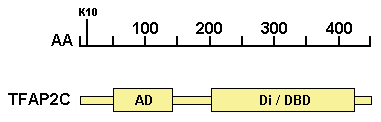
Assignment of TFAP2C functional domains. AA: aminoacids, K10: SUMOylation site, AD: activation domain, Di/DBD: dimerization domain/DNA binding domain (adapted from Williams and Tjian, 1991).
Description
A helixloop-helix motif in the DNA binding domain binds to GC-rich consensus site, SCCTSRGGS (S=G/C, R=A/G) (Woodfield et al., 2010), in the promoters of target genes and mediates TFAP2C specific transcriptional activity.
Expression
TFAP2C is widely expressed within secondary outgrowths in the human mammary gland by 19 weeks gestation. In the adult mammary gland TFAP2C expression can be found in epithelial and myoepithelial compartments.
TFAP2C expression was reported in 16-40 weeks placenta, 5-10 weeks decidu and chorion (Li et al., 2002).
TFAP2C is expressed in gonocytes at weeks 12-37 of gestation, indicating a role of this transcription factor in fetal germ cell development. TFAP2C and c-KIT, a known target of AP-2 transcription factors, were coexpressed in gonocytes, making a direct regulation possible. With increasing differentiation of fetal testis, gradual downregulation of TFAP2C from the 12th to 37th week of gestation was observed. Furthermore, TFAP2C was expressed abundantly in 25/25 IGCNUs, 52/53 testicular seminomas, 10/10 metastatic seminomas, 9/9 extragonadal seminomas and 5/5 dysgerminomas (Pauls et al., 2005).
Normal tissues with TFAP2C expression: colon, lymph node, brain, heart, kidney, liver, lung, thyroid, adrenal gland, ovary, prostate, testis.
TFAP2C expression was reported in 16-40 weeks placenta, 5-10 weeks decidu and chorion (Li et al., 2002).
TFAP2C is expressed in gonocytes at weeks 12-37 of gestation, indicating a role of this transcription factor in fetal germ cell development. TFAP2C and c-KIT, a known target of AP-2 transcription factors, were coexpressed in gonocytes, making a direct regulation possible. With increasing differentiation of fetal testis, gradual downregulation of TFAP2C from the 12th to 37th week of gestation was observed. Furthermore, TFAP2C was expressed abundantly in 25/25 IGCNUs, 52/53 testicular seminomas, 10/10 metastatic seminomas, 9/9 extragonadal seminomas and 5/5 dysgerminomas (Pauls et al., 2005).
Normal tissues with TFAP2C expression: colon, lymph node, brain, heart, kidney, liver, lung, thyroid, adrenal gland, ovary, prostate, testis.
Localisation
Nuclear.
Function
It plays a role in the development of the eyes, face, body wall, limbs, and neural tube (Hoffman et al., 2007; Li and Cornell, 2007). Deletion of Tcfap2c during development resulted in a specific reduction of upper layer neurons in the occipital cortex (Pinto et al., 2009). Conditional ablation of Tcfap2c results in a delay in skin development and abnormal expression of p63, K14, K1, filaggrin, repetin and secreted Ly6/Plaur domain containing 1, key genes required for epidermal development and differentiation (Guttormsen et al., 2008).
Heterozygous Tfap2c-knockout mice were detected to have decreased body size while homozygous mice died at 7-9 days of embryonic development due to failure of proliferation of extraembryonic trophectodermal cells (Werling and Schorle, 2002). TFAP2C is also implicated in the regulation of the adenosine deaminase (ADA) gene, a gene involved in purine metabolism found expressed at the maternal-fetal interface (Werling and Schorle, 2002).
Heterozygous Tfap2c-knockout mice were detected to have decreased body size while homozygous mice died at 7-9 days of embryonic development due to failure of proliferation of extraembryonic trophectodermal cells (Werling and Schorle, 2002). TFAP2C is also implicated in the regulation of the adenosine deaminase (ADA) gene, a gene involved in purine metabolism found expressed at the maternal-fetal interface (Werling and Schorle, 2002).
Homology
Mouse, Tfap2c (Mus musculus: NP_033361.2) (NCBI).
Predicted homology: chicken (Gallus gallus: XM_417497.4), zebrafish (Danio rerio: NM_001008576.1) (NCBI).
Predicted homology: chicken (Gallus gallus: XM_417497.4), zebrafish (Danio rerio: NM_001008576.1) (NCBI).
Mutations
Germinal
2 patients with deletions of chromosome 20q13.2-q13.3 were reported to have feeding difficulties, microcephaly, facial dysmorphism with high forehead, broad nasal bridge, small chin and malformed ears, mild psychomotor retardation, and hypotonia (Geneviève et al., 2005).
Somatic
39 mutations were detected after analysis of 8164 samples (COSMIC: gene overview for TFAP2C) without direct links to certain diseases pathogenesis.
Deletion analyses of the promoter and chloramphenicol acetyl transferase reporter gene assays indicate that the sequence between -746 and -575 is important for its expression in mammary carcinoma cell lines (Li et al., 2002).
Combined mutation of the three putative Sp sites reduced promoter activity by 80% in trophoblast and nontrophoblast cells, demonstrating the functional importance of these sites in regulating TFAP2C gene expression (Li and Kellems, 2003).
Deletion analyses of the promoter and chloramphenicol acetyl transferase reporter gene assays indicate that the sequence between -746 and -575 is important for its expression in mammary carcinoma cell lines (Li et al., 2002).
Combined mutation of the three putative Sp sites reduced promoter activity by 80% in trophoblast and nontrophoblast cells, demonstrating the functional importance of these sites in regulating TFAP2C gene expression (Li and Kellems, 2003).
Implicated in
Entity name
Breast cancer
Note
TFAP2C plays a critical role in maintaining the luminal subtype of breast cancer. TFAP2C directly binds to promoters and activates ESR1 along with luminal-associated genes (Woodfield et al., 2010). TFAP2C repressed CD44 expression in basal-derived breast cancer (Spanheimer et al., 2013a). Regulation of Ret by TFAP2C occurs independently of ESR1 expression in breast carcinoma (Spanheimer et al., 2013b). TFAP2C regulates the expression of GPX1, which influences the redox state and sensitivity to oxidative stress induced by peroxides (Kulak et al., 2013).
Prognosis
Resistance to Tamoxifen treatment and reduction of survival rate had correlation with TFAP2C overexpression (Guler et al., 2007). ERBB2-negative/AP-2-positive expression patients had a better prognosis than patients with ERBB2-positive/AP-2-positive tumors (Gee et al., 2009).
In primary breast cancer specimens, high TFAP2C and low CD44 expression were associated with pCR after neoadjuvant chemotherapy and could be predictive of tumors that have improved response to neoadjuvant chemotherapy (Spanheimer et al., 2013a).
Elevated expression levels of TFAP2C in breast tumors were reported as predictors of poor prognosis (Zhao et al., 2003) and advancing clinical grade (Sotiriou et al., 2006).
In primary breast cancer specimens, high TFAP2C and low CD44 expression were associated with pCR after neoadjuvant chemotherapy and could be predictive of tumors that have improved response to neoadjuvant chemotherapy (Spanheimer et al., 2013a).
Elevated expression levels of TFAP2C in breast tumors were reported as predictors of poor prognosis (Zhao et al., 2003) and advancing clinical grade (Sotiriou et al., 2006).
Entity name
Seminomatous germ cell tumors
Note
Immunohistochemistry marker to the detection of germ cell tumors (Pauls et al., 2005).
Entity name
Melanoma
Note
AP-2γ expression is lower in thick melanomas, it is associated with unfavourable histo-pathological parameters (increased vascularity, vascular invasion and mitoses) (Osella-Abate et al., 2012).
Entity name
Pre-eclampsia
Note
Elevated TFAP2C concentrations are associated with human placental defects such as pre-eclampsia and intrauterine growth restriction (Kuckenberg et al., 2012).
Breakpoints
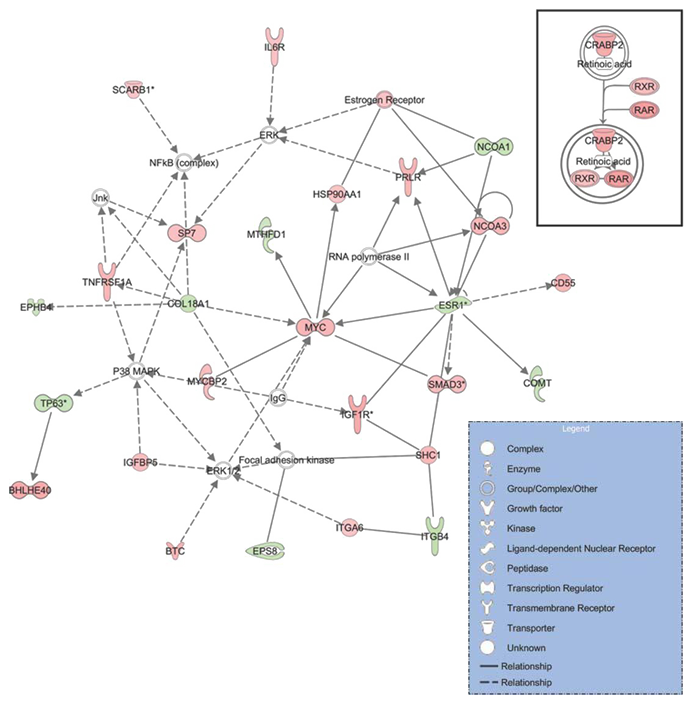
TFAP2C target genes. Analysis was done by Ingenuity Systems. Red tone indicates genes repressed by TFAP2C and green indicates genes induced by TFAP2C. Insert: TFAP2C target genes RXR, RAR, and CRABP2 are involved in the retinoic acid signaling pathway (Woodfield et al., 2010).
Article Bibliography
| Pubmed ID | Last Year | Title | Authors |
|---|---|---|---|
| 19671168 | 2009 | Identification of target genes of transcription factor activator protein 2 gamma in breast cancer cells. | Ailan H et al |
| 15548692 | 2004 | Physical and functional interactions between the Wwox tumor suppressor protein and the AP-2gamma transcription factor. | Aqeilan RI et al |
| 7846046 | 1995 | The developmentally regulated transcription factor AP-2 is involved in c-erbB-2 overexpression in human mammary carcinoma. | Bosher JM et al |
| 16153159 | 2005 | Distal ERBB2 promoter fragment displays specific transcriptional and nuclear binding activities in ERBB2 overexpressing breast cancer cells. | Delacroix L et al |
| 12072434 | 2002 | Transcription factor AP-2 interacts with the SUMO-conjugating enzyme UBC9 and is sumolated in vivo. | Eloranta JJ et al |
| 18825690 | 2009 | Overexpression of TFAP2C in invasive breast cancer correlates with a poorer response to anti-hormone therapy and reduced patient survival. | Gee JM et al |
| 15915160 | 2005 | Paternal deletion of the GNAS imprinted locus (including Gnasxl) in two girls presenting with severe pre- and post-natal growth retardation and intractable feeding difficulties. | Geneviève D et al |
| 17947476 | 2007 | Wwox and Ap2gamma expression levels predict tamoxifen response. | Guler G et al |
| 18353300 | 2008 | Disruption of epidermal specific gene expression and delayed skin development in AP-2 gamma mutant mice. | Guttormsen J et al |
| 17724731 | 2007 | Tfap2 transcription factors in zebrafish neural crest development and ectodermal evolution. | Hoffman TL et al |
| 14573793 | 2003 | Transcription factor AP-2gamma stimulates proliferation and apoptosis and impairs differentiation in a transgenic model. | Jäger R et al |
| 22560121 | 2012 | The role of transcription factor Tcfap2c/TFAP2C in trophectoderm development. | Kuckenberg P et al |
| 22964634 | 2013 | Transcriptional regulation of the GPX1 gene by TFAP2C and aberrant CpG methylation in human breast cancer. | Kulak MV et al |
| 12801994 | 2003 | Sp1 and Sp3 Are important regulators of AP-2gamma gene transcription. | Li M et al |
| 12490322 | 2002 | The human transcription factor activation protein-2 gamma (AP-2gamma): gene structure, promoter, and expression in mammary carcinoma cell lines. | Li M et al |
| 17258188 | 2007 | Redundant activities of Tfap2a and Tfap2c are required for neural crest induction and development of other non-neural ectoderm derivatives in zebrafish embryos. | Li W et al |
| 9113991 | 1997 | Identification of ERF-1 as a member of the AP2 transcription factor family. | McPherson LA et al |
| 23036739 | 2012 | Expression of AP-2α, AP-2γ and ESDN in primary melanomas: correlation with histopathological features and potential prognostic value. | Osella-Abate S et al |
| 15700319 | 2005 | Transcription factor AP-2gamma, a novel marker of gonocytes and seminomatous germ cell tumors. | Pauls K et al |
| 19749747 | 2009 | AP2gamma regulates basal progenitor fate in a region- and layer-specific manner in the developing cortex. | Pinto L et al |
| 22945355 | 2012 | AP2γ regulates neural and epidermal development downstream of the BMP pathway at early stages of ectodermal patterning. | Qiao Y et al |
| 16478745 | 2006 | Gene expression profiling in breast cancer: understanding the molecular basis of histologic grade to improve prognosis. | Sotiriou C et al |
| 22878616 | 2013 | Expression of the RET proto-oncogene is regulated by TFAP2C in breast cancer independent of the estrogen receptor. | Spanheimer PM et al |
| 11940672 | 2002 | Transcription factor gene AP-2 gamma essential for early murine development. | Werling U et al |
| 19798054 | 2009 | AP-2gamma promotes proliferation in breast tumour cells by direct repression of the CDKN1A gene. | Williams CM et al |
| 2010091 | 1991 | Analysis of the DNA-binding and activation properties of the human transcription factor AP-2. | Williams T et al |
| 8661133 | 1996 | Chromosomal mapping of the human and mouse homologues of two new members of the AP-2 family of transcription factors. | Williamson JA et al |
| 20629094 | 2010 | Identification of primary gene targets of TFAP2C in hormone responsive breast carcinoma cells. | Woodfield GW et al |
| 12833450 | 2003 | Elevated expression levels of NCOA3, TOP1, and TFAP2C in breast tumors as predictors of poor prognosis. | Zhao C et al |
Other Information
Locus ID:
NCBI: 7022
MIM: 601602
HGNC: 11744
Ensembl: ENSG00000087510
Variants:
dbSNP: 7022
ClinVar: 7022
TCGA: ENSG00000087510
COSMIC: TFAP2C
RNA/Proteins
| Gene ID | Transcript ID | Uniprot |
|---|---|---|
| ENSG00000087510 | ENST00000201031 | Q92754 |
| ENSG00000087510 | ENST00000416606 | A2A2R7 |
Expression (GTEx)
Pathways
Protein levels (Protein atlas)
References
| Pubmed ID | Year | Title | Citations |
|---|---|---|---|
| 38243114 | 2024 | Lineage regulators TFAP2C and NR5A2 function as bipotency activators in totipotent embryos. | 1 |
| 38789684 | 2024 | Tead4 and Tfap2c generate bipotency and a bistable switch in totipotent embryos to promote robust lineage diversification. | 0 |
| 38243114 | 2024 | Lineage regulators TFAP2C and NR5A2 function as bipotency activators in totipotent embryos. | 1 |
| 38789684 | 2024 | Tead4 and Tfap2c generate bipotency and a bistable switch in totipotent embryos to promote robust lineage diversification. | 0 |
| 36723462 | 2023 | Transcription factor AP-2 gamma/Krüppel-like factor 10 axis is involved in miR-3656-related dysfunction of endothelial cells in hypertension. | 0 |
| 36752341 | 2023 | KLF14/miR-1283/TFAP2C axis inhibits HER2-positive breast cancer progression via declining tumor cell proliferation. | 4 |
| 37169570 | 2023 | TFAP2C exacerbates psoriasis-like inflammation by promoting Th17 and Th1 cells activation through regulating TEAD4 transcription. | 2 |
| 37191968 | 2023 | TFAP2C inhibits cell autophagy to alleviate myocardial ischemia/reperfusion injury by regulating miR-23a-5p/SFRP5/Wnt5a axis. | 0 |
| 36723462 | 2023 | Transcription factor AP-2 gamma/Krüppel-like factor 10 axis is involved in miR-3656-related dysfunction of endothelial cells in hypertension. | 0 |
| 36752341 | 2023 | KLF14/miR-1283/TFAP2C axis inhibits HER2-positive breast cancer progression via declining tumor cell proliferation. | 4 |
| 37169570 | 2023 | TFAP2C exacerbates psoriasis-like inflammation by promoting Th17 and Th1 cells activation through regulating TEAD4 transcription. | 2 |
| 37191968 | 2023 | TFAP2C inhibits cell autophagy to alleviate myocardial ischemia/reperfusion injury by regulating miR-23a-5p/SFRP5/Wnt5a axis. | 0 |
| 36197225 | 2022 | Roles of activator protein-2 gamma in breast cancer: A narrative review (SANRA). | 0 |
| 36476988 | 2022 | HN1L/AP-2γ/PLK1 signaling drives tumor progression and chemotherapy resistance in esophageal squamous cell carcinoma. | 4 |
| 36197225 | 2022 | Roles of activator protein-2 gamma in breast cancer: A narrative review (SANRA). | 0 |
Citation
Maria V Bogachek ; Ronald J Weigel
TFAP2C (transcription factor AP-2 gamma (activating enhancer binding protein 2 gamma))
Atlas Genet Cytogenet Oncol Haematol. 2013-10-01
Online version: http://atlasgeneticsoncology.org/gene/42528/tfap2c-(transcription-factor-ap-2-gamma-(activating-enhancer-binding-protein-2-gamma))
