Identity
HGNC
LOCATION
11q24.1
LOCUSID
ALIAS
HEL-33,HEL-S-72p,HSC54,HSC70,HSC71,HSP71,HSP73,HSPA10,LAP-1,LAP1,NIP71
FUSION GENES
DNA/RNA
Note
The human HSPA8 gene includes nine exons and eight introns. It is mapped into chromosome 11, 11q23.3-q25 (Sonna et al., 2002). Introns 5, 6 and 8 contain highly conserved repeats about 90 bp which code for U14 snoRNA (Chen et al., 1996). Exons 2, 3, 6, 7, and 9 code for the peptides of extremely uniform length, between 61 and 69 amino acids while exons 4, 8 and 5 code for peptides of 51, 78 and 185 amino acids, respectively. Two 150 bp direct repeats (nt 674 to nt 829 and nt 1783 to nt 1937) are 85% homologous to each other (Dworniczak and Mirault, 1987).
Description
The gene coding for HSC70, HSPA8 affects the posttranscriptional silencing mediated by RNAi and is a component of the RNAi pathway in Drosophila cultured cells (Dorner et al., 2006). The promoter region of the HSPa8 gene includes a TATA box, two CCAAT boxes, two SP1 elements and two sets of heat shock response elements (HSE) where the heat shock transcriptional factors bind (Chen et al., 2002).
Proteins
Note
The HSPA8 gene coding for the protein HSC70, also known as HSP73, is a 73 kDa heat shock cognate protein. HSC70 is an ATP binding chaperone and has intrinsic ATPase activity which hydrolyzes ATP into ADP (Jakob et al., 1996). HSC70 hydrolyzing ATP initiates the conformational change of HSC70 and further causes substrate binding by HSC70 (Sullivan and Pipas, 2002).
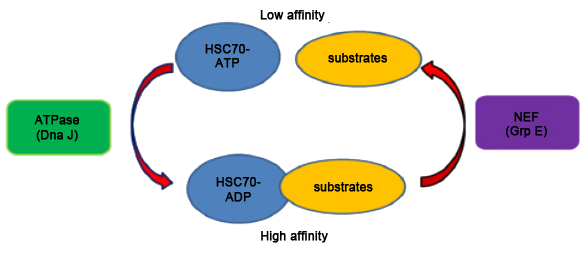
The model for HSC70 and substrates binding and releasing cycle. In the ATP-bound state, HSC70 has low affinity with the substrates. After hydrolysis of ATP with the ATPase activity, HSC70 in the ADP bound state binds with the substrates with high affinity. Some co-chaperones such as Dna J homologues enhance the ATPase activity of HSC70. Nucleotide exchange factors such as GrpE enhance the dissociation of bound ADP from HSC70 to allow the binding of ATP, resetting the cycle.
Description
HSC70, also called HSP73, is a 73 kDa heat shock cognate protein. The basic structure of human HSC70 includes three parts: a 44 kDa amino-terminal adenosine triphosphatase (ATPase) domain (residues 1-384), also known as the ATP-binding domain, an 18 kDa peptide (substrate) binding domain (residues 385-543), and a 10 kDa carboxyl-terminal domain (residues 544-646) which is also designated as the variable or "lid" domain (Smith et al., 1998; Tsukahara et al., 2000; Sullivan and Pipas, 2002). The carboxyl-terminal amino acid sequence Glu-Glu-Val-Asp (EEVD motif), which is absolutely conserved in all eukaryotic HSC70 and HSP70 family members, is essential for association with some co-chaperones (Mosser et al., 2000). Two amino acid sequences have the characteristics of nuclear localization signals in human HSC70 which are involved in nuclear import of HSC70: DAKRL69-73 in the amino-terminal and KRKHKKDISENKRAVRR246-262 in the ATPase domain (Lamian et al., 1996; Tsukahara and Maru, 2004).

The structure of HSC70. The basic structure of human HSC70 includes three parts: a 44 kDa ATPase domain, an 18 kDa peptide (substrate) binding domain and a 10 kDa carboxyl-terminal domain, also known as "lid" domain.
Expression
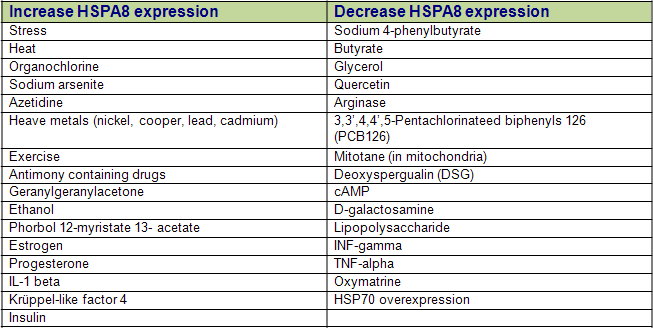
Various conditions and molecules can affect the expression of the HSPA8 gene. The table below summarizes the factors which affect the expression of the HSPA8 gene (Liu et al., 2012).
Localisation
HSC70 is a major cytosolic molecular chaperone (Place and Hofmann, 2005). However, HSC70 is also located in various cellular locations such as nuclear and close to cellular membrane (Arispe et al., 2002). HSC70 can interact with the lipid bilayer in the cellular membrane directly and form ion-conductance channels allowing ion flow through the cellular membrane. HSC70 is also identified as a tyrosine-phosphorylated protein associated with the nuclear envelope. HSC70 supports the nuclear import of karyophilic proteins and may play a role in nucleocytoplasmic transport (Otto et al., 2001).
Function
1. As a molecular chaperone, HSC70 regulates protein folding, maintains protein normal structure and functions, and protects cells from physical and chemcial damage. HSC70 regulates protein maturation and interacts with nascent polypeptides in the process of new protein synthesis (Beckmann et al., 1990; Beckmann et al.,1992). HSC70 can also regulate the translocation of proteins into different cellular organelles such as endoplasmic reticulum and mitochondria (Chirico et al., 1998, Sheffield et al., 1990).
2. HSC70 was oginally characterized as an uncoating ATPase that dissociates clathrin triskelions from clathrin-coated vesicles. It catalyzes the ATP-dependent uncoating of clathrin-coated pits (chappell et al., 1986; Goldfarb et al., 2005).
3. HSC70 is involved in targeting protein to lysosomes for degradation (Terlecky et al., 1992) and to ubiquitin/proteasome machinery for degradation (Massyuki, 1994).
4. HSC70 regulates cellular signaling and functions such as steroid receptor maturation and Akt signaling pathway (Kimmins and MacRae, 2000; Shiota et al., 2010).
5. HSC70 is important in regulating apoptosis, embryonic development and aging (Beere, 2004; Sreedhar and Csermely, 2004; Kodiha et al., 2005).
2. HSC70 was oginally characterized as an uncoating ATPase that dissociates clathrin triskelions from clathrin-coated vesicles. It catalyzes the ATP-dependent uncoating of clathrin-coated pits (chappell et al., 1986; Goldfarb et al., 2005).
3. HSC70 is involved in targeting protein to lysosomes for degradation (Terlecky et al., 1992) and to ubiquitin/proteasome machinery for degradation (Massyuki, 1994).
4. HSC70 regulates cellular signaling and functions such as steroid receptor maturation and Akt signaling pathway (Kimmins and MacRae, 2000; Shiota et al., 2010).
5. HSC70 is important in regulating apoptosis, embryonic development and aging (Beere, 2004; Sreedhar and Csermely, 2004; Kodiha et al., 2005).
Homology
HSC70 belongs to the HSP70 family in which includes other three members: the HSP70, the glucose-regulated protein 78 (GRP78), and HSP75. Human HSC70 shares 85% amino acid similarity with HSP70 (Ali et al., 2003). They have similar functions and interact with each other in an ATP-dependent manner. HSC70 can form a stable complex with newly synthesized HSP70 upon heat shock (Brown et al., 1993).
Implicated in
Entity name
Various cancers
Note
The HSPA8 gene is higher expressed in some cancer cells such as human colon cancer (Kubota et al., 2000).
HSC70 regulates functions of various cancer-related genes and proteins. HSC70 functions as a molecular stabilizer of nonphosphorylated retinoblastoma protein (pRb) by directly binding to it (Inoue et al., 1995). HSC70 binds to a mutant form of p53 and p73 and links them for degradation. HSPA8 gene can suppress oncogene (such as mutant p53 and Ras) mediated transformation (Yehiely and Oren, 1992; Gaiddon et al., 2001).
HSC70 regulates functions of various cancer-related genes and proteins. HSC70 functions as a molecular stabilizer of nonphosphorylated retinoblastoma protein (pRb) by directly binding to it (Inoue et al., 1995). HSC70 binds to a mutant form of p53 and p73 and links them for degradation. HSPA8 gene can suppress oncogene (such as mutant p53 and Ras) mediated transformation (Yehiely and Oren, 1992; Gaiddon et al., 2001).
Cytogenetics
Intronic polymorphism (1541-1542delGT) of HSPA8 is associated with decrease of lung cancer risk (Rusin et al., 2004).
Entity name
Cadiovascular diseases
Note
HSC70 plays a protective role in myocardial injuries. HSC70 is commonly found in atherosclerotic plaques during the atherogenesis and therosclerotic plaque progression and it appears to be a protective factor against cellular stress (Dupont et al., 2008). HSC70 expression is significantly decreased in diabetic myocardium because of insulin deficiency. Insulin directly increases the abundance of HSC70 in cultured cardiomyocytes and overexpression of HSC70 leads to protect against stress via suppression of apoptosis signalling (Chen et al., 2006).
Entity name
Neurological diseases
Note
HSC70 is directly involved in cell survival during neurulation and HSC70 acts as an intrinsic protector of neuroepithelial and neural precursor cells (Rubio et al., 2002). HSC70 mediates the chaperone mediated lysosomal degradation of α-synuclei which is accumulated in Parkingsons disease and other neurodegenerative diseases (Mak et al., 2010). HSC70 facilitates degradation of the amyotrophic lateral sclerosis (ALS) -linked mutant SOD1 protein in an ubiquitination-dependent manner (Urushitani et al., 2004; Casoni et al., 2005). HSC70 mediates the autophagy for the degradation of mutant huntingtin protein which can cause Huntingtons disease (Bauer et al., 2010).
Entity name
Liver diseases
Note
HSC70 has been implicated in the pathogenesis and the pathophysiology of hepatic diseases such as hepatitis B and C, non-alcoholic steatohepatitis autoimmune hepatitis, and primary biliary cirrhosis. HSC70 plays important role in the replication of hepatitis B virus and hepatitis C virus. HSC70 could be a novel molecular target for diagnosis and treatment of hepatitis B and C (Wang et al., 2010).
Article Bibliography
| Pubmed ID | Last Year | Title | Authors |
|---|---|---|---|
| 12893250 | 2003 | Tissue- and stressor-specific differential expression of two hsc70 genes in carp. | Ali KS et al |
| 10899168 | 2000 | ATP and ADP modulate a cation channel formed by Hsc70 in acidic phospholipid membranes. | Arispe N et al |
| 20190739 | 2010 | Harnessing chaperone-mediated autophagy for the selective degradation of mutant huntingtin protein. | Bauer PO et al |
| 1607378 | 1992 | Examining the function and regulation of hsp 70 in cells subjected to metabolic stress. | Beckmann RP et al |
| 15169835 | 2004 | "The stress of dying": the role of heat shock proteins in the regulation of apoptosis. | Beere HM et al |
| 8436586 | 1993 | The constitutive and stress inducible forms of hsp 70 exhibit functional similarities and interact with one another in an ATP-dependent fashion. | Brown CR et al |
| 15699043 | 2005 | Protein nitration in a mouse model of familial amyotrophic lateral sclerosis: possible multifunctional role in the pathogenesis. | Casoni F et al |
| 2937542 | 1986 | Uncoating ATPase is a member of the 70 kilodalton family of stress proteins. | Chappell TG et al |
| 16899576 | 2006 | Downregulation of the constitutively expressed Hsc70 in diabetic myocardium is mediated by insulin deficiency. | Chen HS et al |
| 9222589 | 1996 | Amplification and altered expression of the hsc70/U14 snoRNA gene in a heat resistant Chinese hamster cell line. | Chen MS et al |
| 11892989 | 2002 | Differential accumulation of U14 snoRNA and hsc70 mRNA in Chinese hamster cells after exposure to various stress conditions. | Chen MS et al |
| 3282179 | 1988 | 70K heat shock related proteins stimulate protein translocation into microsomes. | Chirico WJ et al |
| 12588994 | 2003 | Hsc70 regulates accumulation of cyclin D1 and cyclin D1-dependent protein kinase. | Diehl JA et al |
| 16882716 | 2006 | A genomewide screen for components of the RNAi pathway in Drosophila cultured cells. | Dorner S et al |
| 18549265 | 2008 | Application of saturation dye 2D-DIGE proteomics to characterize proteins modulated by oxidized low density lipoprotein treatment of human macrophages. | Dupont A et al |
| 3037489 | 1987 | Structure and expression of a human gene coding for a 71 kd heat shock 'cognate' protein. | Dworniczak B et al |
| 16895583 | 2006 | Region-specific regulation of glucocorticoid receptor/HSP90 expression and interaction in brain. | Furay AR et al |
| 11238924 | 2001 | A subset of tumor-derived mutant forms of p53 down-regulate p63 and p73 through a direct interaction with the p53 core domain. | Gaiddon C et al |
| 16585520 | 2006 | Differential effects of Hsc70 and Hsp70 on the intracellular trafficking and functional expression of epithelial sodium channels. | Goldfarb SB et al |
| 16785324 | 2006 | TOR coordinates bulk and targeted endocytosis in the Drosophila melanogaster fat body to regulate cell growth. | Hennig KM et al |
| 7673249 | 1995 | 70-kDa heat shock cognate protein interacts directly with the N-terminal region of the retinoblastoma gene product pRb. Identification of a novel region of pRb-mediating protein interaction. | Inoue A et al |
| 8626558 | 1996 | Assessment of the ATP binding properties of Hsp90. | Jakob U et al |
| 11147968 | 2000 | Maturation of steroid receptors: an example of functional cooperation among molecular chaperones and their associated proteins. | Kimmins S et al |
| 15930140 | 2005 | Stress inhibits nucleocytoplasmic shuttling of heat shock protein hsc70. | Kodiha M et al |
| 20617406 | 2010 | Increased expression of co-chaperone HOP with HSP90 and HSC70 and complex formation in human colonic carcinoma. | Kubota H et al |
| 8892974 | 1996 | Evidence for the existence of a novel mechanism for the nuclear import of Hsc70. | Lamian V et al |
| 22960394 | 2012 | Comprehensive review on the HSC70 functions, interactions with related molecules and involvement in clinical diseases and therapeutic potential. | Liu T et al |
| 20200163 | 2010 | Lysosomal degradation of alpha-synuclein in vivo. | Mak SK et al |
| 10982831 | 2000 | The chaperone function of hsp70 is required for protection against stress-induced apoptosis. | Mosser DD et al |
| 8082777 | 1994 | A 70-kDa heat shock cognate protein suppresses the defects caused by a proteasome mutation in Saccharomyces cerevisiae. | Ohba M et al |
| 11168378 | 2001 | Identification of tyrosine-phosphorylated proteins associated with the nuclear envelope. | Otto H et al |
| 15637165 | 2005 | Comparison of Hsc70 orthologs from polar and temperate notothenioid fishes: differences in prevention of aggregation and refolding of denatured proteins. | Place SP et al |
| 12059972 | 2002 | Programmed cell death in the neurulating embryo is prevented by the chaperone heat shock cognate 70. | Rubio E et al |
| 14991745 | 2004 | Intronic polymorphism (1541-1542delGT) of the constitutive heat shock protein 70 gene has functional significance and shows evidence of association with lung cancer risk. | Rusin M et al |
| 2193031 | 1990 | Mitochondrial precursor protein. Effects of 70-kilodalton heat shock protein on polypeptide folding, aggregation, and import competence. | Sheffield WP et al |
| 20018937 | 2010 | Heat shock cognate protein 70 is essential for Akt signaling in endothelial function. | Shiota M et al |
| 9860803 | 1998 | Molecular chaperones: biology and prospects for pharmacological intervention. | Smith DF et al |
| 11896043 | 2002 | Invited review: Effects of heat and cold stress on mammalian gene expression. | Sonna LA et al |
| 15031001 | 2004 | Heat shock proteins in the regulation of apoptosis: new strategies in tumor therapy: a comprehensive review. | Sreedhar AS et al |
| 12040123 | 2002 | T antigens of simian virus 40: molecular chaperones for viral replication and tumorigenesis. | Sullivan CS et al |
| 1577755 | 1992 | Protein and peptide binding and stimulation of in vitro lysosomal proteolysis by the 73-kDa heat shock cognate protein. | Terlecky SR et al |
| 14684748 | 2004 | Identification of novel nuclear export and nuclear localization-related signals in human heat shock cognate protein 70. | Tsukahara F et al |
| 15198682 | 2004 | CHIP promotes proteasomal degradation of familial ALS-linked mutant SOD1 by ubiquitinating Hsp/Hsc70. | Urushitani M et al |
| 20176893 | 2010 | Heat stress cognate 70 host protein as a potential drug target against drug resistance in hepatitis B virus. | Wang YP et al |
| 1467307 | 1992 | The gene for the rat heat-shock cognate, hsc70, can suppress oncogene-mediated transformation. | Yehiely F et al |
| 16580737 | 2006 | Fusion protein of ATPase domain of Hsc70 with TRP2 acting as a tumor vaccine against B16 melanoma. | Zhang H et al |
Other Information
Locus ID:
NCBI: 3312
MIM: 600816
HGNC: 5241
Ensembl: ENSG00000109971
Variants:
dbSNP: 3312
ClinVar: 3312
TCGA: ENSG00000109971
COSMIC: HSPA8
RNA/Proteins
Expression (GTEx)
Pathways
Protein levels (Protein atlas)
References
| Pubmed ID | Year | Title | Citations |
|---|---|---|---|
| 38215959 | 2024 | Hemin competitively inhibits HSPA8 ATPase activity mitigating its foldase function. | 0 |
| 38395908 | 2024 | RPL35A promotes the progression of cholangiocarcinoma by mediating HSPA8 ubiquitination. | 0 |
| 38418371 | 2024 | Plasmodium falciparum J-dot localized J domain protein A8iJp modulates the chaperone activity of human HSPA8. | 0 |
| 38419499 | 2024 | HSPA8-mediated stability of the CLPP protein regulates mitochondrial autophagy in cisplatin-resistant ovarian cancer cells. | 0 |
| 38569476 | 2024 | HSPA8 Chaperone Complex Drives Chaperone-Mediated Autophagy Regulation in Acute Promyelocytic Leukemia Cell Differentiation. | 0 |
| 38608617 | 2024 | Experimental and computational investigation of the effect of Hsc70 structural variants on inhibiting amylin aggregation. | 0 |
| 38215959 | 2024 | Hemin competitively inhibits HSPA8 ATPase activity mitigating its foldase function. | 0 |
| 38395908 | 2024 | RPL35A promotes the progression of cholangiocarcinoma by mediating HSPA8 ubiquitination. | 0 |
| 38418371 | 2024 | Plasmodium falciparum J-dot localized J domain protein A8iJp modulates the chaperone activity of human HSPA8. | 0 |
| 38419499 | 2024 | HSPA8-mediated stability of the CLPP protein regulates mitochondrial autophagy in cisplatin-resistant ovarian cancer cells. | 0 |
| 38569476 | 2024 | HSPA8 Chaperone Complex Drives Chaperone-Mediated Autophagy Regulation in Acute Promyelocytic Leukemia Cell Differentiation. | 0 |
| 38608617 | 2024 | Experimental and computational investigation of the effect of Hsc70 structural variants on inhibiting amylin aggregation. | 0 |
| 36624187 | 2023 | LAP1 supports nuclear adaptability during constrained melanoma cell migration and invasion. | 10 |
| 37254218 | 2023 | ZNF330/NOA36 interacts with HSPA1 and HSPA8 and modulates cell cycle and proliferation in response to heat shock in HEK293 cells. | 2 |
| 37372351 | 2023 | Association between HSPA8 Gene Variants and Ischemic Stroke: A Pilot Study Providing Additional Evidence for the Role of Heat Shock Proteins in Disease Pathogenesis. | 1 |
Citation
Tuoen Liu ; Shousong Cao
HSPA8 (heat shock 70kDa protein 8)
Atlas Genet Cytogenet Oncol Haematol. 2013-08-01
Online version: http://atlasgeneticsoncology.org/gene/40878/submit-meetings/teaching-explorer/
