ING3 (inhibitor of growth family, member 3)
2014-11-01 Audrey Mouche , Katherine Yaacoub , Thierry Guillaudeux , Rémy Pedeux AffiliationINSERM U917, Microenvironnement et Cancer, Rennes, France, Universite de Rennes 1, Rennes, France (AM, KY, RP, TG); Etablissement Francais du Sang, Rennes, France (RP); UMS Biosit 3480 CNRS\\\/018 INSERM (TG)
Identity
HGNC
LOCATION
7q31.31
IMAGE

LEGEND
Figure 1. Chromosomal localization of the ING3 gene in Homo sapiens.
LOCUSID
ALIAS
Eaf4,ING2,MEAF4,p47ING3
FUSION GENES
DNA/RNA
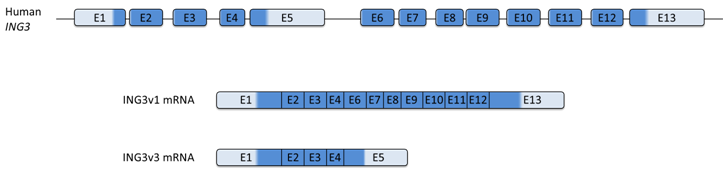
Figure 2. Structure and transcripts of Human ING3 genes. Coding regions are in dark blue and non-coding regions are represented in light blue.
Description
In 1996, Karl Riabowols group identified a new Tumor Suppressor Gene (TSG) by using subtractive hybridization between cDNAs from normal mammary epithelial cells and mammary epithelial cells from tumor. This experiment was followed by an in vivo screen for tumourigenesis. Using this method, the authors identified a new candidate TSG that they named ING1 for INhibitor of Growth 1 (Garkavtsev et al., 1996). Few years later, ING2, ING3, ING4 and ING5 were identified by homology search. ING3 was identified through bioinformatic analyses in order to find human EST clone showing a high homology with the p33ING1b and p33ING2 cDNAs (Nagashima et al., 2003).
Transcription
The ING3 gene has been mapped to chromosome 7 at locus 7q31. Interestingly, unlike ING1, 2, 4 and 5, ING3 is located far from telomeric regions and is evolutionarily distinct from the other (Fig.1) (He et al., 2005). Human ING3 is made of twelve exons, resulting in 2 transcribed variants (ING3v1a, ING3v3) (Fig.2).
Pseudogene
INGX is the pseudogene of ING (He et al., 2005).
Proteins

Figure 3. Schematic representation of ING3 proteins structure. In the C-terminal part: Nuclear Localization Signal (NLS), Plant Homeo Domain (PHD). In the N-terminal part: Leucine Zipper-Like domain (LZL), Novel Conserved Region (NCR).
Description
The ING proteins are characterized by the presence of a highly conserved PHD in their C-terminal part. This domain is commonly found in proteins involved in chromatin modification (Bienz, 2006; Mellor, 2006). The C-terminal part of ING3 isoform contains a Leucine Zipper-Like domain (LZL) and a Novel Conserved Region (NCR) (Fig.3).
Expression
ING3 is ubiquitously expressed in mammalian tissues. Moreover, ING3 expression is increased in oocytes from Human, Rhesus monkey and mice (Awe and Byrne, 2013).
Localisation
ING3 contains an NLS domain, so it is mainly located in the nucleus.
Function
ING3 is a candidate tumor suppressor gene. ING3 regulates apoptosis in a p53 dependent and independent manner. Indeed, ING3 activates bax transcription through p53 and promotes apoptosis via Fas/caspase 8 pathway in melanoma cells (Nagashima et al., 2003; Wang and Li, 2006). Moreover, ING3 is a member of the human NuA4 histone acetyltransferase (HAT) complex which is involved in transcriptional activation of genes through acetylation of histones H4 and H2A (Doyon et al., 2004). ING3 through its involvement in the NuA4 HAT complex regulates the expression of mTOR. Consequently, ING3 regulates oocyte polarization and asymmetric division during oocyte mice maturation through the mTOR pathway (Suzuki et al., 2013).
Implicated in
Entity name
Ameloblastoma
Note
The analysis of LOH (loss of heterozygosity) for ING genes family, in 33 samples of ameloblastoma cases, showed a high percentage of allelic loss (48.5%) for ING3 gene. Moreover, there is a strong correlation between the inactivation of ING3 gene and tumor aggressiveness (Borkosky et al., 2010).
Entity name
Breast cancer
Note
The analysis of ING3 status in 9 breast cancer cell lines revealed a downregulation of ING3v1 and v3 mRNA in 2 of these cell lines. However, their mRNA abundances were increased in seven other cell lines compared to normal breast epithelial cells (Walzak et al., 2008).
Entity name
Colorectal carcinoma
Note
In colorectal carcinoma, the ING3 mRNA expression was reduced compared to colorectal non-neoplastic mucosa (NNM). In addition, the expression of ING3 protein has been detected in the cytoplasm but not in the nucleus. Moreover, there is no difference of ING3 protein level between NNM and carcinomas tissues. However, the expression of ING3 was not correlated to the prognosis of patients with colorectal cancer. These results suggest that downregulation of ING3 may have a significant role in colorectal carcinogenesis (Gou et al., 2014).
Entity name
Cutaneous melanoma
Note
In malignant melanoma, nuclear expression of ING3 was reduced compared to dysplastic nevi, while an increase of cytoplasmic expression is found, in 24%, 39%, and 62% of the dysplastic nevi, primary melanoma, and metastases, respectively. In addition, the location of primary melanomas and the upregulated ING3 cytoplasmic expression are not correlated. In patients with strong nuclear ING3 staining, the survival rate reached 93%, whereas in patients with negative-to-moderate nuclear ING3 staining, the survival rate was just 44%. These findings suggest that ING3 is an important factor for melanoma prognosis and progression (Wang et al., 2007).
Entity name
Head and neck squamous carcinoma
Note
The analysis of loss of heterozygosity in 49 head and neck squamous cell carcinoma (HNSCC) showed that 48% had an allelic deletion detected in 2 regions on chromosome 7q31 where ING3 is mapped. In addition, only one sample showed a missense mutation manifested by nucleotide change from GAC to GGC at codon 20 which leads to an amino acid substitution from aspartic acid to glycine. A silent mutation from GAC to GAT has been detected in three samples at codon 356 with no amino acid change. Moreover, 50% of primary tumor tissues and 75% of tumor derived cell lines showed a decreased expression of ING3 mRNA. In one case, a complete loss of ING3 mRNA has been detected in 2 primary tissues. In this study, a significant decrease of ING3 mRNA expression but rare mutation found, suggests that a transcriptional mechanism, such as promoter methylation, may contribute to the HNSCC development (Gunduz et al., 2002).
Entity name
Hepatocellular carcinoma
Note
In the case of hepatocellular carcinoma (HCC), the analysis of ING3 mRNA expression revealed that in all the 49 tumor samples, ING3 was downregulated compared to normal livers. In addition, the expression of ING3 mRNA is reduced in 18 HCC cell lines compared to noncancerous cell lines. Moreover, in 64/112 samples of HCC, a downregulation of ING3 protein expression was found, while 24/112 samples had an upregulation of ING3 and 24/112 exhibited the same expression of ING3 protein. However, the overexpression of ING3 suppresses cell proliferation in Hep3B cell line, thus confirming that ING3 may be tumor suppressor gene (Lu et al., 2012). Another study showed that 16/20 patients with HCC exhibited a downregulation of ING3 protein and ING3 mRNA expression. In addition, in 4/6 hepatic cell lines, there is a downregulation of ING3 protein and ING3 mRNA expression (Yang et al., 2012).
Entity name
Lung cancer
Note
In two lung cancer cell lines, a downregulation of ING3v1 and v3 transcripts has been detected (Walzak et al., 2008).
Entity name
Ovarian cancer
Note
ING3v1 and ING3v3 showed a weak decrease of mRNA expression, in 1/1 ovarian cancer cell line GI-102 (Walzak et al., 2008).
Entity name
Pancreatic cancer
Note
In GI-103 pancreatic cell line, mRNA expression of ING3v3 transcript is downregulated but, surprisingly, ING3v1 is upregulated (Walzak et al., 2008).
Entity name
Prostate cancer
Note
In PC3 prostate cancer cell line, mRNA expression levels of ING3v1 and v3 are decreased (Walzak et al., 2008).
Article Bibliography
| Pubmed ID | Last Year | Title | Authors |
|---|---|---|---|
| 23458164 | 2013 | Identifying candidate oocyte reprogramming factors using cross-species global transcriptional analysis. | Awe JP et al |
| 16297627 | 2006 | The PHD finger, a nuclear protein-interaction domain. | Bienz M et al |
| 20681410 | 2010 | Allelic loss of the ING gene family loci is a frequent event in ameloblastoma. | Borkosky SS et al |
| 14966270 | 2004 | Structural and functional conservation of the NuA4 histone acetyltransferase complex from yeast to humans. | Doyon Y et al |
| 8944021 | 1996 | Suppression of the novel growth inhibitor p33ING1 promotes neoplastic transformation. | Garkavtsev I et al |
| 24927342 | 2014 | Downregulated inhibitor of growth 3 (ING3) expression during colorectal carcinogenesis. | Gou WF et al |
| 12080476 | 2002 | Allelic loss and reduced expression of the ING3, a candidate tumor suppressor gene at 7q31, in human head and neck cancers. | Gunduz M et al |
| 15356280 | 2005 | Phylogenetic analysis of the ING family of PHD finger proteins. | He GH et al |
| 22807958 | 2012 | Downregulation of inhibitor of growth 3 is correlated with tumorigenesis and progression of hepatocellular carcinoma. | Lu M et al |
| 16839870 | 2006 | It takes a PHD to read the histone code. | Mellor J et al |
| 12545155 | 2003 | A novel PHD-finger motif protein, p47ING3, modulates p53-mediated transcription, cell cycle control, and apoptosis. | Nagashima M et al |
| 24066152 | 2013 | ING3 is essential for asymmetric cell division during mouse oocyte maturation. | Suzuki S et al |
| 17720155 | 2008 | Expression profiles of mRNA transcript variants encoding the human inhibitor of growth tumor suppressor gene family in normal and neoplastic tissues. | Walzak AA et al |
| 17634537 | 2007 | Prognostic significance of nuclear ING3 expression in human cutaneous melanoma. | Wang Y et al |
| 16520380 | 2006 | ING3 promotes UV-induced apoptosis via Fas/caspase-8 pathway in melanoma cells. | Wang Y et al |
| 22550337 | 2012 | Expression and prognostic value of ING3 in human primary hepatocellular carcinoma. | Yang HY et al |
Other Information
Locus ID:
NCBI: 54556
MIM: 607493
HGNC: 14587
Ensembl: ENSG00000071243
Variants:
dbSNP: 54556
ClinVar: 54556
TCGA: ENSG00000071243
COSMIC: ING3
RNA/Proteins
Expression (GTEx)
Pathways
| Pathway | Source | External ID |
|---|---|---|
| Chromatin organization | REACTOME | R-HSA-4839726 |
| Chromatin modifying enzymes | REACTOME | R-HSA-3247509 |
| HATs acetylate histones | REACTOME | R-HSA-3214847 |
Protein levels (Protein atlas)
References
| Pubmed ID | Year | Title | Citations |
|---|---|---|---|
| 38281617 | 2024 | ING3 inhibits the malignant progression of lung adenocarcinoma by negatively regulating ITGB4 expression to inactivate Src/FAK signaling. | 0 |
| 38281617 | 2024 | ING3 inhibits the malignant progression of lung adenocarcinoma by negatively regulating ITGB4 expression to inactivate Src/FAK signaling. | 0 |
| 34439818 | 2021 | A Novel Splice Variant of the Inhibitor of Growth 3 Lacks the Plant Homeodomain and Regulates Epithelial-Mesenchymal Transition in Prostate Cancer Cells. | 5 |
| 34685579 | 2021 | ING Tumour Suppressors and ING Splice Variants as Coregulators of the Androgen Receptor Signalling in Prostate Cancer. | 7 |
| 34787253 | 2021 | ING3 and ING4 immunoexpression and their relation to the development of benign odontogenic lesions. | 1 |
| 34791430 | 2021 | Inhibitor of growth protein 3 epigenetically silences endogenous retroviral elements and prevents innate immune activation. | 4 |
| 34439818 | 2021 | A Novel Splice Variant of the Inhibitor of Growth 3 Lacks the Plant Homeodomain and Regulates Epithelial-Mesenchymal Transition in Prostate Cancer Cells. | 5 |
| 34685579 | 2021 | ING Tumour Suppressors and ING Splice Variants as Coregulators of the Androgen Receptor Signalling in Prostate Cancer. | 7 |
| 34787253 | 2021 | ING3 and ING4 immunoexpression and their relation to the development of benign odontogenic lesions. | 1 |
| 34791430 | 2021 | Inhibitor of growth protein 3 epigenetically silences endogenous retroviral elements and prevents innate immune activation. | 4 |
| 31886514 | 2020 | Downregulation of nuclear ING3 expression and translocalization to cytoplasm promotes tumorigenesis and progression in head and neck squamous cell carcinoma (HNSCC). | 7 |
| 32334834 | 2020 | Nuclear localization of ING3 is required to suppress melanoma cell migration, invasion and angiogenesis. | 4 |
| 31886514 | 2020 | Downregulation of nuclear ING3 expression and translocalization to cytoplasm promotes tumorigenesis and progression in head and neck squamous cell carcinoma (HNSCC). | 7 |
| 32334834 | 2020 | Nuclear localization of ING3 is required to suppress melanoma cell migration, invasion and angiogenesis. | 4 |
| 30804473 | 2019 | ING3 is required for ATM signaling and DNA repair in response to DNA double strand breaks. | 10 |
Citation
Audrey Mouche ; Katherine Yaacoub ; Thierry Guillaudeux ; Rémy Pedeux
ING3 (inhibitor of growth family, member 3)
Atlas Genet Cytogenet Oncol Haematol. 2014-11-01
Online version: http://atlasgeneticsoncology.org/gene/40977/new-content/case-report-explorer/
