LATS2 (LATS, large tumor suppressor, homolog 2 (Drosophila))
2010-01-01 Damjan Glavač , Mojca Stražišar AffiliationDepartment of Molecular genetics, Institute of Pathology, Faculty of Medicine, University of Ljubljana, Ljubljana, Slovenia
Identity
HGNC
LOCATION
13q12.11
IMAGE

LEGEND
UBA: ubiquitin-associated domain, PK: protein kinase domain, AGC: AGC-C terminal domain, Nu-B: NB-nucleotide binding domain.
LOCUSID
ALIAS
KPM
FUSION GENES
DNA/RNA
Note
Type: functioning gene, 8 exons.
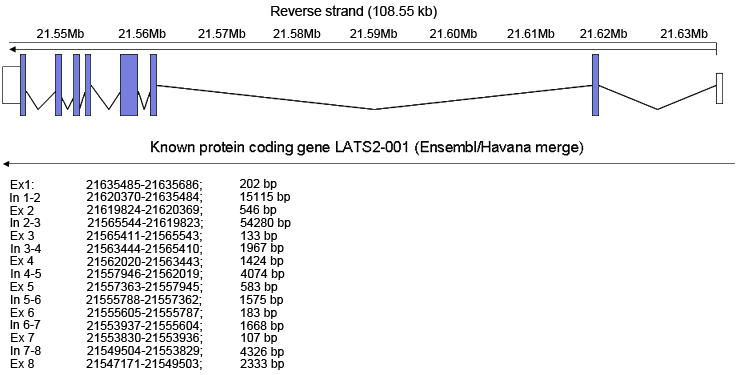
Filled blocks: coding exons, white blocks: non-coding exons, line: intron region, Ex: exon, In: intron, bp: base pair, kb: kilobase.
Description
Yabuta et al. (2000) mapped the human LATS2 gene to 13q11-q12 (FISH); gene with protein product. Gene encodes a serine/threonine protein kinase belonging to the LATS tumor suppressor family.
Proteins
Note
LATS2 is a nuclear protein of approximately 120 kDa and 1088 AA. The protein localizes to centrosomes during interphase, and early and late metaphase. It interacts with the centrosomal proteins aurora-A and Ajuba and is required for accumulation of gamma-tubulin and spindle formation at the onset of mitosis. It also interacts with a negative regulator of TP53 and may function in a positive feedback loop with TP53 that responds to cytoskeleton damage. Additionally, it can function as a co-repressor of androgen-responsive gene expression.
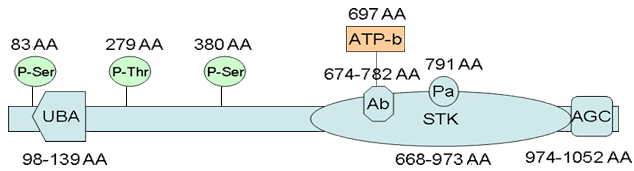
UBA: ubiquitin-associated domain, STK: serin/threonin kinase domain, AGC: AGC- C terminal domain, Ab: ATP-binding domain, AA: amino acid, P-Ser: phosphorylated serine, P-Thr: phosphorylated threonine, ATP-b: ATP binding site, Pa: proton acceptor.
Description
LATS2 protein is a serine/threonine protein kinase, 1088 AA; 120kDa; cofactor is magnesium. Subunit interacts and is phosphorylated by STK6. LATS2 binds to AR and interacts to JUB during mitosis. Complex regulates spindle apparatus organisation through gamma-tubulin recruitment to the centrosome. Protein is auto-phosphorylated and phosphorylated during M- and G1/S- phase of cell cycle; phosphorylated and activated by STK3.
Expression
Expressed at high levels in heart and skeletal muscle and at lower levels in all other tissues examined. Gene is found in cDNA libraries from the following tissue types: b-cell, bone, bone marrow, brain, cartilage, cerebrum, colon, ear, embryonic tissue, eye, foetus, gastrointestinal tract, heart, kidney, liver, lung, lymph node, lympho-reticular, mammary gland, muscle, nervous, ovary, pancreas, pancreatic islet, peripheral nervous system, placenta, pooled tissue, prostate, skin, spleen, stem cell, stomach, t-cell, testis, uncharacterized tissue, uterus, vascular.
Localisation
Cytoplasm, nucleus, spindle pole, centrosome; co-localizes with STK6 at the centrosomes during interphase, early pro-phase and cytokinesis. Migrates to spindle poles during mitosis, and to the mid-body during cytokinesis. S83 of Lats2 is a phosphorylation target of Aurora-A and the phosphorylation plays a role of the centrosomal localization of Lats2 (Toji et al., 2004).
Function
Protein product involved in: G1/S transition of mitotic cell cycle, hormone-mediated signalling pathway; negative regulation of Cyclin-dependent protein kinase activity; protein amino acid phosphorylation; protein kinase cascade; centrosome localisation; ATP binding; Mg-ion binding, nucleotide binding, protein serine/threonine kinase activity; protein tyrosine kinase activity; transferase activity; negative regulation of androgen receptor activity. LATS2 is a tumour suppressor that plays critical role in centrosome duplication, maintenance of mitotic fidelity and genomic stability. Negatively regulates G1/S transition by down-regulating cyclin E/CDK2 kinase activity.
LATS2 is involved in conserved Hippo signalling pathway (Zhang et al., 2008; Hergovich et al., 2009). LATS2 has an essential role in the integrity of processes that govern centrosome duplication, mitotic fidelity and genomic stability (McPherson et al., 2004). Components of the pathway bring LATS2 in contact with MST1 and MST2 kinase, which phosphorylates and activates LATS2. Functionally, pathway with LATS2 included is involved in cell proliferation, apoptosis, and cell migration. Involvement in apoptosis has been demonstrated in lung cancer cells where LATS2 has been shown to induce apoptosis through down regulation of BCL-2 and BCL-XL (BCL2L1) anti-apoptotic proteins (Ke et al., 2004).
LATS2 has been reported to inhibit cell growth by causing G1/S and/or G2/M cycle arrest (Li et al., 2003; Kamikubo et al., 2003). LATS2 binds MDM2 and with inhibiting its E3 ligase activity activates TP53. In turn TP53 rapidly and selectively up-regulates LATS2 expression in G2/M cells, defining positive feedback loop. Therefore LATS2-MDM2-TP53 constitutes a novel checkpoint pathway critical for maintenance of proper chromosome number (Aylon et al., 2007). LATS2 is also associated with Ajuba in LATS2-Ajuba complex that regulates organization of the spindle apparatus through recruitment of γ-tubulin to the centrosome (Abe et al., 2006).
In vitro over expression of LATS2 was seen to cause G1/S arrest through the inhibition of CDK2 activity (Li et al., 2003). Complete LATS2 knock-out cells exhibit an acceleration of exit from mitosis and marked down-regulation of critical mitotic regulators, proving its role in coordinating accurate cytokinesis completion, governing the stabilization of other regulators of mitosis (Yabuta at al., 2007). Study of LATS2 knock-out cells and transient co-expression of LATS2, YAP and TP73 showed that LATS2 contributes to the stability of YAP2 (YAP1) and TP73, which is dependant on the kinase function leading to the conclusion that LATS2 is involved in the fate of TP73 through YAP2 (Kawahara et al., 2008).
LATS2 is involved in conserved Hippo signalling pathway (Zhang et al., 2008; Hergovich et al., 2009). LATS2 has an essential role in the integrity of processes that govern centrosome duplication, mitotic fidelity and genomic stability (McPherson et al., 2004). Components of the pathway bring LATS2 in contact with MST1 and MST2 kinase, which phosphorylates and activates LATS2. Functionally, pathway with LATS2 included is involved in cell proliferation, apoptosis, and cell migration. Involvement in apoptosis has been demonstrated in lung cancer cells where LATS2 has been shown to induce apoptosis through down regulation of BCL-2 and BCL-XL (BCL2L1) anti-apoptotic proteins (Ke et al., 2004).
LATS2 has been reported to inhibit cell growth by causing G1/S and/or G2/M cycle arrest (Li et al., 2003; Kamikubo et al., 2003). LATS2 binds MDM2 and with inhibiting its E3 ligase activity activates TP53. In turn TP53 rapidly and selectively up-regulates LATS2 expression in G2/M cells, defining positive feedback loop. Therefore LATS2-MDM2-TP53 constitutes a novel checkpoint pathway critical for maintenance of proper chromosome number (Aylon et al., 2007). LATS2 is also associated with Ajuba in LATS2-Ajuba complex that regulates organization of the spindle apparatus through recruitment of γ-tubulin to the centrosome (Abe et al., 2006).
In vitro over expression of LATS2 was seen to cause G1/S arrest through the inhibition of CDK2 activity (Li et al., 2003). Complete LATS2 knock-out cells exhibit an acceleration of exit from mitosis and marked down-regulation of critical mitotic regulators, proving its role in coordinating accurate cytokinesis completion, governing the stabilization of other regulators of mitosis (Yabuta at al., 2007). Study of LATS2 knock-out cells and transient co-expression of LATS2, YAP and TP73 showed that LATS2 contributes to the stability of YAP2 (YAP1) and TP73, which is dependant on the kinase function leading to the conclusion that LATS2 is involved in the fate of TP73 through YAP2 (Kawahara et al., 2008).
Mutations
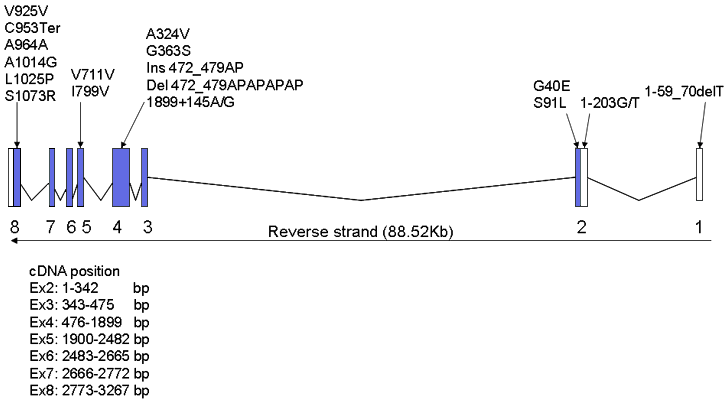
Position of alterations marked on the exons; length and position of the coding region described according to the exons.
Germinal
No data.
Somatic
Mutations are rare and mostly found in cancerous tissue. More frequently hypermethylation of the LATS2 promoter and or down-regulation of the expression is related to different kind of cancers (lung, breast, hepatocellular, leukaemias, testicular, astrocytomas, retinoblastoma, head and neck).
When polymorphism is noted or when dbSNP entrance number is provided, alterations are listed as polymorphisms; references are those when the alteration was first published.
When polymorphism is noted or when dbSNP entrance number is provided, alterations are listed as polymorphisms; references are those when the alteration was first published.
| 1-59_70delT | polymorphism | Strazisar M, Mlakar V, Glavac D. LATS2 tumour specific mutations and down-regulation of the gene in non-small cell carcinoma. Lung Cancer. 2009; 64(3): 257-62 |
| 119G>A (G40E) in lung adenocarcinoma cell line | Greenman C, Stephens P, Smith R, et al. Patterns of somatic mutation in human cancer genomes. Nature. 2007 Mar 8; 446(7132): 153-8. | |
| 1-203G/T | polymorphism | Strazisar M, Mlakar V, Glavac D. LATS2 tumour specific mutations and down-regulation of the gene in non-small cell carcinoma. Lung Cancer. 2009; 64(3): 257-62 |
| 272C>T (S91L) | dbSNP rs55842804 | Greenman C, Stephens P, Smith R, et al. Patterns of somatic mutation in human cancer genomes. Nature. 2007 Mar 8; 446(7132): 153-8. |
| ins 472_479 AP | polymorphism | Strazisar M, Mlakar V, Glavac D. LATS2 tumour specific mutations and down-regulation of the gene in non-small cell carcinoma. Lung Cancer. 2009; 64(3): 257-62 |
| del 472_479 APAPAPAP | Strazisar M, Mlakar V, Glavac D. LATS2 tumour specific mutations and down-regulation of the gene in non-small cell carcinoma. Lung Cancer. 2009; 64(3): 257-62 | |
| 971C>T (A324V) | dbSNP rs558614 | Yabuta N, Fujii T, Copeland NG, et al. Structure, expression, and chromosome mapping of LATS2, a mammalian homologue of the Drosophila tumor suppressor gene lats/warts. Genomics. 2000 Jan 15; 63(2): 263-70. |
| 1087G>A (G363S) | dbSNP rs2770928 | |
| 1899+145A/G | polymorphism | Strazisar M, Mlakar V, Glavac D. LATS2 tumour specific mutations and down-regulation of the gene in non-small cell carcinoma. Lung Cancer. 2009; 64(3): 257-62 |
2133C>T (V711V) | ||
| 2395A>G (I799V) | dbSNP rs35368391 | Greenman C, Stephens P, Smith R, et al. Patterns of somatic mutation in human cancer genomes. Nature. 2007 Mar 8; 446(7132): 153-8. |
| 2775G>A (V925V) in lung adenocarcinoma cell line | Sanger | |
| 2859C>A (C953Ter) in ovary mucinous carcinoma (not specified) | Sanger | |
| 2892C>T (A964A) | Strazisar M, Mlakar V, Glavac D. LATS2 tumour specific mutations and down-regulation of the gene in non-small cell carcinoma. Lung Cancer. 2009; 64(3): 257-62 | |
| 3041C>G (A1014G) | dbSNP rs45523141 | Greenman C, Stephens P, Smith R, et al. Patterns of somatic mutation in human cancer genomes. Nature. 2007 Mar 8; 446(7132): 153-8. |
| 3074T>C (L1025P) | dbSNP rs56116059 | Greenman C, Stephens P, Smith R, et al. Patterns of somatic mutation in human cancer genomes. Nature. 2007 Mar 8; 446(7132): 153-8. |
| 3219C>A (S1073R) | Strazisar M, Mlakar V, Glavac D. LATS2 tumour specific mutations and down-regulation of the gene in non-small cell carcinoma. Lung Cancer. 2009; 64(3): 257-62 |
Implicated in
Entity name
Various cancers
Note
Loss of LATS2 in mice is lethal. Knockout of the gene in mice embryonic fibroblasts induces mitotic defects, genomic instability and loss of contact inhibition (McPherson et al., 2004; Yabuta et al., 2007). Over-expression of LATS2 inhibits tumour formation in mice, or reduces cell growth in human tumour cell lines (Yang et al., 2001; Xia et al., 2002; Li et al., 2003) and on the other hand mutations and/or reduced expression (either methylation or miRNA regulation or unknown) have been observed in variety of human cancers; leukaemia (Jimenez-Velasco et al., 2005), astrocytomas (Jiang et al., 2006), prostate (Powzaniuk et al., 2004), breast (Takahashi et al., 2005), lung (Strazisar et al., 2009), head and neck (Steinmann et al., 2009), retinoblastoma (Chaktaborty et al., 2007), oesophageal (Lee et al., 2009), hepatocellular (Chen et al., 2005) and possibly also colon (Sivarajasingham et al., 2003) cancer. Frequent LOH of the gene has been observed in breast, ovary and liver cancer (Lee et al., 1988; Sato et al., 1991; Wang and Roger, 1988).
Entity name
Breast cancer
Note
Reduced expression of LATS2 mRNA is associated with biologically aggressive phenotypes of breast cancer, indicating that the reduced function of LATS2 can lead to accelerated cell proliferation and have as a result higher incidence of distant metastases (Takahashi et al., 2005). LATS2 mRNA levels were in 2007 discovered to be clinically useful for the prediction of response to epirubicin plus cyclophosphamide treatment in breast cancer patients (Takahashi et al., 2007).
Entity name
Acute lymphoblastic leukaemia
Prognosis
Down regulation mainly by aberrant promoter methylation of LATS2 is also associated with poor prognosis in acute lymphoblastic leukaemia (Jimenez-Velasco et al., 2005).
Entity name
Testicular and prostate tumours
Note
In testicular germ cell tumours miRNAs (miR-372 and miR-373) were implicated in neutralization of TP53-mediated CDK inhibition, through direct inhibition of the expression of LATS2 (Voorhoeve et al., 2006). It has been also shown that LATS2 is down regulated in human testicular cancer cells (Vorhoeve et al., 2006; Duale et al., 2007). LATS2 functions also as negative regulator of AR (androgen receptor), which plays an essential role in the development and maintenance of the male reproductive system and in prostate cancer. It has been shown that expression of LATS2 is lower in human prostate tumours, and suggested to contribute to the development of prostate cancer through regulation AR-mediated transcription (Powzaniuk et al., 2004).
Entity name
Astrocytomas
Note
Methylation of LATS2 and down regulation was detected in astrocytomas and proposed as a useful target for astrocytomas therapy by Jiang et al. (2006).
Entity name
Oesophageal squamous cell carcinoma
Note
Frequent polymorphic changes but rare tumour specific mutations of the LATS2 gene were found in oesophageal squamous cell carcinoma, indicating LATS2 is inactivated in only small parts of oesophageal tumours (Ishizaki et al., 2002).
Entity name
Non-small cell lung cancer
Note
Down regulation of LATS2 have been found in non-small cell lung cancer and mutations discovered have been related mostly to squamous lung cell carcinomas (Strazisar et al., 2009a; Strazisar et al., 2009b).
Breakpoints
Article Bibliography
| Pubmed ID | Last Year | Title | Authors |
|---|---|---|---|
| 16413547 | 2006 | LATS2-Ajuba complex regulates gamma-tubulin recruitment to centrosomes and spindle organization during mitosis. | Abe Y et al |
| 17015431 | 2006 | A positive feedback loop between the p53 and Lats2 tumor suppressors prevents tetraploidization. | Aylon Y et al |
| 19855428 | 2009 | Silencing of the Lats2 tumor suppressor overrides a p53-dependent oncogenic stress checkpoint and enables mutant H-Ras-driven cell transformation. | Aylon Y et al |
| 18236473 | 2008 | Pharmacogenomic profile of soy isoflavone concentrate in the prostate of Nrf2 deficient and wild-type mice. | Barve A et al |
| 17604597 | 2007 | Identification of genes associated with tumorigenesis of retinoblastoma by microarray analysis. | Chakraborty S et al |
| 15688006 | 2005 | The Ste20-like kinase Mst2 activates the human large tumor suppressor kinase Lats1. | Chan EH et al |
| 16075462 | 2005 | Molecular genetic evidence supporting a novel human hepatocellular carcinoma tumor suppressor locus at 13q12.11. | Chen CF et al |
| 19842174 | 2009 | Comparative expression of zebrafish lats1 and lats2 and their implication in gastrulation movements. | Chen CH et al |
| 19739119 | 2010 | Molecular characterization of human homologs of yeast MOB1. | Chow A et al |
| 17068154 | 2007 | Gene-expression profiling and array-based CGH classify CD4+CD56+ hematodermic neoplasm and cutaneous myelomonocytic leukemia as distinct disease entities. | Dijkman R et al |
| 17711579 | 2007 | Molecular portrait of cisplatin induced response in human testis cancer cell lines based on gene expression profiles. | Duale N et al |
| 17321332 | 2007 | Combined translocation with ZNF198-FGFR1 gene fusion and deletion of potential tumor suppressors in a myeloproliferative disorder. | Etienne A et al |
| 18391985 | 2008 | Fbw7 regulates the activity of endoreduplication mediators and the p53 pathway to prevent drug-induced polyploidy. | Finkin S et al |
| 18802403 | 2008 | Mdm2 exerts pro-apoptotic activities by antagonizing insulin-like growth factor-I-mediated survival. | Froment P et al |
| 17344846 | 2007 | Patterns of somatic mutation in human cancer genomes. | Greenman C et al |
| 19484742 | 2009 | Mammalian NDR/LATS protein kinases in hippo tumor suppressor signaling. | Hergovich A et al |
| 10871863 | 2000 | Molecular cloning of a novel human protein kinase, kpm, that is homologous to warts/lats, a Drosophila tumor suppressor. | Hori T et al |
| 19332559 | 2009 | TTK/hMps1 mediates the p53-dependent postmitotic checkpoint by phosphorylating p53 at Thr18. | Huang YF et al |
| 12370754 | 2002 | Frequent polymorphic changes but rare tumor specific mutations of the LATS2 gene on 13q11-12 in esophageal squamous cell carcinoma. | Ishizaki K et al |
| 17049657 | 2006 | Promoter hypermethylation-mediated down-regulation of LATS1 and LATS2 in human astrocytoma. | Jiang Z et al |
| 16208412 | 2005 | Downregulation of the large tumor suppressor 2 (LATS2/KPM) gene is associated with poor prognosis in acute lymphoblastic leukemia. | Jiménez-Velasco A et al |
| 12624101 | 2003 | Inhibition of cell growth by conditional expression of kpm, a human homologue of Drosophila warts/lats tumor suppressor. | Kamikubo Y et al |
| 18565851 | 2008 | Kpm/Lats2 is linked to chemosensitivity of leukemic cells through the stabilization of p73. | Kawahara M et al |
| 15265683 | 2004 | Putative tumor suppressor Lats2 induces apoptosis through downregulation of Bcl-2 and Bcl-x(L). | Ke H et al |
| 15675572 | 2005 | [Aurora kinases and cancer]. | Kimura M et al |
| 19501585 | 2009 | MicroRNA-373 (miR-373) post-transcriptionally regulates large tumor suppressor, homolog 2 (LATS2) and stimulates proliferation in human esophageal cancer. | Lee KH et al |
| 12853976 | 2003 | Lats2, a putative tumor suppressor, inhibits G1/S transition. | Li Y et al |
| 18927464 | 2008 | Lats2 is a negative regulator of myocyte size in the heart. | Matsui Y et al |
| 15343267 | 2004 | Lats2/Kpm is required for embryonic development, proliferation control and genomic integrity. | McPherson JP et al |
| 18281475 | 2008 | Integrated genomic profiling of chronic lymphocytic leukemia identifies subtypes of deletion 13q14. | Ouillette P et al |
| 15131260 | 2004 | The LATS2/KPM tumor suppressor is a negative regulator of the androgen receptor. | Powzaniuk M et al |
| 17538946 | 2007 | Frequent hypermethylation of MST1 and MST2 in soft tissue sarcoma. | Seidel C et al |
| 14597449 | 2003 | Identifying a region of interest in site- and stage-specific colon cancer on chromosome 13. | Sivarajasingham NS et al |
| 19885608 | 2009 | Frequent promoter hypermethylation of tumor-related genes in head and neck squamous cell carcinoma. | Steinmann K et al |
| 19238334 | 2009 | The expression of COX-2, hTERT, MDM2, LATS2 and S100A2 in different types of non-small cell lung cancer (NSCLC). | Strazisar M et al |
| 17297610 | 2007 | Low LATS2 mRNA level can predict favorable response to epirubicin plus cyclophosphamide, but not to docetaxel, in breast cancers. | Takahashi Y et al |
| 15147269 | 2004 | The centrosomal protein Lats2 is a phosphorylation target of Aurora-A kinase. | Toji S et al |
| 19799973 | 2010 | Identification of LATS transcriptional targets in HeLa cells using whole human genome oligonucleotide microarray. | Visser S et al |
| 17695719 | 2007 | A genetic screen implicates miRNA-372 and miRNA-373 as oncogenes in testicular germ cell tumors. | Voorhoeve PM et al |
| 10673337 | 2000 | Structure, expression, and chromosome mapping of LATS2, a mammalian homologue of the Drosophila tumor suppressor gene lats/warts. | Yabuta N et al |
| 17478426 | 2007 | Lats2 is an essential mitotic regulator required for the coordination of cell division. | Yabuta N et al |
| 18413746 | 2008 | Negative regulation of YAP by LATS1 underscores evolutionary conservation of the Drosophila Hippo pathway. | Zhang J et al |
| 19584286 | 2009 | Transcriptional output of the Salvador/warts/hippo pathway is controlled in distinct fashions in Drosophila melanogaster and mammalian cell lines. | Zhang X et al |
| 19878866 | 2009 | Mst out and HCC in. | Zhao B et al |
Other Information
Locus ID:
NCBI: 26524
MIM: 604861
HGNC: 6515
Ensembl: ENSG00000150457
Variants:
dbSNP: 26524
ClinVar: 26524
TCGA: ENSG00000150457
COSMIC: LATS2
RNA/Proteins
| Gene ID | Transcript ID | Uniprot |
|---|---|---|
| ENSG00000150457 | ENST00000382592 | Q9NRM7 |
| ENSG00000150457 | ENST00000382592 | A0A024RDM3 |
Expression (GTEx)
Pathways
Protein levels (Protein atlas)
References
| Pubmed ID | Year | Title | Citations |
|---|---|---|---|
| 38568805 | 2024 | A LATS2 and ALKBH5 positive feedback loop supports their oncogenic roles. | 0 |
| 38652219 | 2024 | MELK aggravates lung adenocarcinoma by regulating EZH2 ubiquitination and H3K27me3 histone methylation of LATS2. | 1 |
| 38568805 | 2024 | A LATS2 and ALKBH5 positive feedback loop supports their oncogenic roles. | 0 |
| 38652219 | 2024 | MELK aggravates lung adenocarcinoma by regulating EZH2 ubiquitination and H3K27me3 histone methylation of LATS2. | 1 |
| 36515852 | 2023 | FBXO22 Accelerates Pancreatic Cancer Growth by Deactivation of the Hippo Pathway via Destabilizing LATS2. | 1 |
| 36796622 | 2023 | circPKD2 inhibits the glioma cell proliferation, invasion and glycolytic metabolism through regulating the miR-1278/LATS2 axis. | 2 |
| 36990424 | 2023 | The E3 ubiquitin ligase SCF (FBXW10)-mediated LATS2 degradation regulates angiogenesis and liver metastasis in colorectal cancer. | 0 |
| 36990459 | 2023 | Mir-629 Repressed LATS2 Expression and Promoted the Proliferation of Prostate Cancer Cells. | 1 |
| 37207933 | 2023 | RNF106 aggravates esophageal squamous cell carcinoma progression through LATS2/YAP axis. | 0 |
| 36515852 | 2023 | FBXO22 Accelerates Pancreatic Cancer Growth by Deactivation of the Hippo Pathway via Destabilizing LATS2. | 1 |
| 36796622 | 2023 | circPKD2 inhibits the glioma cell proliferation, invasion and glycolytic metabolism through regulating the miR-1278/LATS2 axis. | 2 |
| 36990424 | 2023 | The E3 ubiquitin ligase SCF (FBXW10)-mediated LATS2 degradation regulates angiogenesis and liver metastasis in colorectal cancer. | 0 |
| 36990459 | 2023 | Mir-629 Repressed LATS2 Expression and Promoted the Proliferation of Prostate Cancer Cells. | 1 |
| 37207933 | 2023 | RNF106 aggravates esophageal squamous cell carcinoma progression through LATS2/YAP axis. | 0 |
| 35027733 | 2022 | The Hippo pathway kinases LATS1 and LATS2 attenuate cellular responses to heavy metals through phosphorylating MTF1. | 11 |
Citation
Damjan Glavač ; Mojca Stražišar
LATS2 (LATS, large tumor suppressor, homolog 2 (Drosophila))
Atlas Genet Cytogenet Oncol Haematol. 2010-01-01
Online version: http://atlasgeneticsoncology.org/gene/41128
