MAPK7 (mitogen-activated protein kinase 7)
2010-02-01 Francisco de Asís Iñesta-Vaquera , Ana Cuenda AffiliationCentro Nacional de Biotecnologia-CSIC, Department of Immunology, Oncology, Madrid, Spain
Identity
HGNC
LOCATION
17p11.2
IMAGE

LEGEND
MAPK7 genomic context (Chromosome 17; location 17p11.2).
LOCUSID
ALIAS
BMK1,ERK4,ERK5,PRKM7
FUSION GENES
DNA/RNA
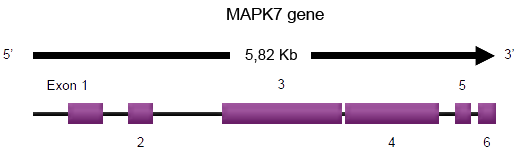
Genomic organization of MAPK7 gene on chromosome 17p11.2. The boxes indicate coding regions (exons 1-6) of the gene.
Description
The MAPK7 entire gene spans 5,82 kb on the short arm of chromosome 17. It contains 6 exons.
Transcription
The human MAPK7 gene encodes an 816 amino-acids protein of about 98 kDa. MAPK7 mRNA is 2445 bp. There are 11 transcripts, seven of which are protein coding. In mice, three splice variants (MAPK7a, b and c) have been reported. Mouse splice variants are generated by alternative splicing across introns 1 and/or 2 (Yan et al., 2001).
Pseudogene
No human or mouse pseudogene known.
Proteins
Note
ERK5, also known as MAPK7 or "Big MAP-Kinase 1" (BMK1) belongs to the Mitogen Activated Protein Kinase (MAPK) family, and therefore to the CGMC kinases in the human kinome (Manning et al., 2002). ERK5, at 98 kDa, is twice the size of other MAPKs and hence the largest kinase within its group. It possesses a catalytic N-terminal domain, which share 50% homology with ERK1 (MAPK3) and ERK2 (MAPK1) and a unique C-terminal tail of about 400 amino-acids long. In vivo, ERK5 is activated to the same extent by environmental stresses, such as oxidative and osmotic shock, and by growth factors. In addition, ERK5 may be activated by the cytokine Interleukin-6 in B cells.
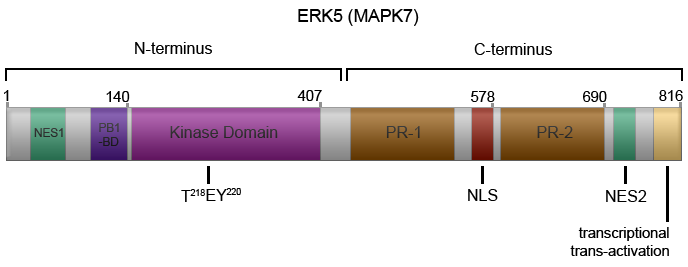
Schematic representation of the human ERK5 (MAPK7) protein domains. NES1 and NES2, bipartite nuclear exportation signal; PB1-BD, PB1 (Phox and Bem domain 1) binding domain; Kinase Domain, catalytic kinase domain; TEY, sequence motif containing ERK5 regulatory phosphorylation residues; PR-1 and PR-2, proline rich domains; Transcriptional trans-activation, transcriptional activity domain.
Description
Human ERK5 (MAPK7) is a Ser/Thr protein kinase of 816 amino-acids with a predicted mass of 98 kDa. The ERK5 N-terminus domain resembles the typical MAPK catalytic domain and includes the MAPK-conserved TXY activation sequence (T218EY220) in the activation loop. The activation of ERK5 occurs via interaction with and dual phosphorylation in its TEY motif by MKK5 (Mody et al., 2003). MKK5 mediated ERK5 activation leads to ERK5 autophosphorylation in its unique C-terminal domain (Morimoto et al., 2007).
Expression
ERK5 (MAPK7) mRNA is widely expressed throughout all tissues.
Localisation
Both in tissues and in cultured cells, ERK5 (MAPK7) localizes to the cytoplasm of cells and/or to the nucleus. As shown in the above diagram, ERK5 molecule contains a bipartite nuclear exportation signal. In resting cells, the N- and C-terminal halves of ERK5 interact producing a nuclear export signal (NES) that retains ERK5 in the cytoplasm of the cells. Upon stimulation, the interaction between the N- and the C-terminal halves is disrupted, and therefore ERK5 enters the nucleus (Kondoh et al., 2006).
Function
Genetic studies have shown that ERK5 (MAPK7) is essential for cardiovascular development and neuronal differentiation. ERK5 knock-out mice die at midgestation due to developmental failures in structures as placenta, heart and vascular system (Regan et al., 2002; Sohn et al., 2002; Yan et al., 2003; Hayashi et al., 2004; Wang et al., 2005). ERK5 also regulates cell survival in a variety of tissues. At nervous system, ERK5 acts as a neuroprotector from neurotrophic factor withdrawal and toxic insults (Cavanaugh, 2004). Also, ERK5 is required to mediate the survival response of neurons to nerve growth factor (Finegan et al., 2009). In the immune system, the ERK5 pathway regulates apoptosis of developing thymocytes (Sohn et al., 2008) and protects B cells from proapoptotic stimuli (Carvajal-Vergara et al., 2005). ERK5 is also required for cell cycle progression. It regulates cyclin D1 expression (Mulloy et al., 2003) and is necessary for EGF-induced cell proliferation and progression through the cell cycle (Kato et al., 1998). Moreover, it has been suggested that the ERK5-NFKappaB pathway may be required for a timely mitotic entry (Cude et al., 2007). Additionally, ERK5, along with other MAPK pathways can play an indirect role in cytoskeleton rearrangement (Barros and Marshall, 2005), in promoting SRC-induced podosome formation (Schramp et al., 2008), and in cell attachment to the extracellular matrix and in endothelial cell migration (Spiering et al., 2009; Sawhney et al., 2009).
ERK5 (MAPK7) is a protein with kinase activity (in its N-terminal region) and also transcriptional activation activity (in the C-terminal half). Downstream targets of ERK5 include the transcription factors MEF2A, MEF2C and MEF2D, SAP1a, c-Myc and CREB. For example, ERK5 phosphorylates SAP1, which enhances its transcriptional activity promoting c-FOS expression (Terasawa et al., 2003), and activates the serum- and glucocorticoid-inducible kinase1 (SGK1) by phosphorylating Ser78 in response to growth factors (Hayashi et al., 2001). In cardiac tissue, ERK5 may couple cells electrically and metabolically by phosphorylating the gap-junction protein Cx43 at a key residue for gap junction communication (Cameron et al., 2003). Also, phosphorylated ERK5 regulates gene expression through its C-terminal transcriptional activation domain (Morimoto et al., 2007).
ERK5 (MAPK7) is a protein with kinase activity (in its N-terminal region) and also transcriptional activation activity (in the C-terminal half). Downstream targets of ERK5 include the transcription factors MEF2A, MEF2C and MEF2D, SAP1a, c-Myc and CREB. For example, ERK5 phosphorylates SAP1, which enhances its transcriptional activity promoting c-FOS expression (Terasawa et al., 2003), and activates the serum- and glucocorticoid-inducible kinase1 (SGK1) by phosphorylating Ser78 in response to growth factors (Hayashi et al., 2001). In cardiac tissue, ERK5 may couple cells electrically and metabolically by phosphorylating the gap-junction protein Cx43 at a key residue for gap junction communication (Cameron et al., 2003). Also, phosphorylated ERK5 regulates gene expression through its C-terminal transcriptional activation domain (Morimoto et al., 2007).
Homology
ERK5 (MAPK7) N-terminal half shares a 50% sequence identity with ERK1/2. The homology of the C-terminal part of ERK5 with other protein has not been reported. ERK5 possesses ortholog in the majority of mammals (sharing 80-98% homology). In C. elegans, the SMA-5 protein is a 60% similar to human ERK5 (Watanabe et al., 2005). In Saccharomyces cerevisiae, Slt2p (Mpk1p) is an ERK5 ortholog (Truman et al., 2006).
Mutations
Note
Not identified.
Implicated in
Entity name
Breast cancer
Note
ERK5 (MAPK7) expression and activity is increased in breast cancer tumours. ERK5 overexpression has been established as an independent predictor of disease-free survival in breast cancer (Montero et al., 2009). In cell models, ERK5 has been linked to the regulation of breast cancer cells proliferation (Esparís-Ogando et al., 2002).
Entity name
Prostatic cancer
Note
ERK5 (MAPK7) immunoreactivity is significantly up-regulated in high-grade prostate cancer. Increased ERK5 cytoplasmic signals correlated with metastases and locally advanced disease at diagnosis. Strong nuclear ERK5 localization in prostatic tumours correlates with poor disease-specific survival (McCracken et al., 2008).
Entity name
Hepatic carcinoma
Note
An increase in ERK5 (MAPK7) copy number was detected in primary HCC tumours. It has been suggested that MAPK7 is likely the target of 17p11 amplification and that the ERK5 protein promotes the growth of hepatic carcinoma cells by regulating mitotic entry (Zen et al., 2009).
Article Bibliography
| Pubmed ID | Last Year | Title | Authors |
|---|---|---|---|
| 15797923 | 2005 | Activation of either ERK1/2 or ERK5 MAP kinase pathways can lead to disruption of the actin cytoskeleton. | Barros JC et al |
| 12637502 | 2003 | Regulation of epidermal growth factor-induced connexin 43 gap junction communication by big mitogen-activated protein kinase1/ERK5 but not ERK1/2 kinase activation. | Cameron SJ et al |
| 15692064 | 2005 | Multifunctional role of Erk5 in multiple myeloma. | Carvajal-Vergara X et al |
| 15153094 | 2004 | Role of extracellular signal regulated kinase 5 in neuronal survival. | Cavanaugh JE et al |
| 17452529 | 2007 | Regulation of the G2-M cell cycle progression by the ERK5-NFkappaB signaling pathway. | Cude K et al |
| 11739740 | 2002 | Erk5 participates in neuregulin signal transduction and is constitutively active in breast cancer cells overexpressing ErbB2. | Esparís-Ogando A et al |
| 19148185 | 2009 | Regulation of neuronal survival by the extracellular signal-regulated protein kinase 5. | Finegan KG et al |
| 15085193 | 2004 | Targeted deletion of BMK1/ERK5 in adult mice perturbs vascular integrity and leads to endothelial failure. | Hayashi M et al |
| 11254654 | 2001 | BMK1 mediates growth factor-induced cell proliferation through direct cellular activation of serum and glucocorticoid-inducible kinase. | Hayashi M et al |
| 9790194 | 1998 | Bmk1/Erk5 is required for cell proliferation induced by epidermal growth factor. | Kato Y et al |
| 16478989 | 2006 | Regulation of nuclear translocation of extracellular signal-regulated kinase 5 by active nuclear import and export mechanisms. | Kondoh K et al |
| 12471243 | 2002 | The protein kinase complement of the human genome. | Manning G et al |
| 18071319 | 2008 | Aberrant expression of extracellular signal-regulated kinase 5 in human prostate cancer. | McCracken SR et al |
| 12628002 | 2003 | An analysis of the phosphorylation and activation of extracellular-signal-regulated protein kinase 5 (ERK5) by mitogen-activated protein kinase kinase 5 (MKK5) in vitro. | Mody N et al |
| 19440538 | 2009 | Expression of Erk5 in early stage breast cancer and association with disease free survival identifies this kinase as a potential therapeutic target. | Montero JC et al |
| 17928297 | 2007 | Activation of a C-terminal transcriptional activation domain of ERK5 by autophosphorylation. | Morimoto H et al |
| 12934098 | 2003 | Activation of cyclin D1 expression by the ERK5 cascade. | Mulloy R et al |
| 12093914 | 2002 | Erk5 null mice display multiple extraembryonic vascular and embryonic cardiovascular defects. | Regan CP et al |
| 19089993 | 2009 | A novel role of ERK5 in integrin-mediated cell adhesion and motility in cancer cells via Fak signaling. | Sawhney RS et al |
| 18573916 | 2008 | ERK5 promotes Src-induced podosome formation by limiting Rho activation. | Schramp M et al |
| 18548009 | 2008 | Non-redundant function of the MEK5-ERK5 pathway in thymocyte apoptosis. | Sohn SJ et al |
| 12221099 | 2002 | ERK5 MAPK regulates embryonic angiogenesis and acts as a hypoxia-sensitive repressor of vascular endothelial growth factor expression. | Sohn SJ et al |
| 19605361 | 2009 | MEK5/ERK5 signaling modulates endothelial cell migration and focal contact turnover. | Spiering D et al |
| 12622723 | 2003 | Regulation of c-Fos and Fra-1 by the MEK5-ERK5 pathway. | Terasawa K et al |
| 16950928 | 2006 | Expressed in the yeast Saccharomyces cerevisiae, human ERK5 is a client of the Hsp90 chaperone that complements loss of the Slt2p (Mpk1p) cell integrity stress-activated protein kinase. | Truman AW et al |
| 15601854 | 2005 | Targeted deletion of mek5 causes early embryonic death and defects in the extracellular signal-regulated kinase 5/myocyte enhancer factor 2 cell survival pathway. | Wang X et al |
| 15944183 | 2005 | Control of body size by SMA-5, a homolog of MAP kinase BMK1/ERK5, in C. elegans. | Watanabe N et al |
| 11139578 | 2001 | Molecular cloning of mouse ERK5/BMK1 splice variants and characterization of ERK5 functional domains. | Yan C et al |
| 14675480 | 2003 | Knockout of ERK5 causes multiple defects in placental and embryonic development. | Yan L et al |
| 18973138 | 2009 | ERK5 is a target for gene amplification at 17p11 and promotes cell growth in hepatocellular carcinoma by regulating mitotic entry. | Zen K et al |
Other Information
Locus ID:
NCBI: 5598
MIM: 602521
HGNC: 6880
Ensembl: ENSG00000166484
Variants:
dbSNP: 5598
ClinVar: 5598
TCGA: ENSG00000166484
COSMIC: MAPK7
RNA/Proteins
Expression (GTEx)
Pathways
Protein levels (Protein atlas)
PharmGKB
| Entity ID | Name | Type | Evidence | Association | PK | PD | PMIDs |
|---|---|---|---|---|---|---|---|
| PA284 | MAP2K7 | Gene | Pathway | associated | 20124951 | ||
| PA30584 | MAP2K1 | Gene | Pathway | associated | 20124951 | ||
| PA30587 | MAP2K2 | Gene | Pathway | associated | 20124951 | ||
| PA30588 | MAP2K3 | Gene | Pathway | associated | 20124951 | ||
| PA30589 | MAP2K4 | Gene | Pathway | associated | 20124951 | ||
| PA30590 | MAP2K5 | Gene | Pathway | associated | 20124951 | ||
| PA30591 | MAP2K6 | Gene | Pathway | associated | 20124951 | ||
| PA7000 | sorafenib | Chemical | Pathway | associated | 20124951 |
References
| Pubmed ID | Year | Title | Citations |
|---|---|---|---|
| 38113141 | 2024 | An ERK5-PFKFB3 axis regulates glycolysis and represents a therapeutic vulnerability in pediatric diffuse midline glioma. | 0 |
| 38369471 | 2024 | HuR promotes castration-resistant prostate cancer progression by altering ERK5 activation via posttranscriptional regulation of BCAT1. | 0 |
| 38113141 | 2024 | An ERK5-PFKFB3 axis regulates glycolysis and represents a therapeutic vulnerability in pediatric diffuse midline glioma. | 0 |
| 38369471 | 2024 | HuR promotes castration-resistant prostate cancer progression by altering ERK5 activation via posttranscriptional regulation of BCAT1. | 0 |
| 36650140 | 2023 | Extracellular signal-Regulated Kinase 5 (ERK5) is required for the Yes-associated protein (YAP) co-transcriptional activity. | 3 |
| 36881097 | 2023 | The Investigation of MAPK7 Gene Variations in Colorectal Cancer Risk. | 1 |
| 36968222 | 2023 | MEK5-ERK5 Axis Promotes Self-renewal and Tumorigenicity of Glioma Stem Cells. | 2 |
| 36980305 | 2023 | VEGF Stimulates Activation of ERK5 in the Absence of C-Terminal Phosphorylation Preventing Nuclear Localization and Facilitating AKT Activation in Endothelial Cells. | 0 |
| 37332046 | 2023 | Etiopathogenic role of ERK5 signaling in sarcoma: prognostic and therapeutic implications. | 1 |
| 37539861 | 2023 | ERK5 Cooperates With MEF2C to Regulate Nr4a1 Transcription in MA-10 and MLTC-1 Leydig Cells. | 0 |
| 36650140 | 2023 | Extracellular signal-Regulated Kinase 5 (ERK5) is required for the Yes-associated protein (YAP) co-transcriptional activity. | 3 |
| 36881097 | 2023 | The Investigation of MAPK7 Gene Variations in Colorectal Cancer Risk. | 1 |
| 36968222 | 2023 | MEK5-ERK5 Axis Promotes Self-renewal and Tumorigenicity of Glioma Stem Cells. | 2 |
| 36980305 | 2023 | VEGF Stimulates Activation of ERK5 in the Absence of C-Terminal Phosphorylation Preventing Nuclear Localization and Facilitating AKT Activation in Endothelial Cells. | 0 |
| 37332046 | 2023 | Etiopathogenic role of ERK5 signaling in sarcoma: prognostic and therapeutic implications. | 1 |
Citation
Francisco de Asís Iñesta-Vaquera ; Ana Cuenda
MAPK7 (mitogen-activated protein kinase 7)
Atlas Genet Cytogenet Oncol Haematol. 2010-02-01
Online version: http://atlasgeneticsoncology.org/gene/41294/mapk7
