PCSK1 (proprotein convertase subtilisin/kexin type 1)
2017-09-01 Béatrice Demoures , Géraldine Siegfried , Abdel-Majid Khatib AffiliationINSERM U1029, Université Bordeaux,Pessac, France
Abstract
PCSK1 is a serine protease involved in the proteolytic processing of a variety of protein precursors mainly neuropeptides and prohormones. In 1991, PC1\/3; also known as PCSK1, PC1, PC3, and SPC3 was identified at the same time by two laboratories separately. The human and mouse PCSK1 genes are localized on chromosomes 5 and 13, respectively. The cleavage of these protein precursors is required for the mediation of their functions including the regulation of glucose homeostasis and food intake. The PCSK1 substrates that regulate these functions include proinsulin, proglucagon, proghrelin and proopiomelanocortin and others. PCSK1 polymorphisms were associated with risk of obesity and with various endocrine disorders. PCSK1 is also involved in the regulation of macrophage activation and cytokine secretion. The inhibition of PCSK1 activity was proposed to reverse the macrophage phenotype from an M2-like to an M1-like phenotype. PCSK1 is highly expressed in breast cancers and in neuroendocrine tumors including carcinoid tumors. The expression of this protease at the RNA and protein levels is also increased in liver colorectal metastasis, suggesting PCSK1 activity in tumorigenesis, however the evidence of PCSK1 roles in these cancers and probably others remain to be defined.
DNA/RNA

Description
Transcription
Proteins
Description
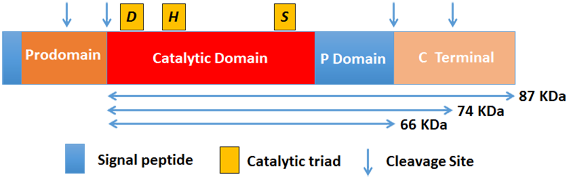
After the production of PCSK1 preproform in the endoplasmic reticulum and removal of its signal peptide, the 94kDa precursor of PCSK1 activation occurs after both N-and C-terminal domains cleavages. The 94kDa precursor undergoes an initial autocatalytic processing of its prosegment (prodomain). After protein scaffold and N-glycosylation, proPCSK1 exits the ER and sorts to the trans-Golgi network. In the early compartment, proPCSK1 is sulfated on its sugar residues. Lately during progression to the mildly acidic environment, an autocatalytic cleavage occurs to remove the prodomain and generates a 87kDa active PCSK1 form (reviewed in Ramos-Molina B et al , 2016 and Stijnen P et al 2016). The cleavage of proPCSK1 that generates the 87 kDa PCSK1 is calcium-independent and occurs at a neutral pH. PCSK1 is sorted after to immature secretory granules where is activated by a cleavages at the C-terminal area and generates the 74 and 66kDa active forms. The active forms are than accumulated in dense-core secretory granules prior secretion.
Expression
Localisation
Function
Homology
Mutations
Germinal
Implicated in
Article Bibliography
| Pubmed ID | Last Year | Title | Authors |
|---|---|---|---|
| 24135795 | 2013 | From diarrhea to obesity in prohormone convertase 1/3 deficiency: age-dependent clinical, pathologic, and enteroendocrine characteristics. | Bandsma RH et al |
| 17543468 | 2007 | Immunohistochemical expression and colocalization of somatostatin, carboxypeptidase-E and prohormone convertases 1 and 2 in rat brain. | Billova S et al |
| 20052009 | 2009 | Targeted production of proprotein convertase PC1 enhances mammary development and tumorigenesis in transgenic mice. | Blanchard A et al |
| 9185698 | 1997 | Pro-protein convertase gene expression in human breast cancer. | Cheng M et al |
| 11241161 | 2001 | Elevated expression of proprotein convertases alters breast cancer cell growth in response to estrogen and tamoxifen. | Cheng M et al |
| 7852339 | 1995 | Endoproteolytic cleavage of its propeptide is a prerequisite for efficient transport of furin out of the endoplasmic reticulum. | Creemers JW et al |
| 1316544 | 1992 | Distribution and regulation of the prohormone convertases PC1 and PC2 in the rat pituitary. | Day R et al |
| 19376969 | 2009 | Functional and structural characterization of a dense core secretory granule sorting domain from the PC1/3 protease. | Dikeakos JD et al |
| 8987779 | 1997 | Cellular localization of the prohormone convertases in the hypothalamic paraventricular and supraoptic nuclei: selective regulation of PC1 in corticotrophin-releasing hormone parvocellular neurons mediated by glucocorticoids. | Dong W et al |
| 26330543 | 2015 | Molecular Consequences of Proprotein Convertase 1/3 (PC1/3) Inhibition in Macrophages for Application to Cancer Immunotherapy: A Proteomic Study. | Duhamel M et al |
| 18771713 | 2008 | Differential regulation of prohormone convertase 1/3, prohormone convertase 2 and phosphorylated cyclic-AMP-response element binding protein by short-term and long-term morphine treatment: implications for understanding the "switch" to opiate addiction. | Espinosa VP et al |
| 23637853 | 2013 | Proprotein convertase 1/3 (PC1/3) in the rat alveolar macrophage cell line NR8383: localization, trafficking and effects on cytokine secretion. | Gagnon H et al |
| 8115023 | 1993 | Immunocytochemical localization of the neuropeptide-synthesizing enzyme PC1 in AtT-20 cells. | Hornby PJ et al |
| 8916141 | 1996 | Prohormone convertases (PC1/3 and PC2) in rat and human pancreas and islet cell tumors: subcellular immunohistochemical analysis. | Itoh Y et al |
| 9207799 | 1997 | Obesity and impaired prohormone processing associated with mutations in the human prohormone convertase 1 gene. | Jackson RS et al |
| 8999965 | 1997 | Cell type-specific protein-DNA interactions at the cAMP response elements of the prohormone convertase 1 promoter. Evidence for additional transactivators distinct from CREB/ATF family members. | Jansen E et al |
| 11081197 | 1999 | Distribution and regulation of proconvertases PC1 and PC2 in human pituitary adenomas. | Jin L et al |
| 10530621 | 1999 | Immunohistochemical expressions of prohormone convertase (PC)1/3 and PC2 in carcinoids of various organs. | Kajiwara H et al |
| 9074629 | 1997 | Expression of PC3, carboxypeptidase E and enkephalin in human monocyte-derived macrophages as a tool for genetic studies. | LaMendola J et al |
| 7822759 | 1995 | Electron microscopic immunocytochemical evidence for the involvement of the convertases PC1 and PC2 in the processing of proinsulin in pancreatic beta-cells. | Malide D et al |
| 23562752 | 2013 | Congenital proprotein convertase 1/3 deficiency causes malabsorptive diarrhea and other endocrinopathies in a pediatric cohort. | Martín MG et al |
| 26808348 | 2016 | Human 'brite/beige' adipocytes develop from capillary networks, and their implantation improves metabolic homeostasis in mice. | Min SY et al |
| 7477119 | 1995 | Brief report: impaired processing of prohormones associated with abnormalities of glucose homeostasis and adrenal function. | O'Rahilly S et al |
| 27288825 | 2016 | PCSK1 Variants and Human Obesity. | Ramos-Molina B et al |
| 17012247 | 2006 | Proprotein convertases: lessons from knockouts. | Scamuffa N et al |
| 7829629 | 1995 | Proprotein convertases (PC1/PC3 and PC2) in normal and neoplastic human tissues: their use as markers of neuroendocrine differentiation. | Scopsi L et al |
| 1765368 | 1991 | Chromosomal assignments of the genes for neuroendocrine convertase PC1 (NEC1) to human 5q15-21, neuroendocrine convertase PC2 (NEC2) to human 20p11.1-11.2, and furin (mouse 7[D1-E2] region). | Seidah NG et al |
| 1988934 | 1991 | Identification of a cDNA encoding a second putative prohormone convertase related to PC2 in AtT20 cells and islets of Langerhans. | Smeekens SP et al |
| 27187081 | 2016 | PCSK1 Mutations and Human Endocrinopathies: From Obesity to Gastrointestinal Disorders. | Stijnen P et al |
| 9521468 | 1998 | Localization of prohormone convertases 1/3 and 2 in the human pituitary gland and pituitary adenomas: analysis by immunohistochemistry, immunoelectron microscopy, and laser scanning microscopy. | Takumi I et al |
| 8874758 | 1996 | Immunocytochemical localization of prohormone convertases PC1/PC3 and PC2 in rat pancreatic islets. | Tanaka S et al |
| 16293189 | 2005 | Abnormal expression and processing of the proprotein convertases PC1 and PC2 in human colorectal liver metastases. | Tzimas GN et al |
| 25613900 | 2015 | Proteomics. Tissue-based map of the human proteome. | Uhlén M et al |
| 7808596 | 1994 | Prohormone convertases PC2 and PC3 in rat neutrophils and macrophages. Parallel changes with proenkephalin-derived peptides induced by LPS in vivo. | Vindrola O et al |
| 25272002 | 2014 | A novel familial mutation in the PCSK1 gene that alters the oxyanion hole residue of proprotein convertase 1/3 and impairs its enzymatic activity. | Wilschanski M et al |
| 24280991 | 2013 | Exome sequencing finds a novel PCSK1 mutation in a child with generalized malabsorptive diarrhea and diabetes insipidus. | Yourshaw M et al |
| 23580127 | 2013 | Differential processing of neuropeptide proprotein in human breast adenocarcinoma. | Zhang JH et al |
| 8380577 | 1993 | The prohormone convertases PC1 and PC2 mediate distinct endoproteolytic cleavages in a strict temporal order during proopiomelanocortin biosynthetic processing. | Zhou A et al |
| 9556596 | 1998 | Regulatory roles of the P domain of the subtilisin-like prohormone convertases. | Zhou A et al |
Other Information
Locus ID:
NCBI: 5122
MIM: 162150
HGNC: 8743
Ensembl: ENSG00000175426
Variants:
dbSNP: 5122
ClinVar: 5122
TCGA: ENSG00000175426
COSMIC: PCSK1
RNA/Proteins
| Gene ID | Transcript ID | Uniprot |
|---|---|---|
| ENSG00000175426 | ENST00000311106 | P29120 |
| ENSG00000175426 | ENST00000508626 | P29120 |
| ENSG00000175426 | ENST00000509190 | D6RJA3 |
Expression (GTEx)
Pathways
Protein levels (Protein atlas)
References
| Pubmed ID | Year | Title | Citations |
|---|---|---|---|
| 38009939 | 2024 | Differential sex-association between PCSK1 polymorphisms and obesity risk in Portuguese children. | 0 |
| 38009939 | 2024 | Differential sex-association between PCSK1 polymorphisms and obesity risk in Portuguese children. | 0 |
| 36822744 | 2023 | Contribution of heterozygous PCSK1 variants to obesity and implications for precision medicine: a case-control study. | 6 |
| 36864747 | 2023 | Functional characterization of all missense variants in LEPR, PCSK1, and POMC genes arising from single-nucleotide variants. | 1 |
| 37761915 | 2023 | Association of PCSK1 and PPARG1 Allelic Variants with Obesity and Metabolic Syndrome in Mexican Adults. | 0 |
| 37877373 | 2023 | The N221D variant in PCSK1 is highly prevalent in childhood obesity and can influence the metabolic profile. | 0 |
| 36822744 | 2023 | Contribution of heterozygous PCSK1 variants to obesity and implications for precision medicine: a case-control study. | 6 |
| 36864747 | 2023 | Functional characterization of all missense variants in LEPR, PCSK1, and POMC genes arising from single-nucleotide variants. | 1 |
| 37761915 | 2023 | Association of PCSK1 and PPARG1 Allelic Variants with Obesity and Metabolic Syndrome in Mexican Adults. | 0 |
| 37877373 | 2023 | The N221D variant in PCSK1 is highly prevalent in childhood obesity and can influence the metabolic profile. | 0 |
| 36292633 | 2022 | Rare Heterozygous PCSK1 Variants in Human Obesity: The Contribution of the p.Y181H Variant and a Literature Review. | 0 |
| 36292633 | 2022 | Rare Heterozygous PCSK1 Variants in Human Obesity: The Contribution of the p.Y181H Variant and a Literature Review. | 0 |
| 33554958 | 2021 | GLP-1 receptor signaling increases PCSK1 and β cell features in human α cells. | 18 |
| 34068683 | 2021 | Novel Homozygous Inactivating Mutation in the PCSK1 Gene in an Infant with Congenital Malabsorptive Diarrhea. | 7 |
| 33554958 | 2021 | GLP-1 receptor signaling increases PCSK1 and β cell features in human α cells. | 18 |
Citation
Béatrice Demoures ; Géraldine Siegfried ; Abdel-Majid Khatib
PCSK1 (proprotein convertase subtilisin/kexin type 1)
Atlas Genet Cytogenet Oncol Haematol. 2017-09-01
Online version: http://atlasgeneticsoncology.org/gene/41671/meetings/deep-insight-explorer/
