IGF1 (Insulin-Like Growth Factor 1 (Somatomedin C))
2013-11-01 Nicholas D Panayi , Randy Burd AffiliationDepartment of Nutritional Sciences, College of Medicine, University of Arizona, Tucson, AZ 85721, USA
Identity
HGNC
LOCATION
12q23.2
LOCUSID
ALIAS
IGF,IGF-I,IGFI,MGF
FUSION GENES
DNA/RNA
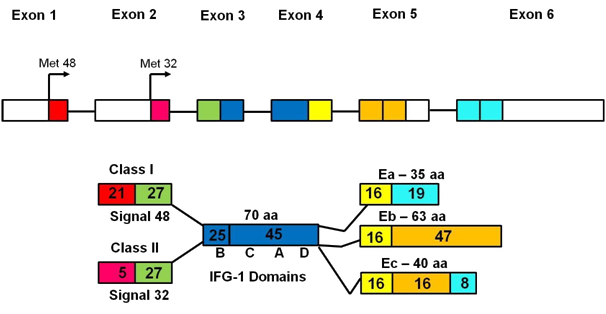
Illustrates IGF-1 splice sites and isoform variants (adapted from Mills et al., 2007).
Description
Genomic size: 84779 bp. The IGF-1 Gene is composed of 6 different exons. Exons 1 and 2 determine the class of the protein and functionally represent the signal peptide for cellular localization post-translation. Exons 3 and 4 will primarily encode the IGF-1 mature peptide; ultimately becoming the receptor binding ligand. Exons 5 and 6 will primarily represent the E domain peptide; with exon six providing the different polyadenylating signals. These parts of the transcript give a functional distinction to the 6 isoforms produced (although such distinctions have yet to be definitively identified) (Adapted from Mills et al., 2007; Philippou et al., 2007).
Transcription
Six different heterogeneous mRNA are transcribed using alternate promoters, alternate splice sites and varying polyadenylation signals. Class one and two are derived from the exon one and two promoter respectively; both are differentially spliced to the common three exon. Each class can be variably spliced to the fifth and sixth exons, producing a total of six different isoforms (Philippou et al., 2007).
Class one isoforms predominate in the extrahepatic tissues and are secreted in a paracrine/autocrine fashion.
Class two isoforms predominate in the liver and are secreted in an endocrine fashion. They are also more sensitive or responsive to growth hormone relative to class 1 (Mills et al., 2007).
Individual isoforms may be more favorably translated depending on the tissue type, the available binding proteins and the physiological context.
Researchers are discovering evidence that suggest certain isoforms may be preferentially expressed under varying amounts of mechanical pressure in skeletal muscle (Philippou et al., 2007). The advantages of one isoform or another, in varying contexts of stress, inflammation, regeneration and hypertrophy are yet to be elucidated.
Class one isoforms predominate in the extrahepatic tissues and are secreted in a paracrine/autocrine fashion.
Class two isoforms predominate in the liver and are secreted in an endocrine fashion. They are also more sensitive or responsive to growth hormone relative to class 1 (Mills et al., 2007).
Individual isoforms may be more favorably translated depending on the tissue type, the available binding proteins and the physiological context.
Researchers are discovering evidence that suggest certain isoforms may be preferentially expressed under varying amounts of mechanical pressure in skeletal muscle (Philippou et al., 2007). The advantages of one isoform or another, in varying contexts of stress, inflammation, regeneration and hypertrophy are yet to be elucidated.
Pseudogene
Not reported.
Proteins
Description
Single polypeptide chain protein consisting of 70 amino acids and three disulfide bridges.
Expression
It is primarily produced and secreted in endocrine fashion by the liver. It is also produced and secreted in autocrine or paracrine fashion in a wide range of extra-hepatic tissues. Tissues produce IGF-1 protein in response to growth hormone during periods of pre/post-natal development, exercise and injury. Inhibited in undernourished states, low protein, growth hormone deficiency and growth hormone receptor insensitivity (Cheng et al., 2006).
Localisation
The protein is post-translationally modified by protease cleavage of the signal and E-peptide. The mature protein subsequently binds to one of six binding proteins and is then secreted form the tissue of origin (IGFBP1, IGFBP2, IGFBP3, IGFBP4, IGFBP5, IGFBP6). IGFBP3 predominates, binding to 80% of the available IGF-1. The binding proteins increase the half life of IGF, preventing renal clearance and inactivation. IGFBP (1,3,4,6) are growth promoting; IGFBP-(2,5) bind IGF-1 and limit IGFR/IGF-1 interaction; a growth inhibiting effect.
Function
Important for growth/development in children and adults. Vital role in anabolic processes in general. Important functions in osteogenesis, axonal generation in nerves, nerve regeneration after ischemic insult, muscle repair and hypertrophy after trauma or exercise (Cheng et al., 2006). Although still under investigation, studies suggest that individual isotype/binding protein combinations manifest in response to specific environmental interactions or physiological demands. In addition, the binding proteins are critical for maintaining the bioavailability of the IGF-1. The unique IGF-1/IGF-1 receptor complex will then signal the protein cascade necessary for tissue metabolism or regeneration. Ischemic damage to the brain illustrates how this concept materializes. Cytotoxic edema and inflammatory markers induce the transcription of a specific isotype; which then binds to a tissue specific binding protein; protecting the integrity of the protein and preventing its renal clearance. The distinctive IGF-1/IGF-1R complex will then activate the protein kinase cascade necessary for axonal regeneration.
Cellular/molecular effects: Upon binding, the tyrosine kinase receptor, IGF-1/IGF-1R complex activates the PI3K/AKT/mTOR and RAS/RAF/MAPK protein cascades. Both interfere with apoptosis and are pro-cell survival; the latter additionally promotes cellular differentiation, metabolism, growth and repair. Given its integral utility in tissue growth, repair and cell cycle regulation, IGF-1 receptors are found ubiquitously throughout the body and include: muscle, bone, cartilage, kidney, liver, lung and nervous tissue (Schiaffino et al., 2011).
It is speculated that binding proteins may not only enhance or subdue IGF-1/IGF-1R interaction but help specify which isoform should predominate.
Biotech and Clinical Application: Recombinant IGF-1 expressed in e. Coli is being tested either for symptomatic relief, tissue regeneration or penetrance reduction in the following diseases or conditions:
- Larons Dwarfism
- Duchennes Muscular Dystrophy
- Amyotrophic Lateral Sclerosis
- Post ischemic damage to brain (stroke)
- Diabetes and Insulin Insensitivity
Cellular/molecular effects: Upon binding, the tyrosine kinase receptor, IGF-1/IGF-1R complex activates the PI3K/AKT/mTOR and RAS/RAF/MAPK protein cascades. Both interfere with apoptosis and are pro-cell survival; the latter additionally promotes cellular differentiation, metabolism, growth and repair. Given its integral utility in tissue growth, repair and cell cycle regulation, IGF-1 receptors are found ubiquitously throughout the body and include: muscle, bone, cartilage, kidney, liver, lung and nervous tissue (Schiaffino et al., 2011).
It is speculated that binding proteins may not only enhance or subdue IGF-1/IGF-1R interaction but help specify which isoform should predominate.
Biotech and Clinical Application: Recombinant IGF-1 expressed in e. Coli is being tested either for symptomatic relief, tissue regeneration or penetrance reduction in the following diseases or conditions:
- Larons Dwarfism
- Duchennes Muscular Dystrophy
- Amyotrophic Lateral Sclerosis
- Post ischemic damage to brain (stroke)
- Diabetes and Insulin Insensitivity
Homology
Shares some sequence homology to insulin and has a relatively weak affinity to insulin receptors.
Implicated in
Entity name
Various cancers
Note
No specific mutations of IGF-1 have been connected to genetically acquired diseases. Despite this fact, certain haplotypes of IGF-1 have been implicated in the survival of solid tumors. It is postulated that IGF-1 has tumor promoting effects when its cellular growth/anti-apoptotic functions become dysregulated (see oncogenesis below). Additionally it plays a critical role in the clinical sequelae of Larons dwarfism (see below).
Disease
High levels implicated in the survival of solid tumors and Acromegaly. Low levels of IGF-1/IGFBP3 consistently found in Larons Dwarfism; An Autosomal recessive disease caused by a mutation in the growth hormone receptor; causing poor ligand interaction with growth hormone and subsequent low levels of IGF-1.
Prognosis
Individuals with Larons are dwarfs with characteristic facial and anatomical anomalies (flat nasal bridge, prominent forehead, obesity, small mandible and phallus). They also exhibit seizures secondary to hypoglycemia. Unlike Achondroplasia, Larons Dwarfism does not respond to GH. Laron Dwarfs have a greater resistance to diabetes, cancer and age progression; underscoring the function of IGF-1 and its critical role in cellular metabolism and cell cycle maintenance (Melnik et al., 2011).
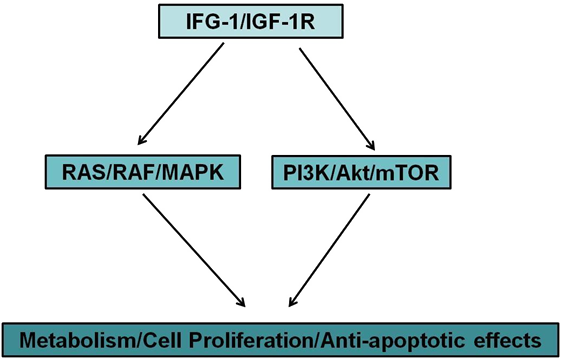
IGF-1 mediated signal transduction (adapted from Schiaffino, S. et. al, 2011).
Oncogenesis
IGF-1 signaling through RAS/RAF/MAPK and has been demonstrated to promote breast cancer and prostate tumorigenesis. IGF-1/IGF-R interaction induces the transcription of survival/ growth enhancing genes. Signaling through these pathways results in increased cellular proliferation and anti-apoptotic effects; promoting a favorable environment for tumor growth. In General, high levels of IGF-1 are found in solid tumors (particularly breast and prostate). Certain SNPs and IGF-1 haplotypes have been associated with increased risk of colon, pancreatic, prostate and breast cancer. It is likely that specific haplotypes in combination with other variables can create a more favorable tumorigenic environment. i.e. Individuals with a BMI>25, containing specific IGF-1 haplotypes may have a greater risk of developing pancreatic cancer (Cheng et al., 2006).
Article Bibliography
| Pubmed ID | Last Year | Title | Authors |
|---|---|---|---|
| 16418515 | 2006 | Common genetic variation in IGF1 and prostate cancer risk in the Multiethnic Cohort. | Cheng I et al |
| 21699736 | 2011 | Over-stimulation of insulin/IGF-1 signaling by western diet may promote diseases of civilization: lessons learnt from laron syndrome. | Melnik BC et al |
| 17845560 | 2007 | A synthetic mechano growth factor E Peptide enhances myogenic precursor cell transplantation success. | Mills P et al |
| 17354613 | 2007 | The role of the insulin-like growth factor 1 (IGF-1) in skeletal muscle physiology. | Philippou A et al |
| 21798082 | 2011 | Regulation of skeletal muscle growth by the IGF1-Akt/PKB pathway: insights from genetic models. | Schiaffino S et al |
Other Information
Locus ID:
NCBI: 3479
MIM: 147440
HGNC: 5464
Ensembl: ENSG00000017427
Variants:
dbSNP: 3479
ClinVar: 3479
TCGA: ENSG00000017427
COSMIC: IGF1
RNA/Proteins
Expression (GTEx)
Pathways
Protein levels (Protein atlas)
References
| Pubmed ID | Year | Title | Citations |
|---|---|---|---|
| 37369954 | 2024 | CircUTRN24/miR-483-3p/IGF-1 Regulates Autophagy Mediated Liver Fibrosis in Biliary Atresia. | 2 |
| 37802324 | 2024 | Association between insulin resistance and serum insulin-like growth factor 1 levels in patients with non-remitting major depressive disorder. | 1 |
| 37811857 | 2024 | Detection rate of IGF-1 variants and their implication to protein binding: study of over 240,000 patients. | 0 |
| 37936281 | 2024 | Circulating levels of FoxP3, M2 (sCD163) and IGF-1 as potential biomarkers associated with Laryngeal Squamous Cell Carcinoma in Tunisian patients. | 0 |
| 37962050 | 2024 | Growth Hormone, Atherosclerosis and Peripheral Arterial Disease: Exploring the Spectrum from Acromegaly to Growth Hormone Deficiency. | 0 |
| 37993643 | 2024 | The utility of IGF1 in the evaluation of pediatric patients with endogenous hypercortisolemia. | 0 |
| 38091723 | 2024 | Whether serum leptin and insulin-like growth factor-1 are predictive biomarkers for post-stroke depression: A meta-analysis and systematic review. | 0 |
| 38198881 | 2024 | Association between serum insulin-like growth factor 1 levels and the improvements of cognitive impairments in a subgroup of schizophrenia: Preliminary findings. | 0 |
| 38247274 | 2024 | Assessment of serum levels and placental bed tissue expression of IGF-1, bFGF, and PLGF in patients with placenta previa complicated with placenta accreta spectrum disorders. | 0 |
| 38279741 | 2024 | Compression Promotes the Osteogenic Differentiation of Human Periodontal Ligament Stem Cells by Regulating METTL14-mediated IGF1. | 0 |
| 38428899 | 2024 | Insulin-like growth factor-1 in myocardial ischemia-reperfusion injury: A review. | 0 |
| 38484906 | 2024 | The mediating role of lower body muscle strength and IGF-1 level in the relationship between age and cognition. A MIDUS substudy. | 0 |
| 38612776 | 2024 | IGF-1 and IGF-2 as Molecules Linked to Causes and Consequences of Obesity from Fetal Life to Adulthood: A Systematic Review. | 0 |
| 38618568 | 2024 | IGF-1 rs6218 polymorphisms modulate the susceptibility to age-related cataract. | 0 |
| 38687996 | 2024 | Association of IGF-1 and IGF-2 genotypes with respiratory muscle strength in individuals with COPD: A cross-sectional study. | 0 |
Citation
Nicholas D Panayi ; Randy Burd
IGF1 (Insulin-Like Growth Factor 1 (Somatomedin C))
Atlas Genet Cytogenet Oncol Haematol. 2013-11-01
Online version: http://atlasgeneticsoncology.org/gene/40927/igf1-(insulin-like-growth-factor-1-(somatomedin-c))
