IGFBP6 (insulin-like growth factor binding protein 6)
2014-04-01 Leon A Bach AffiliationDepartment of Endocrinology, Diabetes, Alfred Hospital, Department of Medicine (Alfred), Monash University, Melbourne 3004, Australia
DNA/RNA
Description
The size of the IGFBP6 gene is 4.91 kb and it contains 4 exons (Thierry-Mieg and Thierry-Mieg, 2006).
Transcription
One 1175 bp transcript encodes the full-sized 240 amino acid protein. Smaller transcripts sized 597, 705 and 463 bp may be incomplete and putatively encode fragments containing 51-140 amino acids (Thierry-Mieg and Thierry-Mieg, 2006).
Proteins
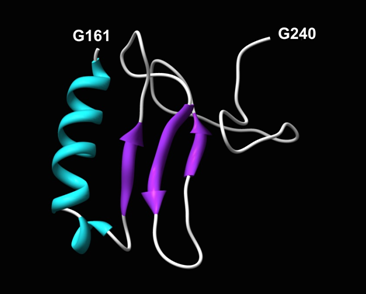
Structure of the C-terminal domain of human IGFBP-6 (Headey et al., 2004; Bach et al., 2013).
Description
IGFBP-6 belongs to the insulin-like growth factor binding protein family. It is expressed as a 240 amino acid proprotein, and processed to a 213-216 amino acid mature protein. It consists of 3 domains: the N- and C-terminal domains, which contain internal disulfide bonds, are joined by a linker domain. It contains 8 disulfide bonds, 5 in the N-terminal IGFBP domain and 3 in the C-terminal domain (Neumann et al., 1998; Neumann and Bach, 1999). Of these, the first 3 N-terminal disulfides are unique, whereas the remaining 2 N-terminal and 3 C-terminal disulfides are homologous with other IGFBPs. A peptide based on the N-terminal subdomain is largely unstructured (Chandrashekaran et al., 2007), whereas the IGF binding subdomain is conserved with other IGFBPs. Human IGFBP-6 is O-glycosylated on 5 Ser/Thr residues within the linker domain, which has a distinct sequence from other IGFBPs (Bach et al., 1992; Neumann et al., 1998). The C-terminal domain contains a thyroglobulin type 1 fold (Headey et al., 2004), which is also true for other IGFBPs, and a functional nuclear localization sequence (Iosef et al., 2008).
Expression
IGFBP6 is widely expressed in human tissues, with low levels of transcripts found in most tissues. Expression is highest in smooth muscle, olfactory bulb, ganglia, retina and the atrioventricular node (Wu et al., 2013). IGFBP6 is also found in many body fluids, including serum, cerebrospinal fluid, amniotic fluid, and follicular fluid (Baxter and Saunders, 1992; Bach, 1999; Kolker et al., 2012). IGFBP6 expression is regulated in a cell-specific manner by cAMP, IGFs, retinoic acid, vitamin D, glucocorticoids, p53, beta-catenin, hedgehog, TGF-beta and SEMA3B (Bach et al., 2013).
Localisation
Predominantly extracellular. Nuclear localization via a C-domain nuclear localization signal that binds importin-a has also been reported (Iosef et al., 2008).
Function
Unlike other IGFBPs, IGFBP-6 has a ~50-fold binding preference for IGF-II over IGF-I. It therefore is a relatively specific inhibitor of IGF-II actions (Bach, 1999; Bach, 2005; Bach et al., 2013). It is antiproliferative and proapoptotic in a number of cell lines in vitro (Bach, 1999; Bach, 2005; Bach et al., 2013). At least some of its actions in regulating cell fate are mediated by interaction with Ku80, a DNA-end binding protein (Iosef et al., 2010). IGFBP-6 has also been reported to have IGF-independent actions, such as promotion of cancer cell migration an IGF-independent mechanism that involves binding prohibitin-2 (Fu et al., 2007; Fu et al., 2013) and angiogenesis (Zhang et al., 2012). It has been reported to be a tumor suppressor in nasopharyngeal cancer through regulation of EGR-1 expression (Kuo et al., 2010).
As well as binding IGFs with high affinity, IGFBP-6 also binds other unrelated proteins, including importin-α, prohibitin-2 and Ku80 as described above. Other proteins that bind IGFBP-6 inhibits osteoblast differentiation, which may be mediated by binding to LIM mineralization protein-1 (LMP-1) (Strohbach et al., 2008), the vitamin D receptor (Cui et al., 2011), and the thyroid hormone-α receptor (Qiu et al., 2012).
Global deletion of IGFBP6 expression does not result in a major phenotype, presumable because of functional redundancy with other IGFBPs.
As well as binding IGFs with high affinity, IGFBP-6 also binds other unrelated proteins, including importin-α, prohibitin-2 and Ku80 as described above. Other proteins that bind IGFBP-6 inhibits osteoblast differentiation, which may be mediated by binding to LIM mineralization protein-1 (LMP-1) (Strohbach et al., 2008), the vitamin D receptor (Cui et al., 2011), and the thyroid hormone-α receptor (Qiu et al., 2012).
Global deletion of IGFBP6 expression does not result in a major phenotype, presumable because of functional redundancy with other IGFBPs.
Homology
IGFBP-6 shares homology with IGFBPs 1-5 in its N-terminal IGF binding domain and its C-terminal domain. It shares homology in its C-domain with other proteins containing a thyroglobulin type 1 fold.
IGFBP-6 is found in mammalian species including man, cow, rat and mouse, as well as trout and salmon. The IGFBP6 gene is duplicated in zebrafish, and each gene has a distinct expression pattern; however, overexpression of either gene inhibits embryonic growth and development (Wang et al., 2009).
IGFBP-6 is found in mammalian species including man, cow, rat and mouse, as well as trout and salmon. The IGFBP6 gene is duplicated in zebrafish, and each gene has a distinct expression pattern; however, overexpression of either gene inhibits embryonic growth and development (Wang et al., 2009).
Implicated in
Entity name
Various cancers
Note
In many studies, IGFBP-6 expression is lower in (1) malignant vs normal cells; and (2) metastatic vs primary tumors, suggesting that it has an inhibitory effect on tumor development, at least in part by inhibiting IGF actions. Examples include rhabdomyosarcoma, head and neck cancer, lung cancer and gastric cancer (Bach et al., 2013). Exogenously added or overexpressed IGFBP-6 inhibits rhabdomyosarcoma and neuroblastoma xenograft growth in mice (Grellier et al., 1998; Gallicchio et al., 2001). IGFBP6 has been implicated as a tumor suppressor in nasopharyngeal cancer by its role as a transcription factor for EGR-1 (Kuo et al., 2010).
Entity name
Chronic renal failure
Note
Circulating IGFBP-6 levels are increased in patients with chronic renal failure (Powell et al., 1997; Van Doorn et al., 1999) and this, together with increased levels of other IGFBPs, may contribute to impaired IGF action in these patients.
Entity name
Proliferative vitreoretinopathy
Note
IGFBP-6 levels are increased in serum and vitreous from patients with this condition, and serum levels decreased after vitrectomy (Yu et al., 2014).
Entity name
Non islet-cell tumor hypoglycemia
Note
This rare condition is due to overexpression by tumors of a partially processed form of IGF-II that does not form normal serum complexes with IGFBPs and the acid-labile subunit and therefore has increased bioavailability. IGFBP-6 levels are increased in this condition (Van Doorn et al., 1999).
Article Bibliography
| Pubmed ID | Last Year | Title | Authors |
|---|---|---|---|
| 23126425 | 2013 | Insulin-like growth factor-binding protein-6 and cancer. | Bach LA et al |
| 1378724 | 1992 | Human insulin-like growth factor binding protein-6 is O-glycosylated. | Bach LA et al |
| 15914054 | 2005 | IGFBP-6 five years on; not so 'forgotten'? | Bach LA et al |
| 1380056 | 1992 | Radioimmunoassay of insulin-like growth factor-binding protein-6 in human serum and other body fluids. | Baxter RC et al |
| 17305365 | 2007 | The N-terminal subdomain of insulin-like growth factor (IGF) binding protein 6. Structure and interaction with IGFs. | Chandrashekaran IR et al |
| 21458526 | 2011 | A novel interaction between insulin-like growth factor binding protein-6 and the vitamin D receptor inhibits the role of vitamin D3 in osteoblast differentiation. | Cui J et al |
| 17519236 | 2007 | Promotion of cancer cell migration: an insulin-like growth factor (IGF)-independent action of IGF-binding protein-6. | Fu P et al |
| 24003225 | 2013 | Prohibitin-2 binding modulates insulin-like growth factor-binding protein-6 (IGFBP-6)-induced rhabdomyosarcoma cell migration. | Fu P et al |
| 11745458 | 2001 | Overexpression of insulin-like growth factor binding protein-6 inhibits rhabdomyosarcoma growth in vivo. | Gallicchio MA et al |
| 9563481 | 1998 | Expression of insulin-like growth factor-binding protein 6 complementary DNA alters neuroblastoma cell growth. | Grellier P et al |
| 15308688 | 2004 | C-terminal domain of insulin-like growth factor (IGF) binding protein-6: structure and interaction with IGF-II. | Headey SJ et al |
| 18039785 | 2008 | A functional nuclear localization signal in insulin-like growth factor binding protein-6 mediates its nuclear import. | Iosef C et al |
| 20188166 | 2010 | Insulin-like growth factor binding protein-6 (IGFBP-6) interacts with DNA-end binding protein Ku80 to regulate cell fate. | Iosef C et al |
| 22139914 | 2012 | MOPED: Model Organism Protein Expression Database. | Kolker E et al |
| 20635349 | 2010 | IGFBP-6 plays a role as an oncosuppressor gene in NPC pathogenesis through regulating EGR-1 expression. | Kuo YS et al |
| 10329650 | 1999 | The N-terminal disulfide linkages of human insulin-like growth factor-binding protein-6 (hIGFBP-6) and hIGFBP-1 are different as determined by mass spectrometry. | Neumann GM et al |
| 9284730 | 1997 | Insulin-like growth factor-binding protein-6 levels are elevated in serum of children with chronic renal failure: a report of the Southwest Pediatric Nephrology Study Group. | Powell DR et al |
| 21997736 | 2012 | Insulin-like growth factor binding protein-6 interacts with the thyroid hormone receptor α1 and modulates the thyroid hormone-response in osteoblastic differentiation. | Qiu J et al |
| 18395833 | 2008 | Potential involvement of the interaction between insulin-like growth factor binding protein (IGFBP)-6 and LIM mineralization protein (LMP)-1 in regulating osteoblast differentiation. | Strohbach C et al |
| 16925834 | 2006 | AceView: a comprehensive cDNA-supported gene and transcripts annotation. | Thierry-Mieg D et al |
| 10468926 | 1999 | Circulating levels of human insulin-like growth factor binding protein-6 (IGFBP-6) in health and disease as determined by radioimmunoassay. | Van Doorn J et al |
| 19279291 | 2009 | Molecular and functional characterization of two distinct IGF binding protein-6 genes in zebrafish. | Wang X et al |
| 23175613 | 2013 | BioGPS and MyGene.info: organizing online, gene-centric information. | Wu C et al |
| 23808406 | 2014 | Kininogen 1 and insulin-like growth factor binding protein 6: candidate serum biomarkers of proliferative vitreoretinopathy. | Yu J et al |
| 21618524 | 2012 | IGF binding protein-6 expression in vascular endothelial cells is induced by hypoxia and plays a negative role in tumor angiogenesis. | Zhang C et al |
Other Information
Locus ID:
NCBI: 3489
MIM: 146735
HGNC: 5475
Ensembl: ENSG00000167779
Variants:
dbSNP: 3489
ClinVar: 3489
TCGA: ENSG00000167779
COSMIC: IGFBP6
RNA/Proteins
Expression (GTEx)
Pathways
Protein levels (Protein atlas)
References
| Pubmed ID | Year | Title | Citations |
|---|---|---|---|
| 35654889 | 2023 | Lactate modulates microglia polarization via IGFBP6 expression and remodels tumor microenvironment in glioblastoma. | 17 |
| 36946206 | 2023 | Evaluation of SNPs from human IGFBP6 associated with gene expression: an in-silico study. | 1 |
| 37336811 | 2023 | Effect of IGFBP6 Knockdown on Proteins Regulating Exosome Synthesis and Secretion in MDA-MB-231 Cell Line. | 0 |
| 35654889 | 2023 | Lactate modulates microglia polarization via IGFBP6 expression and remodels tumor microenvironment in glioblastoma. | 17 |
| 36946206 | 2023 | Evaluation of SNPs from human IGFBP6 associated with gene expression: an in-silico study. | 1 |
| 37336811 | 2023 | Effect of IGFBP6 Knockdown on Proteins Regulating Exosome Synthesis and Secretion in MDA-MB-231 Cell Line. | 0 |
| 34396926 | 2022 | The clinical characteristics and prognostic value of IGFBP6 in glioma. | 3 |
| 35430273 | 2022 | MAFB promotes the malignant phenotypes by IGFBP6 in esophageal squamous cell carcinomas. | 1 |
| 35457175 | 2022 | IGFBP-6: At the Crossroads of Immunity, Tissue Repair and Fibrosis. | 11 |
| 34396926 | 2022 | The clinical characteristics and prognostic value of IGFBP6 in glioma. | 3 |
| 35430273 | 2022 | MAFB promotes the malignant phenotypes by IGFBP6 in esophageal squamous cell carcinomas. | 1 |
| 35457175 | 2022 | IGFBP-6: At the Crossroads of Immunity, Tissue Repair and Fibrosis. | 11 |
| 32037372 | 2020 | IGFBP6 Is Downregulated in Unstable Carotid Atherosclerotic Plaques According to an Integrated Bioinformatics Analysis and Experimental Verification. | 17 |
| 32156471 | 2020 | Decreased expression of IGFBP6 correlates with poor survival in colorectal cancer patients. | 4 |
| 32037372 | 2020 | IGFBP6 Is Downregulated in Unstable Carotid Atherosclerotic Plaques According to an Integrated Bioinformatics Analysis and Experimental Verification. | 17 |
Citation
Leon A Bach
IGFBP6 (insulin-like growth factor binding protein 6)
Atlas Genet Cytogenet Oncol Haematol. 2014-04-01
Online version: http://atlasgeneticsoncology.org/gene/40933/igfbp6-(insulin-like-growth-factor-binding-protein-6)
