PHLDA1 (pleckstrin homology-like domain, family A, member 1)
2014-01-01 Maria Aparecida Nagai AffiliationDiscipline of Oncology, Department of Radiology, Oncology, Medical School, University of Sao Paulo, Center for Translational Investigation in Oncology, Cancer Institute from Sao Paulo State, Sao Paulo, Brazil
Identity
HGNC
LOCATION
12q21.2
LOCUSID
ALIAS
DT1P1B11,PHRIP,TDAG51
FUSION GENES
DNA/RNA
Description
PHLDA1 gene contains 2 exons, 1 intervening sequence and spans 6,3 kb of genomic DNA.
Transcription
1,2 kb mRNA.
Pseudogene
Not identified.
Proteins
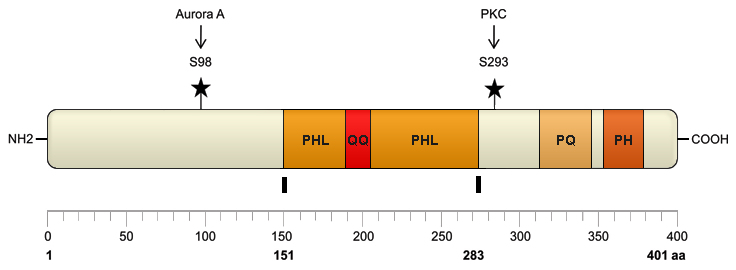
Schematic representation of the modular structure of PHLDA1 protein. PHL: pleckstrin homology-like domain spanning amino acids residues from 150 to 283; QQ: proline/glutamine rich sequence (aa residues from 189 to 204); PQ: proline-glutamine tracts (aa residues from 311 to 346); PH: proline-histidine-rich tracts (aa residues from 352 to 389); *: indicates phosphorylation sites.
Description
The PHLDA1 gene encodes for a 401 amino acid protein that is a member of the evolutionarily conserved pleckstrin homology-like domain family. PHLDA1 protein has a modular structure containing a central pleckstrin homology-like domain (PHL) and prolin-glutamine (PQ) and proline-histidine (PH) repeats in the C-terminal region (see figure above).
Expression
PHLDA1 is widely expressed in mammalian tissues displaying cytoplasmic, vesicle membrane, plasma membrane and nuclear subcellular localization. PHLDA1 expression is up-regulated by estrogen, IGF-1 (insulin-like growth factor 1), FGF (fibroblast growth factor), TPA (phorbol ester), and ER (endoplamic reticulum)-stress agents such as homocysteine, tunicamicyne, and farnesol.
Localisation
Cytoplasm, vesicle membrane, plasma membrane, nucleus.
Function
Protein binding. Several evidences have implicate PHLDA1 as a potential transcriptional activator that acts as a pro-apoptotic and antiproliferative factor, however the mechanisms by which PHLDA1 mediates cell survival is still under investigation.
Mutations
Note
Short genetic variation - dbSNP: rs139162669, rs73385441, rs74620794, rs147230079, rs76437300, rs186978611, rs140610935, rs144470255, rs79545253, rs147644129.
Implicated in
Entity name
Melanoma
Note
PHLDA1 expression was associated with reduced cell growth and colony formation and with increased apoptotic rates and drug sensitivity in melanoma cell lines. Loss of PHLDA1 has been correlated with melanoma progression (Neef et al., 2002).
Entity name
Breast cancer
Note
Down-regulation of PHLDA1 mRNA and protein expression is frequently observed in primary invasive breast tumours. Down-regulation of PHLDA1 protein has been shown to be a strong predictor of poor prognosis for breast cancer patients, indicating that reduced PHLDA1 expression contribute for breast cancer progression and might serve as useful prognostic biomarker of disease outcome (Nagai et al., 2007).
Entity name
Oral cancer
Note
Reduced expression of PHLDA1 was observed in 60,7% of oral squamous cell carcinomas (OSCC), especially in well-differentiated tumors. Positive PHLDA1 immunostaining was associated with advanced clinical stages of the disease, suggesting that PHLDA1 has a functional role in oral tumorigenesis. Overall and disease-free survival rates were significantly better in patients with tumors that were negative for PHLDA1, and a multivariate analysis suggested that PHLDA1 is an independent prognostic factor in OSCC patients (Coutinho-Camillo et al., 2013).
Entity name
Colon cancer
Note
Altered PHLDA1 expression has been shown to be associated with the process of intestinal tumorigenesis (Sakthianandeswaren et al., 2011).
Entity name
Basal cell carcinoma
Note
PHLDA1 has also been shown to be a follicular and epithelial stem cell marker (Ohyama et al., 2006; Sakthianandeswaren et al., 2011) with potential to differentiates between trichoepithelioma and basal cell carcinoma (Sellheyer and Nelson, 2011).
Entity name
Atherosclerosis
Note
In vivo and in vitro studies demonstrated that increased PHLDA1 expression induced by homocysteine promotes detachment-mediated programmed cell death and contributes to the development of atherosclerosis (Hossain et al., 2003). Genetic variant in an intergenic region of the PHLDA1 gene (rs2367446) has been shown to be associated with the development of cardiovascular diseases (Hossain et al., 2013).
Entity name
Epilepsy
Note
PHLDA1 expression has been shown to be higher in the anterior temporal neocortex from patients with intractable epilepsy when compared with the levels observed in the neocortex from the control group, suggesting a possible association of PHLDA1 in the physiopathology of the disease (Xi et al., 2007).
Article Bibliography
| Pubmed ID | Last Year | Title | Authors |
|---|---|---|---|
| 23748915 | 2013 | Expression of PAR-4 and PHLDA1 is prognostic for overall and disease-free survival in oral squamous cell carcinomas. | Coutinho-Camillo CM et al |
| 10594239 | 1999 | A novel pleckstrin homology-related gene family defined by Ipl/Tssc3, TDAG51, and Tih1: tissue-specific expression, chromosomal location, and parental imprinting. | Frank D et al |
| 23686369 | 2013 | Deficiency of TDAG51 protects against atherosclerosis by modulating apoptosis, cholesterol efflux, and peroxiredoxin-1 expression. | Hossain GS et al |
| 21807936 | 2011 | PHLDA1 is a crucial negative regulator and effector of Aurora A kinase in breast cancer. | Johnson EO et al |
| 10894922 | 2000 | Assignment of the human PHLDA1 gene to chromosome 12q15 by radiation hybrid mapping. | Kuske MD et al |
| 18641796 | 2008 | Transcriptional up-regulation of PHLDA1 by 17beta-estradiol in MCF-7 breast cancer cells. | Marchiori AC et al |
| 17211533 | 2007 | Down-regulation of PHLDA1 gene expression is associated with breast cancer progression. | Nagai MA et al |
| 12384558 | 2002 | Identification of the human PHLDA1/TDAG51 gene: down-regulation in metastatic melanoma contributes to apoptosis resistance and growth deregulation. | Neef R et al |
| 15002043 | 2004 | Regulation of T-cell death-associated gene 51 (TDAG51) expression in human T-cells. | Oberg HH et al |
| 16395407 | 2006 | Characterization and isolation of stem cell-enriched human hair follicle bulge cells. | Ohyama M et al |
| 8673705 | 1996 | A novel gene product that couples TCR signaling to Fas(CD95) expression in activation-induced cell death. | Park CG et al |
| 21558389 | 2011 | PHLDA1 expression marks the putative epithelial stem cells and contributes to intestinal tumorigenesis. | Sakthianandeswaren A et al |
| 21352265 | 2011 | Follicular stem cell marker PHLDA1 (TDAG51) is superior to cytokeratin-20 in differentiating between trichoepithelioma and basal cell carcinoma in small biopsy specimens. | Sellheyer K et al |
| 15037619 | 2004 | TDAG51 mediates the effects of insulin-like growth factor I (IGF-I) on cell survival. | Toyoshima Y et al |
| 17870236 | 2007 | TDAG51 in the anterior temporal neocortex of patients with intractable epilepsy. | Xi ZQ et al |
Other Information
Locus ID:
NCBI: 22822
MIM: 605335
HGNC: 8933
Ensembl: ENSG00000139289
Variants:
dbSNP: 22822
ClinVar: 22822
TCGA: ENSG00000139289
COSMIC: PHLDA1
RNA/Proteins
| Gene ID | Transcript ID | Uniprot |
|---|---|---|
| ENSG00000139289 | ENST00000266671 | Q8WV24 |
| ENSG00000139289 | ENST00000602540 | R4GND3 |
| ENSG00000139289 | ENST00000619060 | Q8WV24 |
Expression (GTEx)
Pathways
Protein levels (Protein atlas)
References
| Pubmed ID | Year | Title | Citations |
|---|---|---|---|
| 37155089 | 2024 | PHLDA1 is a P53 target gene involved in P53-mediated cell apoptosis. | 1 |
| 38237682 | 2024 | Restoration of the ER stress response protein TDAG51 in hepatocytes mitigates NAFLD in mice. | 0 |
| 37155089 | 2024 | PHLDA1 is a P53 target gene involved in P53-mediated cell apoptosis. | 1 |
| 38237682 | 2024 | Restoration of the ER stress response protein TDAG51 in hepatocytes mitigates NAFLD in mice. | 0 |
| 36107262 | 2022 | PHLDA1 promotes glioblastoma cell growth via sustaining the activation state of Ras. | 4 |
| 36107262 | 2022 | PHLDA1 promotes glioblastoma cell growth via sustaining the activation state of Ras. | 4 |
| 33982211 | 2021 | BMP4 and PHLDA1 are plausible drug-targetable candidate genes for KRAS G12A-, G12D-, and G12V-driven colorectal cancer. | 4 |
| 33982211 | 2021 | BMP4 and PHLDA1 are plausible drug-targetable candidate genes for KRAS G12A-, G12D-, and G12V-driven colorectal cancer. | 4 |
| 32434409 | 2020 | TDAG51 (T-Cell Death-Associated Gene 51) Is a Key Modulator of Vascular Calcification and Osteogenic Transdifferentiation of Arterial Smooth Muscle Cells. | 5 |
| 33179538 | 2020 | Prognostic and predictive value of Pleckstrin homology-like domain, family A family members in breast cancer. | 4 |
| 32434409 | 2020 | TDAG51 (T-Cell Death-Associated Gene 51) Is a Key Modulator of Vascular Calcification and Osteogenic Transdifferentiation of Arterial Smooth Muscle Cells. | 5 |
| 33179538 | 2020 | Prognostic and predictive value of Pleckstrin homology-like domain, family A family members in breast cancer. | 4 |
| 28640659 | 2018 | PHLDA1 (pleckstrin homology-like domain, family A, member 1) knockdown promotes migration and invasion of MCF10A breast epithelial cells. | 6 |
| 29233889 | 2018 | Transcriptionally inducible Pleckstrin homology-like domain, family A, member 1, attenuates ErbB receptor activity by inhibiting receptor oligomerization. | 7 |
| 29490281 | 2018 | PHLDA1 Mediates Drug Resistance in Receptor Tyrosine Kinase-Driven Cancer. | 27 |
Citation
Maria Aparecida Nagai
PHLDA1 (pleckstrin homology-like domain, family A, member 1)
Atlas Genet Cytogenet Oncol Haematol. 2014-01-01
Online version: http://atlasgeneticsoncology.org/gene/41707/
