PRAME (Preferentially Expressed Antigen In Melanoma)
2014-04-01 Joel Fulton , David M Heery AffiliationCentre for Biomolecular Sciences, School of Pharmacy, University of Nottingham, Nottingham NG7 2RD, UK
Identity
HGNC
LOCATION
22q11.22
LOCUSID
ALIAS
CT130,MAPE,OIP-4,OIP4
FUSION GENES
DNA/RNA
Note
PRAME is a member of a multigene family present in humans and other mammals. It was originally identified as a gene encoding a novel cancer-testis antigen that is over expressed in melanoma (Ikeda et al., 1997). Its evolution is consistent with adaptive (positive) selection similar to gene clusters involved in immunity and reproduction, such as the NALP family (Tian et al., 2009). Expression of PRAME has been shown to be regulated by hypomethylation of its promoter in AML and CML (Ortmann et al., 2008; Roman-Gomez et al., 2007).
Description
The gene is encoded on the reverse strand of chromosome 22 (22q11.22) covering a region of approximately 12 kilobases and is within the human immunoglobulin lambda gene locus (Kawasaki et al., 1997). This locus contains a large number of Vl gene segments which code for production of l light chains during B cell development and several other non-immunoglobulin genes, for example, tandem Suppressor of Hairy Wing genes (SUHW1/ZNF280A and SUHW2/ZNF280B) and a gene encoding a putative membrane glycoprotein (POM121L1).
Transcription
The NCBI database annotates five PRAME mRNA transcripts ranging from 2.1-2.7 kb in length (2141, 2162, 2197, 2220, 2776 bases) which encode the same protein.
Transcript (Including UTRs):
- Position: chr22:22890123-22896603, Size: 6481, Total exon count: 4
- Strand: -
Coding region:
- Position: chr22:22890489-22893484, Size: 2996, Coding exon count: 3
Transcript (Including UTRs):
- Position: chr22:22890123-22896603, Size: 6481, Total exon count: 4
- Strand: -
Coding region:
- Position: chr22:22890489-22893484, Size: 2996, Coding exon count: 3
Pseudogene
The gene seems to have undergone multiple duplications during hominid evolution, and at least 22 PRAME-like genes and 10 pseudogenes have been identified in the human genome (Birtle et al., 2005).
Proteins
Note
PRAME is a leucine-rich protein of which 21.8% of residues are leucine or isoleucine.
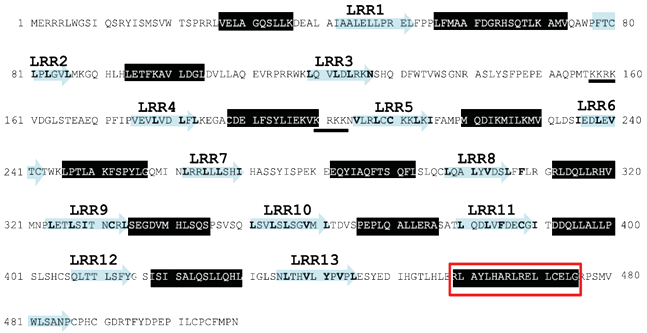
Predicted domain structure of the human PRAME sequence highlighting Leucine Rich Repeats (LRRs). The LRRs are numbered and indicated by the blue arrows; residues conserved in typical LRRs are highlighted in bold. The black boxes indicate regions predicted to have a high probability of α-helicity, and two predicted NLS sequences are underlined. The boxed area in red is a region implicated in interaction with retinoic acid receptors (Wadelin et al., 2010).
Description
NP_006106 : Predicted 509 amino acid, 58 kDa protein.
Expression
PRAME is expressed at low levels in a few normal tissues, at intermediate level in adrenals, ovary, and endometrium and at high level in the testes. It has been shown to be overexpressed in malignant cells including the vast majority of primary and metastatic melanomas and is recognized by cytolytic T lymphocytes (Haqq et al., 2005). In PRAME-negative leukaemias the gene can be induced by demethylating agents (Sigalotti et al., 2004).
Localisation
The protein has been observed to localise to both the nucleus and perinuclear regions (Tajeddine et al., 2005). PRAME contains several candidate nuclear localisation signal (NLS) sequences (See Figure).
Function
Human PRAME and its paralogues are related to LRR family proteins, some of which are known to have functions in cell immunity and signal transduction. It has been suggested that, like TLRs, PRAME may be upregulated in response to encounters with microbial pathogens, and may be involved in targeting intracellular PAMPs to the Golgi for ubiquitylation and processing. (Wadelin et al., 2013). PRAME has been reported to function as a repressor of retinoic acid (RA) signalling through interactions with retinoic acid receptors (RARs) and repression of the RARb2 gene (Epping et al., 2005; Epping et al., 2007).
Homology
Sequence homology and structural predictions suggest that PRAME is related to the leucine-rich repeat (LRR) family of proteins such as the Toll-like receptors. The Oogenesins 1-4 also show considerable homology to PRAME and PRAME family members (Dade et al., 2003).
Mutations
Note
Some listed in COSMIC.
Implicated in
Entity name
Melanoma
Note
High levels of PRAME mRNA are present in the majority of primary and metastatic melanomas (88% and 95% respectively) (Haqq et al., 2005), while being absent in normal haematopoietic tissues including bone marrow (Oehler et al., 2009; Radich et al., 2006; Steinbach et al., 2002; van Baren et al., 1998).
Entity name
Acute and chronic leukaemia, non Hodgkins lymphomas
Note
Numerous studies have reported highly elevated levels of PRAME in both acute and chronic leukaemias and non Hodgkins lymphomas (van Baren et al., 1998; Matsushita et al., 2001; Oehler et al., 2009; Qin et al., 2009; Radich et al., 2006; Santamaria et al., 2008). PRAME expression has been suggested to be predicator for a good clinical outcome in childhood acute lymphoblastic leukemia in addition to being a target for immunotherapy, and biomarker for the monitoring of minimal residual disease (Abdelmalak et al., 2014).
Entity name
Neuroblastoma
Note
PRAME is expressed in high-stage neuroblastoma and associated with poor outcome (Oberthuer et al., 2004).
Entity name
Breast cancer
Note
PRAME is expressed in advanced breast cancer and has been shown to be an independent prognostic factor for shortened disease-free survival (Doolan et al., 2008).
Entity name
Ovarian adenocarcinoma
Note
PRAME was found to be a biomarker and prognostic factor for patients with stage III serous ovarian adenocarcinomas (Partheen et al., 2008).
Entity name
Lung squamous cell carcinoma
Note
Northern blot analysis demonstrated that high proportion of positive tumours were shown to express PRAME (Ikeda et al., 1997).
Entity name
Head and neck cancer
Note
Reverse-transcriptase polymerase chain reaction (RT-PCR) showed high expression of the gene coding for the tumor antigen PRAME in surgical samples of the tumors, margins, and lymph nodes from patients with a diagnosis of head and neck carcinoma (Figueiredo et al., 2006).
Entity name
Neurological neoplasms
Note
PRAME has been identified as a potential CT antigen for medulloblastoma (Boon et al., 2003) and is universally expressed in high-stage neuroblastoma, and has been associated with poor outcome (Oberthuer et al., 2004).
Article Bibliography
| Pubmed ID | Last Year | Title | Authors |
|---|---|---|---|
| 24600975 | 2014 | PRAME gene expression in childhood acute lymphoblastic leukemia: impact on prognosis. | Abdelmalak CA et al |
| 16159394 | 2005 | Duplication and positive selection among hominin-specific PRAME genes. | Birtle Z et al |
| 14576832 | 2003 | Comparison of medulloblastoma and normal neural transcriptomes identifies a restricted set of activated genes. | Boon K et al |
| 14675769 | 2003 | Identification of a new expanding family of genes characterized by atypical LRR domains. Localization of a cluster preferentially expressed in oocyte. | Dadé S et al |
| 17624586 | 2008 | Prevalence and prognostic and predictive relevance of PRAME in breast cancer. | Doolan P et al |
| 17968018 | 2007 | A functional genetic screen identifies retinoic acid signaling as a target of histone deacetylase inhibitors. | Epping MT et al |
| 16475205 | 2006 | Expression of cancer testis antigens in head and neck squamous cell carcinomas. | Figueiredo DL et al |
| 15833814 | 2005 | The gene expression signatures of melanoma progression. | Haqq C et al |
| 9047241 | 1997 | Characterization of an antigen that is recognized on a melanoma showing partial HLA loss by CTL expressing an NK inhibitory receptor. | Ikeda H et al |
| 9074928 | 1997 | One-megabase sequence analysis of the human immunoglobulin lambda gene locus. | Kawasaki K et al |
| 11298586 | 2001 | Quantitative monitoring of the PRAME gene for the detection of minimal residual disease in leukaemia. | Matsushita M et al |
| 15240516 | 2004 | The tumor-associated antigen PRAME is universally expressed in high-stage neuroblastoma and associated with poor outcome. | Oberthuer A et al |
| 19625708 | 2009 | The preferentially expressed antigen in melanoma (PRAME) inhibits myeloid differentiation in normal hematopoietic and leukemic progenitor cells. | Oehler VG et al |
| 18587578 | 2008 | Aberrant hypomethylation of the cancer-testis antigen PRAME correlates with PRAME expression in acute myeloid leukemia. | Ortmann CA et al |
| 18709641 | 2008 | Four potential biomarkers as prognostic factors in stage III serous ovarian adenocarcinomas. | Partheen K et al |
| 18950857 | 2009 | Expression patterns of WT1 and PRAME in acute myeloid leukemia patients and their usefulness for monitoring minimal residual disease. | Qin Y et al |
| 16477019 | 2006 | Gene expression changes associated with progression and response in chronic myeloid leukemia. | Radich JP et al |
| 17382387 | 2007 | Epigenetic regulation of PRAME gene in chronic myeloid leukemia. | Roman-Gomez J et al |
| 18815192 | 2008 | The relevance of preferentially expressed antigen of melanoma (PRAME) as a marker of disease activity and prognosis in acute promyelocytic leukemia. | Santamaría C et al |
| 15604288 | 2004 | Intratumor heterogeneity of cancer/testis antigens expression in human cutaneous melanoma is methylation-regulated and functionally reverted by 5-aza-2'-deoxycytidine. | Sigalotti L et al |
| 12419593 | 2002 | PRAME gene expression in childhood acute lymphoblastic leukemia. | Steinbach D et al |
| 16103086 | 2005 | Tumor-associated antigen preferentially expressed antigen of melanoma (PRAME) induces caspase-independent cell death in vitro and reduces tumorigenicity in vivo. | Tajeddine N et al |
| 19682372 | 2009 | Evolution and functional divergence of NLRP genes in mammalian reproductive systems. | Tian X et al |
| 20799951 | 2010 | Leucine-rich repeat protein PRAME: expression, potential functions and clinical implications for leukaemia. | Wadelin F et al |
| 23460923 | 2013 | PRAME is a golgi-targeted protein that associates with the Elongin BC complex and is upregulated by interferon-gamma and bacterial PAMPs. | Wadelin FR et al |
| 9753074 | 1998 | PRAME, a gene encoding an antigen recognized on a human melanoma by cytolytic T cells, is expressed in acute leukaemia cells. | van Baren N et al |
Other Information
Locus ID:
NCBI: 23532
MIM: 606021
HGNC: 9336
Ensembl: ENSG00000185686
Variants:
dbSNP: 23532
ClinVar: 23532
TCGA: ENSG00000185686
COSMIC: PRAME
RNA/Proteins
Expression (GTEx)
Protein levels (Protein atlas)
References
| Pubmed ID | Year | Title | Citations |
|---|---|---|---|
| 38030788 | 2024 | PRAME induces genomic instability in uveal melanoma. | 4 |
| 38085958 | 2024 | PReferentially Expressed Antigen in MElanoma Expression in Uterine and Ovarian Carcinosarcomas. | 0 |
| 38338862 | 2024 | PRAME Updated: Diagnostic, Prognostic, and Therapeutic Role in Skin Cancer. | 3 |
| 38596687 | 2024 | Targeting PRAME for acute myeloid leukemia therapy. | 0 |
| 38030788 | 2024 | PRAME induces genomic instability in uveal melanoma. | 4 |
| 38085958 | 2024 | PReferentially Expressed Antigen in MElanoma Expression in Uterine and Ovarian Carcinosarcomas. | 0 |
| 38338862 | 2024 | PRAME Updated: Diagnostic, Prognostic, and Therapeutic Role in Skin Cancer. | 3 |
| 38596687 | 2024 | Targeting PRAME for acute myeloid leukemia therapy. | 0 |
| 35512215 | 2023 | PRAME Expression in Endometrioid and Serous Endometrial Carcinoma: A Potential Immunotherapeutic Target and Possible Diagnostic Pitfall. | 0 |
| 36200756 | 2023 | PRAME is a useful marker for the differential diagnosis of melanocytic tumours and histological mimics. | 5 |
| 36282437 | 2023 | Diagnostic utility of immunohistochemistry in concordance with mRNA analysis of PRAME in the stratification of high-risk uveal melanoma patients. | 2 |
| 36603407 | 2023 | The role of PRAME and NY-ESO-1 as potential therapeutic and prognostic biomarkers in triple-negative breast carcinomas. | 3 |
| 36669074 | 2023 | Staged Excision of Lentigo Maligna of the Head and Neck: Assessing Surgical Excision Margins With Melan A, SOX10, and PRAME Immunohistochemistry. | 2 |
| 36912431 | 2023 | PRAME Expression in Mucosal Melanoma of the Head and Neck Region. | 4 |
| 36922454 | 2023 | Quantitative expression evaluation of PRAME gene in osteosarcoma. | 1 |
Citation
Joel Fulton ; David M Heery
PRAME (Preferentially Expressed Antigen In Melanoma)
Atlas Genet Cytogenet Oncol Haematol. 2014-04-01
Online version: http://atlasgeneticsoncology.org/gene/41828/prame-(preferentially-expressed-antigen-in-melanoma)
