TRPM8 (transient receptor potential cation channel, subfamily M, member 8)
2013-05-01 María Llanos Valero , Luis A Pardo AffiliationMolecular Oncology Laboratory. Facultad de Medicina. CRIB. UCLM. Albacete, Spain (MLV); Department of Molecular Biology of Neuronal Signals, Max-Planck Institute of Experimental Medicine, Gottingen, Germany (LAP)
Identity
DNA/RNA
Description
Transcription
Proteins
Description
Expression
Localisation
Function
TRPM8 is a polymodal receptor, activated by cold and also by membrane depolarization, as well as several inflammatory agents, and natural and chemical compounds as menthol and icilin. The activation by icilin requiries the presence of intracellular calcium (Chuang et al., 2004).
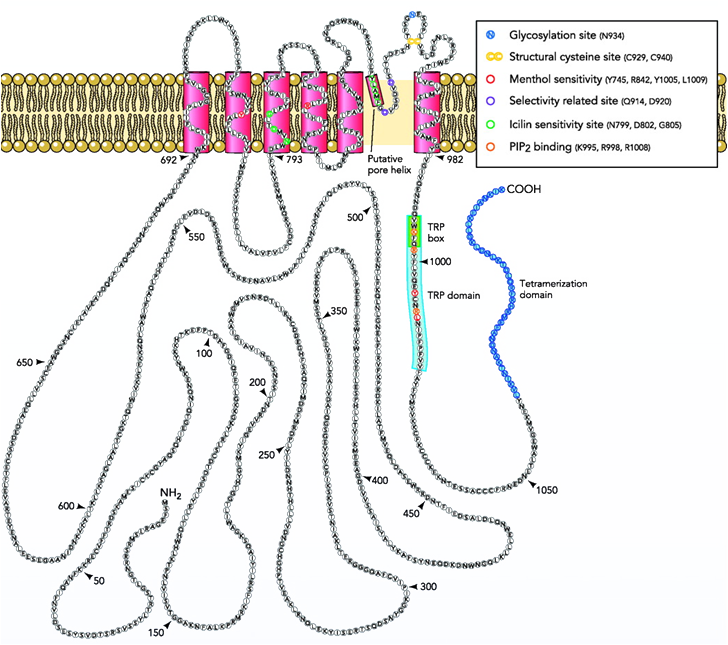
The residues involved in menthol activation are Tyr745 in the S2 segment and Tyr1005 and Leu1009, located in the C-terminus (Bandell et al., 2006).
Besides menthol and icilin, there are many agonist described for the channel as WS-12, CPS-39, linalool, geraniol, frescolat etc, as well as well-known antagonists; BCTC, thio-BCTC, capsazepine, AMTB and JNJ41876666 (Behrendt et al., 2004; Valero et al., 2012; Journigan and Zaveri, 2013).
One year before being cloned, TRPM8 was described as a transcript overexpressed in prostate cancer cells (Tsavaler et al., 2001; Zhang and Barritt, 2004). Nowadays, the presence of the channel has been described for a variety of tumours (Lehenkyi and Prevarskaya, 2011) as melanoma (Guo et al., 2012), colon or breast (Dhennin-Duthille et al., 2011).
Modulation
TRPM8 channels are activated by stimulation of tyrosin-kinase and protein G-coupled receptors. The channel is also capable of activating Gq protein (Klasen et al., 2012).
PI(4,5)P2 acts as a positive modulator of cold and menthol sensitivity by changing the voltage-sensitivity of the channel (Rohacs et al., 2005; Daniels et al., 2009; Yudin and Rohacs, 2012).
Protein Kinase C is implicated in TRPM8 desensitization (Yudin and Rohacs, 2012).
Phospolipase C (PLC)-coupled receptors mediate adaptation of TRPM8 to thermal stimuli (Daniels et al., 2009; Yudin and Rohacs, 2012).
There are indications of modulation by PKC and PKA, which would underlie reduced responses to cold and menthol in neurons in the presence of bradykinin and prostaglandin E2 (Latorre et al., 2011; Yudin and Rohacs, 2012).
TRPM8 also co-expresses with TrkA, the high affinity tyrosine kinase receptor for NGF (Latorre et al., 2011).
Implicated in
Article Bibliography
| Pubmed ID | Last Year | Title | Authors |
|---|---|---|---|
| 16520735 | 2006 | High-throughput random mutagenesis screen reveals TRPM8 residues specifically required for activation by menthol. | Bandell M et al |
| 17538622 | 2007 | The menthol receptor TRPM8 is the principal detector of environmental cold. | Bautista DM et al |
| 14757700 | 2004 | Characterization of the mouse cold-menthol receptor TRPM8 and vanilloid receptor type-1 VR1 using a fluorometric imaging plate reader (FLIPR) assay. | Behrendt HJ et al |
| 19399484 | 2009 | Converting cold into pain. | Belmonte C et al |
| 22128173 | 2012 | Regulation of activity of transient receptor potential melastatin 8 (TRPM8) channel by its short isoforms. | Bidaux G et al |
| 23500195 | 2013 | Targeting TRP channels for pain relief. | Brederson JD et al |
| 19812688 | 2009 | The contribution of TRPM8 and TRPA1 channels to cold allodynia and neuropathic pain. | Caspani O et al |
| 17368756 | 2007 | Intracellular trafficking of TRP channels. | Cayouette S et al |
| 15363396 | 2004 | The super-cooling agent icilin reveals a mechanism of coincidence detection by a temperature-sensitive TRP channel. | Chuang HH et al |
| 19019830 | 2009 | Activity of the neuronal cold sensor TRPM8 is regulated by phospholipase C via the phospholipid phosphoinositol 4,5-bisphosphate. | Daniels RL et al |
| 22178934 | 2011 | High expression of transient receptor potential channels in human breast cancer epithelial cells and tissues: correlation with pathological parameters. | Dhennin-Duthille I et al |
| 17065148 | 2006 | Trafficking and assembly of the cold-sensitive TRPM8 channel. | Erler I et al |
| 22897572 | 2012 | Role of TRPM in melanocytes and melanoma. | Guo H et al |
| 23159643 | 2013 | TRPM8 ion channel ligands for new therapeutic applications and as probes to study menthol pharmacology. | Journigan VB et al |
| 12858355 | 2003 | Identification of an HLA-A*0201-restricted T-cell epitope derived from the prostate cancer-associated protein trp-p8. | Kiessling A et al |
| 22460725 | 2012 | The TRPM8 ion channel comprises direct Gq protein-activating capacity. | Klasen K et al |
| 23407943 | 2013 | A sensory-labeled line for cold: TRPM8-expressing sensory neurons define the cellular basis for cold, cold pain, and cooling-mediated analgesia. | Knowlton WM et al |
| 21841075 | 2011 | A cool channel in cold transduction. | Latorre R et al |
| 21290334 | 2011 | Oncogenic TRP channels. | Lehen'kyi V et al |
| 11882888 | 2002 | Identification of a cold receptor reveals a general role for TRP channels in thermosensation. | McKemy DD et al |
| 11893340 | 2002 | A TRP channel that senses cold stimuli and menthol. | Peier AM et al |
| 17908685 | 2007 | The role of the N terminus and transmembrane domain of TRPM8 in channel localization and tetramerization. | Phelps CB et al |
| 15852009 | 2005 | PI(4,5)P2 regulates the activation and desensitization of TRPM8 channels through the TRP domain. | Rohács T et al |
| 11325849 | 2001 | Trp-p8, a novel prostate-specific gene, is up-regulated in prostate cancer and other malignancies and shares high homology with transient receptor potential calcium channel proteins. | Tsavaler L et al |
| 23251635 | 2012 | TRPM8 ion channels differentially modulate proliferation and cell cycle distribution of normal and cancer prostate cells. | Valero ML et al |
| 20730379 | 2010 | TRP channels in human prostate. | Van Haute C et al |
| 22061619 | 2012 | Regulation of TRPM8 channel activity. | Yudin Y et al |
| 15548706 | 2004 | Evidence that TRPM8 is an androgen-dependent Ca2+ channel required for the survival of prostate cancer cells. | Zhang L et al |
Other Information
Locus ID:
NCBI: 79054
MIM: 606678
HGNC: 17961
Ensembl: ENSG00000144481
Variants:
dbSNP: 79054
ClinVar: 79054
TCGA: ENSG00000144481
COSMIC: TRPM8
RNA/Proteins
Expression (GTEx)
Pathways
References
| Pubmed ID | Year | Title | Citations |
|---|---|---|---|
| 38316991 | 2024 | Sterile inflammation via TRPM8 RNA-dependent TLR3-NF-kB/IRF3 activation promotes antitumor immunity in prostate cancer. | 1 |
| 38339011 | 2024 | Joint CB1 and NGF Receptor Activation Suppresses TRPM8 Activation in Etoposide-Resistant Retinoblastoma Cells. | 1 |
| 38437228 | 2024 | Cold temperature induces a TRPM8-independent calcium release from the endoplasmic reticulum in human platelets. | 0 |
| 38316991 | 2024 | Sterile inflammation via TRPM8 RNA-dependent TLR3-NF-kB/IRF3 activation promotes antitumor immunity in prostate cancer. | 1 |
| 38339011 | 2024 | Joint CB1 and NGF Receptor Activation Suppresses TRPM8 Activation in Etoposide-Resistant Retinoblastoma Cells. | 1 |
| 38437228 | 2024 | Cold temperature induces a TRPM8-independent calcium release from the endoplasmic reticulum in human platelets. | 0 |
| 36168728 | 2023 | TRPM8 indicates poor prognosis in colorectal cancer patients and its pharmacological targeting reduces tumour growth in mice by inhibiting Wnt/β-catenin signalling. | 11 |
| 36609627 | 2023 | TRPM8 promotes hepatocellular carcinoma progression by inducing SNORA55 mediated nuclear-mitochondrial communication. | 3 |
| 36675209 | 2023 | Nebulized Menthol Impairs Mucociliary Clearance via TRPM8 and MUC5AC/MUC5B in Primary Airway Epithelial Cells. | 2 |
| 37208975 | 2023 | Downregulation of TRPM7, TRPM8, and TRPV1 channels modulate apoptotic parameters and neurodegenerative markers: Focus on neuronal differentiation and Parkinson's disease model. | 1 |
| 37542841 | 2023 | Functional expression of the thermally activated transient receptor potential channels TRPA1 and TRPM8 in human myotubes. | 2 |
| 37635201 | 2023 | TCAF2 in Pericytes Promotes Colorectal Cancer Liver Metastasis via Inhibiting Cold-Sensing TRPM8 Channel. | 3 |
| 37728085 | 2023 | TRPM8 as a Potential Biomarker and Therapeutic Target for Gastric Cancer Identified by a Combination of Text Mining and RNA Sequencing. | 2 |
| 37857704 | 2023 | Structure of human TRPM8 channel. | 2 |
| 36168728 | 2023 | TRPM8 indicates poor prognosis in colorectal cancer patients and its pharmacological targeting reduces tumour growth in mice by inhibiting Wnt/β-catenin signalling. | 11 |
Citation
María Llanos Valero ; Luis A Pardo
TRPM8 (transient receptor potential cation channel, subfamily M, member 8)
Atlas Genet Cytogenet Oncol Haematol. 2013-05-01
Online version: http://atlasgeneticsoncology.org/gene/42709/trpm8-(transient-receptor-potential-cation-channel-subfamily-m-member-8)
