ALOX15 (Arachidonate 15-Lipoxygenase)
2006-06-01 Sreeparna Banerjee AffiliationDepartment of Biology, Office: Z-16\\\/Lab: B-59, Middle East Technical University, 06531 Ankara, Turkey
DNA/RNA
Note
With the exception of ALOX5, all human LOX genes, including ALOX15, are clustered on the short arm of chromosome 17 within a few megabases of each other. ALOX12, which has 86% sequence homology to ALOX15 is in closest proximity (17p13.1). Since chromosome 17 is known for gene duplications, the multiple LOX genes on the same chromosome may be as a result of such duplications.
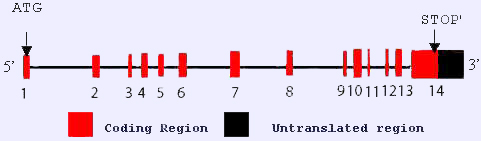
ALOX15Fig. Diagram of the ALOX15 gene. Exons are represented by red boxes (in scale) untranscribed sequences in black, with exon numbers on the bottom. The arrows show the ATG and the stop codons respectively.
Description
ALOX15 gene spans a region of 10.7 kilo bases. and has 14 exons, the sizes being 149, 202, 82, 123, 104, 161, 144, 210, 87, 170, 122, 101, 108 and 859 bps.
Transcription
ALOX15 mRNA has 2702 bps.
TH2 cytokines
TH2 cytokines
Pseudogene
The arachidonate 15-lipoxygenase pseudogene (ALOX15P) is located on 17p13.1.
Proteins
Note
Two different 15-Lipoxygenases exist, 15-LOX-1 (reticulocyte type) and 15-LOX-2 (epidermis type), differentiated by their tissue expression and a 40% homology at the amino acid level. 15-LOX-1 preferentially oxygenates linoleic acid into 13(S)-hydroxyoctadecadienoic acid (13(S)-HPODE) whereas 15-LOX-2 preferentially metabolizes arachidonic acid (AA) to 15S- hydroperoxyeicosatetraenoic acid (15-HETE) with poor activity with linoleic acid (LA).
Description
15-LOX-1 protein consists of 661 amino acids and is 74.7 kDa. It contains 1 gram atom of non-haem non-sulphur bound iron per mole of the enzyme. Conserved domain search, the presence of a polycystin/lipoxygenase/alpha-toxin (PLAT) domain in the 15-LOX-1 protein allows it access and enables it to catalyze enzymatic lipid peroxidation in complex biological structures via direct dioxygenation of phospholipids and cholesterol esters of biomembranes and plasma lipoproteins. The membrane binding domain of the rabbit reticulocyte 15-LOX are determined by a concerted action of the N-terminal beta-barrel and the C-terminal catalytic domain.
Expression
15-LOX-1 was first purified in rabbit reticulocytes and was subsequently found to be specifically expressed or induced in mast cells, eosinophils, activated monocytes or dendritic cells, and bronchial epithelial cells.
Localisation
Located in the cytoplasm.
Function
15-LOX-1 is a member of the inflammatory leukotriene biosynthesis pathway where, in presence of molecular oxygen, it converts arachidonic acid to(15-HETE). Also acts on C-12 of arachidonate forming products (12-HETE) at a ratio of 12:1 (15-HETE:12-HETE). Preferentially converts linoleic acid to 13(S)-HODE.
Homology
C. familiaris LOC4894581 similar to Arachidonate 15-lipoxygenase;
R. norvegicus: Alox15 arachidonate 12-lipoxygenase;
M. musculus: Alox15 arachidonate 15-lipoxygenase (12/15LOX);
A. thaliana: F12B7.11, F12B7_111 iron ion binding / lipoxygenase;
R. norvegicus: Alox15 arachidonate 12-lipoxygenase;
M. musculus: Alox15 arachidonate 15-lipoxygenase (12/15LOX);
A. thaliana: F12B7.11, F12B7_111 iron ion binding / lipoxygenase;
Mutations
Note
No mutations have been reported for ALOX15 that cause congenital anomalies. Single nucleotide polymorphism (SNP) studies have revealed that a C-to-T base exchange (-292C/T) enhances the transcriptional activity of the ALOX15 promoter in macrophages through the generation of a novel SPI1 transcription factor binding site. In addition, a G to A base exchange (-5229G/A) in the ALOX15 promoter region has been associated with low bone mineral density.
Implicated in
Entity name
Prostate cancer
Note
Genechip study of the mRNA levels of key enzymes involved in the LA and AA pathways in 18 human donor (normal) prostates compared to 60 prostate tumours showed a lower level of 15-LOX-1 expression (the key enzyme in the LA pathway) in contrast to a higher 15-lipoxygenase-2 expression in donor (normal) prostates. On the other hand, significantly high levels of 15-LOX-1 and low levels of 15-LOX-2/ALOX15B were observed in prostate carcinoma tissues.
Entity name
Colorectal cancer
Note
The role of 15-LOX-1 in colorectal cancer is controversial with some researchers claiming a mitogenic role through up-regulation of the EGF signaling pathway as well as activation of ERK and down regulation of anti-inflammatory PPAR-gamma transcriptional activity. Its upregulation by mutant TP53 has been reported. On the other hand, in recent years others have shown that 15-LOX-1 expression is reduced in colorectal cancer and implicated 13(S)-HPODE in the pro-apoptotic functions of 15-LOX-1. 15-LOX-1 expression was shown to be down-regulated in colorectal adenomas (compared with non neoplastic epithelial mucosa) in 87% (13 of 15) of patients with familial adenomatous polyposis resulting in an escape from apoptosis.
Ectopic restoration of 15-LOX-1 expression re-established apoptosis in Caco-2 colon cancer cells. A proapoptotic function ascribed to 15-LOX-1 and 15-LOX-2 in colon cancer is said to be through the activation of the anti-tumorigenic PPAR-gamma and down-regulation of the pro-tumorigenic PPAR-delta/beta. In addition, the apoptotic functions of NSAIDS are reported to be via an upregulation of 15-LOX-1.
Entity name
Breast cancer
Note
An immunoblot analysis of metastatic human breast carcinoma cells with antibodies to 15-LOX-1 and 15-LOX-2 indicated that it is the 15(S)-LOX-2 isoform that generates 15-HETE and activates specific growth factor receptor-related signalling pathways, thereby initiating signal transduction events resulting in enhanced cell adhesion to the extracellular matrix. However, a second study indicated that both 15-LOX-2 and 15-LOX-1 were expressed at significantly lower levels in metastatic tumours and in patients who died of breast cancer related causes. This reduction is correlated with the disease progression of breast cancer and a poor clinical outcome.
Entity name
Atherosclerosis
Disease
Atherosclerosis is a chronic proliferative disease of the arterial wall that is associated with aberrant immune reactions. A proatherogenic activity of 12/15LOX via oxidation of low density lipoproteins and formation of foam cells in various rodent atherosclerosis models has been shown. A similar extrapolation to humans has not been convincingly proven, particularly since significantly lower expression of 15-LOX-1 was detected in diseased and normal human arteries when compared to 5-LOX.
Entity name
Asthma
Disease
Patients with severe asthma with persistent airway eosinophils have been shown to manifest high levels of 15(S)-HETE in bronchoalveolar lavage (BALF), which may be associated with airway fibrosis. In addition, IL-4-induced apoptosis via upregulation of 15-LOX-1 and PPAR-gamma may contribute to severe loss of alveolar structures and infiltration of eosinophils, mononuclear phagocytes, etc., into the lung tissue of chronic asthma patients.
Article Bibliography
| Pubmed ID | Last Year | Title | Authors |
|---|---|---|---|
| 9177185 | 1997 | Discovery of a second 15S-lipoxygenase in humans. | Brash AR et al |
| 12444024 | 2002 | 15-lipoxygenase: a Janus enzyme? | Chanez P et al |
| 14566836 | 2003 | 15-hydroxy-eicosatetraenoic acid arrests growth of colorectal cancer cells via a peroxisome proliferator-activated receptor gamma-dependent pathway. | Chen GG et al |
| 9927047 | 1999 | Expression of 15-lipoxygenase-1 in human colorectal cancer. | Ikawa H et al |
| 16556493 | 2006 | Reduction of isoforms of 15-lipoxygenase (15-LOX)-1 and 15-LOX-2 in human breast cancer. | Jiang WG et al |
| 16678271 | 2006 | Inflammation and immune regulation by 12/15-lipoxygenases. | Kühn H et al |
| 16566819 | 2006 | The yin and yang of 15-lipoxygenase-1 and delta-desaturases: dietary omega-6 linoleic acid metabolic pathway in prostate. | Kelavkar U et al |
| 10200270 | 1999 | Effects of mutant p53 expression on human 15-lipoxygenase-promoter activity and murine 12/15-lipoxygenase gene expression: evidence that 15-lipoxygenase is a mutator gene. | Kelavkar UP et al |
| 15194425 | 2004 | Transcriptional regulation of 15-lipoxygenase expression by promoter methylation. | Liu C et al |
| 14643174 | 2004 | 15-Lipoxygenase-1 has anti-tumorigenic effects in colorectal cancer. | Nixon JB et al |
| 16000313 | 2005 | 15S-Lipoxygenase-2 mediates arachidonic acid-stimulated adhesion of human breast carcinoma cells through the activation of TAK1, MKK6, and p38 MAPK. | Nony PA et al |
| 12517954 | 2003 | IL-4 induces apoptosis in A549 lung adenocarcinoma cells: evidence for the pivotal role of 15-hydroxyeicosatetraenoic acid binding to activated peroxisome proliferator-activated receptor gamma transcription factor. | Shankaranarayanan P et al |
| 16357157 | 2005 | The critical role of 15-lipoxygenase-1 in colorectal epithelial cell terminal differentiation and tumorigenesis. | Shureiqi I et al |
| 15838625 | 2005 | Association of a single nucleotide polymorphism in the lipoxygenase ALOX15 5'-flanking region (-5229G/A) with bone mineral density. | Urano T et al |
| 12004065 | 2002 | The N-terminal domain of the reticulocyte-type 15-lipoxygenase is not essential for enzymatic activity but contains determinants for membrane binding. | Walther M et al |
| 16320347 | 2006 | Functional polymorphism in ALOX15 results in increased allele-specific transcription in macrophages through binding of the transcription factor SPI1. | Wittwer J et al |
| 12748293 | 2003 | Interleukin-13 induction of 15-lipoxygenase gene expression requires p38 mitogen-activated protein kinase-mediated serine 727 phosphorylation of Stat1 and Stat3. | Xu B et al |
| 15165036 | 2004 | 15-LOX-1 inhibits p21 (Cip/WAF 1) expression by enhancing MEK-ERK 1/2 signaling in colon carcinoma cells. | Yoshinaga M et al |
| 16288226 | 2006 | Oxidative metabolism of linoleic acid modulates PPAR-beta/delta suppression of PPAR-gamma activity. | Zuo X et al |
Other Information
Locus ID:
NCBI: 246
MIM: 152392
HGNC: 433
Ensembl: ENSG00000161905
Variants:
dbSNP: 246
ClinVar: 246
TCGA: ENSG00000161905
COSMIC: ALOX15
RNA/Proteins
| Gene ID | Transcript ID | Uniprot |
|---|---|---|
| ENSG00000161905 | ENST00000293761 | P16050 |
| ENSG00000161905 | ENST00000570836 | P16050 |
| ENSG00000161905 | ENST00000574640 | P16050 |
Expression (GTEx)
Pathways
Protein levels (Protein atlas)
References
| Pubmed ID | Year | Title | Citations |
|---|---|---|---|
| 38641013 | 2024 | Identifying ALOX15-initiated lipid peroxidation increases susceptibility to ferroptosis in asthma epithelial cells. | 0 |
| 38685084 | 2024 | Association between arachidonate lipoxygenase 15,c.-292 C > T gene polymorphism and non-cystic fibrosis bronchiectasis in children: a pilot study on the effects on airway lipoxin A4 and disease phenotype. | 0 |
| 38641013 | 2024 | Identifying ALOX15-initiated lipid peroxidation increases susceptibility to ferroptosis in asthma epithelial cells. | 0 |
| 38685084 | 2024 | Association between arachidonate lipoxygenase 15,c.-292 C > T gene polymorphism and non-cystic fibrosis bronchiectasis in children: a pilot study on the effects on airway lipoxin A4 and disease phenotype. | 0 |
| 36529997 | 2023 | Photothermal lipolysis accelerates ECM production via macrophage-derived ALOX15-mediated p38 MAPK activation in fibroblasts. | 0 |
| 37673368 | 2023 | CircRNA 06209 inhibits cataract development by sponging miR-6848-5p and regulating ALOX15 expression. | 0 |
| 37716021 | 2023 | 15-lipoxygenase and cyclooxygenase expression profile and their related modulators in COVID-19 infection. | 1 |
| 37849828 | 2023 | A review on the relationship between Arachidonic acid 15-Lipoxygenase (ALOX15) and diabetes mellitus. | 1 |
| 37874359 | 2023 | Epigenetic regulation of 15-lipoxygenase-1 expression in human chondrocytes by promoter methylation. | 0 |
| 36529997 | 2023 | Photothermal lipolysis accelerates ECM production via macrophage-derived ALOX15-mediated p38 MAPK activation in fibroblasts. | 0 |
| 37673368 | 2023 | CircRNA 06209 inhibits cataract development by sponging miR-6848-5p and regulating ALOX15 expression. | 0 |
| 37716021 | 2023 | 15-lipoxygenase and cyclooxygenase expression profile and their related modulators in COVID-19 infection. | 1 |
| 37849828 | 2023 | A review on the relationship between Arachidonic acid 15-Lipoxygenase (ALOX15) and diabetes mellitus. | 1 |
| 37874359 | 2023 | Epigenetic regulation of 15-lipoxygenase-1 expression in human chondrocytes by promoter methylation. | 0 |
| 34762602 | 2022 | 15LO1 dictates glutathione redox changes in asthmatic airway epithelium to worsen type 2 inflammation. | 37 |
Citation
Sreeparna Banerjee
ALOX15 (Arachidonate 15-Lipoxygenase)
Atlas Genet Cytogenet Oncol Haematol. 2006-06-01
Online version: http://atlasgeneticsoncology.org/gene/42986/alox15-(arachidonate-15-lipoxygenase)
