GNAQ (guanine nucleotide binding protein (G protein), q polypeptide)
2011-03-01 Swapna Vemula , Klaus Griewank , Boris C Bastian AffiliationDepartment of Pathology, University of California, San Francisco, CA, USA (SV); Department of Pathology, Human Oncology, Pathogenesis Program, Memorial Sloan Kettering Cancer Center, New York, NY, USA (KG, BCB)
Identity
HGNC
LOCATION
9q21.2
LOCUSID
ALIAS
CMC1,G-ALPHA-q,GAQ,SWS
FUSION GENES
DNA/RNA
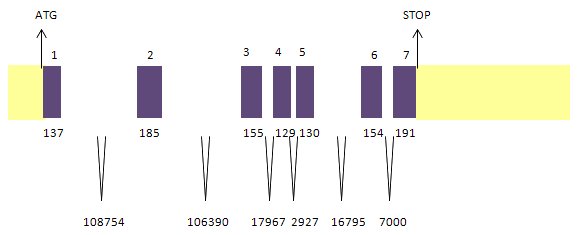
Diagram of GNAQ gene. The transcribed exons are represented in purple, the 5 and 3 untranslated region is represented in yellow. The exon numbers are indicated on the top and the number of base pairs per exon is indicated at the bottom. Introns are represented by black bars along with the number of base pairs. The arrows represent the start and stop codons.
Description
The GNAQ gene is composed of 7 exons spanning a region of 310993 nucleotides.
Transcription
Transcript length is 6539 bp. Length of ORF is 1080 bp.
Pseudogene
GNAQP in 2q14.3-q21.
Proteins
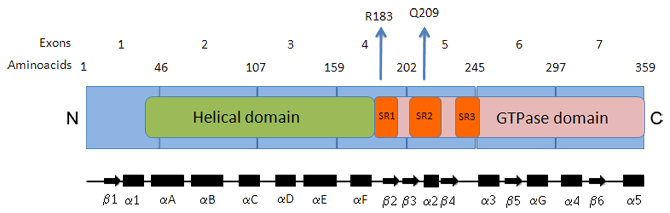
Schematic diagram of functional domains of GNAQ protein. The blue boxes represent the exons with exon numbers and the amino acid numbers on the top. The inner boxes represent the different domains: Helical domain (Green), Switch regions (Orange) (SR1: 182-192, SR2: 204-224, SR3: 236-247) are involved in conformational change based on the binding of GDP or GTP, GTPase domain (Pink) is essential for hydrolysis of GTP to GDP. N and C represent the amino and carboxy terminals of the protein respectively. The two arrows (R183, Q209) represent the hotspot mutations. Adapted from Mizuno and Itoh, 2009.
Description
Amino acid residues: 359. Molecular weight: 42141 daltons.
GNAQ is a proto oncogene which encodes for alpha subunit of q class of heterotrimeric GTP binding protein.
GNAQ is a proto oncogene which encodes for alpha subunit of q class of heterotrimeric GTP binding protein.
Expression
GNAQ is ubiquitously expressed in all tissues.
Localisation
Cytoplasm. Signaling occurs at the membrane.
Function
GNAQ mediates signal between the G protein coupled receptor (GPCR) and downstream effectors. Receptor activation by ligand binding causes the activation of GNAQ by catalyzing the release of GDP and binding of GTP. In its active form GTP-bound GNAQ causes the release of the beta and gamma subunits of the heterotrimeric G-protein. GTP-GNAQ and beta and gamma subunits transfer the receptor-mediated signal to downstream effectors through secondary messengers which participate in diverse signaling pathways to evoke different effectors. The known effectors for GNAQ include PLC beta, p63-RhoGEF, Trio, and Duet (Maize et al., 2005; Eom et al., 2009). GNAQ has been shown to activate the MAP kinase pathway, possibly via DAG-mediated activation of protein kinase C isoforms. GNAQ has an intrinsic GTPase domain at the C terminus which causes the hydrolysis of GTP to GDP and the G-alpha-GDP re-associates with G-beta and G-gamma subunits.
Mutations
Note
Somatic mutations of GNAQ affect codons 183 and 209 resulting in R183Q, Q209L, Q209P, Q209R, and Q209Y.
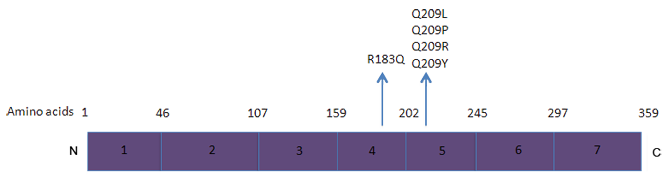
Schematic representation of GNAQ mutations in melanocytic neoplasms. The purple boxes represent the exons with the exon numbers indicated within the boxes, amino acid numbers indicated on top. The arrows represent the two hotspot mutations along with the amino acid change. N and C represent the amino and carboxy terminal of GNAQ protein.
Germinal
No germinal mutations have been described.
Somatic
Somatic mutations in GNAQ have been described in melanocytic neoplasia (Hubbard et al., 2006; Onken et al., 2008; Küsters-Vandevelde et al., 2009). In Uveal Melanoma, 97% of the hotspot mutations cause the amino acid substitution Q209L, the other 3% of mutations cause amino acid change to R183Q. The Glutamine 209 of GNAQ is similar to residue 61 of RAS protein. The Q209 and R183 mutations cause complete or partial loss of intrinsic GTPase activity respectively thereby locking the protein in a constitutively active form. Q209 and R183 mutations occur in a mutually exclusive pattern in human neoplasia. Mutations in GNAQ are also mutually exclusive from the hotspot mutations in GNA11, which belongs to the same family and shares 90% sequence homology. GNAQ mutations are not concomitant with other common oncogenic mutations in BRAF, NRAS or KIT found in melanocytic neoplasia.
Table representing the exon 5 mutation frequencies of GNAQ and GNA11 in melanocytic neoplams.
| Categories | Subtypes | GNA11 Ex5 | GNAQ Ex5 | Neither | Total | |||
|---|---|---|---|---|---|---|---|---|
| number of samples | % | number of samples | % | number of samples | % | |||
| Blue nevi | Amelanotic blue nevus | 0 | 0.0% | 7 | 70.0% | 3 | 30.0% | 10 |
| Cellular blue nevus | 3 | 8.3% | 26 | 72.2% | 7 | 19.4% | 36 | |
| Common blue nevus | 4 | 6.7% | 39 | 65.0% | 17 | 28.3% | 60 | |
| Nevus of Ito | 0 | 0.0% | 0 | 0.0% | 7 | 100.0% | 7 | |
| Nevus of Ota | 1 | 5.0% | 2 | 10.0% | 17 | 85.0% | 20 | |
| Malignant blue nevus | 1 | 16.7% | 2 | 33.3% | 3 | 50.0% | 6 | |
| Total | 9 | 6.5% | 76 | 54.7% | 54 | 38.8% | 139 | |
| Ocular melanocytic tumors | Conjunctival melanoma | 0 | 0.0% | 0 | 0.0% | 9 | 100.0% | 9 |
| Uveal melanoma, primary | 52 | 31.9% | 73 | 44.8% | 38 | 23.3% | 163 | |
| Uveal melanoma, metastasis | 13 | 56.5% | 5 | 21.7% | 5 | 21.7% | 23 | |
| Uveal nevus | 0 | 0.0% | 1 | 100.0% | 0 | 0.0% | 1 | |
| Total | 65 | 33.2% | 79 | 40.3% | 52 | 26.5% | 196 | |
| Other nevi | Common nevus | 0 | 0.0% | 0 | 0.0% | 22 | 100.0% | 22 |
| Congenital nevus | 0 | 0.0% | 0 | 0.0% | 17 | 100.0% | 17 | |
| Deep penetrating nevus | 0 | 0.0% | 0 | 0.0% | 27 | 100.0% | 27 | |
| Spitz nevus | 0 | 0.0% | 0 | 0.0% | 19 | 100.0% | 19 | |
| Atypical Spitz tumor | 0 | 0.0% | 0 | 0.0% | 20 | 100.0% | 20 | |
| Total | 0 | 0.0% | 0 | 0.0% | 105 | 100.0% | 105 | |
| Extra-ocular melanomas | Acral | 0 | 0.0% | 0 | 0.0% | 47 | 100.0% | 47 |
| CSD | 0 | 0.0% | 1 | 1.4% | 73 | 98.6% | 74 | |
| Mucosal | 0 | 0.0% | 0 | 0.0% | 62 | 100.0% | 62 | |
| NonCSD | 0 | 0.0% | 0 | 0.0% | 90 | 100.0% | 90 | |
| Total | 0 | 0.0% | 1 | 0.4% | 272 | 99.6% | 273 | |
| Grand Total | 713 | |||||||
Implicated in
Entity name
Blue nevi
Note
The hotspot mutation of Q209 in Exon 5 is found in 55% of blue nevi. The R183 mutation in Exon 4 is less common and is found in 1% of blue nevi. The mutations of GNAQ or its paralog GNA11 are expected to be early events in oncogenesis. A mutation in either gene alone is often found in benign proliferations of dermal melanocytes such as blue nevi.
Prognosis
Blue nevi are typically benign melanocytic nevi that rarely progress to melanoma (malignant blue nevus).
Cytogenetics
Blue nevi typically lack the presence of chromosomal aberrations.
Table representing the exon 5 mutation frequencies of GNAQ and GNA11 in blue nevi.
| Categories | Subtypes | GNA11 Ex5 | GNAQ Ex5 | Neither | Total | |||
|---|---|---|---|---|---|---|---|---|
| number of samples | % | number of samples | % | number of samples | % | |||
| Blue nevi | Amelanotic blue nevus | 0 | 0.0% | 7 | 70.0% | 3 | 30.0% | 10 |
| Total | 9 | 6.5% | 76 | 54.7% | 54 | 38.8% | 139 | |
Entity name
Uveal melanoma
Note
The hotspot mutation of Q209 in Exon 5 is found in 45% of primary uveal melanoma and 22% of metastatic uveal melanomas. R183 mutation in Exon 4 is less common and is found in 3% of uveal melanoma.
Prognosis
Uveal melanoma is the most common primary intraocular malignancy with a 10 year survival rate of approximately 50%. Uveal melanoma has a high propensity of metastasis to the liver. The prognosis of uveal melanoma is highly dependent on the presence of additional genetic alterations, primarily loss of chromosome 3 and trisomy 8q.
Cytogenetics
Uveal melanoma has been shown to have frequent chromosomal aberrations like monosomy 3, trisomy 8q and recently 80% of uveal metastasis have been shown to have mutations in BAP1.
Table representing the exon 5 mutation frequencies of GNAQ and GNA11 in uveal melanoma.
| Categories | Subtypes | GNA11 Ex5 | GNAQ Ex5 | Neither | Total | |||
|---|---|---|---|---|---|---|---|---|
| number of samples | % | number of samples | % | number of samples | % | |||
| Ocular melanocytic tumors | Conjunctival melanoma | 0 | 0.0% | 0 | 0.0% | 9 | 100.0% | 9 |
| Total | 65 | 33.2% | 79 | 40.3% | 52 | 26.5% | 196 | |
| Uveal nevus | 0 | 0.0% | 1 | 100.0% | 0 | 0.0% | 1 | |
Entity name
Primary melanocytic neoplasms of the central nervous system
Note
Recently GNAQ Q209 mutations have also been shown to be present in primary melanocytic neoplasms of the central nervous system, (in this study GNAQ exon 4 was not investigated). Primary melanocytic neoplasms of the central nervous system (CNS) are rather rare tumors, originating from melanocytes that are considered to be derived from the leptomeninges. The tumors represent a spectrum in terms of malignant potential. Some are classified as low-grade melanocytomas, others as intermediate malignancy and some as overtly malignant melanomas.
Prognosis
Highly varied, depending on the grade of the tumor.
Entity name
Other diseases
Note
So far no activating mutations of GNAQ in other cancers have been reported. Collectively four studies to date have sequenced more than 1500 tumor samples of a collection of various major tumor types and failed to identify any mutations in other settings than the ones described above.
There have been two reports indicating that promoter associated expression of GNAQ may be of importance. One of the reports indicates the presence of a dinucleotide SNP in the promoter region as a genetic risk factor for cardiac hypertrophy. The second report links promoter associated expression differences to polycystic ovary syndrome, raising the possibility that expression levels could be relevant in some settings.
There have been two reports indicating that promoter associated expression of GNAQ may be of importance. One of the reports indicates the presence of a dinucleotide SNP in the promoter region as a genetic risk factor for cardiac hypertrophy. The second report links promoter associated expression differences to polycystic ovary syndrome, raising the possibility that expression levels could be relevant in some settings.
Article Bibliography
| Pubmed ID | Last Year | Title | Authors |
|---|---|---|---|
| 19551532 | 2009 | Somatic mutation of GNAQ gene is rare in common solid cancers and leukemias. | Eom HS et al |
| 18326504 | 2008 | Characterization of the GNAQ promoter and association of increased Gq expression with cardiac hypertrophy in humans. | Frey UH et al |
| 8431862 | 1993 | Cytogenetic analysis of uveal melanoma. Consistent occurrence of monosomy 3 and trisomy 8q. | Horsman DE et al |
| 16182515 | 2006 | Cell signalling diversity of the Gqalpha family of heterotrimeric G proteins. | Hubbard KB et al |
| 19936769 | 2010 | Activating mutations of the GNAQ gene: a frequent event in primary melanocytic neoplasms of the central nervous system. | Küsters-Vandevelde HV et al |
| 19718445 | 2009 | Mutational profile of GNAQQ209 in human tumors. | Lamba S et al |
| 16096412 | 2005 | Genomic analysis of blue nevi and related dermal melanocytic proliferations. | Maize JC Jr et al |
| 18719078 | 2008 | Oncogenic mutations in GNAQ occur early in uveal melanoma. | Onken MD et al |
| 8622452 | 1996 | Prognostic implications of monosomy 3 in uveal melanoma. | Prescher G et al |
| 15763193 | 2005 | Uveal melanoma: epidemiologic aspects. | Singh AD et al |
Other Information
Locus ID:
NCBI: 2776
MIM: 600998
HGNC: 4390
Ensembl: ENSG00000156052
Variants:
dbSNP: 2776
ClinVar: 2776
TCGA: ENSG00000156052
COSMIC: GNAQ
RNA/Proteins
| Gene ID | Transcript ID | Uniprot |
|---|---|---|
| ENSG00000156052 | ENST00000286548 | P50148 |
| ENSG00000156052 | ENST00000286548 | A0A024R240 |
| ENSG00000156052 | ENST00000411677 | B1AM21 |
Expression (GTEx)
Pathways
Protein levels (Protein atlas)
PharmGKB
| Entity ID | Name | Type | Evidence | Association | PK | PD | PMIDs |
|---|---|---|---|---|---|---|---|
| PA193 | HTR2A | Gene | Pathway | associated | 19741567 | ||
| PA194 | HTR2C | Gene | Pathway | associated | 19741567 | ||
| PA27946 | F2R | Gene | Pathway | associated | 20938371 | ||
| PA27949 | F2RL3 | Gene | Pathway | associated | 20938371 | ||
| PA32868 | P2RY1 | Gene | Pathway | associated | 20938371 | ||
| PA33384 | PLCB1 | Gene | Pathway | associated | 19741567, 20938371 | ||
| PA33385 | PLCB2 | Gene | Pathway | associated | 19741567 | ||
| PA33386 | PLCB3 | Gene | Pathway | associated | 19741567 | ||
| PA33387 | PLCB4 | Gene | Pathway | associated | 19741567 | ||
| PA33393 | PLCG2 | Gene | Pathway | associated | 20938371 | ||
| PA348 | TBXA2R | Gene | Pathway | associated | 20938371 |
References
| Pubmed ID | Year | Title | Citations |
|---|---|---|---|
| 37750536 | 2024 | Papillary Hemangioma Harbors Somatic GNA11 and GNAQ Mutations. | 1 |
| 37802294 | 2024 | GNAQ/GNA11 Mosaicism Is Associated with Abnormal Serum Calcium Indices and Microvascular Neurocalcification. | 2 |
| 38013159 | 2024 | Characterization of Patient-Derived GNAQ Mutated Endothelial Cells from Capillary Malformations. | 4 |
| 37750536 | 2024 | Papillary Hemangioma Harbors Somatic GNA11 and GNAQ Mutations. | 1 |
| 37802294 | 2024 | GNAQ/GNA11 Mosaicism Is Associated with Abnormal Serum Calcium Indices and Microvascular Neurocalcification. | 2 |
| 38013159 | 2024 | Characterization of Patient-Derived GNAQ Mutated Endothelial Cells from Capillary Malformations. | 4 |
| 37098137 | 2023 | Developmental expression of the Sturge-Weber syndrome-associated genetic mutation in Gnaq: a formal test of Happle's paradominant inheritance hypothesis. | 6 |
| 37481708 | 2023 | Gαq Signaling Activates β-Catenin-Dependent Gene Transcription. | 0 |
| 37606556 | 2023 | GNAQ R183Q somatic mutation contributes to aberrant arteriovenous specification in Sturge-Weber syndrome through Notch signaling. | 0 |
| 37098137 | 2023 | Developmental expression of the Sturge-Weber syndrome-associated genetic mutation in Gnaq: a formal test of Happle's paradominant inheritance hypothesis. | 6 |
| 37481708 | 2023 | Gαq Signaling Activates β-Catenin-Dependent Gene Transcription. | 0 |
| 37606556 | 2023 | GNAQ R183Q somatic mutation contributes to aberrant arteriovenous specification in Sturge-Weber syndrome through Notch signaling. | 0 |
| 33707187 | 2022 | Somatic GNAQ R183Q mutation is located within the sclera and episclera in patients with Sturge-Weber syndrome. | 5 |
| 34670408 | 2022 | Endothelial GNAQ p.R183Q Increases ANGPT2 (Angiopoietin-2) and Drives Formation of Enlarged Blood Vessels. | 0 |
| 35132089 | 2022 | Cryo-EM structures of human bradykinin receptor-G(q) proteins complexes. | 7 |
Citation
Swapna Vemula ; Klaus Griewank ; Boris C Bastian
GNAQ (guanine nucleotide binding protein (G protein), q polypeptide)
Atlas Genet Cytogenet Oncol Haematol. 2011-03-01
Online version: http://atlasgeneticsoncology.org/gene/43280
