ZFX (zinc finger protein, X-linked)
2014-10-01 Modjtaba Emadi-Baygi AffiliationDept of Genetics, Faculty of Basic Sciences, Shahrekord University, Shahrekord, Iran
DNA/RNA
Note
Differential splicing of a single ZFX transcript results in five variants. Variants 1, 2 and 3 result in isoform I, variant 4 results in isoform II and variant 5 results in isoform III.

Structure of the human ZFX gene. Exon positions (green) and sizes (nt-nucleotides) are labelled.
Description
ZFX gene is a human X- chromosome gene that escapes X inactivation (Schneider-Gadicke et al.,1989a) and is composed of 10 exons, ranging in size from 57 to 6062 nt. Exons 1 to 5 in isoform 2 and exons 1 to 6 in isoform 1 comprise the 5 UTR and encodes N-terminal acidic domain. Exon 10 contains 3 UTR and AATAAA polyadenylation signal and encodes C-terminal zinc - finger domain for isoforms 1 and 2 (Schneider-Gadicke et al.,1989a).
Transcription
Transcription initiation sites were not exactly identified, but there is same ORF with the first ATG codon at nucleotide 1 in cDNAs (Schneider-Gadicke et al.,1989b).
Pseudogene
Pseudogenes were not exactly identified.
Proteins
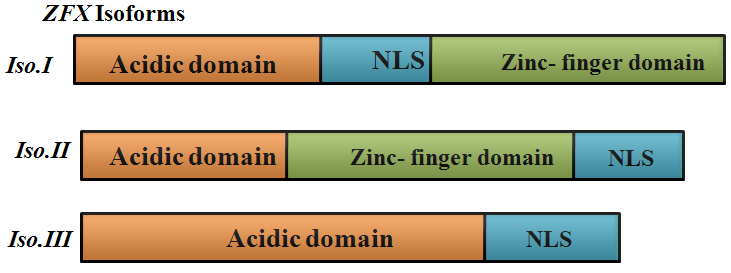
Structure of the human ZFX isoforms. Acidic domain (orange), nuclear localisation signal (blue) and zinc finger domain (green) are labelled.
Description
The ZFX isoform I, the longest isoform, contains 805 amino acids (130 kDa). Isoforms II (91 kDa) and III contain 576 and 432 amino acids, respectively. Isoform II binds to the AGGGCCCCA and AGGCCCCGA sequences located at HLA-A11 promoter (LHaridon et al.,1996) and in accompanying with isoform I could play a role as co-activators in HIV-1 LTR induction (Nikpour et al., 2012). Isoforms I and II contain three domains: acidic domain (transcription activation region), nuclear localization signal (NLS) and 13 zinc finger domains, that differ in the length of their N-terminal (acidic) domain resulting in qualitatively and quantitatively different regulatory properties (Schneider-Gadicke et al., 1989b).
Expression
ZFX gene escapes X inactivation in humans (Schneider-Gadicke et al., 1989a) and is expressed in a wide range of human tissues (Schneider-Gadicke et al.,1989b).
Localisation
It was shown that ZFX isoform I is concentrated in the nucleus of glioma cell line, while ZFX isoform II is found in the cytoplasm (Zhu et al., 2013).
Function
ZFX gene is differentially expressed in tissues and may have separate functions in gonadal and somatic tissues (Lau and Chan, 1989). It may play a role as a sex determination factor in mammals (Zhu et al., 2013). ZFX acts as a transcriptional regulator in self renewal and differentiation mechanisms in human embryonic and hematopoietic stem cells (Galan-Caridad et al., 2007; Harel et al., 2012). ZFX has an important role in cell cycle progression and cell growth control (Jiang et al., 2012b).
Homology
In mammals, ZFX gene is highly conserved (Ashworth et al., 1990; Lau and Chan, 1989; Palmer et al., 1990). Zinc finger protein X linked is one of the members of ZFY family comprised of three members: ZFX, ZFY and ZFA (Palmer et al., 1990).
Mutations
Note
A novel Xp22.11 deletion causing a syndrome of craniosynostosis and periventricular nodular heterotopias affecting all or part of three annotated genes, ZFX, PDK3, and PCYT1B has recently been reported in a male subject (van Kogelenberg et al., 2011). Furthermore, Zfx mutation results in small animal size and reduced germ cell number in male and female mice (Luoh et al., 1997). Moreover, molecular cytogenetic analysis of a male infant with severe mental retardation and autism shows that there is a duplication in Xp in this subject (Rao et al., 1994).
Implicated in
Entity name
Glioma cell and cell lines
Note
In human glioma cell lines, knocking down of ZFX expression by lentivirus-mediated RNA interference (RNAi) shows that ZFX plays an important role in glioma cell proliferation, survival and growth potential in both subcutaneous and intracranial models in mice (Zhu et al., 2013). Furthermore, Zhou et al. detected ZFX expression in U251 cells using semi- quantitative PCR. They showed that expression of ZFX is significantly higher in glioma tissues compared to non glioma tissues using real-time RT-PCR. In the same vein, Knocking down of ZFX gene expression in U251 cells results in disturbed cell proliferation and increased apoptosis and arrested cells in S phase (Zhou et al., 2011).
Entity name
Gastric cancer tissues and cells
Note
ZFX gene expression was examined by quantitative real-time RT-PCR in 30 paired gastric tissue samples. Result shows that ZFX gene has differential expression in gastric tissues. There is a statistically significant association between the ZFX expression and different tumour types and grades (Nikpour et al., 2012). Furthermore, ZFX silencing inhibits gastric cancer cell growth in both in vitro and in vivo via modulating extracellular signal-regulated kinase/mitogen-activated protein kinase (ERK-MAPK) pathway (Wu et al., 2013).
Entity name
Non - small cell lung cancer (NSCLC)
Note
ZFX overexpresses in NSCLC and its expression is correlated with lymph node metastasis. Knocking down of ZFX gene by short hairpin RNA interference (shRNA) in NSCLC cell line reduces cell viability and colony formation and causes cell cycle arrest (Jiang et al., 2012b).
Entity name
Laryngeal squamous cell carcinoma (LSCC)
Note
ZFX expression up-regulates in LSCC tissues compared to the non- tumoral tissues. Knock-down of ZFX by shRNA results in suppression of proliferation and colony-forming potential of infected Hep-2 human LSCC cells and induces enhancing of cell apoptosis. Furthermore, high expression of ZFX associates with LSCC progression and its decreased expression associates with declined tumor cell growth (Fang et al., 2012).
Entity name
Osteosarcoma cells
Note
Inhibition of ZFX expression by siRNA results in decreased proliferation, colony formation and invasion of Saos-2 cells. Silencing of ZFX gene expression causes cell cycle arrest in which greater portion of the cells existed in G1 phase and minor portion in S and G2/M phases (Jiang et al., 2013; Jiang et al., 2012a).
Entity name
Prostate cancer
Note
Prostate cancer tissues show higher expression of ZFX than that observed in normal adjacent tissues and BPH tissues. Furthermore, silencing the expression of ZFX in the prostate cancer cells effectively abolishes the cellular proliferation and colony-formation ability, and results in G1 phase cell cycle arrest. Moreover, inhibition of ZFX induces apoptosis by activating caspase-1, caspase-3 and caspase-9. (Jiang et al., 2012c).
Entity name
Childhood B lineage acute lymphoblastic leukemia
Note
ZFX protein expresses in human leukemia cell lines REH, HL-60, NB(4) and K562. Furthermore, ZFX mRNA expression increases in the newly-diagnosed ALL group while in the ALL complete remission group was significantly reduces. Moreover, ZFX mRNA level is significantly higher in Children with a poor prognosis than those with a good prognosis at diagnosis (Wang et al., 2013).
Article Bibliography
| Pubmed ID | Last Year | Title | Authors |
|---|---|---|---|
| 1691708 | 1990 | Zfa is an expressed retroposon derived from an alternative transcript of the Zfx gene. | Ashworth A et al |
| 22009483 | 2012 | Knockdown of zinc finger protein, X-linked (ZFX) inhibits cell proliferation and induces apoptosis in human laryngeal squamous cell carcinoma. | Fang J et al |
| 17448993 | 2007 | Zfx controls the self-renewal of embryonic and hematopoietic stem cells. | Galan-Caridad JM et al |
| 22879936 | 2012 | ZFX controls the self-renewal of human embryonic stem cells. | Harel S et al |
| 22898899 | 2012 | Knockdown of zinc finger protein X-linked inhibits prostate cancer cell proliferation and induces apoptosis by activating caspase-3 and caspase-9. | Jiang H et al |
| 23461064 | 2012 | The role of ZFX in non-small cell lung cancer development. | Jiang M et al |
| 24353675 | 2013 | Zinc finger X-chromosomal protein promotes growth and tumorigenesis in human osteosarcoma cells. | Jiang R et al |
| 24139414 | 2012 | Zinc finger X-chromosomal protein (ZFX) promotes solid agar colony growth of osteosarcoma cells. | Jiang R et al |
| 8657576 | 1996 | Transcriptional regulation of the MHC class I HLA-A11 promoter by the zinc finger protein ZFX. | L'Haridon M et al |
| 2511751 | 1989 | The putative testis-determining factor and related genes are expressed as discrete-sized transcripts in adult gonadal and somatic tissues. | Lau YF et al |
| 9187153 | 1997 | Zfx mutation results in small animal size and reduced germ cell number in male and female mice. | Luoh SW et al |
| 22357206 | 2012 | Differential expression of ZFX gene in gastric cancer. | Nikpour P et al |
| 2308929 | 1990 | Comparison of human ZFY and ZFX transcripts. | Palmer MS et al |
| 8045561 | 1994 | Molecular cytogenetic analysis of a duplication Xp in a male: further delineation of a possible sex influencing region on the X chromosome. | Rao PN et al |
| 2500252 | 1989 | ZFX has a gene structure similar to ZFY, the putative human sex determinant, and escapes X inactivation. | Schneider-Gädicke A et al |
| 23866268 | 2013 | [Expression of zinc finger protein X-linked in childhood B lineage acute lymphoblastic leukemia]. | Wang Z et al |
| 23587796 | 2013 | Knockdown of ZFX inhibits gastric cancer cell growth in vitro and in vivo via downregulating the ERK-MAPK pathway. | Wu S et al |
| 22185393 | 2011 | The Zfx gene is expressed in human gliomas and is important in the proliferation and apoptosis of the human malignant glioma cell line U251. | Zhou Y et al |
| 23322077 | 2013 | ZFX regulates glioma cell proliferation and survival in vitro and in vivo. | Zhu Z et al |
| 22052819 | 2011 | A novel Xp22.11 deletion causing a syndrome of craniosynostosis and periventricular nodular heterotopia. | van Kogelenberg M et al |
Other Information
Locus ID:
NCBI: 7543
MIM: 314980
HGNC: 12869
Ensembl: ENSG00000005889
Variants:
dbSNP: 7543
ClinVar: 7543
TCGA: ENSG00000005889
COSMIC: ZFX
RNA/Proteins
Expression (GTEx)
Protein levels (Protein atlas)
References
| Pubmed ID | Year | Title | Citations |
|---|---|---|---|
| 38325380 | 2024 | Variants in ZFX are associated with an X-linked neurodevelopmental disorder with recurrent facial gestalt. | 1 |
| 38325380 | 2024 | Variants in ZFX are associated with an X-linked neurodevelopmental disorder with recurrent facial gestalt. | 1 |
| 33632059 | 2021 | Zfx-induced upregulation of UBE2J1 facilitates endometrial cancer progression via PI3K/AKT pathway. | 2 |
| 34324278 | 2021 | Circ_0000520 contributes to triple-negative breast cancer progression through mediating the miR-1296/ZFX axis. | 9 |
| 33632059 | 2021 | Zfx-induced upregulation of UBE2J1 facilitates endometrial cancer progression via PI3K/AKT pathway. | 2 |
| 34324278 | 2021 | Circ_0000520 contributes to triple-negative breast cancer progression through mediating the miR-1296/ZFX axis. | 9 |
| 32406922 | 2020 | Characterization of the ZFX family of transcription factors that bind downstream of the start site of CpG island promoters. | 19 |
| 32406922 | 2020 | Characterization of the ZFX family of transcription factors that bind downstream of the start site of CpG island promoters. | 19 |
| 29753316 | 2019 | Differential Expression Profile of ZFX Variants Discriminates Breast Cancer Subtypes. | 0 |
| 30520073 | 2019 | LncRNA SNHG20 contributes to cell proliferation and invasion by upregulating ZFX expression sponging miR-495-3p in gastric cancer. | 22 |
| 31310241 | 2019 | CCAT1 promotes triple-negative breast cancer progression by suppressing miR-218/ZFX signaling. | 34 |
| 31432109 | 2019 | Homoharringtonine enhances the effect of imatinib on chronic myelogenous leukemia cells by downregulating ZFX. | 2 |
| 29753316 | 2019 | Differential Expression Profile of ZFX Variants Discriminates Breast Cancer Subtypes. | 0 |
| 30520073 | 2019 | LncRNA SNHG20 contributes to cell proliferation and invasion by upregulating ZFX expression sponging miR-495-3p in gastric cancer. | 22 |
| 31310241 | 2019 | CCAT1 promotes triple-negative breast cancer progression by suppressing miR-218/ZFX signaling. | 34 |
Citation
Modjtaba Emadi-Baygi
ZFX (zinc finger protein, X-linked)
Atlas Genet Cytogenet Oncol Haematol. 2014-10-01
Online version: http://atlasgeneticsoncology.org/gene/43623/deep-insight-explorer/
