ELAVL1 (ELAV (embryonic lethal, abnormal vision, Drosophila)-like 1 (Hu antigen R))
2008-09-01 Virginie Dormoy-Raclet , Imed-Eddine Gallouzi AffiliationDepartment of Biochemistry, McGill University, 3655 Promenade Sir William Osler, Montreal, Quebec H3G 1Y6, Canada
Identity
HGNC
LOCATION
19p13.2
LOCUSID
ALIAS
ELAV1,HUR,Hua,MelG
FUSION GENES
DNA/RNA

Description
The ELAV1 gene, located on the minus strand, encompasses 47072 bp with 6 exons and 5 introns.
Transcription
mRNA of 2,3 kb but a second putative poly(A) signal is described leading to a 6 kb mRNA.
Coding sequence from 168 to 1148 b.
Coding sequence from 168 to 1148 b.
Proteins
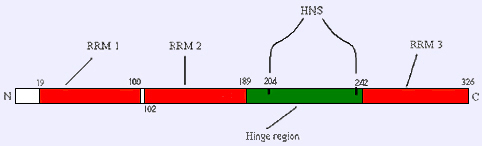
Description
The HuR protein consists of 326 aa (36 kDa). HuR has three highly conserved motifs belonging to the RNA recognition motif (RRM) superfamily and a hinge region between RRMs 2 and 3 named the HuR nucleocytoplasmic shuttling (HNS) domain. It has been shown that the HNS domain regulates the localization of HuR by mediating its association with adaptor proteins for nuclear export such as pp32/PHAP-I and APRIL and with import factors transportin-1, transportin-2, and importin.
Expression
Ubiquitously expressed
Localisation
Predominantly nuclear but shuttles between the nuclear and the cytoplasm.
Function
HuR belongs to the ELAV/Hu family (embryonic lethal abnormal vision phenotype in flies) of RNA-binding proteins (RBPs). Like other Hu/ELAVL RBPs, HuR contains 3 RRM through which it binds to specific mRNA and influences their post-transcriptional expression. HuR exhibits a high affinity for adenosine and uracil- (AU-) rich elements (ARE) leading to the stabilization and/or transport of its target host messages. In addition to its role as an mRNA stabilizer and transporter, HuR has been shown to mediate the translation of mRNAs and rarely to repress translation. Moreover, HuR plays a key role in the enhancement of caspase-dependent apoptosis induced by extreme stress conditions. In response to a lethal stress, HuR accumulates in the cytoplasm, where it undergoes caspase-mediated cleavage. This cleavage appears to be important for pp32/PHAP-I - mediated enhancement of the caspase-dependent apoptosis. HuR was shown to play others critical functions in cells responding to immune stimuli, nutrient availability, and exposure to damaging agents. Similarly, it has an important regulatory function in the progression of cells through the division cycle, the implementation of differentiation programs, the promotion of cell migration, cell invasion and a malignant phenotype, and the inhibition of replicative senescence.
Mutations
Note
No HuR mutations have been found in cancer or other diseases.
Implicated in
Entity name
Cancer
Oncogenesis
Breast , Lung , Colon and Ovary cancer. Expression of HuR is increased in all cancer tissues compared to the normal-tissue counterparts. It exists a consistent correlation between HuR expression levels and advancing stages of malignancy.
Entity name
Cachexia
Disease
Cachexia, characterized by the excessive loss of skeletal muscle, is frequently seen in patients with chronic diseases such as cancer. The bioactive gas nitric oxide has been identified as an important player in cancer-induced cachexia because NO is directly involved in the loss of MyoD mRNA (a key factor needed for the myogenic process, which is destabilized during cachexia) and muscle fiber. These events are mediated by the ability of HuR to associate and stabilizes the message encoding the inducible NO synthase enzyme.
Entity name
Hypertension
Disease
Chronic hypertension is associated with functional and morphological alterations of the vessel wall (ie, dysfunctional vascular endothelium and thickening of the smooth muscle layer). The pathomechanisms accounting for hypertension-induced vascular alterations are likely to be multifactorial. HuR is not only an important factor controlling vascular gene expression, but it is also subject to control by vasoactive factors that regulate cGMP and cAMP levels and downregulate its expression.
Entity name
Paraneoplastic neurological disease
Disease
Paraneoplastic enecephalomyelitis/sensory neuronopathy (PEM/SSN) is characterized by the presence of a common autoantibody, referred to as anti-Hu or type I anti-neuronal nuclear antibody (ANNA-1). The target of these antibodies is the family of Hu antigens (Hel-N1, HuC, HuD and HuR).
Article Bibliography
| Pubmed ID | Last Year | Title | Authors |
|---|---|---|---|
| 11289308 | 2001 | HuR and mRNA stability. | Brennan CM et al |
| 16024790 | 2005 | NF-kappa B-mediated MyoD decay during muscle wasting requires nitric oxide synthase mRNA stabilization, HuR protein, and nitric oxide release. | Di Marco S et al |
| 17548472 | 2007 | The RNA-binding protein HuR promotes cell migration and cell invasion by stabilizing the beta-actin mRNA in a U-rich-element-dependent manner. | Dormoy-Raclet V et al |
| 9628880 | 1998 | Overexpression of HuR, a nuclear-cytoplasmic shuttling protein, increases the in vivo stability of ARE-containing mRNAs. | Fan XC et al |
| 10585760 | 1999 | Hu antigen specificities of ANNA-I autoantibodies in paraneoplastic neurological disease. | King PH et al |
| 15883232 | 2005 | Human-antigen R (HuR) expression in hypertension: downregulation of the mRNA stabilizing protein HuR in genetic hypertension. | Klöss S et al |
| 17132932 | 2005 | HuR: post-transcriptional paths to malignancy. | López de Silanes I et al |
| 18180367 | 2008 | Caspase-mediated cleavage of HuR in the cytoplasm contributes to pp32/PHAP-I regulation of apoptosis. | Mazroui R et al |
| 12944397 | 2003 | RNAi-mediated HuR depletion leads to the inhibition of muscle cell differentiation. | van der Giessen K et al |
Other Information
Locus ID:
NCBI: 1994
MIM: 603466
HGNC: 3312
Ensembl: ENSG00000066044
Variants:
dbSNP: 1994
ClinVar: 1994
TCGA: ENSG00000066044
COSMIC: ELAVL1
RNA/Proteins
| Gene ID | Transcript ID | Uniprot |
|---|---|---|
| ENSG00000066044 | ENST00000407627 | Q15717 |
| ENSG00000066044 | ENST00000593807 | M0QZR9 |
| ENSG00000066044 | ENST00000596154 | M0R055 |
| ENSG00000066044 | ENST00000596459 | Q15717 |
Expression (GTEx)
Pathways
Protein levels (Protein atlas)
References
| Pubmed ID | Year | Title | Citations |
|---|---|---|---|
| 37878047 | 2024 | HuR-induced circ_0082319 contributes to hepatocellular carcinoma by elevating PTK2 through miR-505-3p. | 1 |
| 38211530 | 2024 | UBE4B regulates p27 expression in A549 NSCLC cells through regulating the interaction of HuR and the p27 5' UTR. | 0 |
| 38319288 | 2024 | TNF and IFNγ-induced cell death requires IRF1 and ELAVL1 to promote CASP8 expression. | 0 |
| 38369471 | 2024 | HuR promotes castration-resistant prostate cancer progression by altering ERK5 activation via posttranscriptional regulation of BCAT1. | 0 |
| 38387687 | 2024 | LncRNA HOST2 promotes NSUN2-mediated breast cancer progression via interaction with ELAVL1. | 0 |
| 38426269 | 2024 | Human antigen R: Exploring its inflammatory response impact and significance in cardiometabolic disorders. | 0 |
| 38443362 | 2024 | CircNUP54 promotes hepatocellular carcinoma progression via facilitating HuR cytoplasmic export and stabilizing BIRC3 mRNA. | 0 |
| 38492777 | 2024 | Human antigen R transfers miRNA to Syntaxin 5 to synergize miRNA export from activated macrophages. | 0 |
| 38507413 | 2024 | SUMOylation controls Hu antigen R posttranscriptional activity in liver cancer. | 0 |
| 38556083 | 2024 | Increased expression of long non-coding RNA FIRRE promotes hepatocellular carcinoma by HuR-CyclinD1 axis signaling. | 0 |
| 38608448 | 2024 | STAT3 promotes cytoplasmic-nuclear translocation of RNA-binding protein HuR to inhibit IL-1β-induced IL-8 production. | 0 |
| 38965208 | 2024 | HuR controls glutaminase RNA metabolism. | 0 |
| 37878047 | 2024 | HuR-induced circ_0082319 contributes to hepatocellular carcinoma by elevating PTK2 through miR-505-3p. | 1 |
| 38211530 | 2024 | UBE4B regulates p27 expression in A549 NSCLC cells through regulating the interaction of HuR and the p27 5' UTR. | 0 |
| 38319288 | 2024 | TNF and IFNγ-induced cell death requires IRF1 and ELAVL1 to promote CASP8 expression. | 0 |
Citation
Virginie Dormoy-Raclet ; Imed-Eddine Gallouzi
ELAVL1 (ELAV (embryonic lethal, abnormal vision, Drosophila)-like 1 (Hu antigen R))
Atlas Genet Cytogenet Oncol Haematol. 2008-09-01
Online version: http://atlasgeneticsoncology.org/gene/44237/elavl1-(elav-(embryonic-lethal-abnormal-vision-drosophila)-like-1-(hu-antigen-r))
