MIR221 (microRNA 221)
2008-09-01 Shiva Akhavan Tabasi , Ayse Elif Erson AffiliationDepartment of Biology, Middle East Technical University, Ankara, Turkey
Identity
HGNC
LOCATION
Xp11.3
LOCUSID
ALIAS
MIRN221 (microRNA 221),hsa-mir-221,miR-221
DNA/RNA
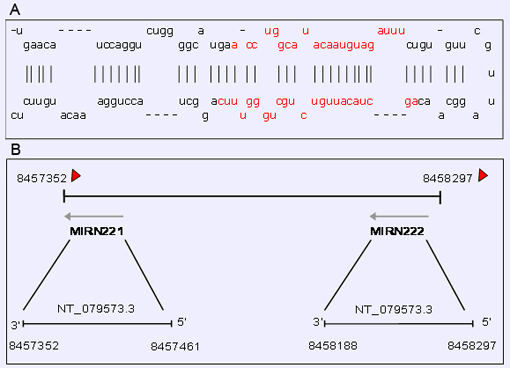
Figure1: A: Stem-loop structure of miR-221. B: Genomic localization of miR-221 (MIRN221) and miR-221(MIRN222) on chromosomal band Xp11.3.
Description
miR-221 and 222 are located in an intergenic region. miR-221 and miR-222 are clustered genes, containing identical seed sequences and both map to the X chromosome separated by 727 bases. The positions of these cluster microRNAs are:
hsa-mir-222 X: 45491365-45491474
has-mir-221 X: 45490529-45490638
Transcription
In general, the microRNA genes are transcribed by RNA polymerase II, whereas RNA polymerase III is also responsible for transcription of some other microRNAs. It is not known which RNA polymerase transcribes miR 221/miR-222. miR-221 and miR-222 were shown to be expressed as a single pri-microRNA transcript in c-kit positive HUVEC cells.
Pre-microRNA 221(Precursor microRNA)
Accession: MI0000298
Length: 110 bp
Sequence:
5-UGAACAUCCAGGUCUGGGGCAUGAACCUGGCAUACAAUGUAGAUUUCUGUGUUC
GUUAGGCAACAGCUACAUUGUCUGCUGGGUUUCAGGCUACCUGGAAACAUGUUCUC -3
Mature miR-221
Accession: MIMAT0000278
Length: 23 nucleotides
Sequence: 65 - agcuacauugucugcuggguuuc - 87
5-UGAACAUCCAGGUCUGGGGCAUGAACCUGGCAUACAAUGUAGAUUUCUGUGUUC
GUUAGGCAACAGCUACAUUGUCUGCUGGGUUUCAGGCUACCUGGAAACAUGUUCUC -3
Pseudogene
No pseudogenes were reported for mir-221 and 222.
Proteins
Note
MicroRNAs are not translated into amino acids.
Implicated in
Entity name
Differentiation and erythropoiesis
Note
Induction of 12-O-tetradecanoylphorbol-13-acetate (TPA), a differentiation stimulator of HL-60 cells, caused growth arrest and the adherent phenotype in 60% of HL-60 cells. MicroRNA expression was analyzed in these TPA treated differentiating HL-60 cells. According to the results of microarray analysis, miR-221 and miR-222 were up-regulated about 3-folds in TPA induced HL-60 cells. On the other hand, the expression of c-kit receptor was down- regulated in these cells, which suggested that c-kit, as was previously reported, the target of miR-221/222.
miR-221 and miR-222 were shown to be down-regulated in erythropoietic culture of cord blood CD34-positive progenitor cells and it was suggested that this reduction could cause erythropoiesis, as the expression of targeted key mRNAs were not blocked. However in another study, the expression of miR-221 (but not miR-222) was shown to be increased during erythropoietic cultures of human CD34 cord blood cells. Further studies also indicated up-regulation of miR-221. Differentially expressed miRNAs during erythropoiesis were detected in cord blood-derived CD34 cells and expression of miR-221 temporarily increased from day 0 to day 2, while its expression returned to the basal level (same as day 0) from day 2 to day 12 of erythropoiesis. However such a fluctuation in the miRNA expression was not found for miR-222 in these cells. Together, these results suggest a need for further investigation to clarify this difference.
Also in kit positive TF-1 erythroleukemic cell line which expresses high amounts of kit protein and low levels of miR-221/miR-222, transfection of these microRNAs blocked proliferation of these cells.
miR-221 and miR-222 were shown to be down-regulated in erythropoietic culture of cord blood CD34-positive progenitor cells and it was suggested that this reduction could cause erythropoiesis, as the expression of targeted key mRNAs were not blocked. However in another study, the expression of miR-221 (but not miR-222) was shown to be increased during erythropoietic cultures of human CD34 cord blood cells. Further studies also indicated up-regulation of miR-221. Differentially expressed miRNAs during erythropoiesis were detected in cord blood-derived CD34 cells and expression of miR-221 temporarily increased from day 0 to day 2, while its expression returned to the basal level (same as day 0) from day 2 to day 12 of erythropoiesis. However such a fluctuation in the miRNA expression was not found for miR-222 in these cells. Together, these results suggest a need for further investigation to clarify this difference.
Also in kit positive TF-1 erythroleukemic cell line which expresses high amounts of kit protein and low levels of miR-221/miR-222, transfection of these microRNAs blocked proliferation of these cells.
Entity name
Angiogenesis, proliferation and cell migration
Note
miR-222 and miR-221 were found to be highly expressed in human cord blood derived CD34 - Hematopoietic Progenitor Cells (HPCs) and Human Umbilical Vein Endothelial cells (HUVECs). HUVECs were used as an in vitro model for angiogenesis as they can form capillary like tubes when exposed to appropriate stimulation. miR-221/miR-222 were shown to be transcribed in a common pri-microRNA in c-kit-positive HUVECs, suggesting a coordinated transcriptional regulation. Another group examined the effect of miR-221/miR-222 expression on the c-kit transcript and protein and they found that the level of c-kit protein was reduced in HUVECs transfected with miR-221/ miR-222, without a change of mRNA levels, which indicated the posttranslational down-regulation effect of these microRNAs on c-kit protein. In addition miR-221/miR-222 transfected cells were not able to do wound healing and tube formation. In another study, down-regulation of eNOS (an angiogenesis regulator) protein by miR-221/miR-222 was claimed and because no target sites for these microRNAs in 3-UTR of eNOS were present, it was suggested that the regulation could be indirect via gene expression, translational efficiency or post-translational pathways. Interestingly, over-expression of miR-221/miR-222 in endothelial cells reduced angiogenesis and cell proliferation whereas conversely in cancer cells, up-regulation of miR-221/miR-222 increased cell proliferation by targeting cell cycle inhibitor p27, possibly indicating that the modulation of proliferation depends on the cell type.
Entity name
Glioblastoma
Note
Glioblastoma tissues and cell lines were investigated for differentially expressed microRNAs compared to normal brain tissue. Microarray and Northern blot results showed a strong up- regulation of miR-221 in glioblastomas.
Entity name
Prostate cancer
Note
In a study, PC3 cells (aggressive prostate carcinoma) and LNCaP and 22Rv1 cell line (slowly growing carcinomas) were tested and a reverse correlation between the expression of miR-221/miR-222 and p27 tumor suppressor was observed. In addition, over-expression of miR-221/miR-222 altered the growth rate of these cells, by triggering a shift from G1 to S phase of the cell cycle.
Entity name
Ovarian cancer
Note
A microRNA microarray study was performed to detect the microRNA expression level in ovarian cancer, using 34 ovarian cancer tissues and 10 ovarian cancer cell lines. The results showed that miR-221 was the most highly expressed microRNA in both ovarian cancer tissues and cell lines compared to non-transformed human ovarian surface epithelium cell line.
Entity name
Bladder cancer
Note
Based on a microarray study, it was shown that human miR-221 was among the remarkably up-regulated microRNAs in bladder cancers when compared to normal bladder mucosa. In this study, a microchip containing 368 probes in triplicate designed for 245 microRNA genes were used for 27 bladder specimens (25 urothelial carcinomas and 2 normal mucosa samples).
Entity name
Papillary thyroid carcinoma
Note
When comparing the expression level of 23 microRNAs in 15 Papillary Thyroid Cancer (PTC) tumors with normal thyroid tissue, a group of researchers found that miR-221/ miR-222 were among the five over-expressed microRNAs in PTC tumors by performing microarray analysis (the results were also confirmed with RT-PCR and Northern blot). Interestingly, quantitative real-time PCR results revealed that miR-221 was over-expressed in normal thyroid tissues of PTC patients when compared to normal thyroid tissues of individuals without clinical thyroid disease, indicating the possible importance of this microRNA in early stages of PTC carcinogenesis.
Entity name
Hepatocellular carcinoma
Note
As it has been shown in many cancers, miR-221 was also found to be up-regulated in human hepatocellular carcinoma (HCC). Over-expression of miR-221 was shown to cause down- regulation of CDKN1B/p27 and CDKN1C/p57 in hepatocellular carcinoma, indicating a reverse relation between their expressions in HCC. miR-221 was shown to target 3 UTRs of CDKN1B/p27 and CDKN1C/p57. Up-regulation of miR-221 caused cell proliferation in HCC cells by increasing the number of cells which were in S1 phase of the cell cycle.
Entity name
Osteogenesis
Note
P-15 is an analog of cell-binding domain of collagen and is involved in binding, migration and differentiation of cells and promoting bone formation from osteoblasts. To understand the mechanism of action of P-15, the expression of microRNAs in osteoblast-like cell line (MG-63) cultured with P-15 was investigated and miR-221 was among the up-regulated ones according to a microRNA microarray study.
Entity name
Lung cancer
Note
A microRNA expression investigation was performed in NSCLC (Non-Small Cell Lung Cancer) cells either resistant or sensitive to TRAIL (TNF-related apoptosis-inducing ligand) to reveal roles of microRNAs in TRAIL resistance. The microarray and real-time PCR analysis showed that miR-221 and miR-222 were remarkably up-regulated in TRAIL-resistant and down-regulated in TRAIL-sensitive NSCLC cells. Also miR-222 over-expression in CALU-1 cells (TRAIL-resistant) was confirmed by Northern blotting. In addition, transfecting CALU-1 cells (TRAIL-resistant lung cells) with anti- miR-221/miR-222, caused TRAIL sensitivity. Consistently over-expression of these microRNAs produced TRAIL-resistant NSCLC cells. Moreover, p27 tumor suppressor and proto-oncogene kit receptor, which are the known targets of miR-221/miR-222, were shown to be up-regulated in TRAIL-sensitive and down-regulated in TRAIL-resistant NSCLC. These microRNAs were also suggested to modulate the expression of Mcl-1 (Myeloid cell leukemia sequence 1) and FADD (Fas-Associated protein with Death Domain) indirectly. Giving these, miR-221 and miR-222 were shown to be responsible for sensitivity to TRAIL in NSCLC cells and could be considered as important targets for diagnostic and therapeutic purposes in NSCLC.
Entity name
Neuroblastoma
Note
MYCN amplification is commonly found in neuroblastomas. MYCN acts as transcription factor and regulates the expression of a number of genes. For finding the microRNA genes that are possibly regulated with MYCN, microarray and q-RT-PCR studies were performed in primary neuroblastoma with MYCN amplification. miR-221 was one of the 7 up-regulated microRNAs in these cells.
Entity name
Pancreatic cancer
Note
For the purpose of finding a microRNA signature in pancreatic cancers, the expression of over 200 microRNA precursors was investigated by real-time PCR in benign tissue, normal pancreas, chronic pancreatitis and pancreatic cancer cell lines. The results showed that a number of microRNAs were over-expressed in the tumors, when compared to normal pancreas. miR-221 was among the microRNAs that were over-expressed in adenocarcinomas and endocrine pancreas cancers. Based on PCR results, over-expression of mature miR-222 was also suggested (similar to miR-221) in pancreas cancer.
Article Bibliography
| Pubmed ID | Last Year | Title | Authors |
|---|---|---|---|
| 17379065 | 2007 | MicroRNA expression profiling during human cord blood-derived CD34 cell erythropoiesis. | Choong ML et al |
| 16039986 | 2005 | Extensive modulation of a set of microRNAs in primary glioblastoma. | Ciafrè SA et al |
| 18560586 | 2008 | MicroRNA expression and identification of putative miRNA targets in ovarian cancer. | Dahiya N et al |
| 16330772 | 2005 | MicroRNAs 221 and 222 inhibit normal erythropoiesis and erythroleukemic cell growth via kit receptor down-modulation. | Felli N et al |
| 18521080 | 2008 | MiR-221 controls CDKN1C/p57 and CDKN1B/p27 expression in human hepatocellular carcinoma. | Fornari F et al |
| 17569667 | 2007 | miR-221 and miR-222 expression affects the proliferation potential of human prostate carcinoma cell lines by targeting p27Kip1. | Galardi S et al |
| 18246122 | 2008 | MicroRNA signatures of TRAIL resistance in human non-small cell lung cancer. | Garofalo M et al |
| 17826655 | 2007 | Micro-RNA profiling in kidney and bladder cancers. | Gottardo F et al |
| 16365291 | 2005 | The role of microRNA genes in papillary thyroid carcinoma. | He H et al |
| 18068232 | 2008 | Targeting microRNA expression to regulate angiogenesis. | Kuehbacher A et al |
| 17149698 | 2007 | Expression profiling identifies microRNA signature in pancreatic cancer. | Lee EJ et al |
| 15944708 | 2005 | MicroRNA expression profiles classify human cancers. | Lu J et al |
| 17964546 | 2007 | Expression patterns of microRNAs 155 and 451 during normal human erythropoiesis. | Masaki S et al |
| 18332763 | 2008 | Peptide-15 changes miRNA expression in osteoblast-like cells. | Palmieri A et al |
| 16849646 | 2006 | MicroRNAs modulate the angiogenic properties of HUVECs. | Poliseno L et al |
| 17943719 | 2008 | MYCN regulates oncogenic MicroRNAs in neuroblastoma. | Schulte JH et al |
| 17379831 | 2007 | Dicer dependent microRNAs regulate gene expression and functions in human endothelial cells. | Suárez Y et al |
Other Information
Locus ID:
NCBI: 407006
MIM: 300568
HGNC: 31601
Ensembl: ENSG00000207870
miRBase:
Variants:
dbSNP: 407006
ClinVar: 407006
TCGA: ENSG00000207870
COSMIC: MIR221
RNA/Proteins
Expression (GTEx)
Pathways
| Pathway | Source | External ID |
|---|---|---|
| MicroRNAs in cancer | KEGG | hsa05206 |
| MicroRNAs in cancer | KEGG | ko05206 |
References
| Pubmed ID | Year | Title | Citations |
|---|---|---|---|
| 38267567 | 2024 | An approach for an enhanced anticancer activity of ferulic acid-loaded polymeric micelles via MicroRNA-221 mediated activation of TP53INP1 in caco-2 cell line. | 0 |
| 38310615 | 2024 | Spheroid architecture strongly enhances miR-221/222 expression and promotes oxidative phosphorylation in an ovarian cancer cell line through a mechanism that includes restriction of miR-9 expression. | 1 |
| 38461326 | 2024 | MicroRNA-221-3p inhibits the inflammatory response of keratinocytes by regulating the DYRK1A/STAT3 signaling pathway to promote wound healing in diabetes. | 2 |
| 38267567 | 2024 | An approach for an enhanced anticancer activity of ferulic acid-loaded polymeric micelles via MicroRNA-221 mediated activation of TP53INP1 in caco-2 cell line. | 0 |
| 38310615 | 2024 | Spheroid architecture strongly enhances miR-221/222 expression and promotes oxidative phosphorylation in an ovarian cancer cell line through a mechanism that includes restriction of miR-9 expression. | 1 |
| 38461326 | 2024 | MicroRNA-221-3p inhibits the inflammatory response of keratinocytes by regulating the DYRK1A/STAT3 signaling pathway to promote wound healing in diabetes. | 2 |
| 35297352 | 2023 | LINC00936/microRNA-221-3p Regulates Tumor Progression in Ovarian Cancer by Interacting with LAMA3. | 5 |
| 36833430 | 2023 | The Role of miRNA-221 and miRNA-34a in Non-Melanoma Skin Cancer of the Head and Neck Region. | 1 |
| 37272651 | 2023 | The predictive value of MiR-221 in cancer chemoresistance: a systematic review and meta-analysis. | 0 |
| 37283359 | 2023 | miR-21, miR-221, and miR-222 upregulation in lung cancer promotes metastasis by reducing oxidative stress and apoptosis. | 2 |
| 37369478 | 2023 | Investigation of miR221 and miR222 as Biomarkers in Non-small Cell Lung Cancer. | 0 |
| 37496996 | 2023 | The AR/miR-221/IGF-1 pathway mediates the pathogenesis of androgenetic alopecia. | 3 |
| 37525394 | 2023 | miR-221-3p targets Ang-2 to inhibit the transformation of HCMECs to tip cells. | 1 |
| 37737255 | 2023 | Identification of transcriptional level variations in microRNA-221 and microRNA-222 as alternate players in the thyroid cancer tumor microenvironment. | 2 |
| 37831346 | 2023 | Circulating hsa-miR-221 as a possible diagnostic and prognostic biomarker of diabetic nephropathy. | 0 |
Citation
Shiva Akhavan Tabasi ; Ayse Elif Erson
MIR221 (microRNA 221)
Atlas Genet Cytogenet Oncol Haematol. 2008-09-01
Online version: http://atlasgeneticsoncology.org/gene/44277/mir221-(microrna-221)
