HNRNPK (heterogeneous nuclear ribonucleoprotein K)
2009-03-01 Michal Mikula , Jerzy Ostrowski AffiliationMaria Sklodowska-Curie Memorial Cancer Center, Institute of Oncology Warsaw, Poland
Identity
HGNC
LOCATION
9q21.32
LOCUSID
ALIAS
AUKS,CSBP,HNRPK,TUNP
FUSION GENES
DNA/RNA
Description
The hnRNPK gene contains 17 exons spanning 12572 bp.
Transcription
Three alternatively spliced human hnRNPK transcripts are known. Both variant 1 (2995 bp) and variant 2 (2960 bp) encode a 464aa long isoform A and the variant 3 (2935 bp) product is the 463aa isoform B. The amino acid sequence at the C-terminus of the isoform A differs from the isoform B as follows: 459-463aa: (A)ADVEGF --> (B)SGKFF.
Pseudogene
At least three hnRNPK human pseudogenes have been found and are deposited in the pseudogene.org database.
Proteins

Fig.1 HnRNPK structure. The rectangles represent K homology domains (KH1, 2, 3), the K interactive region (KI), the nuclear localization signal (NLS) and the nuclear shuttling domain (KNS).
Description
The hnRNPK protein (65kDa) is structurally related to four other poly(C)-binding proteins (PCBP) which contain three K homology (KH) domains that enable RNA and DNA binding with a high affinity towards polycytosine tracts. The KH domain is about 70 amino acids in length and is found in a variety of proteins from archaea through higher eukaryotes. hnRNPK also carries a nuclear localisation signal (NLS) and a nuclear shuttling domain (KNS) together which allow it to translocate between the cytoplasm and nucleus. It also contains a segment called the K protein interactive (KI) region, located between the KH2 and KH3 domain, which has an intrinsically disordered structure. This domain is not found in the other PCBP proteins and is responsible for many of the known hnRNPK protein-protein interactions (Bomsztyk et al., 2004).
Expression
K protein is an abundant factor.
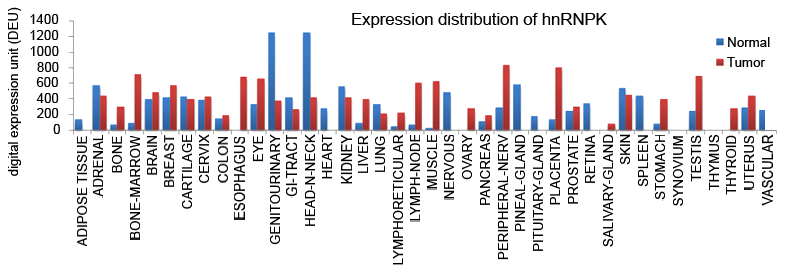
Fig.2 HnRNPK expression patterns in normal and cancer tissues based on human EST sequence abundance derived from the GeneHub-GEPIS database.
Localisation
Predominantly in the nucleus and cytoplasm; also found in mitochondria and plasma membrane.
Function
The functions of hnRNPK are defined by its modular structure that allows it to interact with both nucleic acids and proteins. It has been suggested that hnRNPK serves as a docking platform that facilitates the interaction between the molecular partners involved in the processes that compose gene expression, such as transcription and translation regulation, mRNA processing and chromatin remodeling (Bomsztyk et al., 2004). With regard to the factors implicated in the process of tumorgenesis, hnRNPK acts as a transcription activator for the CT element in the human c-myc promoter (Michelotti et al., 1996), the BRCA1 promoter (Thakur et al., 2003) and the basal promoter of the Eukaryotic translation initiation factor 4E - eIF-4E (Lynch et al., 2005). In response to DNA damage, hnRNPK is transiently recruited to the promoters of p53-responsive genes (p21) where it acts as a cofactor of TP53 protein and is required for triggering transcriptional activation (Moumen et al., 2005). A recent study identified K protein as a regulator of androgen receptor (AR) expression levels; it represses AR expression and androgen-induced prostate cancer cell growth through translational regulation of AR mRNA (Mukhopadhyay et al., 2009). In a loss-of-function screening system based on intracellular expression of single domain antibodies, hnRNPK was found as a potential target for cell migration and metastasis of human cancerous cells (Inoue et al., 2007).
Homology
Shares homology with four other PCBP proteins which contain three KH domains.
Mutations
Note
No mutation of human hnRNPK gene has been reported.
Implicated in
Entity name
Esophageal cancer
Note
Expression analysis. A proteomic study on 72 esophageal squamous cell carcinoma cases and adjacent normal tissues in 57 of these cases.
The study revealed that tumors with nodal metastases had a higher amount of hnRNP K than those without lymph node metastases. The expression of K protein was up-regulated in esophageal cancer tissues compared with normal tissues (Hatakeyama et al., 2006).
The study revealed that tumors with nodal metastases had a higher amount of hnRNP K than those without lymph node metastases. The expression of K protein was up-regulated in esophageal cancer tissues compared with normal tissues (Hatakeyama et al., 2006).
Entity name
Colorectal cancer
Note
Expression analysis. A study utilizing a proteomic approach to compare the protein expression of normal colon epithelium to colorectal cancer tissues.
The overexpression and cytoplasmatic localization of hnRNP K correlated with advancement of colorectal cancer. In normal colon K protein was detected only in the nucleus whereas in tumour tissues the protein was observed both in the cytoplasm and the nucleus (Carpenter et al., 2006).
The overexpression and cytoplasmatic localization of hnRNP K correlated with advancement of colorectal cancer. In normal colon K protein was detected only in the nucleus whereas in tumour tissues the protein was observed both in the cytoplasm and the nucleus (Carpenter et al., 2006).
Entity name
Lung cancer
Note
Expression analysis. An examination of the expression of K protein and other hnRNP proteins in lung cancer cell lines and biopsies from 32 lung cancer by real time RT-PCR and immunochistochemistry.
Nuclear expression of hnRNP K in H460 cells increased from non-confluent to confluent cultures. In confluent cells hnRNP K protein was also found in the cytoplasm.
Up-regulation of hnRNP K was observed in 60% of the tumors examined with a higher expression in adenocarcinomas (79%) versus squamous cell carcinomas (33%). In these cases the localization of the protein was mostly nuclear, but half of the positive cases revealed also cytoplasmic staining (Pino et al., 2003).
Nuclear expression of hnRNP K in H460 cells increased from non-confluent to confluent cultures. In confluent cells hnRNP K protein was also found in the cytoplasm.
Up-regulation of hnRNP K was observed in 60% of the tumors examined with a higher expression in adenocarcinomas (79%) versus squamous cell carcinomas (33%). In these cases the localization of the protein was mostly nuclear, but half of the positive cases revealed also cytoplasmic staining (Pino et al., 2003).
Entity name
Nasopharyngeal carcinoma
Note
An Immunochistochemical examination of hnRNP K and thymidine phosphorylase (TP) expression in 121 nasopharyngeal carcinoma cases.
An aberrant cytoplasmic localization of hnRNP K and its overexpression was associated with poor survival of NPC patients (Chen et al., 2008).
An aberrant cytoplasmic localization of hnRNP K and its overexpression was associated with poor survival of NPC patients (Chen et al., 2008).
Article Bibliography
| Pubmed ID | Last Year | Title | Authors |
|---|---|---|---|
| 15170860 | 2004 | hnRNP K: one protein multiple processes. | Bomsztyk K et al |
| 16953238 | 2006 | Heterogeneous nuclear ribonucleoprotein K is over expressed, aberrantly localised and is associated with poor prognosis in colorectal cancer. | Carpenter B et al |
| 18559600 | 2008 | Heterogeneous ribonucleoprotein k and thymidine phosphorylase are independent prognostic and therapeutic markers for nasopharyngeal carcinoma. | Chen LC et al |
| 17133371 | 2006 | Protein clusters associated with carcinogenesis, histological differentiation and nodal metastasis in esophageal cancer. | Hatakeyama H et al |
| 17483488 | 2007 | Loss-of-function screening by randomized intracellular antibodies: identification of hnRNP-K as a potential target for metastasis. | Inoue A et al |
| 16024782 | 2005 | hnRNP K binds a core polypyrimidine element in the eukaryotic translation initiation factor 4E (eIF4E) promoter, and its regulation of eIF4E contributes to neoplastic transformation. | Lynch M et al |
| 8628302 | 1996 | Heterogeneous nuclear ribonucleoprotein K is a transcription factor. | Michelotti EF et al |
| 16360036 | 2005 | Retracted: hnRNP K: an HDM2 target and transcriptional coactivator of p53 in response to DNA damage. | Moumen A et al |
| 19258514 | 2009 | Heterogeneous nuclear ribonucleoprotein K is a novel regulator of androgen receptor translation. | Mukhopadhyay NK et al |
| 12871776 | 2003 | Altered patterns of expression of members of the heterogeneous nuclear ribonucleoprotein (hnRNP) family in lung cancer. | Pino I et al |
| 12748281 | 2003 | Regulation of BRCA1 transcription by specific single-stranded DNA binding factors. | Thakur S et al |
Other Information
Locus ID:
NCBI: 3190
MIM: 600712
HGNC: 5044
Ensembl: ENSG00000165119
Variants:
dbSNP: 3190
ClinVar: 3190
TCGA: ENSG00000165119
COSMIC: HNRNPK
RNA/Proteins
Expression (GTEx)
Pathways
Protein levels (Protein atlas)
References
| Pubmed ID | Year | Title | Citations |
|---|---|---|---|
| 38165048 | 2024 | Heterogeneous nuclear ribonucleoprotein K promotes cap-independent translation initiation of retroviral mRNAs. | 2 |
| 38414246 | 2024 | Hnrnpk protects against osteoarthritis through targeting WWC1 mRNA and inhibiting Hippo signaling pathway. | 1 |
| 38654325 | 2024 | Tumor-suppressive miR-4732-3p is sorted into fucosylated exosome by hnRNPK to avoid the inhibition of lung cancer progression. | 0 |
| 38165048 | 2024 | Heterogeneous nuclear ribonucleoprotein K promotes cap-independent translation initiation of retroviral mRNAs. | 2 |
| 38414246 | 2024 | Hnrnpk protects against osteoarthritis through targeting WWC1 mRNA and inhibiting Hippo signaling pathway. | 1 |
| 38654325 | 2024 | Tumor-suppressive miR-4732-3p is sorted into fucosylated exosome by hnRNPK to avoid the inhibition of lung cancer progression. | 0 |
| 35866661 | 2023 | HnRNP K regulates inflammatory gene expression by mediating splicing pattern of transcriptional factors. | 1 |
| 36617174 | 2023 | BBOX1-AS1 mediates trophoblast cells dysfunction via regulating hnRNPK/GADD45A axis†. | 2 |
| 36700980 | 2023 | hnRNP K induces HPV16 oncogene expression and promotes cervical cancerization. | 0 |
| 36736887 | 2023 | Epigenetic Control of Cancer Cell Proliferation and Cell Cycle Progression by HNRNPK via Promoting Exon 4 Inclusion of Histone Code Reader SPIN1. | 2 |
| 36933825 | 2023 | Unravelling the Tripartite Interactions Among Hepatitis E Virus RNA, miR-140 and hnRNP K. | 0 |
| 37248433 | 2023 | c-Myc-induced long noncoding RNA MIRE cooperates with hnRNPK to stabilize ELF2 mRNA and promotes clear cell renal cell carcinogenesis. | 1 |
| 37460467 | 2023 | MGCG regulates glioblastoma tumorigenicity via hnRNPK/ATG2A and promotes autophagy. | 0 |
| 37592256 | 2023 | Keratin 19 binds and regulates cytoplasmic HNRNPK mRNA targets in triple-negative breast cancer. | 1 |
| 38279484 | 2023 | Regulatory mechanism of interaction between Y-box-binding protein 1 and heterogenous nuclear ribonucleoprotein K in cell division cycle 25a signal pathway and lung cancer metastasis. | 0 |
Citation
Michal Mikula ; Jerzy Ostrowski
HNRNPK (heterogeneous nuclear ribonucleoprotein K)
Atlas Genet Cytogenet Oncol Haematol. 2009-03-01
Online version: http://atlasgeneticsoncology.org/gene/44314/hnrnpk
