ASNS (asparagine synthetase)
2008-11-01 Philip L Lorenzi , Michael C Ryan , Ogechi N Ikediobi , John N Weinstein AffiliationDNA/RNA
Description
ASNS is encoded on chromosome 7 and has 14 exons. The promoter begins 173 bases upstream of the start codon, which is on exon 4, with three GC-rich sequences (GC-I, GC-II, and GC-III) followed by two nutrient sensing response elements, NSRE-1 (ATGATGAAA; at nt -70) and NSRE-2 (GTTACA; at nt -49). The stop codon is on exon 14.
Transcription
The full length transcript (RefSeq variant 1; NM_133436 on Fig1) is 2348 bp long. Ten alternative splicing isoforms have been reported with most variation occurring primarily in the 5UTR.
Various forms of cellular stress, including nutrient deprivation, lead to increased ASNS transcription. One component of that mechanism includes translation of the activating transcription factor family of proteins (ATF2, ATF3, ATF4, ATF5, and ATF6), all of which increase ASNS transcription through binding to NSRE-1 and/or NSRE-2. TRB3 is a negative feedback regulator of ATF4-dependent transcription, and C/EBP-beta is a negative regulator of ATF5-dependent transcription. DDIT3/CHOP is also a negative regulator of ASNS transcription.
ASNS has also been reported to be a significant target of transactivation by mutant p53, whereas wild-type p53 inhibits transcriptional activation of the NSREs.
ASNS mRNA has been shown to exhibit a half-life of 9 h and periodic, clock-like up-regulation every around 35 min in cell culture.
Various forms of cellular stress, including nutrient deprivation, lead to increased ASNS transcription. One component of that mechanism includes translation of the activating transcription factor family of proteins (ATF2, ATF3, ATF4, ATF5, and ATF6), all of which increase ASNS transcription through binding to NSRE-1 and/or NSRE-2. TRB3 is a negative feedback regulator of ATF4-dependent transcription, and C/EBP-beta is a negative regulator of ATF5-dependent transcription. DDIT3/CHOP is also a negative regulator of ASNS transcription.
ASNS has also been reported to be a significant target of transactivation by mutant p53, whereas wild-type p53 inhibits transcriptional activation of the NSREs.
ASNS mRNA has been shown to exhibit a half-life of 9 h and periodic, clock-like up-regulation every around 35 min in cell culture.
Proteins
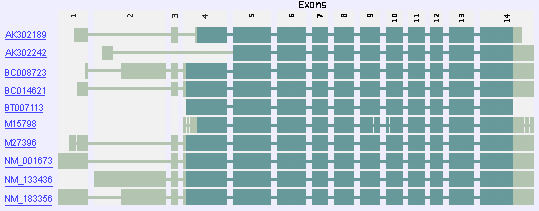
Representation of the ASNS gene, its mRNA splice variants, and its protein isoforms.
Each unique splice variant is identified by an accession number on the left-hand side. Exons are numbered at the top of the image. Lighter green indicates UTRs, and dark green indicates protein-coding regions. Exons are drawn to scale. Intronic sections are indicated by thin green lines and are not drawn to scale.
Description
Transcripts NM_001673, NM_133436, NM_183356, BC008723, BC014621, BT007113, and M27396 encode a common 561 aa (64 kDa) ASNS protein sequence. Transcripts AK302189 and M15798 encode 540 aa N-terminally truncated proteins that differ in sequence between amino acids 312-322 and 332-339. Transcript AK302242 encodes a 478 aa isoform that is further truncated at the N-terminus.
Expression
Only the 561 aa isoform has been experimentally confirmed, and it has been found to be up-regulated by nutrient deprivation. Its half-life is reported to be 43-46 h.
Localisation
ASNS protein is cytoplasmic, but prediction algorithms also predict a small fraction of nuclear localization.
Function
ASNS catalyzes the synthesis of asparagine from glutamine and aspartic acid. In addition to providing asparagine for global protein synthesis, ASNS expression appears to be required for the transition from G1 to S phase of the cell cycle.
Homology
The 561 aa ASNS isoform has 29% identity with a protein called asparagine synthetase domain containing 1 (ASNSD1) that is 643 aa in length and encoded by a transcript (NM_019048) produced by chromosome 2.
Mutations
Note
A total of 136 SNPs have been reported in the ASNS gene region thus far, and 9 of these are coding SNPs: C1820A (P547H); C1399T (R407X); C1389G (L403L); 1299G (G373-frameshift); G1009A (A277T); T809A (V210E); A546T (A122A); G524C (C115S); C324T (H48H). Of those nine coding SNPs, only V210E has been validated by multiple independent groups including the HapMap Project. None of the SNPs has thus far been clinically associated with a disease or drug response phenotype.
Germinal
All reported SNPs appear to be of germline origin.
Somatic
None of the reported SNPs have been associated with tumor initiation or progression.
Implicated in
Entity name
Cancer
Note
Chemotherapeutic efficacy of L-asparaginase. The enzyme-drug L-asparaginase has been used since the 1970s to treat acute lymphoblastic leukemia. ASNS expression has been found to be correlated with L-asparaginase efficacy in leukemia cell lines, in leukemia primary tumor samples, and more recently in cancer cell lines from other tissues of origin. Silencing ASNS expression by RNAi has indicated the L-asparaginase/ASNS relationship is causal and suggests that ASNS expression may be useful as a predictive clinical biomarker of L-asparaginase efficacy.
Prognosis
Low ASNS expression suggests good response to L-asparaginase.
Entity name
Protein and/or amino acid deprivation
Note
The Amino Acid Response (AAR) pathway is triggered by protein and/or amino acid deprivation, which leads to a build up of uncharged tRNA, which bind to and activate the GCN2 kinase, which in turn phosphorylates eIF2alpha. P-eIF2 alpha suppresses global translation initiation yet causes an increase of ATF4 synthesis from preexisting mRNA. ATF4 stimulates transcription of a variety of stress-response genes, including ASNS.
Article Bibliography
| Pubmed ID | Last Year | Title | Authors |
|---|---|---|---|
| 11415466 | 2001 | Asparagine synthetase expression alone is sufficient to induce l-asparaginase resistance in MOLT-4 human leukaemia cells. | Aslanian AM et al |
| 10856289 | 2000 | Activation of the human asparagine synthetase gene by the amino acid response and the endoplasmic reticulum stress response pathways occurs by common genomic elements. | Barbosa-Tessmann IP et al |
| 1543496 | 1992 | TSH is able to induce cell cycle-related gene expression in rat thyroid cell. | Colletta G et al |
| 18840095 | 2009 | Transcriptional induction of the human asparagine synthetase gene during the unfolded protein response does not require the ATF6 and IRE1/XBP1 arms of the pathway. | Gjymishka A et al |
| 1682798 | 1991 | Regulation of asparagine synthetase gene expression by amino acid starvation. | Gong SS et al |
| 17185229 | 2006 | An inhibitor of human asparagine synthetase suppresses proliferation of an L-asparaginase-resistant leukemia cell line. | Gutierrez JA et al |
| 17369260 | 2007 | TRB3 inhibits the transcriptional activation of stress-regulated genes by a negative feedback on the ATF4 pathway. | Jousse C et al |
| 18852115 | 2008 | Asparagine synthetase is a predictive biomarker of L-asparaginase activity in ovarian cancer cell lines. | Lorenzi PL et al |
| 16756505 | 2006 | Asparagine synthetase chemotherapy. | Richards NG et al |
| 15077194 | 2004 | Tumor-derived p53 mutants induce oncogenesis by transactivating growth-promoting genes. | Scian MJ et al |
Other Information
Locus ID:
NCBI: 440
MIM: 108370
HGNC: 753
Ensembl: ENSG00000070669
Variants:
dbSNP: 440
ClinVar: 440
TCGA: ENSG00000070669
COSMIC: ASNS
RNA/Proteins
Expression (GTEx)
Pathways
Protein levels (Protein atlas)
PharmGKB
| Entity ID | Name | Type | Evidence | Association | PK | PD | PMIDs |
|---|---|---|---|---|---|---|---|
| PA448492 | asparaginase | Chemical | Literature, MultilinkAnnotation | associated | 24268318 |
References
| Pubmed ID | Year | Title | Citations |
|---|---|---|---|
| 38206293 | 2024 | An endoplasmic reticulum stress-related signature featuring ASNS for predicting prognosis and immune landscape in prostate cancer. | 0 |
| 38474084 | 2024 | Integrated Bioinformatics Analysis Identified ASNS and DDIT3 as the Therapeutic Target in Castrate-Resistant Prostate Cancer. | 0 |
| 38206293 | 2024 | An endoplasmic reticulum stress-related signature featuring ASNS for predicting prognosis and immune landscape in prostate cancer. | 0 |
| 38474084 | 2024 | Integrated Bioinformatics Analysis Identified ASNS and DDIT3 as the Therapeutic Target in Castrate-Resistant Prostate Cancer. | 0 |
| 34535013 | 2022 | Association of allele-specific methylation of the ASNS gene with asparaginase sensitivity and prognosis in T-ALL. | 9 |
| 35129766 | 2022 | The edited UPF1 is correlated with elevated asparagine synthetase in pancreatic ductal adenocarcinomas. | 1 |
| 35469797 | 2022 | An intractable epilepsy phenotype of ASNS novel mutation in two patients with asparagine synthetase deficiency. | 9 |
| 35739087 | 2022 | Asparagine synthetase regulates lung-cancer metastasis by stabilizing the β-catenin complex and modulating mitochondrial response. | 9 |
| 34535013 | 2022 | Association of allele-specific methylation of the ASNS gene with asparaginase sensitivity and prognosis in T-ALL. | 9 |
| 35129766 | 2022 | The edited UPF1 is correlated with elevated asparagine synthetase in pancreatic ductal adenocarcinomas. | 1 |
| 35469797 | 2022 | An intractable epilepsy phenotype of ASNS novel mutation in two patients with asparagine synthetase deficiency. | 9 |
| 35739087 | 2022 | Asparagine synthetase regulates lung-cancer metastasis by stabilizing the β-catenin complex and modulating mitochondrial response. | 9 |
| 33959786 | 2021 | Influence of genetic variants in asparaginase pathway on the susceptibility to asparaginase-related toxicity and patients' outcome in childhood acute lymphoblastic leukemia. | 4 |
| 34543685 | 2021 | Dual blockade of macropinocytosis and asparagine bioavailability shows synergistic anti-tumor effects on KRAS-mutant colorectal cancer. | 0 |
| 33959786 | 2021 | Influence of genetic variants in asparaginase pathway on the susceptibility to asparaginase-related toxicity and patients' outcome in childhood acute lymphoblastic leukemia. | 4 |
Citation
Philip L Lorenzi ; Michael C Ryan ; Ogechi N Ikediobi ; John N Weinstein
ASNS (asparagine synthetase)
Atlas Genet Cytogenet Oncol Haematol. 2008-11-01
Online version: http://atlasgeneticsoncology.org/gene/44323/asns-(asparagine-synthetase)
