RLN2 (relaxin 2)
2009-11-01 Jordan M Willcox , Alastair JS Summerlee AffiliationDepartment of Biomedical Sciences, Ontario Veterinary College, University of Guelph, Guelph, Ontario, N1G 2W1, Canada
Identity
HGNC
LOCATION
9p24.1
IMAGE

LEGEND
RLN2 is located on chromosome 9 (position shown by yellow arrow).
LOCUSID
ALIAS
H2,RLXH2,bA12D24.1.1,bA12D24.1.2,prorelaxin H2
FUSION GENES
DNA/RNA
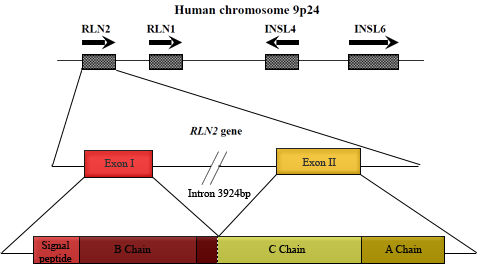
Schematic representation of the transcription of the human RLN2 gene. Adapted from Bathgate et al., 2006 (with permission). The gene is located with the RLN1, INSL4 and INSL6 genes on chromosome 9 at 9p24. The RLN2 gene consists of two exons and is transcribed to give preprorelaxin-2 mRNA. Exon I encodes for the signal peptide, the B Chain and part of the C Chain, and Exon II encodes for the remainder of the C Chain and the A chain of H2 relaxin. The arrows on the diagrams indicate the orientation of the genes. Although insulin and H2 relaxin are similar, there is no report that the insulin gene possess an intron.
Description
RLN2 is a functioning gene of 4,712 bp comprising 2 exons and 1 intron.
Transcription
The length of the transcript is 588bp. mRNA is expressed in high levels in ovary and placenta, and in lower levels in fibroblasts, a number of tumours, heart and brain.
Alternate splicing: 2 isoforms: P04090-1, P04090-2.
Alternate splicing: 2 isoforms: P04090-1, P04090-2.
Pseudogene
None but there are a number of similar genes of the same family. These include: RLN1 and RLN2 genes in a tight cluster with INSL4 and INSL6 genes on chromosome 9 at 9p24. The RLN3 gene is located on chromosome 19 at 19p13.3 in close proximity to INSL3 at 19p13.2 and the INSL5 gene is located on chromosome 1 at 1p31.1
Proteins
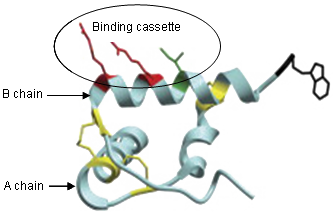
Modified from Westhuizen et al. 2008.
Characteristic two-peptide chain hormone held together by disulphide bonds (shown in yellow) which provide the tertiary form of the molecule. There is a relaxin receptor binding motif (shown in red and green).
Description
Protein length of the precursor peptide is 185 amino acids with a molecular weight 21,043 Daltons.
The functional peptide has 21 amino acids in the A chain and 27 in the B chain and with a molecular weight 5,989 Daltons.
There is a specific binding motif (see diagram above) Arg-X-X-X-Arg-X-X-Ile/Val which are vital for binding and the projection from the tertiary structure is important in binding to the Type C LGR receptor (RXPF1). These receptors have a large and very distinctive ectodomain which includes an LDLa module at the far end of the N-terminus followed by a LRR domain (10 LRR). It is thought that this links with a unique hinge-like region leading into the transmembrane domain. There are seven transmembrane helices and an intracellular C-terminus.
The functional peptide has 21 amino acids in the A chain and 27 in the B chain and with a molecular weight 5,989 Daltons.
There is a specific binding motif (see diagram above) Arg-X-X-X-Arg-X-X-Ile/Val which are vital for binding and the projection from the tertiary structure is important in binding to the Type C LGR receptor (RXPF1). These receptors have a large and very distinctive ectodomain which includes an LDLa module at the far end of the N-terminus followed by a LRR domain (10 LRR). It is thought that this links with a unique hinge-like region leading into the transmembrane domain. There are seven transmembrane helices and an intracellular C-terminus.
Expression
mRNA and protein found in brain, heart, skin, lungs, liver, kidney, ovary, uterus, testis, prostate and in prostatic and mammary neoplasia. Expression induced by a variety of factors in different tissues.
Localisation
Cytoplasm.
Function
Brain
- - Increased food intake
- Mediates stress behaviour
- Increased fluid intake
- Release of a number of hypothalamic peptides including vasopressin, oxytoxcin, LH, and angiotensin II
- - Increased rate of atrial contraction
- Increased force of atrial contraction
- Reduced fibrosis
- Differentiation and development
- Release of ANP
- - Decreased blood pressure
- Decreased total peripheral resistance
- Vasodilation
- - Reduced fibosis
- - Increased lung perfusion and gas exchange
- Relaxes bronchi
- Reduced fibrosis
- Reduced degranulation mast cells
- Reduced inflammatory leukocytes
- - Reduced fibosis
- - Increased GFR
- Increased ERPF
- Increased Na+ excretion
- Reduced fibosis
- - Follicular ripening
- Germ cell maturation
- - Angiogenesis
- Endometrial thickening
- - Softening (shift from collagenous to more elastic tissue)
- - Softening (shift from collagenous to more elastic tissue)
- - Differentiation and development
- - Increased sperm motility
- Possible role in hypertrophy and neoplastic change
- - Possible role in testicular descent in rats
- - Angiogenesis
- Vasodilation
- Reduced fibrosis
- Reduced apoptosis
Homology
Generally 30-60% sequence homology is observed between relaxin 2 among species.
Mutations
Note
It is assumed that the members of the relaxin-gene family are predominantly functional mutations of an original relaxin gene (RLN3) located on chromosome 19 at 19p13.3 and translocated at some stage predominantly to chromosome 9.
Implicated in
Entity name
Prostate cancer
Disease
Prostate cancer is the most common form of carcinoma in men (Lippman et al., 2009). If left untreated, this form of cancer becomes highly metastatic, primarily to the bones and lymphatic system. RLN2 is implicated in the progression, development, and spread of prostate cancer. RLN2 increases extra-cellular matrix turnover, promotes tumor invasiveness, and neo-vascularization (Silvertown et al., 2006).
Prognosis
Given that circulating relaxin increases in experimental models of prostate cancer, it is possible RLN2 may be employed as an early marker for prostate cancer and act as a screening mechanism in clinical settings. Furthermore, RLN2 exhibits the potential for genetic therapy to target and neutralize this gene as a novel treatment for prostate cancer.
Oncogenesis
RLN2 has been implicated in the progression of prostate tumors. RLN2 expression is increased in prostate tumors (Silvertown et al., 2006). Antagonism with analogues of RLN2 (Silvertown et al., 2007) demonstrates antagonistic properties and impairs prostate tumor growth and development.
Entity name
Breast cancer
Disease
Breast cancer is the most common form of carcinoma in women. RLN2 increases the invasiveness of breast cancer cells via the induction of matrix metalloproteinases (MMPs) (Binder et al., 2002). Circulating relaxin also increases in patients with breast cancer (Binder et al., 2004).
Prognosis
Since serum relaxin concentrations are increased in patients with breast cancer, relaxin may be used as a screening tool for breast cancer. Furthermore, RLN2 may be targeted for genetic therapy as a novel treatment for breast cancer.
Oncogenesis
RLN2 increases the oncogenic potential of breast cancer cells by stimulating growth, invasiveness, and metastasis.
Entity name
Thyroid cancer
Disease
There are four types of thyroid cancer: papillary, folliculary, medullary, and anaplastic. While limited research has been conducted with regards to RLN2 and thyroid cancer, it is possible relaxin enhances the course and development of thyroid cancer.
Oncogenesis
RLN2 acts as an autocrine/paracrine factor to enhance growth and invasiveness of thyroid cancer cells (Hombach-Klonisch et al., 2006). RLN2 may also increase motility of thyroid cancer cells thereby contributing to increased metastatic potential.
Article Bibliography
| Pubmed ID | Last Year | Title | Authors |
|---|---|---|---|
| 18200333 | 2007 | Gateways to clinical trials. | Bayés M et al |
| 12200455 | 2002 | Relaxin enhances in-vitro invasiveness of breast cancer cell lines by up-regulation of matrix metalloproteases. | Binder C et al |
| 15377840 | 2004 | Elevated concentrations of serum relaxin are associated with metastatic disease in breast cancer patients. | Binder C et al |
| 7829601 | 1995 | Relaxin gene expression in human reproductive tissues by in situ hybridization. | Bogic LV et al |
| 6548703 | 1984 | Two human relaxin genes are on chromosome 9. | Crawford RJ et al |
| 1656049 | 1991 | X-ray structure of human relaxin at 1.5 A. Comparison to insulin and implications for receptor binding determinants. | Eigenbrot C et al |
| 17363522 | 2007 | Relaxin promotes prostate cancer progression. | Feng S et al |
| 15956728 | 2005 | Demonstration of upregulated H2 relaxin mRNA expression during neuroendocrine differentiation of LNCaP prostate cancer cells and production of biologically active mammalian recombinant 6 histidine-tagged H2 relaxin. | Figueiredo KA et al |
| 10750025 | 2000 | Isolation and analysis of the 3'-untranslated regions of the human relaxin H1 and H2 genes. | Garibay-Tupas JL et al |
| 8735594 | 1996 | Expression of human relaxin genes: characterization of a novel alternatively-spliced human relaxin mRNA species. | Gunnersen JM et al |
| 15956719 | 2005 | Signal switching after stimulation of LGR7 receptors by human relaxin 2. | Halls ML et al |
| 2005217 | 1991 | Expression of the human relaxin H1 gene in the decidua, trophoblast, and prostate. | Hansell DJ et al |
| 16877360 | 2006 | Relaxin enhances the oncogenic potential of human thyroid carcinoma cells. | Hombach-Klonisch S et al |
| 6548702 | 1984 | Relaxin gene expression in human ovaries and the predicted structure of a human preprorelaxin by analysis of cDNA clones. | Hudson P et al |
| 15164053 | 2004 | DNA sequence and analysis of human chromosome 9. | Humphray SJ et al |
| 19416221 | 2009 | Estrogen and TCDD influence RLN2 gene activity in estrogen receptor-positive human breast cancer cells. | Kietz S et al |
| 16010410 | 2005 | INSL3 in the benign hyperplastic and neoplastic human prostate gland. | Klonisch T et al |
| 19066370 | 2009 | Effect of selenium and vitamin E on risk of prostate cancer and other cancers: the Selenium and Vitamin E Cancer Prevention Trial (SELECT). | Lippman SM et al |
| 17653089 | 2008 | Inappropriate activation of androgen receptor by relaxin via beta-catenin pathway. | Liu S et al |
| 18236174 | 2007 | Effects of recombinant H2 relaxin on the expression of matrix metalloproteinases and tissue inhibitor metalloproteinase in cultured early placental extravillous trophoblasts. | Maruo N et al |
| 19073841 | 2009 | Relaxin inhibits renal myofibroblast differentiation via RXFP1, the nitric oxide pathway, and Smad2. | Mookerjee I et al |
| 9096859 | 1997 | An autocrine/paracrine role of human decidual relaxin. I. Interstitial collagenase (matrix metalloproteinase-1) and tissue plasminogen activator. | Qin X et al |
| 18718015 | 2008 | Relaxin reduces xenograft tumour growth of human MDA-MB-231 breast cancer cells. | Radestock Y et al |
| 7958621 | 1994 | Relaxin: structures, functions, promises, and nonevolution. | Schwabe C et al |
| 17197386 | 2007 | Analog of H2 relaxin exhibits antagonistic properties and impairs prostate tumor growth. | Silvertown JD et al |
| 2076464 | 1990 | Structural characterization by mass spectrometry of native and recombinant human relaxin. | Stults JT et al |
| 9730618 | 1998 | The INSL4 gene maps close to WI-5527 at 9p24.1-->p23.3 clustered with two relaxin genes and outside the critical region for the monosomy 9p syndrome. | Veitia R et al |
| 18675759 | 2008 | Relaxin family peptide receptors--from orphans to therapeutic targets. | van der Westhuizen ET et al |
Other Information
Locus ID:
NCBI: 6019
MIM: 179740
HGNC: 10027
Ensembl: ENSG00000107014
Variants:
dbSNP: 6019
ClinVar: 6019
TCGA: ENSG00000107014
COSMIC: RLN2
RNA/Proteins
| Gene ID | Transcript ID | Uniprot |
|---|---|---|
| ENSG00000107014 | ENST00000381627 | P04090 |
| ENSG00000107014 | ENST00000416837 | H0Y5M9 |
Expression (GTEx)
Pathways
References
| Pubmed ID | Year | Title | Citations |
|---|---|---|---|
| 36947362 | 2023 | The dual and multifaceted role of relaxin-2 in cancer. | 2 |
| 37142649 | 2023 | The role of breast milk beta-endorphin and relaxin-2 on infant colic. | 0 |
| 36947362 | 2023 | The dual and multifaceted role of relaxin-2 in cancer. | 2 |
| 37142649 | 2023 | The role of breast milk beta-endorphin and relaxin-2 on infant colic. | 0 |
| 35657397 | 2022 | Relaxin-2 during pregnancy according to glycemia, continence status, and pelvic floor muscle function. | 0 |
| 35657397 | 2022 | Relaxin-2 during pregnancy according to glycemia, continence status, and pelvic floor muscle function. | 0 |
| 34454945 | 2021 | Structural Insights into the Unique Modes of Relaxin-Binding and Tethered-Agonist Mediated Activation of RXFP1 and RXFP2. | 6 |
| 34454945 | 2021 | Structural Insights into the Unique Modes of Relaxin-Binding and Tethered-Agonist Mediated Activation of RXFP1 and RXFP2. | 6 |
| 32024951 | 2020 | Tissue-specific relaxin-2 is differentially associated with the presence/size of an arterial aneurysm and the severity of atherosclerotic disease in humans. | 4 |
| 32360533 | 2020 | Recombinant human H2 relaxin (serelaxin) as a cardiovascular drug: aiming at the right target. | 10 |
| 32024951 | 2020 | Tissue-specific relaxin-2 is differentially associated with the presence/size of an arterial aneurysm and the severity of atherosclerotic disease in humans. | 4 |
| 32360533 | 2020 | Recombinant human H2 relaxin (serelaxin) as a cardiovascular drug: aiming at the right target. | 10 |
| 30918325 | 2019 | Human relaxin-2 attenuates hepatic steatosis and fibrosis in mice with non-alcoholic fatty liver disease. | 11 |
| 31007042 | 2019 | The Role of Relaxin-2 in Tissue Remodeling of Chronic Rhinosinusitis With Nasal Polyps. | 4 |
| 30918325 | 2019 | Human relaxin-2 attenuates hepatic steatosis and fibrosis in mice with non-alcoholic fatty liver disease. | 11 |
Citation
Jordan M Willcox ; Alastair JS Summerlee
RLN2 (relaxin 2)
Atlas Genet Cytogenet Oncol Haematol. 2009-11-01
Online version: http://atlasgeneticsoncology.org/gene/44421/rln2-(relaxin-2)
