ADAMTS15 (ADAM Metallopeptidase With Thrombospondin Type 1 Motif, 15)
2014-02-01 Santiago Cal , Alvaro J Obaya AffiliationDNA/RNA
Description
8 exons, spans approximately 27.66 Kb of genomic DNA in the centromere-to-telomere orientation. The translation initiation codon is located to exon 1, and the stop codon to exon 8.
Proteins
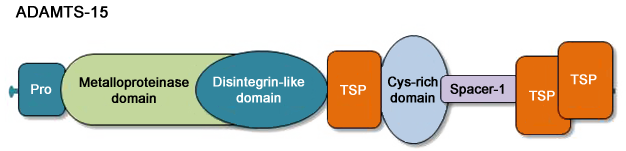
Domain organization of ADAMTS-15. Pro: prodomain; TSP: thrombospondin type-1 domains.
Expression
ADAMTS15 cDNA was originally cloned from both, a human liver and kidney fetal cDNA library (Cal et al., 2002). Later on, in the search for proteinases and proteinase inhibitors in articular cartilage from femoral heads of patients with end-stage osteoarthritis (OA) Kevorkian et al. found high levels of ADAMTS-15 expression in samples from both, OA patients as well as normal controls (Kevorkian et al., 2004). In relation with ADAMTS-15 participation in tumor progression its expression has been described in either normal cells or cells adjacent or marginal to cancer tissue in samples from colon adenocarcinoma as well as in samples from head and neck squamous cell carcinoma (Viloria et al., 2009; Stokes et al., 2010). Additionally ADAMTS-15 presence has also been detected in some breast and prostate cancer cell lines (Molokwu et al., 2010).
Localisation
Extracellular, mostly pericellular.
Function
Few studies describe ADAMTS-15 function beyond those describing its participation in cancer and osteoartritic processes. Regarding cancer, ADAMTS-15 has recently emerged as a putative tumor suppresor gene since it is downregulated in breast cancer, and functionally inactivated through specific mutations in colorectal cancer (Porter et al., 2004; Porter et al., 2006; Viloria et al., 2009). In addition, aberrant expression of ADAMTS-15 is implicated in prostate cancer progression (Molokwu et al., 2010). The latest apparently results from the relationship between ADAMTS-15 expression and versican degradation. Thus, ADAMTS-15 seems to be acting as a versican-degrading enzyme whose accumulation potentially contributes to prostate cancer pathology (Cross et al., 2005). In this regard, versican seems to be one of the targets of ADAMTS-15 proteolityc activity which involves this protein in processes such as cancer or skeletal muscle fiber formation (Croos et al., 2005; Stupka et al., 2013; Dancevic et al., 2013).
Homology
ADAMTS-15 belongs to the A Disintegrin And Metalloprotease Domains with ThromboSpondin motifs (ADAMTS) family, which consists of 19 secreted zinc metalloproteinases (Porter et al., 2005). All members of the family share the same structural domain design. ADAMTS-15 is, among all the members, closely related to ADAMTS-1 which suggested its involvement in angiogenic processes (Cal et al., 2002).
The ADAMTS15 gene is conserved in chimpanzee (Refseq: XM_522253), macaque (Refseq: XM_001113698), dog (Refseq: XM_005620295), cow (Refseq: NM_001192390), mouse (Refseq: NM_001024139), rat (Refseq: NM_001106810), chicken (Refseq: XM_417874), and zebrafish (Refseq: XM_001341842).
The ADAMTS15 gene is conserved in chimpanzee (Refseq: XM_522253), macaque (Refseq: XM_001113698), dog (Refseq: XM_005620295), cow (Refseq: NM_001192390), mouse (Refseq: NM_001024139), rat (Refseq: NM_001106810), chicken (Refseq: XM_417874), and zebrafish (Refseq: XM_001341842).
Mutations
Somatic
ADAMTS15 was identified as one of the so-called CAN genes found to be mutated in a small set of colorectal cancers (Sjöblom et al., 2006). Two heterozigous somatic mutations were described out of eleven human cancer samples (cDNA: 2309A>G, cDNA: 2632T>G). Functional relevance of mutations found in colorectal cancer were described for a deleterious single base mutation 24544ΔG affecting the two carboxy-terminal thrombospondin motifs of ADAMTS-15 (Viloria et al., 2009). The derived truncated form of ADAMTS-15 (ADAMTS15_G849fs) is barely found in the pericellular space of the cell being mostly liberated to the culture media. Functional studies revealed ADAMTS15_G849fs not showing the anti-tumoral properties of full length ADAMTS-15. In the same study, three other mutations where identified, a base pair mutation affecting the second TSP-1 domain (24616C>T), a silent base pair change (13777C>T) and another base deletion generating a completely truncated form of ADAMTS-15 (366Δ) (Viloria et al., 2009).
Implicated in
Entity name
Various cancers
Note
ADAMTS-15 has recently emerged as a putative tumor suppresor gene since it is downregulated in breast cancer, and functionally inactivated through specific mutations in colorectal cancer (Porter et al., 2006; López-Otín et al., 2009; Viloria et al., 2009). In addition, aberrant expression of ADAMTS-15 is implicated in prostate cancer progression (Cross et al., 2005; Molokwu et al., 2010). The first indication regarding a potential protective role for ADAMTS15 derived from the observation that low ADAMTS15 expression levels coupled to high ADAMTS8 levels conferred poor prognosis to breast cancer patients (Porter et al., 2006). Moreover, ADAMTS15 was identified as one of the so-called CAN genes found to be mutated in a small set of colorectal cancers (Sjöblom et al., 2006). Functional support to the putative relevance of ADAMTS-15 as a tumor suppresor protease was described after finding four additional mutations in ADAMTS-15 gene sequence in human colon carcinomas (Viloria et al., 2009). Two of the new mutations resulted in the generation of truncated forms of ADAMTS-15, one of them lacking the last two thrombospondin domains whereas the other originating a complete ADAMTS-15 knock-down. Functional analysis revealed that the presence of the two last thrombospondin domains is important for the pericellular loacalization of ADAMTS-15 and affects the anti-tumoral function of full length ADAMTS-15 (Viloria et al., 2009; Dancevic et al., 2013). More recently, ADAMTS-15 has been described as a head and neck squamous cell carcinoma (HNSCC)-associated proteinase since its expression is elevated (together with ADAMTS-1 and ADAMTS-8) in areas surrounding HNSCC tumor microenvironment (Demircan et al., 2009; Stokes et al., 2010). In addition, these three members of the ADAMTS family have elevated expression levels in HNSCC tumor versus normal tissue and in HNSCC derived cell lines vs normal keratinocytes (Stokes et al., 2010). ADAMTS-15 has also been indirectly involved in androgen-mediated prostate cancer growth and proliferation, function that depends on ADAMTS-15 versicanolytic activity (Cross et al., 2005; Molokwu et al., 2010). Molokwu et al identified one androgen-responsive element (ARE) in ADAMTS-15 promoter and 12 more AREs in its gene sequence. In the same article the authors demonstrated ADAMTS-15 reduction both, at mRNA and protein levels, in the presence of dihidrotestorone (DHT). ADAMTS-15 down-regulation in prostate cancer resulted in high versican levels which is a poor prognosis indicator in these type of tumors (Ricciardelli et al., 1998; Luo et al., 2002; Molokwu et al., 2010).
Entity name
Colon cancer
Note
ADAMTS15 expression inversely correlates with histopathologic differentiation grade in human colorectal carcinomas when analyzing ADAMTS-15 inmunostaining in normal colon epithelia, well-differentiated tumors, moderately differentiated tumors, and poorly differentiated colorectal carcinomas (Viloria et al., 2009).
Entity name
Head and neck squamous carcinoma (HNSCC)
Note
ADAMTS15 mRNA levels, together with those of other ADAMTS members (ADAMTS1, ADAMTS4, ADAMTS5, ADAMTS8, ADAMTS9), were reduced in HNSCC primary tumors compared with paired non-cancerous tissues (Demircan et al., 2009). Regarding tumor microenvironment ADAMTS15 expression is elevated in adjacent and margin tissue when compared with tumor center tissue (Stokes et al., 2010).
Entity name
Breast cancer
Note
ADAMTS15 elevated expression correlates with favorable outcome in patients with breast cancer (Porter et al., 2006).
Article Bibliography
| Pubmed ID | Last Year | Title | Authors |
|---|---|---|---|
| 11867212 | 2002 | Cloning, expression analysis, and structural characterization of seven novel human ADAMTSs, a family of metalloproteinases with disintegrin and thrombospondin-1 domains. | Cal S et al |
| 15599946 | 2005 | The expression and regulation of ADAMTS-1, -4, -5, -9, and -15, and TIMP-3 by TGFbeta1 in prostate cells: relevance to the accumulation of versican. | Cross NA et al |
| 24220035 | 2013 | Biosynthesis and expression of a disintegrin-like and metalloproteinase domain with thrombospondin-1 repeats-15: a novel versican-cleaving proteoglycanase. | Dancevic CM et al |
| 19260128 | 2009 | Increased mRNA expression of ADAMTS metalloproteinases in metastatic foci of head and neck cancer. | Demircan K et al |
| 14730609 | 2004 | Expression profiling of metalloproteinases and their inhibitors in cartilage. | Kevorkian L et al |
| 19844170 | 2009 | Protective roles of matrix metalloproteinases: from mouse models to human cancer. | López-Otín C et al |
| 11967953 | 2002 | Gene expression signature of benign prostatic hyperplasia revealed by cDNA microarray analysis. | Luo J et al |
| 20590445 | 2010 | Androgen regulates ADAMTS15 gene expression in prostate cancer cells. | Molokwu CN et al |
| 15554875 | 2005 | The ADAMTS metalloproteinases. | Porter S et al |
| 15073121 | 2004 | Dysregulated expression of adamalysin-thrombospondin genes in human breast carcinoma. | Porter S et al |
| 16152618 | 2006 | ADAMTS8 and ADAMTS15 expression predicts survival in human breast carcinoma. | Porter S et al |
| 9563891 | 1998 | Elevated levels of versican but not decorin predict disease progression in early-stage prostate cancer. | Ricciardelli C et al |
| 16959974 | 2006 | The consensus coding sequences of human breast and colorectal cancers. | Sjöblom T et al |
| 20305301 | 2010 | Expression profiles and clinical correlations of degradome components in the tumor microenvironment of head and neck squamous cell carcinoma. | Stokes A et al |
| 23233679 | 2013 | Versican processing by a disintegrin-like and metalloproteinase domain with thrombospondin-1 repeats proteinases-5 and -15 facilitates myoblast fusion. | Stupka N et al |
| 19458070 | 2009 | Genetic inactivation of ADAMTS15 metalloprotease in human colorectal cancer. | Viloria CG et al |
Other Information
Locus ID:
NCBI: 170689
MIM: 607509
HGNC: 16305
Ensembl: ENSG00000166106
Variants:
dbSNP: 170689
ClinVar: 170689
TCGA: ENSG00000166106
COSMIC: ADAMTS15
RNA/Proteins
| Gene ID | Transcript ID | Uniprot |
|---|---|---|
| ENSG00000166106 | ENST00000299164 | Q8TE58 |
Expression (GTEx)
Pathways
Protein levels (Protein atlas)
References
| Pubmed ID | Year | Title | Citations |
|---|---|---|---|
| 35962790 | 2022 | Biallelic variants in ADAMTS15 cause a novel form of distal arthrogryposis. | 0 |
| 35962790 | 2022 | Biallelic variants in ADAMTS15 cause a novel form of distal arthrogryposis. | 0 |
| 32354091 | 2020 | ADAMTS-15 Has a Tumor Suppressor Role in Prostate Cancer. | 16 |
| 32354091 | 2020 | ADAMTS-15 Has a Tumor Suppressor Role in Prostate Cancer. | 16 |
| 28005267 | 2017 | Human gingiva transcriptome during wound healing. | 14 |
| 28323982 | 2017 | Versican Proteolysis by ADAMTS Proteases and Its Influence on Sex Steroid Receptor Expression in Uterine Leiomyoma. | 10 |
| 28005267 | 2017 | Human gingiva transcriptome during wound healing. | 14 |
| 28323982 | 2017 | Versican Proteolysis by ADAMTS Proteases and Its Influence on Sex Steroid Receptor Expression in Uterine Leiomyoma. | 10 |
| 25099234 | 2015 | Metalloproteinase-dependent and -independent processes contribute to inhibition of breast cancer cell migration, angiogenesis and liver metastasis by a disintegrin and metalloproteinase with thrombospondin motifs-15. | 25 |
| 25649796 | 2015 | Genetic study of intracranial aneurysms. | 19 |
| 25099234 | 2015 | Metalloproteinase-dependent and -independent processes contribute to inhibition of breast cancer cell migration, angiogenesis and liver metastasis by a disintegrin and metalloproteinase with thrombospondin motifs-15. | 25 |
| 25649796 | 2015 | Genetic study of intracranial aneurysms. | 19 |
| 23233679 | 2013 | Versican processing by a disintegrin-like and metalloproteinase domain with thrombospondin-1 repeats proteinases-5 and -15 facilitates myoblast fusion. | 42 |
| 23233679 | 2013 | Versican processing by a disintegrin-like and metalloproteinase domain with thrombospondin-1 repeats proteinases-5 and -15 facilitates myoblast fusion. | 42 |
| 20590445 | 2010 | Androgen regulates ADAMTS15 gene expression in prostate cancer cells. | 11 |
Citation
Santiago Cal ; Alvaro J Obaya
ADAMTS15 (ADAM Metallopeptidase With Thrombospondin Type 1 Motif, 15)
Atlas Genet Cytogenet Oncol Haematol. 2014-02-01
Online version: http://atlasgeneticsoncology.org/gene/45587/adamts15-(adam-metallopeptidase-with-thrombospondin-type-1-motif-15)
