AXIN2 (axin 2)
2007-01-01 Thomas A Hughes AffiliationPathology and Tumour Biology Section, Leeds Institute of Molecular Medicine, Wellcome Trust Brenner Building, St Jamess University Hospital, University of Leeds, Leeds LS9 7TF, UK
DNA/RNA
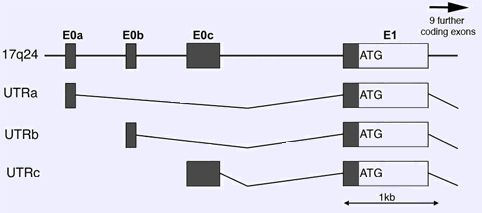
The 5 end of the human AXIN2 gene. An alignment of human genomic DNA (top line) with the 5 end of different Axin2 mRNA variants. Exons are shown as boxes (non-coding: filled; coding: open) and the translational start codon is marked (ATG).
Description
The AXIN2 gene spans about 35 kbp including 10 coding exons and 3 non-coding 5 exons (E0a, 0b and 0c; see above). Nearby genes: about 70 kbp upstream is CCDC46 (coiled-coil domain containing 46), about 300 kbp downstream is RGS9 (regulator of G-protein signalling 9). In addition, there is a putative gene that overlaps the AXIN2 non-coding 5 exons and coding exon 1 (E1) and is transcribed from the same strand (Gnomon model hmm119498); there is no published data on whether this is actually expressed.
Transcription
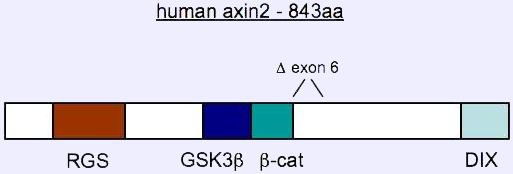
Transcription occurs from three separate promoters leading to initiation at each of the three non-coding 5 exons. mRNAs are spliced so that that each non-coding exon is expressed separately, rather than in combinations. It is unclear whether transcription can initiate at the first coding exon (E1). Promoters can be activated by TCF transcription factors binding at multiple sites and by E2F1 binding at up to 4 sites, although E2F1 can also induce transcription in the absence of consensus sites. It has been reported that exon 6 can be omitted in an alternatively-spliced form.
Pseudogene
None identified
Proteins
Description
Human Axin2 is an 843 amino acids protein (777 amino acids from delta exon 6 mRNAs) containing an RGS domain (regulator of G protein signalling; amino acids 81-200), a GSK-3 beta binding domain (amino acids 327-413), a beta-catenin binding domain (amino acids 413-476), and a DIX domain (domain in dishevelled and axin; amino acids 761-843).
Expression
Expression appears to be ubiquitous in adult tissues (although at differing levels), but is limited to specific regions during embryonic development. Expression is regulated at multiple levels including transcription, mRNA stability, translation and protein stability.
Localisation
Axin2 protein has been localised to the cytoplasm, the nucleus and the mitotic spindle.
Function
Molecular functions :
1) Axin2 acts as a negative regulator of canonical Wnt/TCF signalling by enhancing formation of the beta-catenin destruction complex. Since expression of Axin2 is itself activated by canonical Wnt/TCF signalling, this results in a negative feedback-loop that restricts TCF activity.
2) Axin2 may influence TCF activity by re-localising beta-catenin to the cytoplasm.
3) Activity of the GSK-3 beta target snail1 can be regulated by Axin2s ability to influence the nucleo-cytoplasmic localisation of GSK-3 beta.
4) Axin2 binds polo-like kinase 1 (PLK1) during mitosis and influences the accuracy of chromosome segregation.
Cellular/physiological functions :
1) Axin2 expression oscillates during early embryogenesis in response to Wnt3a - this is required to achieve correct the temporal TCF activity to allow somatogenesis.
2) A requirement for Axin2 for correct calvarial morphogenesis and craniosynostosis has been revealed in Axin2 -/- mice.
3) Axin2 appears to act as a tumour suppressor, and somatic mutations have been seen in many different tumour types (see below).
1) Axin2 acts as a negative regulator of canonical Wnt/TCF signalling by enhancing formation of the beta-catenin destruction complex. Since expression of Axin2 is itself activated by canonical Wnt/TCF signalling, this results in a negative feedback-loop that restricts TCF activity.
2) Axin2 may influence TCF activity by re-localising beta-catenin to the cytoplasm.
3) Activity of the GSK-3 beta target snail1 can be regulated by Axin2s ability to influence the nucleo-cytoplasmic localisation of GSK-3 beta.
4) Axin2 binds polo-like kinase 1 (PLK1) during mitosis and influences the accuracy of chromosome segregation.
Cellular/physiological functions :
1) Axin2 expression oscillates during early embryogenesis in response to Wnt3a - this is required to achieve correct the temporal TCF activity to allow somatogenesis.
2) A requirement for Axin2 for correct calvarial morphogenesis and craniosynostosis has been revealed in Axin2 -/- mice.
3) Axin2 appears to act as a tumour suppressor, and somatic mutations have been seen in many different tumour types (see below).
Homology
Axin2 is 44% identical to axin in mice and knock-in experiments suggest that the proteins can be functionally equivalent.
Mutations
Note
A large number of different mutations in the AXIN2 gene have been identified. In many cases (but not all) these lead to premature translational termination and protein truncation. Truncated Axin2 protein is more stable than the wild type, while there has been speculation that the mRNA may be less stable.
Germinal
Heterozygous germ line mutations in exon 7 that lead to premature termination are associated with familial tooth agenesis and a predisposition to colorectal cancer. Further germ line polymorphisms associated with familial tooth agenesis have been identified in exons 2 and 7. A polymorphism within exon 1 has been identified that is associated with risk of lung cancer. Many other polymorphisms that have yet to be associated with any function have been detected.
Somatic
The genomic region containing the AXIN2 gene shows loss of heterozygosity and re-arrangements in a variety of cancers. In addition somatic point mutations and deletions have been identified in colorectal cancer, hepatocellular carcinomas, ovarian endometrioid adenocarcinomas and hepatoblastomas. Many of these mutations/deletions result in translation of truncated proteins that are likely to be functionally inactive, although one report has suggested that these truncated proteins have a dominant negative activity.
Implicated in
Entity name
Colorectal cancer (CRC)
Oncogenesis
Axin2 is often over-expressed in CRC as a result of the deregulation of canonical Wnt/beta-catenin signalling that is an early event in CRC development (usually caused by mutations/deletions in APC or beta-catenin). Somatic inactivating mutations within Axin2 have been reported in CRC and theoretically these could contribute to further deregulation of Wnt/beta-catenin - suggesting that Axin2 is a tumour suppressor. However mutations have only been seen in microsatellite unstable tumours and often within regions of mono-nucleotide repeats (exon 7), hence whether Axin2 mutations are cause or effect in these tumours remains undetermined. In support of Axin2s role as a tumour suppressor are observations that Axin2 is silenced by promoter methylation in many microsatellite unstable tumours. As discussed above, heterozygotes for some germ line mutations in AXIN2 are predisposed to CRC although this seems to be involved with only a very small proportion of familial colorectal cancer.
Entity name
Other cancers (hepatocellular carcinomas, hepatoblastomas, ovarian endometrioid adenocarcinomas)
Oncogenesis
Somatic mutations in Axin2 have been detected in a range of cancer types. It is usually assumed that these lead to partial inactivation of Axin2 function thereby deregulation of canonical Wnt/beta-catenin signalling. In most cases this has not formally been demonstrated, and the contribution of Axin2 mutations to any putative change in Wnt/beta-catenin activity and to the development of these cancers remains mostly unclear.
Entity name
Familial Tooth Agenesis (see above)
Article Bibliography
| Pubmed ID | Last Year | Title | Authors |
|---|---|---|---|
| 12072559 | 2002 | Subcellular distribution of Wnt pathway proteins in normal and neoplastic colon. | Anderson CB et al |
| 12636920 | 2003 | Wnt3a plays a major role in the segmentation clock controlling somitogenesis. | Aulehla A et al |
| 9554852 | 1998 | Functional interaction of an axin homolog, conductin, with beta-catenin, APC, and GSK3beta. | Behrens J et al |
| 15899843 | 2005 | Mouse axin and axin2/conductin proteins are functionally equivalent in vivo. | Chia IV et al |
| 11474173 | 2001 | Genomic structure, chromosome mapping and expression analysis of the human AXIN2 gene. | Dong X et al |
| 16815967 | 2006 | Aberrant Wnt/beta-catenin signaling can induce chromosomal instability in colon cancer. | Hadjihannas MV et al |
| 15885887 | 2006 | Regulation of axin2 expression at the levels of transcription, translation and protein stability in lung and colon cancer. | Hughes TA et al |
| 15067328 | 2004 | Immunohistochemical analysis and mutational analyses of beta-catenin, Axin family and APC genes in hepatocellular carcinomas. | Ishizaki Y et al |
| 11809808 | 2002 | Wnt/beta-catenin/Tcf signaling induces the transcription of Axin2, a negative regulator of the signaling pathway. | Jho EH et al |
| 16820935 | 2006 | Single nucleotide polymorphism of the AXIN2 gene is preferentially associated with human lung cancer risk in a Japanese population. | Kanzaki H et al |
| 15538750 | 2004 | Mutations and elevated transcriptional activity of conductin (AXIN2) in hepatoblastomas. | Koch A et al |
| 16247484 | 2006 | Epigenetic silencing of AXIN2 in colorectal carcinoma with microsatellite instability. | Koinuma K et al |
| 16554443 | 2006 | Nucleo-cytoplasmic distribution of beta-catenin is regulated by retention. | Krieghoff E et al |
| 15042511 | 2004 | Mutations in AXIN2 cause familial tooth agenesis and predispose to colorectal cancer. | Lammi L et al |
| 11940574 | 2002 | Activation of AXIN2 expression by beta-catenin-T cell factor. A feedback repressor pathway regulating Wnt signaling. | Leung JY et al |
| 11017067 | 2000 | Mutations in AXIN2 cause colorectal cancer with defective mismatch repair by activating beta-catenin/TCF signalling. | Liu W et al |
| 11809809 | 2002 | Negative feedback loop of Wnt signaling through upregulation of conductin/axin2 in colorectal and liver tumors. | Lustig B et al |
| 16432638 | 2006 | Axis inhibition protein 2 (AXIN2) polymorphisms may be a risk factor for selective tooth agenesis. | Mostowska A et al |
| 15841489 | 2005 | Germline mutations of AXIN2 are not associated with nonsyndromic colorectal cancer. | Peterlongo P et al |
| 9500463 | 1998 | Consortium study on 1280 breast carcinomas: allelic loss on chromosome 17 targets subregions associated with family history and clinical parameters. | Phelan CM et al |
| 9408751 | 1997 | Four regions of allelic imbalance on 17q12-qter associated with high-grade breast tumors. | Plummer SJ et al |
| 15735151 | 2005 | The links between axin and carcinogenesis. | Salahshor S et al |
| 16708370 | 2006 | Mutations within Wnt pathway genes in sporadic colorectal cancers and cell lines. | Suraweera N et al |
| 12101426 | 2002 | Mutational spectrum of beta-catenin, AXIN1, and AXIN2 in hepatocellular carcinomas and hepatoblastomas. | Taniguchi K et al |
| 15802015 | 2005 | Genetic and epigenetic changes of components affecting the WNT pathway in colorectal carcinomas stratified by microsatellite instability. | Thorstensen L et al |
| 11719457 | 2001 | Diverse mechanisms of beta-catenin deregulation in ovarian endometrioid adenocarcinomas. | Wu R et al |
| 9566905 | 1998 | Axil, a member of the Axin family, interacts with both glycogen synthase kinase 3beta and beta-catenin and inhibits axis formation of Xenopus embryos. | Yamamoto H et al |
| 17072303 | 2006 | A Wnt-Axin2-GSK3beta cascade regulates Snail1 activity in breast cancer cells. | Yook JI et al |
| 15790973 | 2005 | The role of Axin2 in calvarial morphogenesis and craniosynostosis. | Yu HM et al |
Other Information
Locus ID:
NCBI: 8313
MIM: 604025
HGNC: 904
Ensembl: ENSG00000168646
Variants:
dbSNP: 8313
ClinVar: 8313
TCGA: ENSG00000168646
COSMIC: AXIN2
RNA/Proteins
Expression (GTEx)
Pathways
Protein levels (Protein atlas)
PharmGKB
| Entity ID | Name | Type | Evidence | Association | PK | PD | PMIDs |
|---|---|---|---|---|---|---|---|
| PA164713176 | Platinum compounds | Chemical | ClinicalAnnotation | associated | PD | 24980784 | |
| PA443622 | Carcinoma, Non-Small-Cell Lung | Disease | ClinicalAnnotation | associated | PD | 24980784 |
References
| Pubmed ID | Year | Title | Citations |
|---|---|---|---|
| 38158447 | 2024 | Axin2 depletion in macrophages alleviated senescence and increased immune response after myocardial infarction. | 0 |
| 38158447 | 2024 | Axin2 depletion in macrophages alleviated senescence and increased immune response after myocardial infarction. | 0 |
| 36502525 | 2023 | AXIN2 germline testing in a French cohort validates pathogenic variants as a rare cause of predisposition to colorectal polyposis and cancer. | 4 |
| 36860143 | 2023 | AXIN2-related oligodontia-colorectal cancer syndrome with cleft palate as a possible new feature. | 1 |
| 36881079 | 2023 | Implications of Axis Inhibition Protein 2 in Breast Cancer Progression. | 0 |
| 37078424 | 2023 | Axin2 coupled excessive Wnt-glycolysis signaling mediates social defect in autism spectrum disorders. | 2 |
| 37169182 | 2023 | ALKBH5 Drives Immune Suppression Via Targeting AXIN2 to Promote Colorectal Cancer and Is a Target for Boosting Immunotherapy. | 16 |
| 37488774 | 2023 | Pancreatic stellate cell-derived exosomal tRF-19-PNR8YPJZ promotes proliferation and mobility of pancreatic cancer through AXIN2. | 4 |
| 37957865 | 2023 | JNK2 Promotes Progression of Esophageal Squamous Cell Carcinoma via Inhibiting Axin2. | 0 |
| 36502525 | 2023 | AXIN2 germline testing in a French cohort validates pathogenic variants as a rare cause of predisposition to colorectal polyposis and cancer. | 4 |
| 36860143 | 2023 | AXIN2-related oligodontia-colorectal cancer syndrome with cleft palate as a possible new feature. | 1 |
| 36881079 | 2023 | Implications of Axis Inhibition Protein 2 in Breast Cancer Progression. | 0 |
| 37078424 | 2023 | Axin2 coupled excessive Wnt-glycolysis signaling mediates social defect in autism spectrum disorders. | 2 |
| 37169182 | 2023 | ALKBH5 Drives Immune Suppression Via Targeting AXIN2 to Promote Colorectal Cancer and Is a Target for Boosting Immunotherapy. | 16 |
| 37488774 | 2023 | Pancreatic stellate cell-derived exosomal tRF-19-PNR8YPJZ promotes proliferation and mobility of pancreatic cancer through AXIN2. | 4 |
Citation
Thomas A Hughes
AXIN2 (axin 2)
Atlas Genet Cytogenet Oncol Haematol. 2007-01-01
Online version: http://atlasgeneticsoncology.org/gene/456/axin2-(axin-2)
