DCD (dermcidin)
2020-07-01 Amanda Soares Hirata , Rodrigo dos Anjos Miguel , Paula Christine Jimenez , Letícia Veras Costa-Lotufo AffiliationAbstract
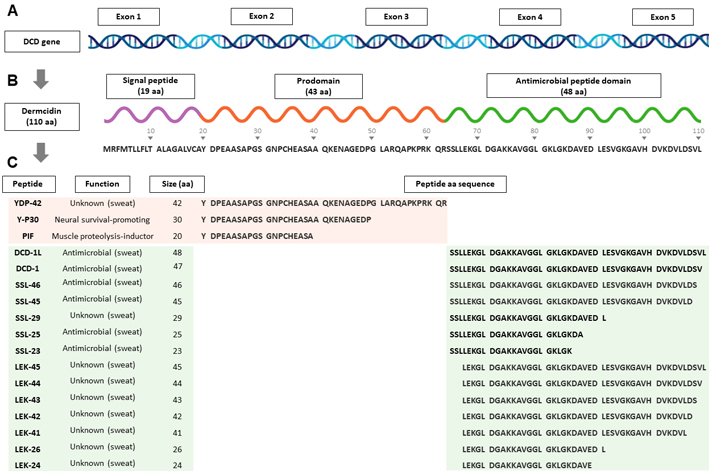
Dermcidin (DCD) is a 110-amino acid protein, which is cleaved in several other peptides with different functions. The best-known function of this protein is as antimicrobial host defense, acting majorly in the skin, where many DCD derivatives were identified to be constitutively secreted, mainly by sweat glands. Additionally, Y-P30, one of such derivatives, has been described as a survival factor predominantly in stressed neural cells. This function has also been investigated in cancer cells, portraying DCD as an oncogene, as well a novel biomarker for this disease. Furthermore, PIF, another DCD derivative, may be an important inducer of non-fat weight loss, which has been related with cachexia. The present review assesses data on DCD and derivatives observing DNA, RNA, encoded proteins and their various functions, highlighting their relevance in cancer and other clinical conditions.
DNA/RNA
Description
Transcription
Proteins
Description
Expression
Dermcidin is also expressed by sebaceous glands and neutrophils in immunity-related circumstances (Dahlhoff et al., 2016; Lominadze et al., 2005) and, moreover, has been shown to be overexpressed in the context of HIV infection of monocytoid cells (Pathak et al., 2009). Additionally, oxidatively stressed neural cell lines express dermcidin in the form of the signal peptide Y-P30, described firstly as DSEP, the diffusible survival/evasion peptide, which can, indeed, be detected in culture media (Cunningham et al., 2002).
The human term placental tissue may express DCD as two splice variants under a restricted spatiotemporal pattern, which may be related to the involvement of dermcidin in the molecular mechanisms of pregnancy. Placental dermcidin can be processed into DCD-1 and defend the fetus against invading microorganisms (Motoyama et al., 2007), or into Y-P30 to exert neuritogenic activity during fetus brain development (Mikhaylova et al., 2014).
In plasma, dermcidin may be found in different conditions: 1) in hepatocellular carcinoma patients (Qiu et al., 2018); 2) overexpressed in patients with arterial hypertension, as a player in modulation of NO levels and induction of platelet aggregation (Ghosh et al., 2011; Ghosh et al., 2012a); 3) in type I diabetes mellitus, inhibiting the synthesis of insulin in hepatocytes and pancreatic cells (Ghosh et al., 2011; Ghosh et al., 2012b). Dermcidin is also secreted by ischemic skeletal muscles, enhancing cardiomyocytes apoptosis under hypoxic conditions and infarct size after permanent coronary artery ligation (Esposito et al., 2015). Moreover, dermcidin is abundantly present in exhaled breath condensate of asthmatic and lung cancer patients, and it can be regarded as a biomarker in these diseases (Bloemen et al., 2001; Chang et al., 2010).
Also, dermcidin has revealed a relevant role in cancer; it offers a survival advantage in some tumors, as reported for breast cancers (Porter et al., 2003; Brauer et al., 2014); prostate cancer (Wang et al., 2003; Stewart et al., 2007); lung cancer, as a biomarker in exhaled breath condensate (Chang et al., 2010); hepatic cancer cells (Lowrie et al., 2006; Shen et al., 2011; Qiu et al., 2018; Lowrie et al., 2011); gastro-oesophageal cancer (Deans et al., 2006); pancreatic cancer cells (Stewart et al., 2008a); a myelogenous leukemia cell line (Stocki et al., 2011); and melanoma (Smith et al., 2005; Rieg et al., 2004; Trzoss et al., 2014). Additionally, tumor cells express PIF, which is resistant to proteolytic digestion by trypsin and the human cancer expression has been related to inhibition of muscle cell differentiation and a high weight loss (Majczak et al., 2007; Todorov et al., 1997; Wigmore et al., 2000; Jiang and Clemens, 2006; Wieland et al., 2007). In fact, PIF was discovered in 1996 in mice and later described as a potent catabolic factor that acts as a cachectic cancer factor (Tisdale et al., 2004; Schittek et al., 2012; Todorov et al., 1996). Although the role of murine PIF is well established, its biology remains speculative in humans (Stewart et al., 2008b).
Localisation
In the dark mucous cells of the secretory coil of eccrine sweat glands, dermcidin is detected in the Golgi complex and in the secretory granules, released in the cell surface and transported to epidermal surface by the sweat duct (Schittek et al., 2001; Rieg et al., 2006, Sakurada et al., 2010). There are differences in the levels of DCD-derived peptides in eccrine sweat of distinct anatomic sites; highest concentrations are found in palms, arms and forehead, where the density of eccrine sweat glands is higher and the body is more exposed to pathogens and minor trauma (Rieg et al., 2004).
Although less profusely, dermcidin is also found in basal tears, in cervicovaginal fluid and in breast milk, in which it also assumes a function associated to innate immunity (You et al., 2010; Shaw et al., 2007; Azkargorta et al., 2015; Chow et al., 2016). Furthermore, dermcidin-derived peptides can be found in lipid droplets secreted by the holocrine sebaceous glands and in the granules of neutrophils, suggesting that this protein has, likewise, an immunity related purpose in these cells (Dahlhoff et al., 2016; Lominadze et al., 2005).
Function
DCD-1L has been studied as a stimulant for production of pro-inflammatory cytokines and chemokines by human keratinocytes cells controlled by G-protein and mitogen-activated protein kinase (MAPK) signaling pathways, thus contributing to the cutaneous immunity (Niyonsaba et al., 2009).
High blood levels of dermcidin variant 2 was found in patients following acute ischemic heart disease. There have been further investigations on rather such variant may inhibit synthesis and release of insulin by the pancreas, an effect that was then shown to be reversed by aspirin or insulin administration (Bank et al., 2014; Ghosh et al., 2014). As a consequence of insulin resistance, there may be increase in blood pressure and atherosclerosis through inhibition of NO production and promotion of prothrombotic effects (Ghosh et al., 2011). The same role for dermcidin was observed in ischemic and hemorrhagic stroke patients (Bank et al., 2015).
Dermcidin has been shown to interact with few proteins within the cell. In this context, phosphorylation at Tyr20 enabled dermcidin to interact with the SH2 domain of NCK1, which, through effector proteins like the PAK1 /ARHGEF6 (also called PIX) complex, stimulates Rho GTPases RAC1 and CDC42 and reorganizes actin cytoskeleton, ultimately promoting cell migration in a hepatocellular carcinoma cell line (SK-HEP1) (Shen et al., 2011). Furthermore, in a gastric cancer cell line (BGC-823), dermcidin protein was one of the proteins bound to a long non-coding RNA (STCAT3), while overexpression of both dermcidin and STCAT3 were related to poor prognosis for patients (Zhang et al., 2018). Considering small molecules - natural products, in this case - dermcidin has been shown to bind paclitaxel and seriniquinone, a marine bacterium derived compound. In the first setting, dermcidin precursor was recovered, along with HSP90AA1 and actinin, from a paclitaxel-biotin probe fed to drug-sensitive breast cancer cell line (MCF7), but not from their paclitaxel-resistant analogue, suggesting a role of dermcidin in the cell resistance profile to this compound and cross-resistance to other anticancer drugs (Zuo et al., 2010). Regarding the later natural product , dermcidin protein was revealed to be a direct target of a seriniquinone probe, which was found to be further bound to other proteins, such as GAPDH and Hsp70, in a colorectal carcinoma cell line (HCT 116) model (Trzoss et al., 2014).
Y-P30 was first seen overexpressed as a neuron survival-promoting peptide in response to oxidative stress (Cunningham et al., 1998), promoting survival of cortical neurons after cerebral lesions by retaining calreticulin in the cytosol and reducing calcium signaling to a degree in which it is protective, regardless of any immune cell inhibition (Cunningham et al., 2000). During hypoxia and hypoglycemia, Y-P30 expression is associated with reduced neural cell death in vitro (Schneeberg et al., 2009). This protein is also related to induction of neurite outgrowth in cortical neurons during early brain development, a role that is suggested by the effect of binding of Y-P30 to PTN (pleiotrophin) in the extracellular axonal membrane, thus increasing syndecan local concentrations and promoting neurite growth (Landgraf et al., 2008). Furthermore, this mechanism can be related to calcium/calmodulin-dependent serine kinase ( CASK) migration to the nucleus, where Y-P30 interacts differently with syndecan-2 ( SDC2) or -3 ( SDC3) in immature or mature neurons, contributing with migration and axonal outgrowth (Landgraf et al., 2014; Neumann et al., 2019).
PIF has been investigated as a catalytic protein, which can induce proteasome expression through NF-kB activation (Wyke and Tisdale, 2005). Consequently, this process results in decreased protein synthesis and severe degradation of skeletal muscle, thus correlating with the weight loss in cachectic cancer patients, an effect typically attributed to PIF (Todorov et al., 1996; Lorite et al., 1997; Todorov et al., 2007). PIF was also associated with the release of Ca2+ from intracellular stocks, suggesting PIF receptor (a zinc-sensing receptor) is coupled to a G-protein to cause calcium release from endoplasmic reticulum (Mirza and Tisdale, 2012). Reinforcing these data, direct and indirect inhibitors of NF-kB were able to attenuate the development of muscle loss (Wyke et al., 2004; Russell et al., 2007).
Homology
Table 1. Comparative identity of human DCD with other species.
| % Identity for: Homo sapiens CDC | Symbol | Protein | DNA |
| vs. P. paniscus | DCD | 100 | 100 |
| vs. P. abelii | DCD | 96.9 | 98.2 |
| vs. N. leucogenys | DCD | 93.8 | 98.4 |
| vs. H. moloch | DCD | 92.8 | 91.7 |
| vs. T. francoisi | DCD | 91.7 | 95.3 |
| vs. R. roxellana | DCD | 91.7 | 94.2 |
| vs. C. angolensis palliatus | DCD | 91.7 | 94 |
| vs. C. jacchus | DCD | 91 | 96 |
| vs. P. tephrosceles | DCD | 90.7 | 92.7 |
| vs. M. mulatta | DCD | 89.7 | 95.2 |
| vs. T. gelada | DCD | 89.7 | 91.1 |
| vs. M. leucophaeus | DCD | 89.7 | 95.9 |
| vs. M. nemestrina | DCD | 89.7 | 89.9 |
| vs. C. sabaeus | DCD | 84.8 | 93.7 |
| vs. A. nancymaae | DCD | 82.3 | 96.8 |
| vs. S. boliviensis boliviensis | DCD | 80.4 | 95.0 |
| vs. S. apella | DCD | 77.3 | 94.3 |
| vs. C. capucinus imitator | DCD | 76.5 | 95.2 |
(Source: http://www.ncbi.nlm.nih.gov/homologene)
Mutations
Somatic
Implicated in
Dermcidin was found among intracellular proteins bound to paclitaxel in a naïve breast cancer cell line (MCF7), however it was not analogously recovered in the paclitaxel resistant counterpart, suggesting involvement of dermcidin in the drug-resistance phenotype (Zuo et al., 2010).
Patients with PIF expression from gastric cancer tissues also presented detectable PIF in urine samples and higher percentages of weight loss (Cabal-Manzano et al., 2001). PIF expression in gastro-oesophageal tumors were found to be elevated in 59% of the cancer samples analyzed and in 67% of adjacent benign tissues. Although this study revealed a high correlation between PIF expression and cancer, upregulation of PIF did not show correlation with cachexia or prognosis (Deans et al., 2006).
Additionally, dermcidin has, likewise, been associated to cell survival in this cancer type (Lowrie et al., 2006), while Y-P30/PIF-core was accounted for cell proliferation in HuH7 hepatic cancer cell lines through different pathways (Lowrie et al., 2011). Dermcidin has been studied as a hepatocellular cancer biomarker, as it is significantly increased in patients enduring this disease (Qiu et al., 2018).
Analogously, PIF displayed elevated expression levels in non-small-cell lung cancer (NSCLC) tissues, which was higher in patients supporting greater weight losses. Although there was no correlation between PIF and tumor clinical staging, a significant correlation between weight loss and survival in the PIF-positive patients was identified (Wang et al., 2010).
Production of PIF was also identified in human melanoma cell line G361. Within this study, the protein was further purified and administered to mice, and those who received treatment experienced weight loss specifically by non-fat mass (Todorov et al., 1999). Moreover, expression of PIF by the melanoma cell line Mel impaired muscle cell differentiation; a feature that could be then counteracted by treatment with a caspase-8-like inhibitory protein (Jiang and Clemens, 2006).
First evidences of the part taken by PIF in pancreatic cancer revealed the protein was only present in urine samples of cancer patients with high proportions of weight loss per month, while it was absent in patients with low to normal weight loss rates (Todorov et al., 1996). Furthermore, PIF was detected in 80% of urine samples from patients with pancreatic cancer (n=55), which also revealed to be the same group that supported a high rate of weight loss (Wigmore et al., 2000). Nevertheless, the occurrence of PIF in urine does not appear to correlate with malignancy of the pancreatic tumor (Teich et al., 2005). Interestingly, cachectic pancreatic cancer patients consuming a nutritional fish oil-enriched supplement decreased their urinary excretion of PIF and actually presented weight gain, suggesting important metabolic modulations between cancer and cachexia (Barber et al., 2001).
DCD demonstrated to be proliferative and survival factors for DCD-transfected PC-3M prostate cell line under oxidative stress or hypoxia conditions, besides PIF portion was attributed to these effects (Stewart et al., 2007). Same authors did not detect DCD mRNA expression in primary prostate cancer tissues (Stewart et al., 2008).
Human cachexia-associated protein (HCAP), a homolog to the PIF protein, is expressed in prostate cancer: cell lines, primary tumors, metastases and present in the urine of cachectic patients, but not in healthy prostate (Wang et al., 2003). Additionally, PIF expression was detected in a prostate cancer cell line (PC-3) causing inhibition of muscle cell differentiation, what could be reversed by cellular caspase-8-like inhibitory protein treatment in vitro (Jiang and Clemens, 2006).
Article Bibliography
| Pubmed ID | Last Year | Title | Authors |
|---|---|---|---|
| 25946035 | 2015 | Human Basal Tear Peptidome Characterization by CID, HCD, and ETD Followed by in Silico and in Vitro Analyses for Antimicrobial Peptide Identification. | Azkargorta M et al |
| 16354654 | 2006 | Cathepsin D is present in human eccrine sweat and involved in the postsecretory processing of the antimicrobial peptide DCD-1L. | Baechle D et al |
| 25879571 | 2015 | Dermcidin exerts its oncogenic effects in breast cancer via modulation of ERBB signaling. | Bancovik J et al |
| 26188955 | 2015 | The impaired synthesis of insulin and its inability to inhibit platelet aggregation in cerebrovascular accident. | Bank S et al |
| 25055737 | 2014 | Dermcidin isoform-2 induced nullification of the effect of acetyl salicylic acid in platelet aggregation in acute myocardial infarction. | Bank S et al |
| 11962246 | 2001 | Effect of a fish oil-enriched nutritional supplement on metabolic mediators in patients with pancreatic cancer cachexia. | Barber MD et al |
| 31227691 | 2019 | Lugdunin amplifies innate immune responses in the skin in synergy with host- and microbiota-derived factors. | Bitschar K et al |
| 21105917 | 2011 | A new approach to study exhaled proteins as potential biomarkers for asthma. | Bloemen K et al |
| 24562771 | 2014 | Dermcidin expression is associated with disease progression and survival among breast cancer patients. | Brauer HA et al |
| 11401311 | 2001 | Proteolysis-inducing factor is expressed in tumours of patients with gastrointestinal cancers and correlates with weight loss. | Cabal-Manzano R et al |
| 20436176 | 2010 | Dermcidin identification from exhaled air for lung cancer diagnosis. | Chang WC et al |
| 26116637 | 2016 | Host Defense Proteins in Breast Milk and Neonatal Yeast Colonization. | Chow BD et al |
| 10833321 | 2000 | Calreticulin binding and other biological activities of survival peptide Y-P30 including effects of systemic treatment of rats. | Cunningham TJ et al |
| 26718508 | 2016 | Expression of dermcidin in sebocytes supports a role for sebum in the constitutive innate defense of human skin. | Dahlhoff M et al |
| 16495932 | 2006 | Expression of the proteolysis-inducing factor core peptide mRNA is upregulated in both tumour and adjacent normal tissue in gastro-oesophageal malignancy. | Deans DA et al |
| 26101262 | 2015 | Dermcidin: a skeletal muscle myokine modulating cardiomyocyte survival and infarct size after coronary artery ligation. | Esposito G et al |
| 22173434 | 2011 | Designing antimicrobial peptides: form follows function. | Fjell CD et al |
| 12379338 | 2002 | Detection of dermcidin-derived peptides in sweat by ProteinChip technology. | Flad T et al |
| 24649391 | 2014 | Neutralization by insulin of the hypertensive effect of dermcidin isoform 2: an environmentally induced diabetogenic and hypertensive protein. | Ghosh R et al |
| 22231923 | 2012 | The control of hyperglycemia in alloxan treated diabetic mice through the stimulation of hepatic insulin synthesis due to the production of nitric oxide. | Ghosh R et al |
| 20809104 | 2011 | The appearance of dermcidin isoform 2, a novel platelet aggregating agent in the circulation in acute myocardial infarction that inhibits insulin synthesis and the restoration by acetyl salicylic acid of its effects. | Ghosh R et al |
| 22448321 | 2012 | The role of dermcidin isoform 2: a two-faceted atherosclerotic risk factor for coronary artery disease and the effect of acetyl salicylic Acid on it. | Ghosh R et al |
| 30783501 | 2019 | Advance of Seriniquinone Analogues as Melanoma Agents. | Hammons JC et al |
| 10883668 | 2000 | Effect of a fluorinated pyrimidine on cachexia and tumour growth in murine cachexia models: relationship with a proteolysis inducing factor. | Hussey HJ et al |
| 17060399 | 2006 | Cellular caspase-8-like inhibitory protein (cFLIP) prevents inhibition of muscle cell differentiation induced by cancer cells. | Jiang Z et al |
| 28619761 | 2017 | Exhaled breath condensate biomarkers for the early diagnosis of lung cancer using proteomics. | López-Sánchez LM et al |
| 18599487 | 2008 | The survival-promoting peptide Y-P30 enhances binding of pleiotrophin to syndecan-2 and -3 and supports its neuritogenic activity. | Landgraf P et al |
| 17448443 | 2007 | Identification of dermcidin in human gestational tissue and characterization of its proteolytic activity. | Lee Motoyama JP et al |
| 15985654 | 2005 | Proteomic analysis of human neutrophil granules. | Lominadze G et al |
| 9376263 | 1997 | Induction of muscle protein degradation by a tumour factor. | Lorite MJ et al |
| 21643625 | 2011 | Proteolysis-inducing factor core peptide mediates dermcidin-induced proliferation of hepatic cells through multiple signalling networks. | Lowrie AG et al |
| 16685272 | 2006 | Dermcidin expression in hepatic cells improves survival without N-glycosylation, but requires asparagine residues. | Lowrie AG et al |
| 28888369 | 2017 | Structure analysis of the membrane-bound dermcidin-derived peptide SSL-25 from human sweat. | Mühlhäuser P et al |
| 18058718 | 2007 | Prediction and biochemical characterization of intrinsic disorder in the structure of proteolysis-inducing factor/dermcidin. | Majczak G et al |
| 32485045 | 2020 | Serum markers improve current prediction of metastasis development in early-stage melanoma patients: a machine learning-based study. | Mancuso F et al |
| 24969620 | 2014 | Analysis of Y-P30/Dermcidin expression and properties of the Y-P30 peptide. | Mikhaylova M et al |
| 22820507 | 2012 | Role of Ca2+ in proteolysis-inducing factor (PIF)-induced atrophy of skeletal muscle. | Mirza KA et al |
| 18949710 | 2008 | Genes up- and down-regulated by dermcidin in breast cancer: a microarray analysis. | Moreira DF et al |
| 31115649 | 2019 | Mass Spectrometry Analysis of the Exhaled Breath Condensate and Proposal of Dermcidin and S100A9 as Possible Markers for Lung Cancer Prognosis. | Núñez-Naveira L et al |
| 30759095 | 2019 | The primate-specific peptide Y-P30 regulates morphological maturation of neocortical dendritic spines. | Neumann JR et al |
| 19014393 | 2009 | The human antimicrobial peptide dermcidin activates normal human keratinocytes. | Niyonsaba F et al |
| 27216146 | 2016 | Vitronectin and dermcidin serum levels predict the metastatic progression of AJCC I-II early-stage melanoma. | Ortega-Martínez I et al |
| 19703016 | 2009 | HIV induces both a down-regulation of IRAK-4 that impairs TLR signalling and an up-regulation of the antibiotic peptide dermcidin in monocytic cells. | Pathak S et al |
| 22262861 | 2012 | Structure-activity analysis of the dermcidin-derived peptide DCD-1L, an anionic antimicrobial peptide present in human sweat. | Paulmann M et al |
| 12953101 | 2003 | A neural survival factor is a candidate oncogene in breast cancer. | Porter D et al |
| 29641283 | 2018 | The Role of Dermcidin in the Diagnosis and Staging of Hepatocellular Carcinoma. | Qiu F et al |
| 31300527 | 2019 | Insulin resistance in prostate cancer patients and predisposing them to acute ischemic heart disease. | Ray U et al |
| 15377337 | 2004 | Dermcidin is constitutively produced by eccrine sweat glands and is not induced in epidermal cells under inflammatory skin conditions. | Rieg S et al |
| 16374474 | 2006 | Generation of multiple stable dermcidin-derived antimicrobial peptides in sweat of different body sites. | Rieg S et al |
| 15944307 | 2005 | Deficiency of dermcidin-derived antimicrobial peptides in sweat of patients with atopic dermatitis correlates with an impaired innate defense of human skin in vivo. | Rieg S et al |
| 17532611 | 2007 | Role of reactive oxygen species in protein degradation in murine myotubes induced by proteolysis-inducing factor and angiotensin II. | Russell ST et al |
| 19914015 | 2010 | Detection of dermcidin for sweat identification by real-time RT-PCR and ELISA. | Sakurada K et al |
| 22455996 | 2012 | The multiple facets of dermcidin in cell survival and host defense. | Schittek B et al |
| 11694882 | 2001 | Dermcidin: a novel human antibiotic peptide secreted by sweat glands. | Schittek B et al |
| 19490911 | 2009 | Neuroprotective effects of the survival promoting peptide Y-P30. | Schneeberg J et al |
| 17567164 | 2007 | Proteomic analysis of human cervico-vaginal fluid. | Shaw JL et al |
| 21397687 | 2011 | Identification of Dermcidin as a novel binding protein of Nck1 and characterization of its role in promoting cell migration. | Shen SL et al |
| 16251803 | 2005 | Whole-genome expression profiling of the melanoma progression pathway reveals marked molecular differences between nevi/melanoma in situ and advanced-stage melanomas. | Smith AP et al |
| 23426625 | 2013 | Crystal structure and functional mechanism of a human antimicrobial membrane channel. | Song C et al |
| 16870749 | 2006 | Naturally processed dermcidin-derived peptides do not permeabilize bacterial membranes and kill microorganisms irrespective of their charge. | Steffen H et al |
| 18403914 | 2008 | The dermcidin gene in cancer: role in cachexia, carcinogenesis and tumour cell survival. | Stewart GD et al |
| 15969757 | 2005 | The presence of the proteolysis-inducing factor in urine does not predict the malignancy of a pancreatic tumour. | Teich N et al |
| 8602222 | 1996 | Characterization of a cancer cachectic factor. | Todorov P et al |
| 18056470 | 2007 | Identification and characterization of a membrane receptor for proteolysis-inducing factor on skeletal muscle. | Todorov PT et al |
| 25271322 | 2014 | Seriniquinone, a selective anticancer agent, induces cell death by autophagocytosis, targeting the cancer-protective protein dermcidin. | Trzoss L et al |
| 20837461 | 2010 | Expression and clinicopathologic significance of proteolysis-inducing factor in non-small-cell lung cancer: an immunohistochemical analysis. | Wang Q et al |
| 12672042 | 2003 | Expression of the human cachexia-associated protein (HCAP) in prostate cancer and in a prostate cancer animal model of cachexia. | Wang Z et al |
| 17785548 | 2007 | Is there a human homologue to the murine proteolysis-inducing factor? | Wieland BM et al |
| 10606911 | 2000 | Characteristics of patients with pancreatic cancer expressing a novel cancer cachectic factor. | Wigmore SJ et al |
| 15477867 | 2004 | Induction of proteasome expression in skeletal muscle is attenuated by inhibitors of NF-kappaB activation. | Wyke SM et al |
| 15714207 | 2005 | NF-kappaB mediates proteolysis-inducing factor induced protein degradation and expression of the ubiquitin-proteasome system in skeletal muscle. | Wyke SM et al |
| 20506419 | 2010 | Post-translation modification of proteins in tears. | You J et al |
| 11807545 | 2002 | Antimicrobial peptides of multicellular organisms. | Zasloff M et al |
| 23841626 | 2013 | Dermcidin: what is its antibiotic potential? | Zeth K et al |
| 29164103 | 2017 | The Human Antimicrobial Peptides Dermcidin and LL-37 Show Novel Distinct Pathways in Membrane Interactions. | Zeth K et al |
| 30226544 | 2018 | Dermcidin as a novel binding protein of lncRNA STCAT3 and its effect on prognosis in gastric cancer. | Zhang J et al |
| 27466123 | 2016 | Human commensals producing a novel antibiotic impair pathogen colonization. | Zipperer A et al |
| 20926015 | 2010 | Establishment of a paclitaxel resistant human breast cancer cell strain (MCF-7/Taxol) and intracellular paclitaxel binding protein analysis. | Zuo KQ et al |
Other Information
Locus ID:
NCBI: 117159
MIM: 606634
HGNC: 14669
Ensembl: ENSG00000161634
Variants:
dbSNP: 117159
ClinVar: 117159
TCGA: ENSG00000161634
COSMIC: DCD
RNA/Proteins
| Gene ID | Transcript ID | Uniprot |
|---|---|---|
| ENSG00000161634 | ENST00000293371 | P81605 |
| ENSG00000161634 | ENST00000456047 | P81605 |
| ENSG00000161634 | ENST00000546807 | P81605 |
Expression (GTEx)
Pathways
| Pathway | Source | External ID |
|---|---|---|
| Immune System | REACTOME | R-HSA-168256 |
| Innate Immune System | REACTOME | R-HSA-168249 |
| Antimicrobial peptides | REACTOME | R-HSA-6803157 |
Protein levels (Protein atlas)
References
| Pubmed ID | Year | Title | Citations |
|---|---|---|---|
| 33981001 | 2021 | Cell surface GRP78 and Dermcidin cooperate to regulate breast cancer cell migration through Wnt signaling. | 10 |
| 33981001 | 2021 | Cell surface GRP78 and Dermcidin cooperate to regulate breast cancer cell migration through Wnt signaling. | 10 |
| 31115649 | 2019 | Mass Spectrometry Analysis of the Exhaled Breath Condensate and Proposal of Dermcidin and S100A9 as Possible Markers for Lung Cancer Prognosis. | 12 |
| 31115649 | 2019 | Mass Spectrometry Analysis of the Exhaled Breath Condensate and Proposal of Dermcidin and S100A9 as Possible Markers for Lung Cancer Prognosis. | 12 |
| 30226544 | 2018 | Dermcidin as a novel binding protein of lncRNA STCAT3 and its effect on prognosis in gastric cancer. | 4 |
| 30734678 | 2018 | Estriol Inhibits Dermcidin Isoform-2 Induced Inflammatory Cytokine Expression Via Nitric Oxide Synthesis in Human Neutrophil. | 1 |
| 30226544 | 2018 | Dermcidin as a novel binding protein of lncRNA STCAT3 and its effect on prognosis in gastric cancer. | 4 |
| 30734678 | 2018 | Estriol Inhibits Dermcidin Isoform-2 Induced Inflammatory Cytokine Expression Via Nitric Oxide Synthesis in Human Neutrophil. | 1 |
| 27650261 | 2017 | Expression of dermcidin in human sinonasal secretions. | 2 |
| 27650261 | 2017 | Expression of dermcidin in human sinonasal secretions. | 2 |
| 26718508 | 2016 | Expression of dermcidin in sebocytes supports a role for sebum in the constitutive innate defense of human skin. | 14 |
| 26944449 | 2016 | PreImplantation factor (PIF*) regulates systemic immunity and targets protective regulatory and cytoskeleton proteins. | 10 |
| 27392853 | 2016 | PiB-PET Imaging-Based Serum Proteome Profiles Predict Mild Cognitive Impairment and Alzheimer's Disease. | 15 |
| 30463107 | 2016 | [Study of tumor-specific expression of some evolutionary new genes]. | 4 |
| 26718508 | 2016 | Expression of dermcidin in sebocytes supports a role for sebum in the constitutive innate defense of human skin. | 14 |
Citation
Amanda Soares Hirata ; Rodrigo dos Anjos Miguel ; Paula Christine Jimenez ; Letícia Veras Costa-Lotufo
DCD (dermcidin)
Atlas Genet Cytogenet Oncol Haematol. 2020-07-01
Online version: http://atlasgeneticsoncology.org/gene/46314/
