CX3CL1 (chemokine (C-X3-C motif) ligand 1)
2013-09-01 Philippe Deterre AffiliationImmunite et Infection, UMR-S 945 INSERM UPMC, Paris, France
Identity
HGNC
LOCATION
16q21
IMAGE

LEGEND
Chromosome 16; NC_000016.9.
LOCUSID
ALIAS
ABCD-3,C3Xkine,CXC3,CXC3C,NTN,NTT,SCYD1,fractalkine,neurotactin
DNA/RNA
Note
CX3CL1 gene is located on the long arm of chromosome 16 at position 13 and contains three exons. This gene encodes for a protein of 397 aa. The first 24 aa represents the peptide signal.
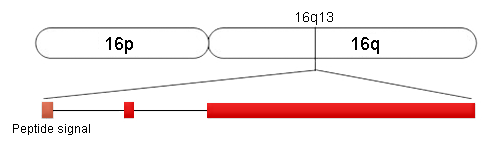
The CX3CL1 gene comprises 3 exons. The first codes for the peptide signal.
Transcription
Only one type of transcript has been described. The 1194-nucleotide transcript encodes a protein of 397 amino acid residues. The primary structure of human CX3CL1 consists of an N-terminal 24-amino acid signal sequence followed by the chemokine domain of CX3CL1, a mucin-like stalk, a transmembrane domain and an intracellular part.
Pseudogene
None described so far.
Proteins
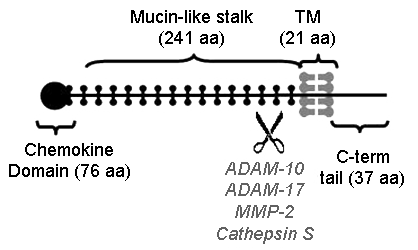
Secondary structure of the membrane form of CX3CL1 (Bazan et al., 1997; Fong et al., 2000).
Description
CX3CL1 is synthesized as a membrane protein consisting of the chemokine domain, a highly glycosylated mucin-like stalk, a transmembrane domain and an intracellular part. Cleavage by some metalloproteinases like ADAM-10 (Hundhausen et al., 2003), ADAM-17 (Garton et al., 2001; Tsou et al., 2001), MMP-2 (Bourd-Boittin et al., 2009) and cathepsin-S (Clark et al., 2009) gives raise to the soluble form of CX3CL1 consisting of the chemokine domain and the glycosylated mucin-like stalk (Bazan et al., 1997; Schulte et al., 2007). The C-terminal part contains two putative adaptor protein-2 (AP-2)-binding motifs, that control the constitutive endocytosis of the whole protein (Huang et al., 2009) mediated by clathrin and dynamin-1 (Robinson et al., 2002).
Expression
The chemokine CX3CL1 is constituvely expressed in microglial cells (Cross and Woodroofe, 1999), astrocytes (Hatori et al., 2002) and some neurons (Harrison et al., 1998; Cross and Woodroofe, 1999; Maciejewski-Lenoir et al., 1999; Deiva et al., 2004). Its expression is stimulated by inflammatory ligands in vascular endothelial cells (Fong et al., 1998; Imaizumi et al., 2000; Fraticelli et al., 2001; Schäfer et al., 2007), renal endothelial (Cross and Woodroofe, 1999) and epithelial cells (Chakravorty et al., 2002), in aortic (Ludwig et al., 2002; Ollivier et al., 2003) and pulmonary (Sukkar et al., 2004) smooth muscle cells and in dendritic cells (Papadopoulos et al., 1999; Dichmann et al., 2001; Pallandre et al., 2008).
Localisation
The chemokine CX3CL1 is mainly localized at the plasma membrane (Bazan et al., 1997; Fong et al., 2000). Its biosynthesis in the Golgi and/or ER organelles starts as an non glycosylated and intracellular.
Function
The function of CX3CL1 relies on both of its forms: the soluble form, released by metalloproteinases, is chemoattractant while the membrane form mediates stable adhesion of leukocytes such as integrins (Fong et al., 1998; Haskell et al., 1999).
Implicated in
Entity name
Glioblastoma
Note
Both CX3CL1 and CX3CR1 are expressed in human surgical glioma samples. The expression of CX3CL1 was inversely correlated with patient overall survival (Erreni et al., 2010). The presence of the rare variant CX3CR1 was shown to be associate with a longer mean survival (Rodero et al., 2008).
Entity name
Atherosclerosis
Note
The CX3CL1 molecule, with its unique CX3CR1 receptor (Imai et al., 1997), has been shown to be central in cellular processes leading to atherosclerosis. In animal models, the deletion of CX3CR1 genes lead to decreased disease (Combadière et al., 2003; Lesnik et al., 2003). In human, the presence of the rare variant CX3CR1 I249 is an independent genetic risk factor for coronary artery disease (Moatti et al., 2001).
Entity name
Neurotoxicity
Note
By binding to its receptor CX3CR1, the CX3CL1 molecule decreases the microglial neurotoxicity mediated by inflammatory molecules (reactive species, matrix metalloproteinase, inflammatory cytokines) (Cardona et al., 2006). CX3CL1 acts by binding to CX3CR1 present on microglia to modulate microglial activation (Cho et al., 2011). However converse data also exist. During focal cerebral ischemia, elimination of CX3CL1 signaling was associated with smaller infarct and enhanced recovery (Dénes et al., 2008).
Article Bibliography
| Pubmed ID | Last Year | Title | Authors |
|---|---|---|---|
| 9024663 | 1997 | A new class of membrane-bound chemokine with a CX3C motif. | Bazan JF et al |
| 19432809 | 2009 | CX3CL1/fractalkine shedding by human hepatic stellate cells: contribution to chronic inflammation in the liver. | Bourd-Boittin K et al |
| 16732273 | 2006 | Control of microglial neurotoxicity by the fractalkine receptor. | Cardona AE et al |
| 12100035 | 2002 | Fractalkine expression on human renal tubular epithelial cells: potential role in mononuclear cell adhesion. | Chakravorty SJ et al |
| 21771791 | 2011 | CX3CR1 protein signaling modulates microglial activation and protects against plaque-independent cognitive deficits in a mouse model of Alzheimer disease. | Cho SH et al |
| 19474321 | 2009 | The liberation of fractalkine in the dorsal horn requires microglial cathepsin S. | Clark AK et al |
| 12600915 | 2003 | Decreased atherosclerotic lesion formation in CX3CR1/apolipoprotein E double knockout mice. | Combadière C et al |
| 10559777 | 1999 | Chemokine modulation of matrix metalloproteinase and TIMP production in adult rat brain microglia and a human microglial cell line in vitro. | Cross AK et al |
| 15610155 | 2004 | Fractalkine reduces N-methyl-d-aspartate-induced calcium flux and apoptosis in human neurons through extracellular signal-regulated kinase activation. | Deiva K et al |
| 18575457 | 2008 | Role of CX3CR1 (fractalkine receptor) in brain damage and inflammation induced by focal cerebral ischemia in mouse. | Dénes A et al |
| 11766992 | 2001 | Fractalkine induces chemotaxis and actin polymerization in human dendritic cells. | Dichmann S et al |
| 20728344 | 2010 | Human glioblastoma tumours and neural cancer stem cells express the chemokine CX3CL1 and its receptor CX3CR1. | Erreni M et al |
| 10660527 | 2000 | Ultrastructure and function of the fractalkine mucin domain in CX(3)C chemokine domain presentation. | Fong AM et al |
| 9782118 | 1998 | Fractalkine and CX3CR1 mediate a novel mechanism of leukocyte capture, firm adhesion, and activation under physiologic flow. | Fong AM et al |
| 11342581 | 2001 | Fractalkine (CX3CL1) as an amplification circuit of polarized Th1 responses. | Fraticelli P et al |
| 11495925 | 2001 | Tumor necrosis factor-alpha-converting enzyme (ADAM17) mediates the cleavage and shedding of fractalkine (CX3CL1). | Garton KJ et al |
| 9724801 | 1998 | Role for neuronally derived fractalkine in mediating interactions between neurons and CX3CR1-expressing microglia. | Harrison JK et al |
| 10187784 | 1999 | Molecular uncoupling of fractalkine-mediated cell adhesion and signal transduction. Rapid flow arrest of CX3CR1-expressing cells is independent of G-protein activation. | Haskell CA et al |
| 12125082 | 2002 | Fractalkine and fractalkine receptors in human neurons and glial cells. | Hatori K et al |
| 19723636 | 2009 | Constitutive endocytosis of the chemokine CX3CL1 prevents its degradation by cell surface metalloproteases. | Huang YW et al |
| 12714508 | 2003 | The disintegrin-like metalloproteinase ADAM10 is involved in constitutive cleavage of CX3CL1 (fractalkine) and regulates CX3CL1-mediated cell-cell adhesion. | Hundhausen C et al |
| 9390561 | 1997 | Identification and molecular characterization of fractalkine receptor CX3CR1, which mediates both leukocyte migration and adhesion. | Imai T et al |
| 11211312 | 2000 | Interferon-gamma stimulates the expression of CX3CL1/fractalkine in cultured human endothelial cells. | Imaizumi T et al |
| 12569158 | 2003 | Decreased atherosclerosis in CX3CR1-/- mice reveals a role for fractalkine in atherogenesis. | Lesnik P et al |
| 11777952 | 2002 | Fractalkine is expressed by smooth muscle cells in response to IFN-gamma and TNF-alpha and is modulated by metalloproteinase activity. | Ludwig A et al |
| 10415068 | 1999 | Characterization of fractalkine in rat brain cells: migratory and activation signals for CX3CR-1-expressing microglia. | Maciejewski-Lenoir D et al |
| 11264153 | 2001 | Polymorphism in the fractalkine receptor CX3CR1 as a genetic risk factor for coronary artery disease. | Moatti D et al |
| 12824004 | 2003 | Fractalkine/CX3CL1 production by human aortic smooth muscle cells impairs monocyte procoagulant and inflammatory responses. | Ollivier V et al |
| 18682600 | 2008 | Dendritic cell and natural killer cell cross-talk: a pivotal role of CX3CL1 in NK cytoskeleton organization and activation. | Pallandre JR et al |
| 10458770 | 1999 | Fractalkine, a CX3C chemokine, is expressed by dendritic cells and is up-regulated upon dendritic cell maturation. | Papadopoulos EJ et al |
| 11813159 | 2002 | Chemokine stimulation of monocyte matrix metalloproteinase-9 requires endogenous TNF-alpha. | Robinson SC et al |
| 19001328 | 2008 | Polymorphism in the microglial cell-mobilizing CX3CR1 gene is associated with survival in patients with glioblastoma. | Rodero M et al |
| 17082482 | 2007 | The CX3C chemokine fractalkine induces vascular dysfunction by generation of superoxide anions. | Schäfer A et al |
| 17467666 | 2007 | Sequential processing of the transmembrane chemokines CX3CL1 and CXCL16 by alpha- and gamma-secretases. | Schulte A et al |
| 15321787 | 2004 | Fractalkine/CX3CL1 production by human airway smooth muscle cells: induction by IFN-gamma and TNF-alpha and regulation by TGF-beta and corticosteroids. | Sukkar MB et al |
| 11571300 | 2001 | Tumor necrosis factor-alpha-converting enzyme mediates the inducible cleavage of fractalkine. | Tsou CL et al |
Other Information
Locus ID:
NCBI: 6376
MIM: 601880
HGNC: 10647
Ensembl: ENSG00000006210
Variants:
dbSNP: 6376
ClinVar: 6376
TCGA: ENSG00000006210
COSMIC: CX3CL1
RNA/Proteins
Expression (GTEx)
Pathways
Protein levels (Protein atlas)
References
| Pubmed ID | Year | Title | Citations |
|---|---|---|---|
| 38280480 | 2024 | Direct interaction of platelet with tumor cell aggravates hepatocellular carcinoma metastasis by activating TLR4/ADAM10/CX3CL1 axis. | 0 |
| 38561692 | 2024 | Increased CX3CL1 in cerebrospinal fluid and ictal serum t-tau elevations in migraine: results from a cross-sectional exploratory case-control study. | 2 |
| 38660801 | 2024 | Mild Hypoxia Accelerates Cerebral Cavernous Malformation Disease Through CX3CR1-CX3CL1 Signaling. | 1 |
| 38715600 | 2024 | Deciphering the role of CX3CL1-CX3CR1 in aortic aneurysm pathogenesis: insights from Mendelian randomization and transcriptomic analyses. | 0 |
| 38760287 | 2024 | Relationship between aggressive features of oral squamous cell carcinoma and the immunoexpression of CX3CR1, CX3CL1 and ITGAV. | 0 |
| 38280480 | 2024 | Direct interaction of platelet with tumor cell aggravates hepatocellular carcinoma metastasis by activating TLR4/ADAM10/CX3CL1 axis. | 0 |
| 38561692 | 2024 | Increased CX3CL1 in cerebrospinal fluid and ictal serum t-tau elevations in migraine: results from a cross-sectional exploratory case-control study. | 2 |
| 38660801 | 2024 | Mild Hypoxia Accelerates Cerebral Cavernous Malformation Disease Through CX3CR1-CX3CL1 Signaling. | 1 |
| 38715600 | 2024 | Deciphering the role of CX3CL1-CX3CR1 in aortic aneurysm pathogenesis: insights from Mendelian randomization and transcriptomic analyses. | 0 |
| 38760287 | 2024 | Relationship between aggressive features of oral squamous cell carcinoma and the immunoexpression of CX3CR1, CX3CL1 and ITGAV. | 0 |
| 37082943 | 2023 | CX3CL1 induces cell migration and invasion through ICAM-1 expression in oral squamous cell carcinoma cells. | 4 |
| 37175630 | 2023 | Fractalkine Improves the Expression of Endometrium Receptivity-Related Genes and Proteins at Desferrioxamine-Induced Iron Deficiency in HEC-1A Cells. | 2 |
| 37175729 | 2023 | The Cytokine CX3CL1 and ADAMs/MMPs in Concerted Cross-Talk Influencing Neurodegenerative Diseases. | 4 |
| 37366231 | 2023 | Plasma fractalkine contributes to systemic myeloid diversity and PD-L1/PD-1 blockade in lung cancer. | 5 |
| 37679252 | 2023 | The cytokine trio - visfatin, placental growth factor and fractalkine - and their role in myocardial infarction with non-obstructive coronary arteries (MINOCA). | 4 |
Citation
Philippe Deterre
CX3CL1 (chemokine (C-X3-C motif) ligand 1)
Atlas Genet Cytogenet Oncol Haematol. 2013-09-01
Online version: http://atlasgeneticsoncology.org/gene/46756/cx3cl1-%28chemokine-%28c-x3-c-motif%29-ligand-1%29
